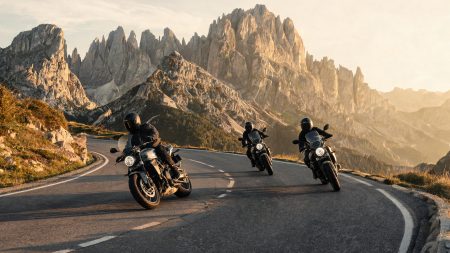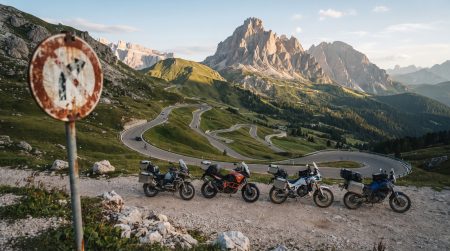
- No physical barriers, no checks and no fines in 2026
- Digital simulation of various access and restriction models from September
- The Sella Ronda stays fully rideable with all four passes this season
For weeks it seemed certain that one of the best-known pass roads in the Dolomites would largely close from the first day of autumn. Around three weeks before the deadline, the South Tyrolean provincial administration has now corrected that expectation. The pilot project does continue, but in a form that initially changes nothing on the road itself.
What applies at the Gardena Pass from 1 September 2026?
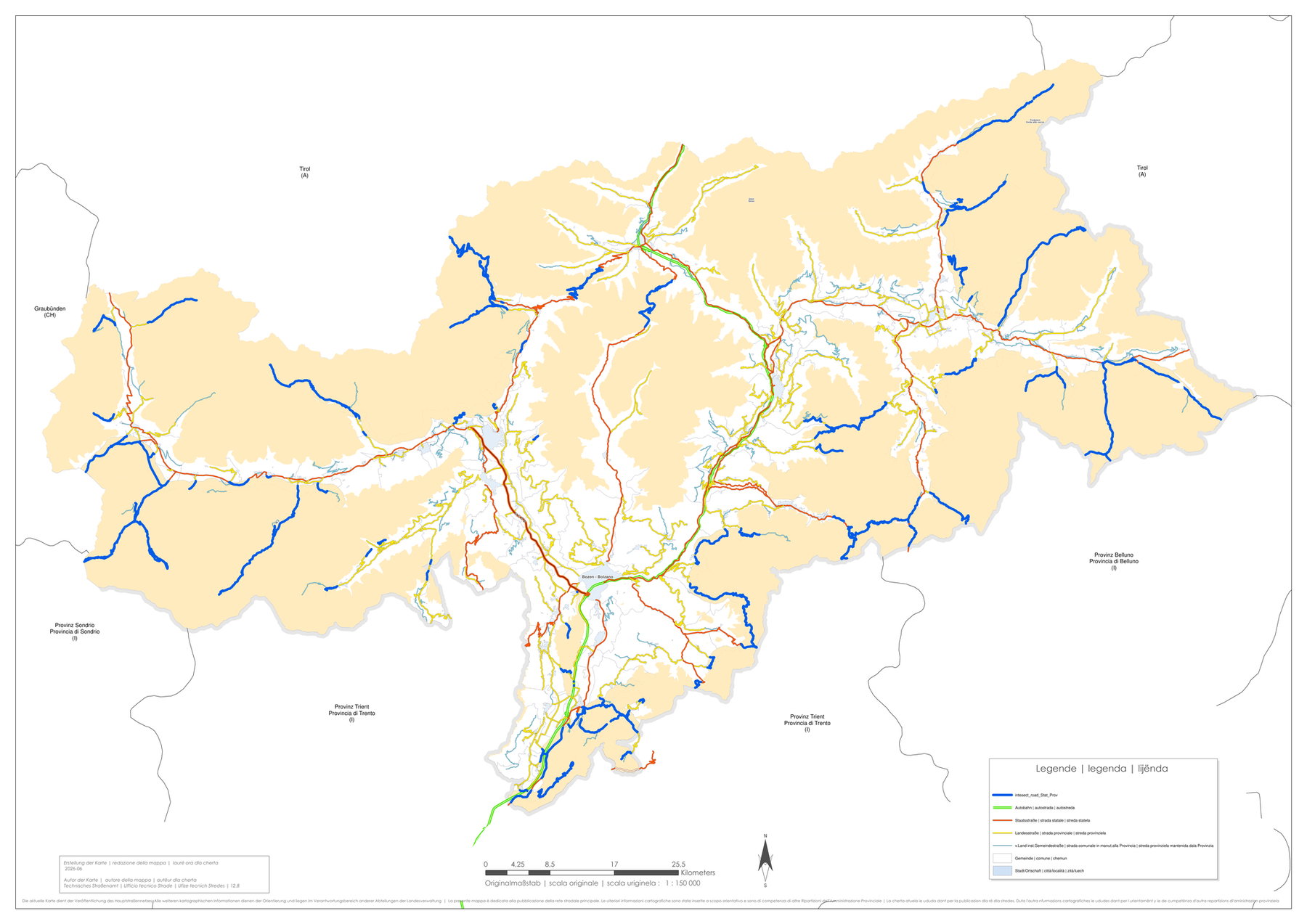
In 2026 there is no traffic restriction at the Gardena Pass that actually stops vehicles. The pass road remains freely open to motorcycles, cars, motorhomes and coaches.
The Autonomous Province of Bolzano stated this unmistakably in a release dated 12 August 2026. The subheading of the press release literally reads: “No restrictions in 2026”. The Val Gardena tourism portal, which represents the municipalities of Ortisei, Santa Cristina and Selva, puts it even more plainly: there will be “neither physical road closures nor penalties” for vehicles that do not comply with the planned restriction. No barrier, no police check, no fine.
What happens instead takes place in data centres. During the test phase the traffic flows are recorded and analysed. The data is meant to provide the basis for how traffic on the Dolomite passes could be managed in future.
The original plan: five months without through traffic
The starting point was a unanimous resolution in principle by the municipal council of Selva di Val Gardena dated 19 March 2026. It provided for what is known as an out-of-town traffic-calmed zone at the Gardena Pass, called a ZTL in Italian officialese, a Zona a Traffico Limitato. Translated, that means: anyone wanting to drive in needs a permit.
A trial run was planned from 1 September 2026 to 1 February 2027. For those five months, through traffic was to be closed to all motorised vehicles. Under the plans at the time, exceptions would have applied to residents, overnight guests of the businesses at the pass, suppliers and public transport. A quota of around 150 vehicles per day, to be reserved in advance, was also discussed at one point.
Because the Gardena Pass is the Strada Statale 243, a municipal resolution alone would not have been enough in any case. Approval by the South Tyrolean provincial government is mandatory.
Why is the closure not coming in 2026 after all?
The provincial administration justifies the step on technical grounds: without a robust simulation there is no way of saying which measures genuine traffic calming actually requires. From within the industry, political pressure is additionally named as a trigger.
The official release states that the measures must be planned carefully in order to prevent congestion or traffic chaos in the villages and valleys. Otherwise the project would be counterproductive. The provincial administration also points out that implementing such a novel scheme involves considerable technical, organisational and legal challenges, and that much remains to be done.
According to media reports, resistance has additionally formed within the tourism industry, particularly among hoteliers who would have felt a closure directly. That account comes from those close to the parties involved and is not confirmed in the official release.
What exactly is being tested in the digital test phase?
Various models for access permits and traffic limits are being simulated, including the consequences for neighbouring areas, economic sectors and groups of people. The calculations run on real traffic data.
A second focus is infrastructure. Among other things, the study examines whether roundabouts, checkpoints, additional third priority lanes and info points in Val Gardena and Val Badia would be needed for such a system to work in everyday use. Should it turn out that the existing infrastructure is insufficient, construction would have to come first.
In parallel, the digital building blocks are being created: an information portal, a registration platform, solutions for local residents and forms with which accommodation providers can register their guests. Precisely these tools would be the prerequisite for any later access scheme to be enforceable at all.
Who is working on the project?
Behind the scheme is a dedicated working group that has been active for ten months. Its goal is Italy’s first Territorial Traffic-Calmed Zone, referred to in official terms as TVZ UNESCO.
Those involved are Ernest Cuccarollo for the municipality of Selva di Val Gardena, Martin Resch for Santa Cristina and the Val Gardena mobility centre, Andreas Sanoner for Ortisei, Francesco Kostner for Corvara, Max Nagler for the Alta Badia tourism cooperative, Kurt Sagmeister for IDM and the appointed consultant Helmuth Moroder. The provincial administration is represented by Elisabeth Berger from the Department of Nature, Landscape and Spatial Development and by Michael Andergassen as special commissioner for provincial mobility planning and traffic management.
The legal basis was created not in Bolzano but in Rome. An amendment to the road traffic regulations was achieved in the transport ministry and in parliament, intended to make traffic calming possible outside built-up areas as well. Only then were the municipalities and the province able to work out the pilot project.
What does this mean for the Sella Ronda?
The Sella Ronda remains fully rideable this season. All four passes of the loop can be reached without a permit.
The circular tour runs around 50 kilometres once around the Sella massif, linking South Tyrol with Trentino and the province of Belluno. Alongside the Gardena Pass at 2,121 metres, it takes in the Sella Pass, the Pordoi Pass and the Campolongo Pass. If one of these passes drops out, the loop becomes a dead-end route and traffic inevitably redistributes onto the remaining crossings.
The figures show just how heavy the load has become. On peak days up to 11,000 vehicles cross the pass road. According to our earlier research, the share of motorcycles on the passes runs to as much as 30 percent depending on season and weather. On the main route through the Val Gardena valley, according to the provincial statistics institute ASTAT, fewer than 10,000 vehicles per day were on the move at peak times around the year 2000; by 2025 the figure had risen to more than 20,000. About half of them continue up to the passes.
What happens in 2027?
Nothing has been decided for 2027. All that is clear is that the analysis of the simulation will form the basis for the next steps.
A considerably more far-reaching scheme remains on the table: a restriction on motorised traffic from mid-May to mid-October, in other words right through the peak season. Originally there were also plans to designate the Sella Pass, the Pordoi Pass and the Campolongo Pass, alongside the Gardena Pass, as traffic-calmed zones for several months. According to the Val Gardena tourism portal, these plans are not currently finalised.
Before any decision, the local population and business representatives are to be involved. The aim is to jointly define the appropriate level of traffic restriction, that is, to determine who may drive and who may not.
The Gardena Pass thus joins a trend that affects motorcyclists across the entire Alpine region. In Tyrol, closures apply on individual routes for motorcycles with a stationary noise level above 95 decibels, while in Trentino speed limits of 60 kilometres per hour have been introduced on some mountain roads. Whether the Dolomites pilot project becomes a blueprint is unlikely to become clear before the simulation has been evaluated.

Frequently Asked Questions
-
Is the Gardena Pass closed in September 2026?
No. The pass road remains freely open to all motorised vehicles. The provincial administration has explicitly announced that there will be no restrictions in 2026.
-
What exactly is the Gardena Pass test phase?
It is a purely digital simulation starting in September 2026. Various models for access permits and traffic limits are calculated using real traffic data, without anything being closed on the road itself.
-
Are there fines for riding over the Gardena Pass?
No. There are neither physical road closures nor penalties. Breaches of the originally planned restriction cannot be punished at all in 2026, because the restriction does not come into force.
-
Can the Sella Ronda be ridden in full in 2026?
Yes. All four passes of the loop are open, namely the Gardena Pass, the Sella Pass, the Pordoi Pass and the Campolongo Pass. Restrictions apply only on individual action days that take place independently of the pilot project.
-
What is planned for 2027?
That remains open. Under discussion is a restriction on motorised traffic from mid-May to mid-October, possibly across several passes. A decision is only due once the test phase has been evaluated and the population and businesses have been consulted.