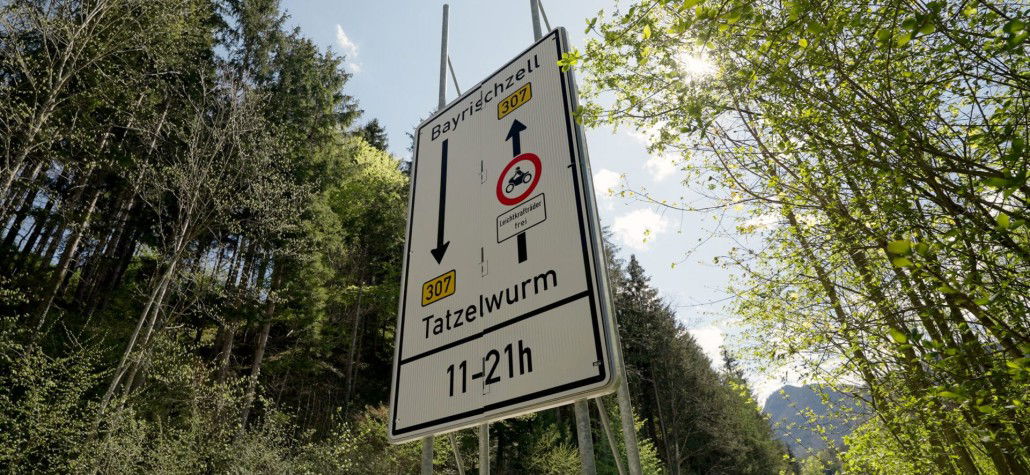
- At the request of the Greens, the transport committee of the Tyrolean state parliament has commissioned a review of extending the motorcycle bans in the Reutte district.
- The focus is on the Engetalstraße from Grän to Pfronten and the Ehenbichler Landesstraße, and sports cars are also to be examined.
- On the routes that are already closed, the state recorded not a single complaint for 2023.
Since 2020, motorcycles with a registered stationary noise level above 95 decibels have been banned from six road sections in the Außerfern region between mid-April and the end of October. Now the list could get longer. The Tyrolean Greens have filed a motion, and the transport committee of the state parliament has commissioned a review in response. It covers additional roads, a possible extension of the rules and, for the first time, cars as well. The Greens’ reasoning reveals a pattern that can be seen again and again with road closures: the problem does not disappear, it moves on.
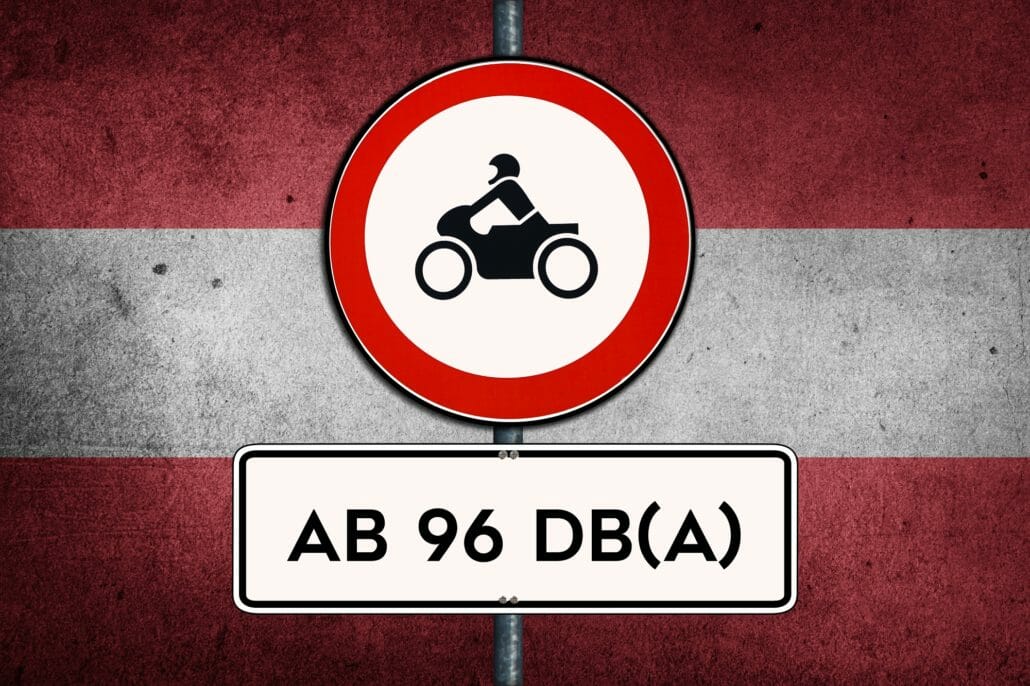
Which roads could be newly closed in Tyrol?
Above all, the Engetalstraße L 261 from Grän to Pfronten and the Ehenbichler Landesstraße in the upper Lech Valley are under discussion. Whether they will actually be added to the ban is now being examined by the state’s responsible departments.
The Engetalstraße connects the Tannheim Valley with the Allgäu. It is narrow, twisty and crosses the border into Bavaria below the Aggenstein. It is popular with motorcyclists because it links tours in the Allgäu with the Austrian passes. A closure would therefore directly affect many riders from Germany. The main advocate for including the Ehenbichler Landesstraße is Margit Dablander, the Greens’ district spokesperson in Reutte.
Besides additional roads, the question is also whether the ban will be extended in time. What is new is the focus on sports cars. The departments are to examine what share they have in traffic noise. What a ban for cars might look like is open. The existing rule cannot simply be transferred, because it explicitly applies only to single-track motor vehicles. So far there is no timetable for the review.
Why do the Greens want to extend the motorcycle ban?
According to the Greens, motorcycles they describe as “loud” are switching to roads that have not been closed so far. The burden is said to have increased sharply, especially on the route from Grän to Pfronten.
Gebi Mair and Dablander visited around 60 households in the Reutte district in the autumn and presented their impressions on October 28, 2026. Traffic was the most frequent topic, above all the planned Fernpass tunnel and its toll. On the subject of noise, the Greens named several causes: sports cars driving in groups from the Kög via Rieden to the Hahntennjoch or the Gaichtpass, groups of moped riders doing laps in Reutte’s Untermarkt, and motorcycles on alternative routes. Mair puts it roughly like this: “loud” motorcycles look for other routes, and people and nature suffer there as well.
Explicit mention of complaints is made in connection with cars. According to the Greens, complaints about particularly “loud” vehicles and illegal races are piling up. The Greens would also like a stricter noise protection law. However, that is not the responsibility of the state but of the federal government.

Are there still complaints about motorcycle noise in Tyrol?
On the closed routes in the Außerfern region, the state of Tyrol recorded not a single complaint to the responsible authorities for 2023. More recent official figures are not yet known.
According to the state, complaints from local residents have fallen sharply since the regulation was introduced in 2020, until they stopped altogether in 2023. In early 2024, Tyrol’s transport councillor René Zumtobel (SPÖ) saw this as proof that the closures work and noticeably relieve the population.
At first glance, this does not fit with the Greens’ statements. On closer inspection, however, the two sides are describing different things. The state counts formal complaints to authorities, and only for the roads where the ban applies. The Greens report impressions from doorstep conversations, and from autumn 2026 at that. Their criticism is directed mainly at roads that are not closed. Part of it also does not concern motorcycles at all, but mopeds and sports cars. Both statements can therefore be true at the same time without either side being untruthful. This could only be clarified with current complaint figures, broken down by road and district. The districts concerned would be Reutte and Imst, because the closed sections of the Hahntennjoch road extend into the municipal area of Imst.
How many motorcycles exceeded 95 decibels in police checks?
Between 2020 and 2023, police checked 27,207 motorcycles on the affected routes. Only 601 of them had a registered stationary noise level above 95 decibels.
| Year | Motorcycles checked | Above 95 dB | Share |
|---|---|---|---|
| 2020 | 8,917 | 135 | 1.5 percent |
| 2021 | 7,527 | 123 | 1.6 percent |
| 2022 | 4,581 | 112 | 2.4 percent |
| 2023 | 6,182 | 231 | 3.7 percent |
The share has risen from year to year, but remains low. Well over 95 percent of the motorcycles checked were therefore allowed to use the routes. In early 2024, Zumtobel also announced targeted checks that were to take place not only on the closed roads but throughout Tyrol.

Is a motorcycle with a stationary noise level above 95 decibels loud?
No, that cannot be concluded from it. The stationary noise level says nothing about how loud a motorcycle actually is when it rides past.
The value is measured while stationary, directly at the exhaust. It is entered in the vehicle registration document under U.1. For the Tyrolean ban, this figure alone counts. How a machine sounds on the road plays no role. The 95-decibel limit was set by Tyrol itself; it is not a general line between “quiet” and “loud” motorcycles. Motorcycles with a higher entry are also fully road-legal and comply with the applicable regulations.
This creates an imbalance. A motorcycle with an entry below 95 decibels may use the routes, no matter how it is ridden. A motorcycle with a higher entry remains banned, even though it may be barely louder or even quieter in actual riding. The Austrian motorcyclists’ initiative Bikers’ Voice demonstrated this back in 2021 with a sound check at the Red Bull Ring, accompanied by a sworn expert. Production motorcycles from Ducati and Suzuki, for example, whose stationary noise is registered above the Tyrolean limit, were barely louder than less powerful touring bikes that are allowed to ride in Tyrol when riding in town and accelerating, and in some cases even quieter. This is exactly where the criticism of the rules comes in: they are based on a value measured at a standstill, not on the noise exposure residents experience in everyday life. Cars, quads and trucks can also continue to use the closed roads, regardless of how “loud” they are.
What do road closures achieve if traffic simply moves elsewhere?
The Tyrolean debate shows that a closure apparently does not solve the problem but shifts it to other roads. The old closure supplies the justification for the new one.
The state sees the absence of complaints on the closed routes as a success. At the same time, the Greens justify the extension by saying that motorcycles are switching to other routes precisely because of these closures. Taken together, the picture is clear: what is perceived as noise has not gone away, it has just changed location. The demand for the next closure is then the logical consequence, and diverted traffic is openly cited as the reason.
If this pattern follows its own logic, the question is where it ends. If the Engetalstraße is closed, traffic will find yet another route, possibly on the German side in the Allgäu. If that is closed too, the game starts all over again. The end result would be an ever denser network of closures, until hardly any road is left for motorcyclists. That is not a solution. Even the Greens point out that a more effective lever lies in the federal noise protection law, in other words with the vehicles themselves and not with the question of who may use which road.
The Außerfern region is not an isolated case. Road closures for motorcyclists are being discussed more and more frequently in the Alps and in Germany, and the same argument often comes up: traffic has shifted from one closed route to another.
Which routes in Tyrol are already closed?
The ban applies every year from April 15 to October 31 on six sections in the Außerfern region. The state put the rules into force again in 2026.
- L 266 Bschlaber Straße between Elmen and Pfafflar
- L 72 and L 246 Hahntennjoch road from Pfafflar over the pass to Imst, Vogelhändlerweg junction
- L 21 Berwang-Namloser Straße between Bichlbach and Stanzach
- B 199 Tannheimer Straße from Weißenbach am Lech to Schattwald at the German border
- B 198 Lechtalstraße from Steeg at the Vorarlberg state border to Weißenbach am Lech
The Fernpass road B 179 is not included. The ban applies to all motorcycles with a stationary noise level above 95 decibels, regardless of whether they are registered in Austria or abroad. Anyone who rides on a closed route anyway faces a fine of 220 euros (approx. 246 US dollars). In certain cases, up to 726 euros (approx. 811 US dollars) is possible.
Legally, the rules have held up so far. The Tyrolean Regional Administrative Court dismissed a complaint, and the EU Commission saw no violation of EU law because domestic and foreign motorcycles are treated equally. There is still resistance, though: until February 2024, a petition calling for the 95 dB rule to be lifted was running.
What motorcyclists should know before the 2027 season
The 2026 season for the ban ended on October 31. Whether further roads will be added from April 15, 2027 is still open.
Anyone planning to ride in the Außerfern region should check their vehicle registration document before setting off. If the value under U.1 is above 95 decibels, the closed sections are off-limits during the season. Anyone who likes to ride the Engetalstraße or through the upper Lech Valley should keep an eye on the state’s decision before planning their next tour.
Frequently asked questions
-
Motorcycle ban Tyrol: Which roads are closed?
Six sections in the Reutte district are closed, including the Lechtalstraße B 198, the Tannheimer Straße B 199 and the Hahntennjoch road. The ban applies from April 15 to October 31 to motorcycles with a stationary noise level above 95 decibels. The Fernpass road B 179 is not affected.
-
Will the motorcycle ban in Tyrol be extended?
That is still open. The transport committee of the Tyrolean state parliament has commissioned a review, with the Engetalstraße to Pfronten and the Ehenbichler Landesstraße mainly under discussion. Sports cars are also to be examined.
-
Are there still complaints about motorcycle noise in the Außerfern region?
According to the state of Tyrol, not a single complaint was filed with the authorities on the closed routes in 2023. The Greens, on the other hand, report annoyance in 2026 about alternative routes, mopeds and sports cars. More recent official figures are not yet known.
-
Does the stationary noise level say anything about how loud a motorcycle is?
No. The stationary noise level is measured at a standstill directly at the exhaust and is listed in the vehicle registration document under U.1. In a sound check by the Bikers’ Voice initiative, motorcycles with a high entry were barely louder than permitted touring bikes when riding, and in some cases even quieter.
-
How much does a violation of the Tyrol motorcycle ban cost?
The fine is 220 euros (approx. 246 US dollars). In certain cases, up to 726 euros (approx. 811 US dollars) can be charged.