- The bodywork is a hand-shaped fiberglass monocoque that comes off in a single piece.
- The suspension was lowered by about 130 millimeters, paired with 19-inch Excel rims and a Moto Master brake.
- The base bike stays street-legal because the tank, subframe and airbox remain in their stock positions.
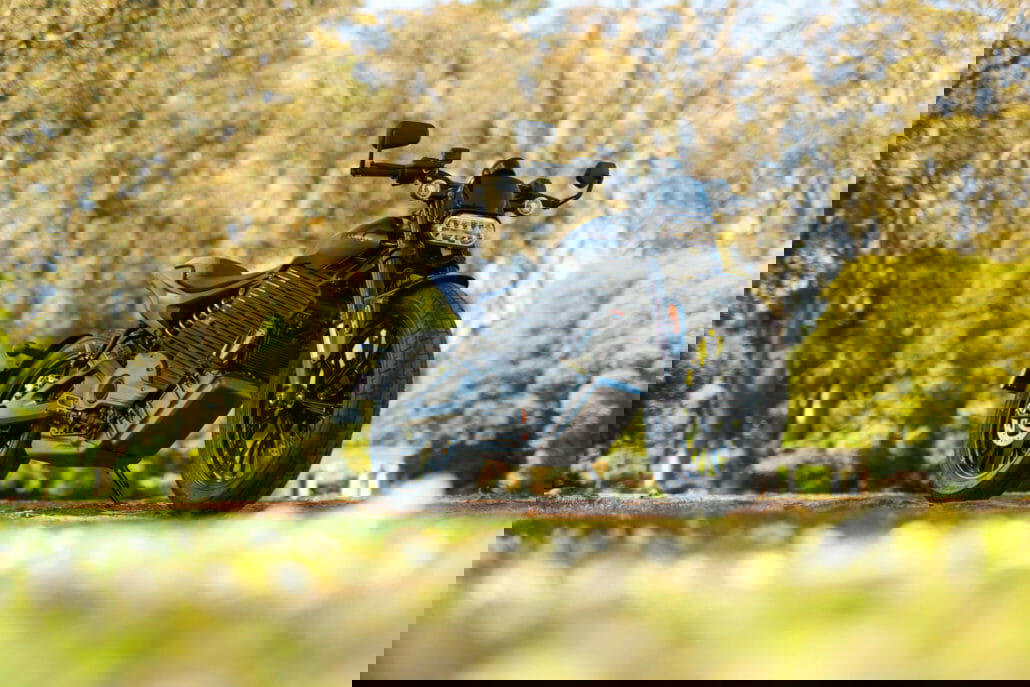
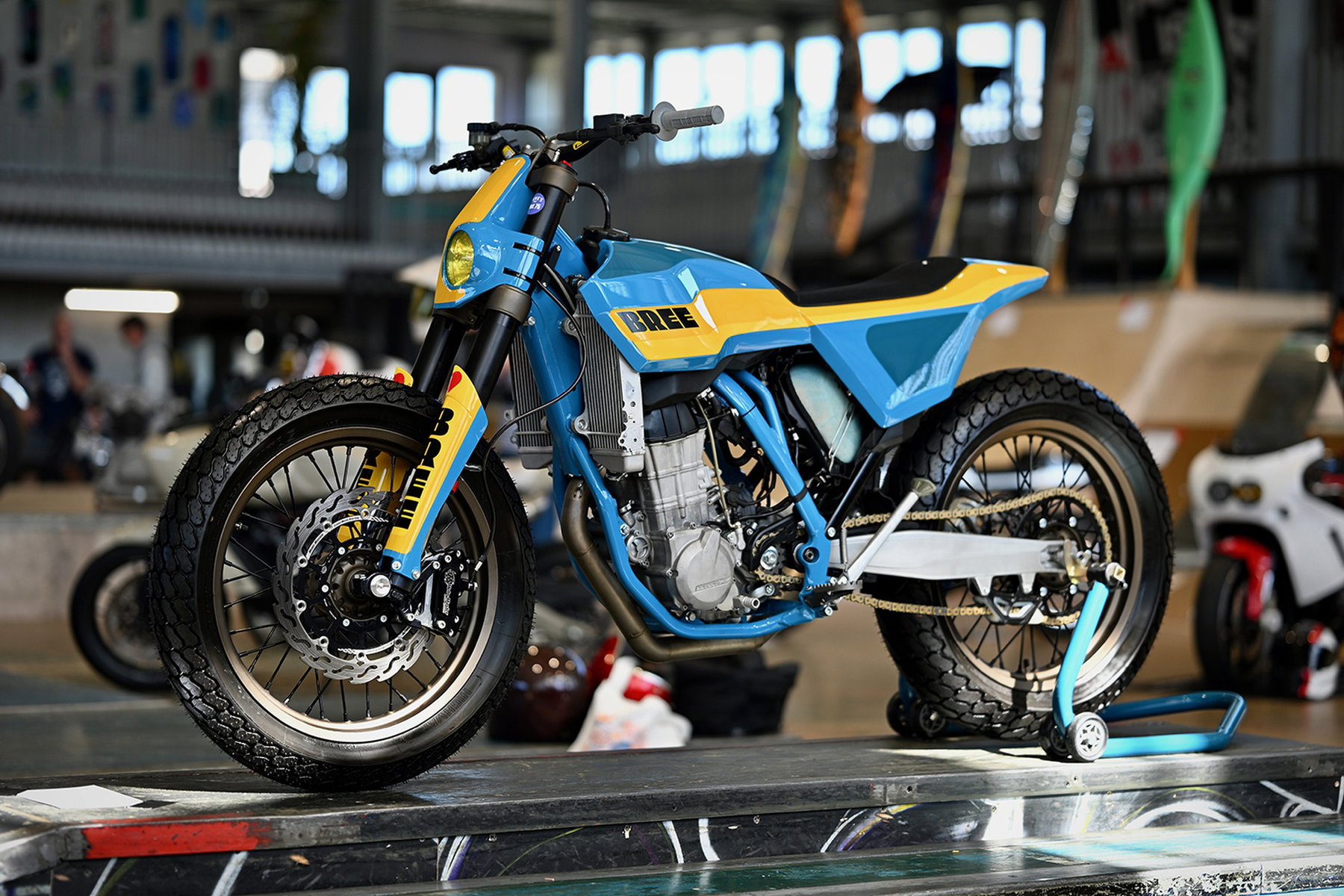
It didn’t start with a computer model, but with a lump of clay. In a home workshop in the Austrian Alps, Moritz Bree and his friend Anton shaped every surface by hand, adjusting the proportions until the motorcycle looked right from every angle. Only afterward did that shape become the mold for the fiberglass bodywork. At a time when CAD software and 3D printers set the tone in the custom scene, the pair deliberately reached for one of the oldest techniques in vehicle design — the kind usually associated with the studios of Porsche, Ferrari or Ducati. The result is a street-legal KTM EXC 500 that looks less like a converted enduro and more like a flat tracker straight out of a factory production line.
How was the KTM EXC 500’s bodywork made?
The bodywork started out as a clay model and was only translated into fiberglass afterward. Anton contributed his knowledge of clay modeling, while Moritz Bree handled the complete technical execution. Both worked the surfaces by hand before the mold was taken for the monocoque. Bree set himself a harder task than simply cutting up the frame or welding a one-off: he wanted to give the motorcycle a new face while keeping the stock, road-legal base structure intact.
Why does the converted KTM EXC 500 stay street-legal?
The KTM EXC 500 stays street-legal because the original tank, subframe and airbox remain unchanged in their stock positions. These parts hide beneath the hand-built fiberglass monocoque, which comes off as a single shell. According to the builder, this lets the motorcycle keep its registration in Austria and Germany while still showing a completely different silhouette on the outside. The approach avoids major changes to the chassis while delivering a cohesive look that is difficult to achieve with bolt-on individual parts.
What technical work went into the flat tracker conversion?
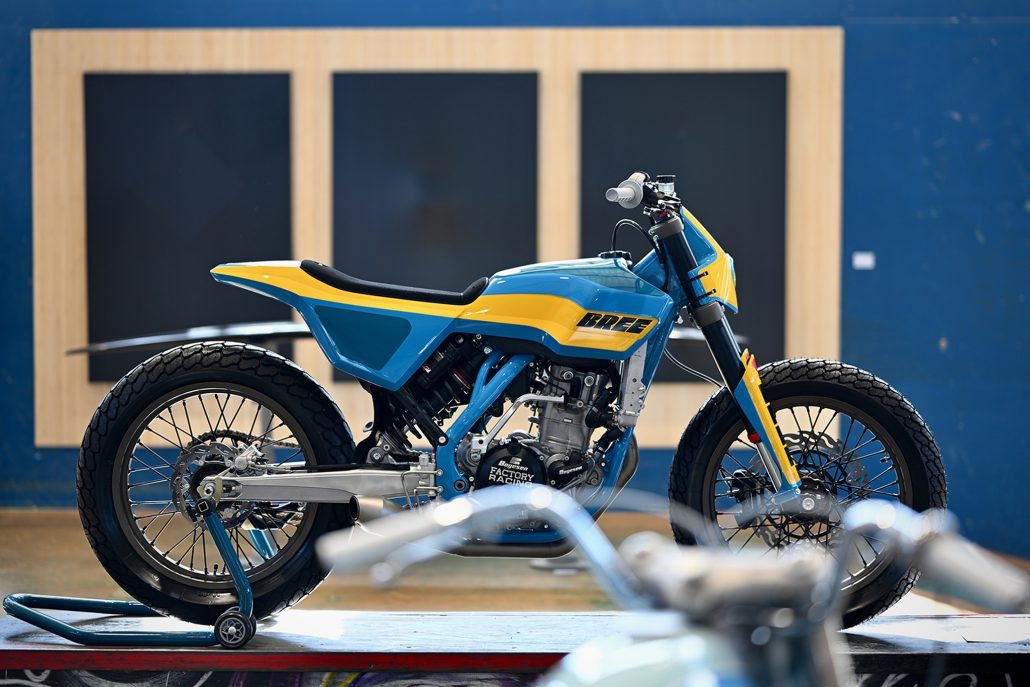
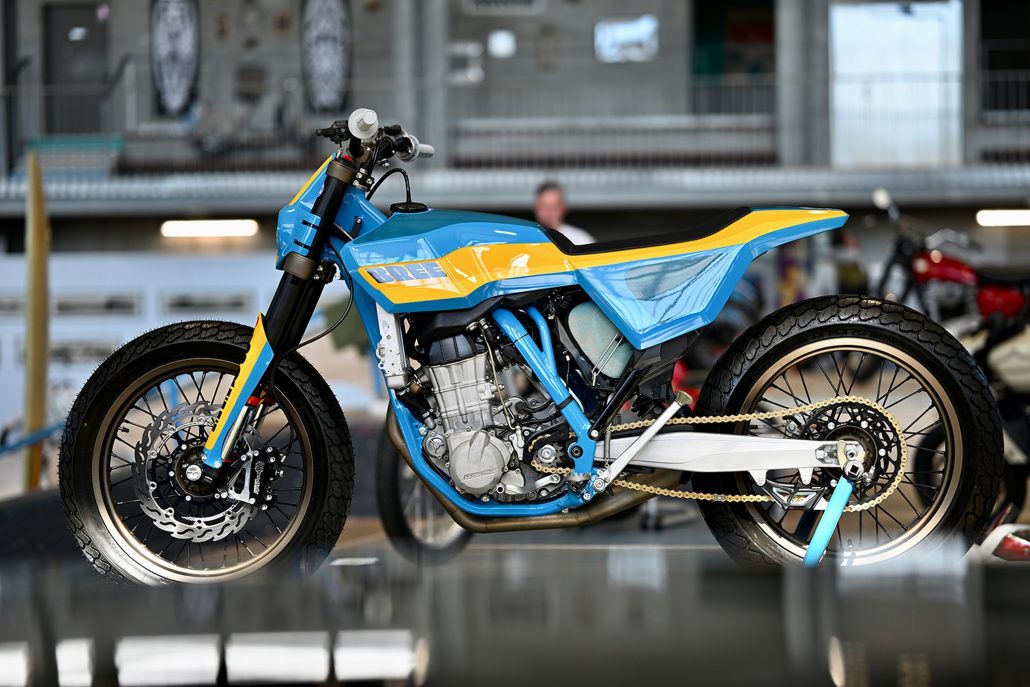
The conversion relies on lowered suspension, new wheels and bolt-on parts that turn the enduro into a flat tracker. The suspension was lowered by about 130 millimeters, replacing the tall enduro seating position with a flat, stretched-out stance. Fresh Excel rims with matching 19-inch tires join a Moto Master brake up front for street use. A ProTaper handlebar keeps the cockpit tidy, and a self-built exhaust runs underneath the engine and exits low, so the bodywork’s continuous line isn’t interrupted.
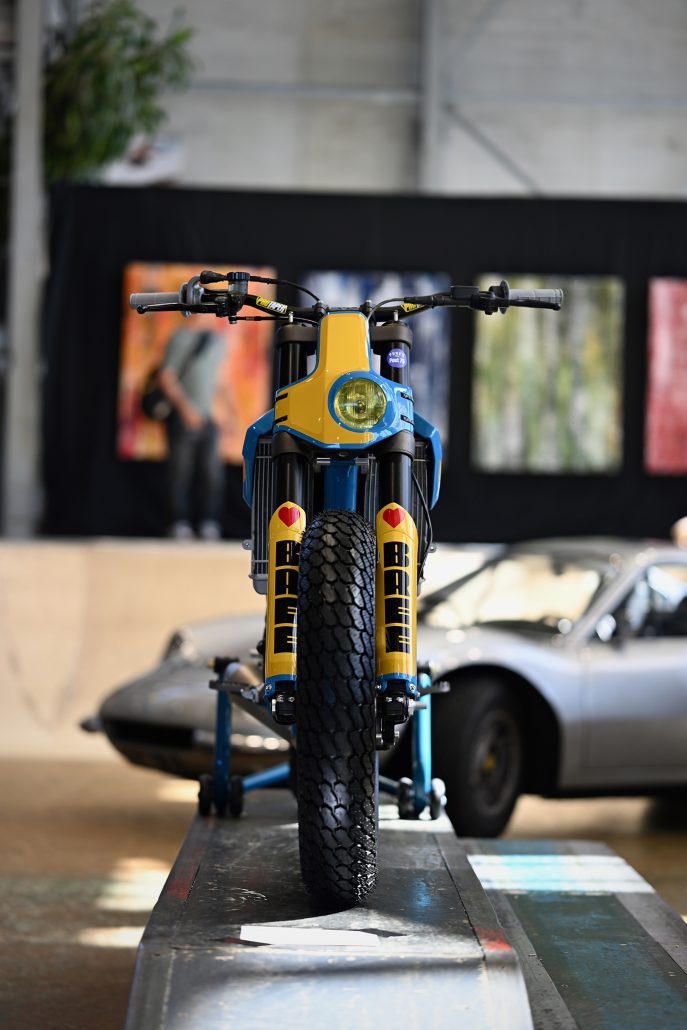
The shape of the bodywork itself follows the same idea. From the compact headlight housing through the tank area to the tapering tail, one surface flows into the next without conspicuous seams or bulky side panels. The integrated LED headlight sits within a race-style number plate, while the radiator stays visible, framed by the bodywork instead of disappearing behind it.
What does the blue-and-yellow paint scheme reference?
The paint scheme in light blue and yellow recalls European motocross and flat track racing of the late 1970s. The powder-coated blue frame is deliberately made part of the overall look rather than hidden. A thin black pinstripe separates the two colors, the graphics stay understated, and even the fork stickers look coordinated rather than promotional. Visually, this style would have suited a factory works racer from that era.
Look closer and the craftsmanship shows in the details. The panel gaps are even, the mounting points stay hidden, and the surfaces have soft transitions that come from the many hours spent on the clay model. While digital design often emphasizes sharp edges, this motorcycle takes the opposite route with rounded surfaces. Among the growing number of enduro-to-flat-tracker conversions, this approach stands out because an entire body was modeled by hand rather than assembled from existing parts.
Who is Moritz Bree?
Moritz Bree is a young builder from Austria who stood out in the scene even as a teenager. As early as 2016, he contributed to designs for brands like Free Spirits and Zaeta, as well as to a converted Yamaha MT-03. He got his passion for motorcycles from his father, who bought him his first kids’ bike at around age three. Bree later trained as a motorcycle mechanic at Reier Motors before opening his own small workshop. Alongside his builds, he raced motocross and flat track, ran laps in the so-called Wall of Death, a round wooden arena for motorcycle riding, and completed a multi-day tour of roughly 4,500 kilometers across nine Balkan countries. That background explains why the KTM EXC 500 doesn’t come across as a pure design study, but as the work of someone who races and wrenches himself.
Frequently Asked Questions
-
What is the base for Moritz Bree’s KTM EXC 500 conversion?
The base is a stock, street-legal KTM EXC 500. The chassis stays largely unchanged, with most of the transformation coming from the new bodywork and suspension setup.
-
Does the converted KTM EXC 500 stay road-legal?
According to the builder, yes. The tank, subframe and airbox remain unchanged in their stock positions, which is said to keep the motorcycle registered in Austria and Germany even though the bodywork is completely new.
-
How was the KTM EXC 500’s bodywork built?
The bodywork started out as a hand-shaped clay model. That became a fiberglass monocoque that comes off as a single shell.
-
What was changed on the KTM EXC 500’s suspension?
The suspension was lowered by about 130 millimeters, significantly changing the seating position and proportions. It’s paired with 19-inch Excel rims and a Moto Master brake up front.