- Violations in Denmark are punished with a fine and a point on the licence
- The MCTC association is proposing a time-limited trial phase with fixed rules
- The motorists organisation FDM warns of more accidents and possible fatalities
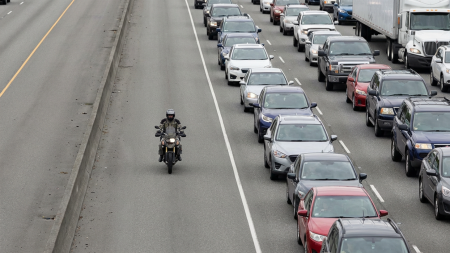
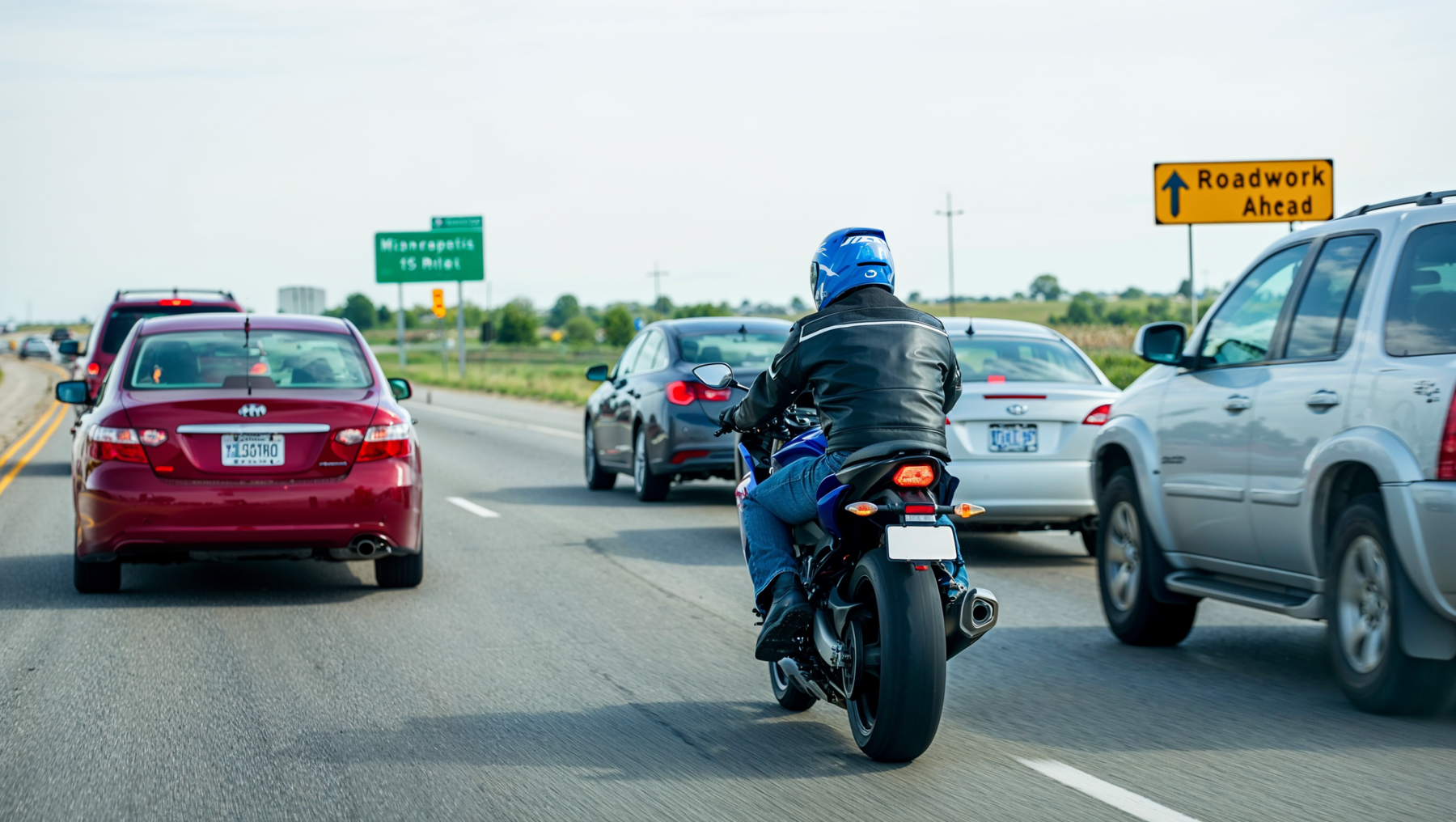
Anyone stuck in a traffic jam on a Danish motorway in summer knows the picture: cars barely moving, and every now and then a motorcycle pushing its way forward between them. It is not allowed. Since the summer of 2026, however, Denmark has been openly arguing about whether that should change. The debate was triggered by a regional television report in which the director of the national motorcyclists association argued for a change in the law. Since then associations, politicians and riders have spoken up, and the front lines are clearly visible.
What does lane splitting mean and what is the legal situation in Denmark?
Lane splitting describes riding past stationary or very slowly moving lines of vehicles, usually between two lanes. In Denmark this is not permitted.
Danish road traffic law prescribes that overtaking is done by pulling out fully to the left. A motorcyclist therefore has to move to the left of the vehicles in the outermost left lane if he wants to pass a queue. Enough space has to remain between car and motorcycle, and the solid line towards the crash barrier must not be crossed. The FDM, the largest interest group representing motorists in Denmark, had this interpretation confirmed by the national police. Overtaking between the rows is not allowed. Anyone who does it anyway risks a fine and a point on the licence. Moving onto the hard shoulder is prohibited as well.
How did the debate get going?
The impulse came from Mario Riewerts, director of the national association MCTC, which organises close to 30,000 motorcyclists and is a member of the European umbrella organisation FEMA. In July 2026 he came out clearly in favour of legalisation in a television report.
Riewerts gave two reasons. „Jeg synes, vi skal gøre det lovligt for motorcyklister at køre imellem rækkerne på flersporede veje. På den ene side kan det være meget varmt for os at stå stille sådan en sommerdag. Men også fordi, det er med til at afvikle trafikken“, he said. Translated: “I think we should make it legal for motorcyclists to ride between the rows on multi-lane roads. On the one hand it can get very hot for us standing still on a summer day like that. But also because it helps to keep traffic flowing.”
He stressed that traffic flow is the most important argument for him and that comfort only comes after that. It is also important to him that emergency vehicles must not be obstructed under any circumstances. A change of rules would therefore have to state clearly when riding through would be permitted and when it would not.
A second rider, Kim Lykke Gyldenkærne, summed up the heat argument. „Dem, der sidder i en bil, har aircondition. Det har du ikke på motorcykel. Du sidder i lædertøj og varme støvler. Og så er du også mere udsat“, he explained. Translated: “Whoever sits in a car has air conditioning. You do not have that on a motorcycle. You sit there in leather gear and warm boots. And you are also more exposed.” According to his own account he deleted his post on the topic from a social network again because many negative comments came in. His opinion has not changed as a result.
Why does the FDM reject legalisation?
The FDM considers legalisation the wrong path and bases that on accident statistics. In the organisation’s assessment, a change in the law would put an additional burden on an already vulnerable group.
„Det er simpelthen den forkerte vej at gå. Vi skulle gerne få færre ulykker på vejene – ikke flere“, said Dennis Lange, chief adviser at the FDM. Translated: “That is simply the wrong way to go. We would like to have fewer accidents on the roads, not more.” Motorcyclists are already overrepresented in accident statistics and are injured more often than other road users.
Lange does not accept the heat argument. Heat on summer days is undisputedly an issue, but everyone has to deal with it before setting off, he says. He also doubts the hoped-for benefit for traffic flow. He is not convinced that enough motorcycles are on the road to make a noticeable difference. In his view the advantage would lie above all with the motorcyclists themselves.
When it comes to references to other countries, Lange urges caution. Rules cannot simply be transferred one to one, because conditions differ from country to country. In France there are considerably more motorcycles and scooters on the road, which creates different conditions. What matters is not what is permitted elsewhere, but what consequences a rule has for road safety.
What do experiences from other countries show?
The MCTC points to studies from California, Belgium, Luxembourg and France. According to the association the results vary, but in its view they do not argue against a regulated legalisation.
A Californian study is said to show that motorcyclists who rode between the rows under controlled conditions were seriously injured less often and were hit from behind less often than those who stayed in the queue. According to the association, official evaluations from Belgium and Luxembourg found no measurable increase in accident figures after the changes in the law there.
The view of France is more nuanced. There, riding through initially started as a trial model. During the trial phase the number of motorcycle accidents on the selected routes rose. A later evaluation is said to have shown, however, that none of the motorcyclists killed had complied with the rules of the trial, among them the requirements on low speed. In the meantime the regulation has become permanent in France. A maximum of 50 kilometres per hour is allowed and no more than 15 kilometres per hour above the surrounding traffic.
What exactly is the association demanding?
The MCTC is not demanding immediate legalisation, but an examination by the transport ministry and parliament. In addition the association proposes a time-limited trial phase with clear requirements on speed and behaviour.
„Vi skal ikke gætte os til trafiksikkerhed. Der findes efterhånden mange års dokumenteret erfaring fra udlandet, og det er det grundlag, en dansk debat og et eventuelt lovforslag bør bygge på“, said Riewerts. Translated: “We should not guess our way to road safety. By now there are many years of documented experience from abroad, and that is the basis a Danish debate and a possible bill should build on.”
Riewerts accuses the opponents of arguing with assumptions and opinions instead of data. At the end of August 2026 he reaffirmed via the umbrella organisation FEMA that nothing has changed in the MCTC’s position. Besides the FDM, the Danish council for safe traffic management had also positioned itself against legalisation. Riewerts says that a factual debate is hardly possible when one side works with facts and the other with assumptions. He compares it to punching a pillow.
How is the political side reacting?
So far with restraint. Transport minister Signe Munk of the SF party did not want to comment on the topic despite repeated requests.
Morten E. G. Brautsch, legal policy spokesman for the Moderaterne party, was more open. „Det kan være varmt for en motorcyklist at holde i kø for eksempel på en motorvej. Og jeg har det sådan, at der helt grundlæggende ikke skal være forbud mod noget, hvis der ikke er behov for det“, he said. Translated: “It can get hot for a motorcyclist to sit in a queue, for example on a motorway. And I see it in such a way that fundamentally there should be no ban on anything if there is no need for it.”
He only wants to commit himself, however, once a technical assessment on road safety is available. He concedes that the situation can look dangerous to outsiders when a motorcycle passes by in a traffic jam. Enquiries to the legal policy spokespeople of other parties initially went unanswered.
A citizens’ proposal has already failed
The debate is not new. Between October 2025 and April 2026 a citizens’ proposal for legalisation was running in Denmark, which would have forced a debate in parliament. 50,000 supporters would have been needed, and 4,463 came together.
In terms of content the proposal was already closely modelled on foreign examples. Riding through was to be permitted only in stationary or slow traffic, with a maximum of 15 kilometres per hour difference to the rest of the traffic, a speed limit of 50 kilometres per hour and exclusively on motorways and roads with at least two lanes in each direction. The reasoning drew among other things on a 2015 study by the University of California, Berkeley titled „Motorcycle Lane Splitting and Safety: A California State-wide Analysis“.
What happens next?
Open. A change in the law is not currently under way, and without a signal from the transport ministry the existing legal situation remains.
With that, Denmark joins a discussion that has been going on in several European countries for years and that has ended differently depending on the state. While France, Belgium and Luxembourg have found their own regulations, a clear ban still applies in Denmark. For motorcyclists travelling there, nothing changes for now. Anyone riding between the rows has to reckon with a fine and a point on the licence.
Frequently Asked Questions
-
Is lane splitting legal in Denmark?
No. Overtaking between rows of vehicles is prohibited in Denmark, even if there appears to be enough space. Overtaking is only allowed to the left of the outermost left lane.
-
What penalty applies for lane splitting in Denmark?
A violation is punished with a fine and can additionally cost a point on the licence. The FDM had this legal situation confirmed by the national police.
-
Who is calling for legalisation in Denmark?
The national association MCTC, which organises close to 30,000 motorcyclists and belongs to the European umbrella organisation FEMA. The association is calling for an examination by the transport ministry and parliament as well as a time-limited trial phase with fixed rules.
-
What are the rules in France?
France permanently legalised riding between the rows after a trial phase. Motorcyclists may ride at a maximum of 50 kilometres per hour and no more than 15 kilometres per hour faster than the surrounding traffic.
➜ This article is part of our comprehensive overview: Motorcycle Law & Policy: Regulations, Court Rulings and Developments for Riders. Find all key information on this topic in one place.