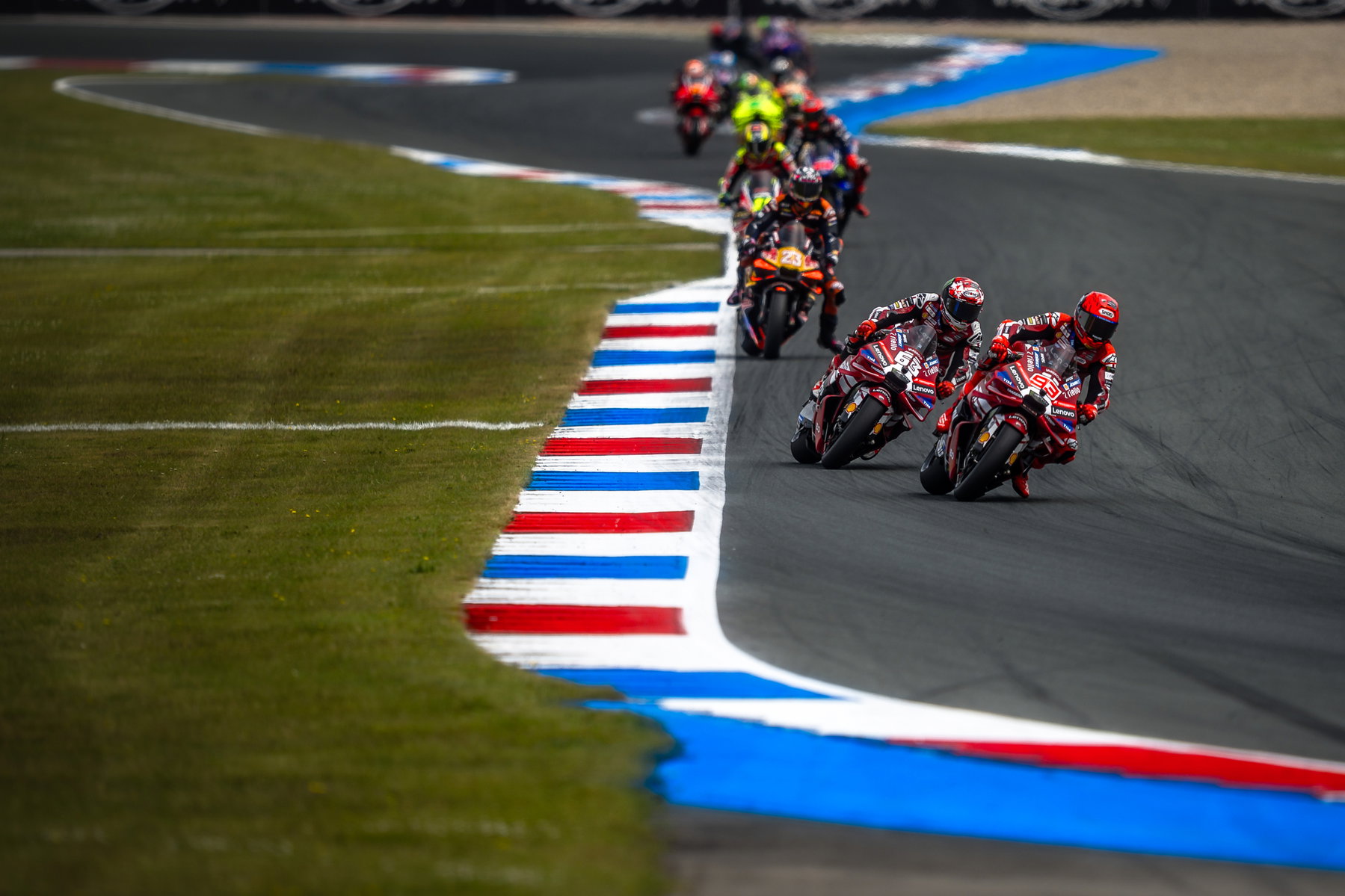
- Marc Marquez names the 44 race starts per season as the key risk factor and downplays criticism of the devices.
- Johann Zarco skips knee surgery and is targeting a September comeback.
- Ducati will field six bikes again in 2027 thanks to extended deals with VR46 and Gresini, while Raul Fernandez is set to stay at Trackhouse.
The spate of serious crashes in the current MotoGP season, especially at the first corner after the start, has triggered an intense safety debate. At the center of it are the technical launch aids. Holeshot devices, which lower the rear of the bike at the start, have been banned since the Dutch Grand Prix at Assen. Ride-height devices, which alter seat height during the race, are also under scrutiny. Marc Marquez, the reigning world champion and Ducati factory rider, believes the debate is too narrowly framed. And while the technology is being argued over, a positive update in Johann Zarco’s case and several rider-market decisions for the 2027 season are also generating headlines.
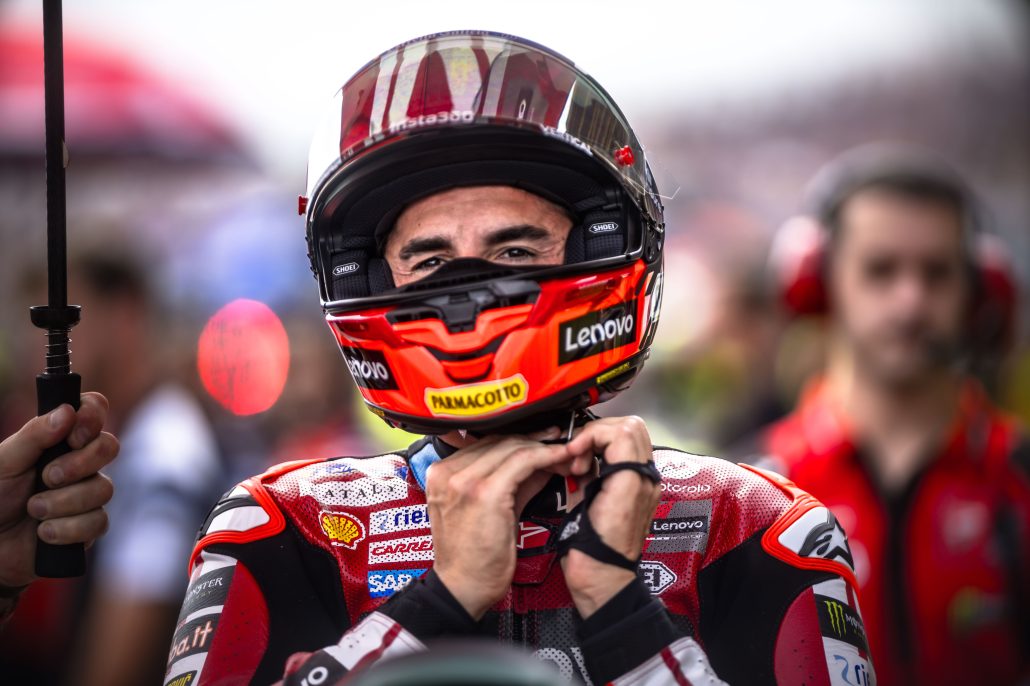
Why Does Marquez Think the Device Debate Misses the Point?
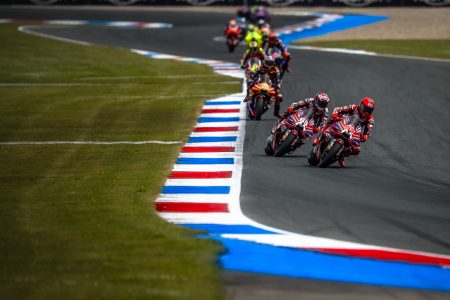
For Marc Marquez, the main reason for the increased risk isn’t the technical aids, but simply the sheer number of starts in a race weekend. “For me, neither the front nor the rear device is the biggest problem. The biggest problem is that on Sunday we arrive there [at turn one] for the fourth time,” the Spaniard said.
That refers to the two practice starts in first free practice on Friday, plus the start of the sprint and finally the start of the grand prix. According to Marquez, this repetition fundamentally changes the approach. He explains that normally the first rider sets the braking point. “But when you get there for the fourth time, you already know that mark, and exactly at the limit.” As a result, hardly anyone leaves a safety margin at the start anymore.
It used to be different, he says. On race Sunday, riders used to deliberately leave some margin on their first braking attempt so as not to miss the first corner. “I remember the first rider used to brake gently two or three times because it was the first time on Sunday. That gave a much bigger safety margin,” he says, describing the difference. Only as the race progressed did braking points shift further back in those days.
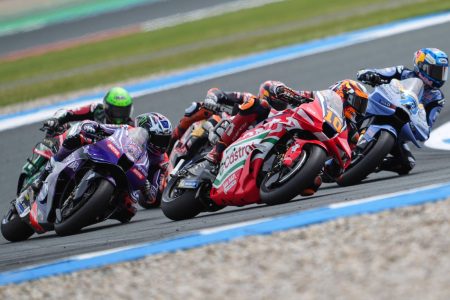
As an example, Marquez cites the start crash at Balaton, where he led the field into the first corner for the first time this season. He says he had his braking point and braked at one hundred percent there. Jorge Martin on the Aprilia had actually hit his mark too, yet the collision still happened. “It was just a small mistake. He braked at the right point, but simply lost the front. There was no time left to react at all,” Marquez says, defending his rival. Because everyone is now riding permanently at the absolute limit, he adds, even a tiny mistake can immediately have serious consequences.
How Does Marquez Rate the Rear and Front Devices?
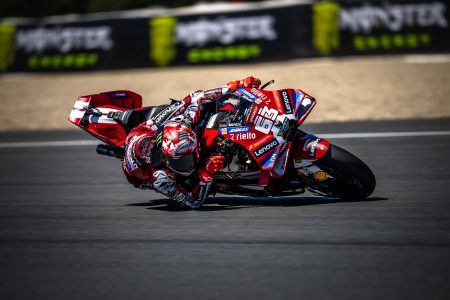
Marquez only partly shares the criticism of the devices — he actually rates the rear device positively. It makes corner exit easier, he says, and provides more stability in some places. “In certain areas, like turn one at Mugello, the bike is calmer and more stable because of it. That makes riding easier, but never more dangerous.”
His verdict on the front device is more nuanced. It does change braking, he says, but bikes without the technology had their own quirks too, such as very long wheelies during which the front wheel barely regained speed and sometimes locked up on landing. Asked whether that was safer, he says no. Marquez warns against romanticizing the past, since safety-relevant issues existed back then too, just different ones than today. His conclusion shifts the focus away from the technology. “Turn one is always the most dangerous point,” he stresses. “The problem is that we now have 44 starts. And that simply increases the statistical probability of these kinds of accidents.” Between sprints and grands prix, regular riders reach 44 race starts over a season, on top of the practice starts.
When Will Johann Zarco Return to MotoGP?
Johann Zarco is targeting a return in September, after a new examination showed that surgery on his left knee, initially expected, is not necessary after all. His team, LCR Honda, announced this following another medical check-up in Lyon.
Zarco suffered serious injuries at the Catalan Grand Prix on May 17. After an initial red flag, the race was restarted, and at the first corner Luca Marini and Francesco Bagnaia crashed together with Zarco. The Frenchman’s left leg got caught in the rear wheel of Bagnaia’s Ducati, tearing several knee ligaments. According to the first medical report, he suffered injuries to the anterior and posterior cruciate ligaments and the inner meniscus, plus a small fibula fracture that has since healed.
On July 1, Zarco consulted specialist Dr. Bertrand Sonnery-Cottet in Lyon to reassess his recovery. The first MRI scans had been taken while there was still significant swelling, which had complicated the diagnosis. As the swelling went down, a more positive picture emerged. “The medial collateral ligament is healing well, while the posterior cruciate ligament, initially thought to be torn, is also showing encouraging signs of natural healing. The anterior cruciate ligament, however, remains torn,” the team’s statement reads. Surgery had also not been possible in the meantime because a burn injury in the knee area first had to heal, as operating on it would have carried an infection risk.
Instead of surgery, Zarco is now following a rehabilitation program focused on recovery and muscle building. “Subject to further medical check-ups, the clear goal is to return to the track in September,” the team announced. That would make the San Marino Grand Prix, September 11–13 in Misano, the earliest possible date. Zarco will certainly miss the first races after the summer break in August, at Silverstone and Aragon. He was most recently replaced at Mugello, Balaton Park, Brno and Assen by 40-year-old Briton Cal Crutchlow, who will also stand in at the German GP at the Sachsenring. Whether Crutchlow will also be confirmed for Silverstone and Aragon remains open.
Why Is Ducati Fielding Six Bikes Again in 2027?
Ducati will again line up with six bikes in the 2027 season, made possible by extended contracts with customer teams VR46 and Gresini. Gresini was the first Ducati satellite team to announce the extension, with Valentino Rossi’s team following a day later.
VR46 remains tied to Ducati through a new three-year contract running until at least the end of the 2029 season as a so-called Factory Supported Team, meaning a factory-backed customer team. The partnership has existed since 2022, with VR46 taking on the factory-supported role in 2025 when the previous team, Pramac, switched to Yamaha. “We are really proud to announce the extension of our agreement with Ducati as a factory-supported team in MotoGP for the next three years,” said VR46 team director Alessio Salucci. Ducati Corse boss Gigi Dall’Igna added: “We are very pleased to continue this journey until at least 2029 and to further strengthen a partnership that has already brought us great satisfaction.” With Ducati machinery, VR46 has taken four wins and 16 podiums since 2022, according to the team.
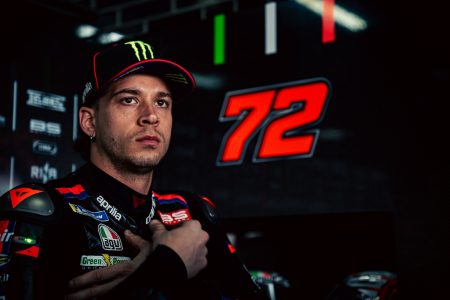
Alongside the two factory bikes of Marc Marquez and Pedro Acosta, Ducati is fielding four further prototypes of the new 850cc Desmosedici. Joan Mir and Daniel Holgado ride for Gresini, while Fermin Aldeguer is set for VR46. The second VR46 seat is still open, with Superbike rider Nicolo Bulega tipped as a candidate, currently leading the World Superbike Championship for the official factory team. Not all six bikes are equal. Aldeguer, who is under contract with Ducati, is set to receive a factory-spec machine, as is 2020 world champion Joan Mir, whose factory bike is funded by Gresini. Holgado and the second VR46 rider will each get a customer version without the bigger in-season updates. The reshuffle also stems from the fact that current riders Fabio di Giannantonio of VR46 and Gresini’s Alex Marquez are moving to the factory KTM team in 2027.
All of this ties in with the new technical regulations for MotoGP 2027. Ducati is developing an 850cc prototype that is lighter, uses less aerodynamics, drops ride-height devices and runs on Pirelli tires. At the first race of the season, the six Ducatis are meant to be identical; only after that will the factory bikes receive updates, while the customer bikes essentially stay unchanged throughout the year. The number is capped by a rule change that has been public since June 22: a maximum of six identical bikes per manufacturer is allowed. At the same time, the Grand Prix Commission decided to scrap ride-height devices and increase the gaps between riders on the starting grid. From 2022 to 2024, Ducati still had eight bikes on the grid with the then-Pramac team and won the title with Jorge Martin in 2024. After the falling-out between Pramac and Ducati, the team switched to Yamaha, and Ducati has been aiming for a return to the eight-bike model ever since.
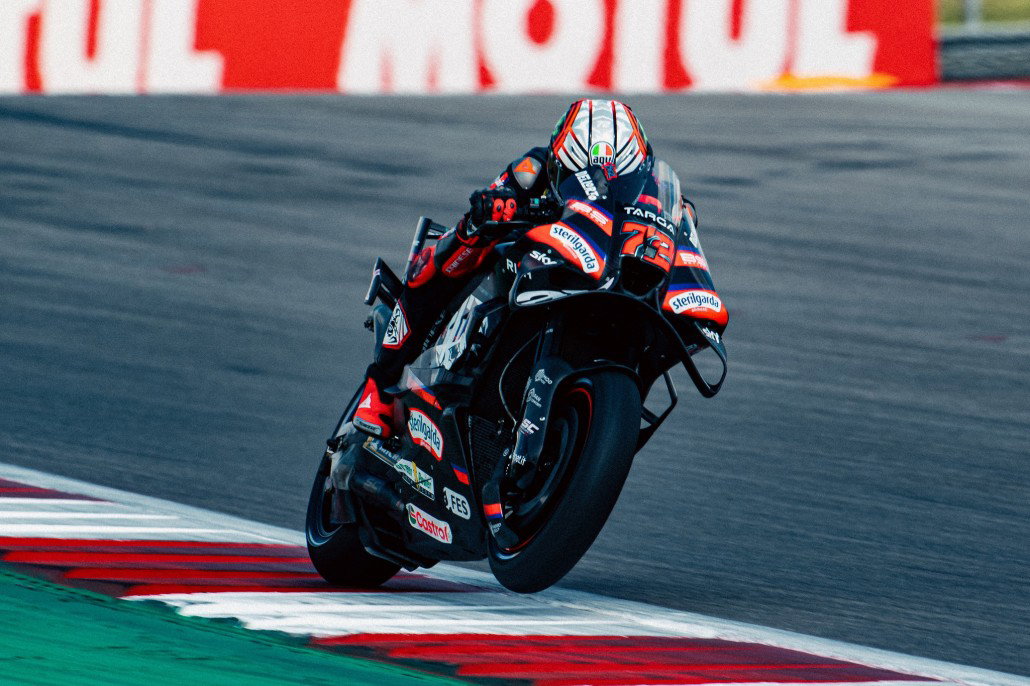
Will Raul Fernandez Stay at Trackhouse?
Raul Fernandez is set to continue riding for Trackhouse beyond 2027, though the new contract has not yet been officially confirmed. New team manager Francesco Guidotti called the Spaniard’s continued stay a done deal in a TV interview after the Dutch TT.
“His future is with us. Aprilia and Trackhouse made that decision together a few years ago, and we want to keep going down this shared path. We believe Raul still has a lot of room to improve,” Guidotti said. On the contract extension, he added: “As for the contract extension, we’re now heading in the right direction and are just working out the final details. We already agree on the key questions. So it’s just a matter of days or hours now.” That would keep Fernandez alongside Enea Bastianini.
Things had looked different before. Trackhouse reportedly initially offered the rider only a one-year deal through the end of 2027, while the rival manufacturer was pitching a contract through the end of 2028. Above all, the strong weekend at Assen is said to have convinced team owner Justin Marks, so Trackhouse is now also offering a two-year contract. Fernandez himself stayed tight-lipped when asked about the timing of the announcement. “Hopefully soon,” he replied in a TV interview. A deal would settle another piece of the puzzle in the MotoGP 2027 rider market, which is filling up rapidly these weeks.
➜ This article is part of our comprehensive overview: 2026 MotoGP Season: The Complete Overview – Teams, Riders, Calendar & Championship Standings. Find all key information on this topic in one place.
Frequently Asked Questions
-
Why Does Marc Marquez Criticize the 44 MotoGP Starts?
Marc Marquez sees the high number of starts as the key risk factor. Because riders approach the first corner at the limit multiple times through the two practice starts, the sprint and the grand prix, they barely leave a safety margin anymore. Over a season, regular riders reach 44 race starts this way.
-
When Will Johann Zarco Return to MotoGP?
Johann Zarco is aiming for a return in September. Surgery on his left knee is not necessary after a new examination; instead, he is following a rehabilitation program. The earliest possible date is the San Marino Grand Prix, September 11 to 13, in Misano.
-
Which Riders Will Ducati Field in 2027?
Ducati is fielding six bikes in 2027. Marc Marquez and Pedro Acosta ride for the factory team, Joan Mir and Daniel Holgado for Gresini, and Fermin Aldeguer plus one still-open second seat for VR46. Superbike rider Nicolo Bulega is considered a candidate.
-
What Changes Under the MotoGP 2027 Regulations?
New technical regulations with 850cc engines take effect for the 2027 season. The bikes will be lighter, use less aerodynamics and drop ride-height devices, while also switching to Pirelli tires. In addition, a maximum of six identical bikes per manufacturer will be allowed.
-
Will Raul Fernandez Stay at Trackhouse?
Raul Fernandez staying at Trackhouse is considered highly likely, though it has not yet been officially confirmed. The team manager described it as a matter of just a few days or hours. Enea Bastianini is set to remain his teammate in 2027.