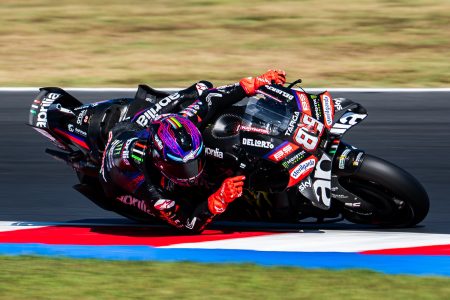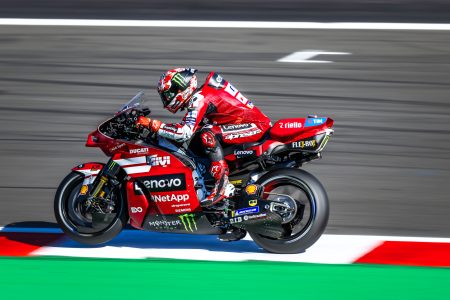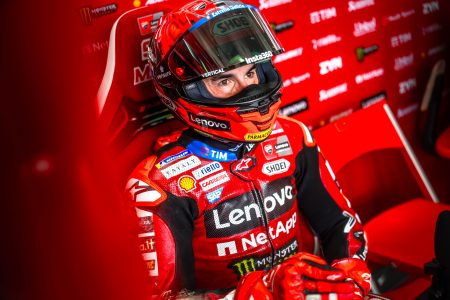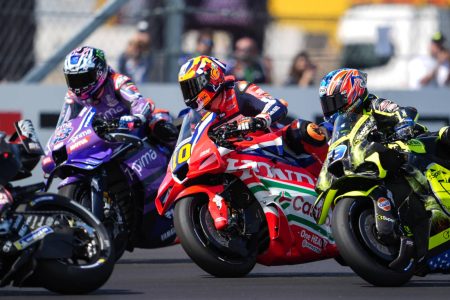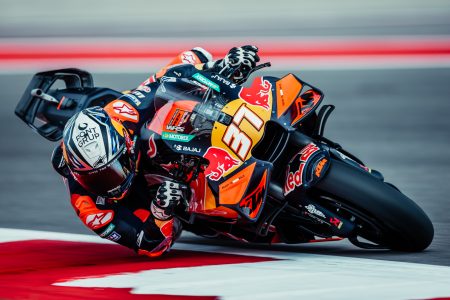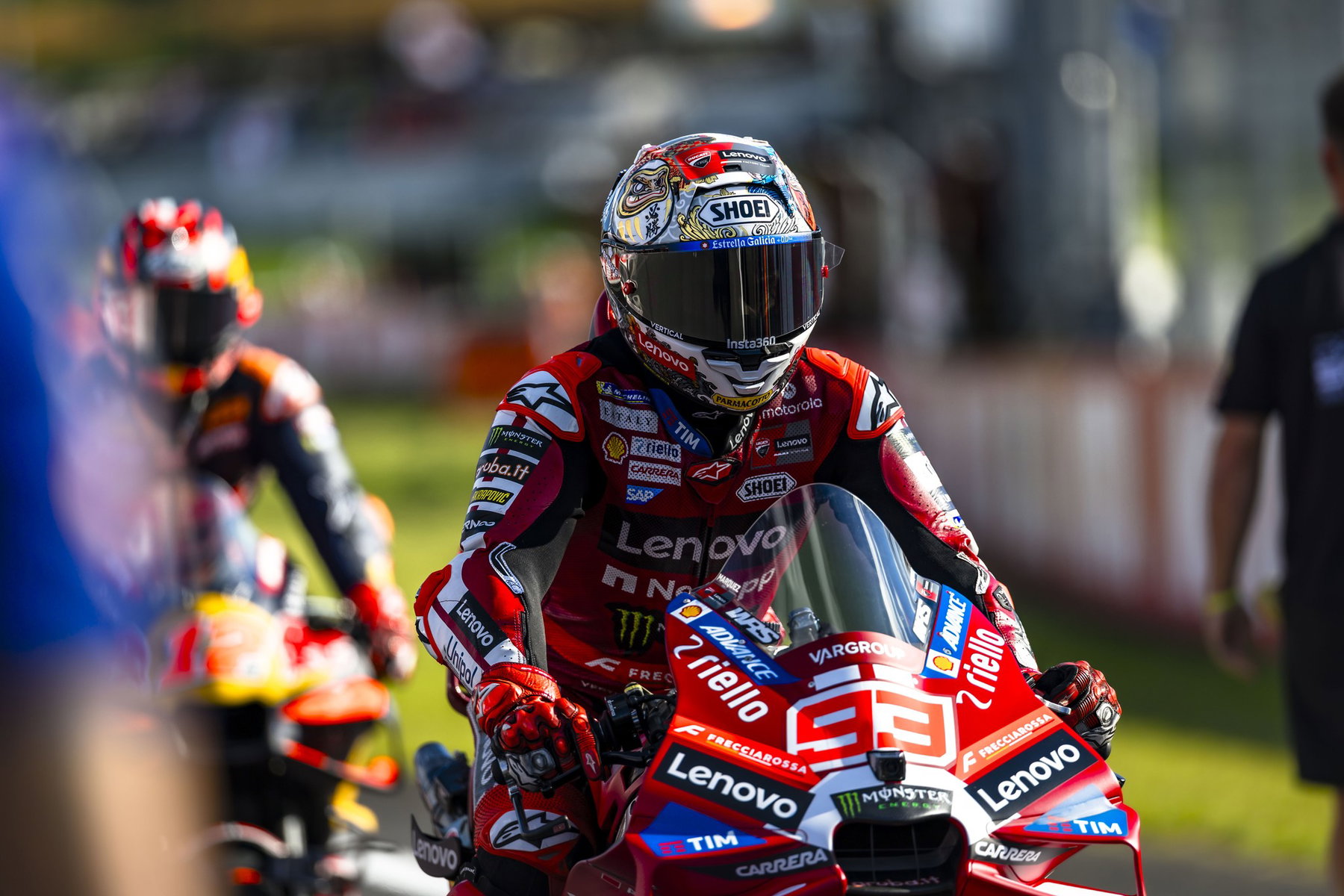
- Marquez takes the full 37 points with Sprint and GP wins, standings: Martin 333, Marquez 331, Bezzecchi 284
- Martin had to save fuel during the race, and Marquez used exactly that phase to pass
- The hard rear tire was the best choice for almost everyone, but no rider had tested it before Sunday
The MotoGP weekend at Motegi has tightened the 2026 title fight once again. Marc Marquez won the Sprint on Saturday and the Japanese Grand Prix on Sunday. Jorge Martin finished third once and second once. Before the weekend, the Aprilia rider still had a twelve-point lead; now it is just two. But there are many stories behind the result: a fuel problem at Aprilia, a lookalike at the kart race, a missed opportunity with the hard tire and several riders struggling with pain or their own mistakes. With six race weekends remaining, the decisive phase of the season is now underway.
How did the MotoGP race at Motegi unfold?
Marc Marquez passed Jorge Martin on lap 11 at Turn 9 and went on to win by 1.363 seconds. Third place went to Marco Bezzecchi, who held on to the podium by just 0.078 seconds ahead of Enea Bastianini.
Martin started from pole position and led the field into the first corner. Marquez slotted in right behind him and closed in lap by lap. After lap 9, only 0.149 seconds separated the two. One lap after Martin’s fastest lap, Marquez attacked on the inside at Turn 9. Martin tried to strike back shortly afterwards but ran onto the green area beside the track at the exit of Turn 9 and lost momentum. From then on, Marquez gradually extended his lead.
Behind the leading duo, Bezzecchi rode alone in third for a long time. In the closing stages, Bastianini came ever closer with several fastest laps. On the penultimate lap, the Tech3 KTM rider posted a 1:43.041, a new race lap record at Motegi. An attack on the final lap at Turn 10, however, did not come off.
Further back, Raul Fernandez, Ai Ogura and Pedro Acosta fought a close three-way battle for fifth place. Fernandez came out on top, Ogura finished sixth and Acosta seventh. That put four Aprilias in the top six. Francesco Bagnaia crossed the line in eighth, more than 20 seconds behind his teammate.
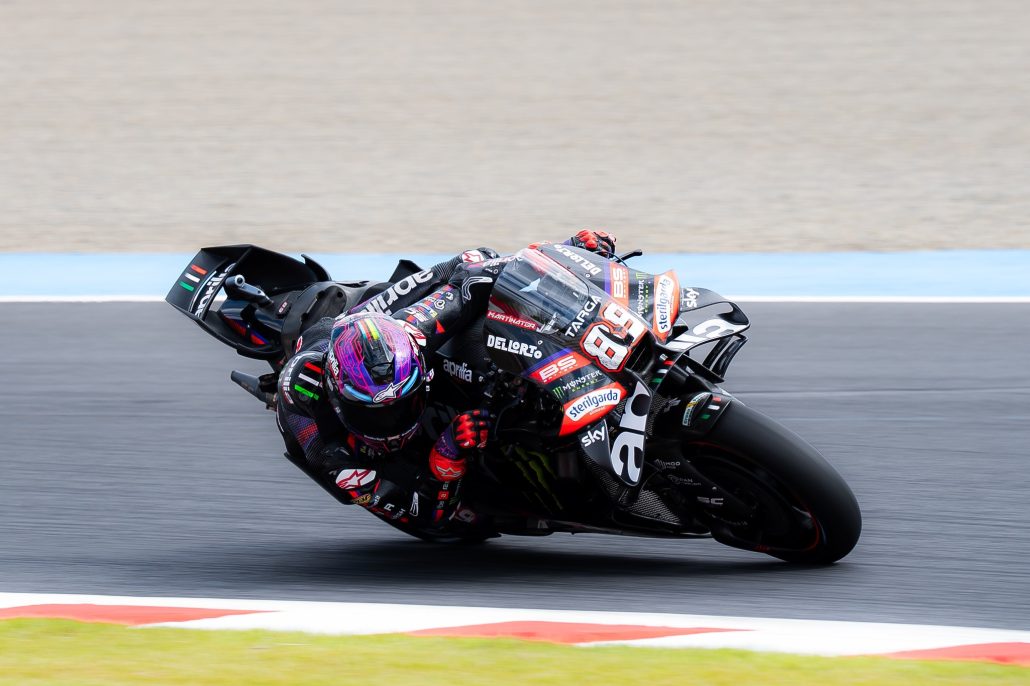
Why couldn’t Martin beat Marquez in Japan?
At one stage of the race, Martin had to keep his fuel consumption under control and therefore back off the pace. That was exactly the moment Marquez went past him.
After the race, the 28-year-old explained that he had been able to ride quite consistently at the front. Then the consumption issues came. “I had some issues with my fuel consumption, so I had to manage a bit, and at that point, he took the advantage,” said Martin.
On top of that, there was a difference on one particular part of the track. “In Turns 8 and 9 he was clearly faster than me. That’s where he made the difference,” Martin analyzed. On the rest of the lap, both were similarly fast, he said. He himself can brake hard and turn the bike in well. Acceleration, on the other hand, is clearly Marquez’s strength. In the fast corners, both were very quick.
Martin was nevertheless happy with his own performance. He spoke of getting better on the Aprilia with every lap. On Saturday the team had made a big step, and on Sunday another one. That it still wasn’t enough clearly weighed on him. “With Marc, you cannot make any mistake either on riding or with the management of the race, so he was stronger.” Even on one of his good days, it had been impossible to beat him.
On the positive side, Martin noted that Aprilia was competitive at a track where the factory used to struggle. According to him, it is Aprilia’s first Sunday podium at Motegi. He also took his second pole position in a row.
What did Marquez say after his win at Motegi?
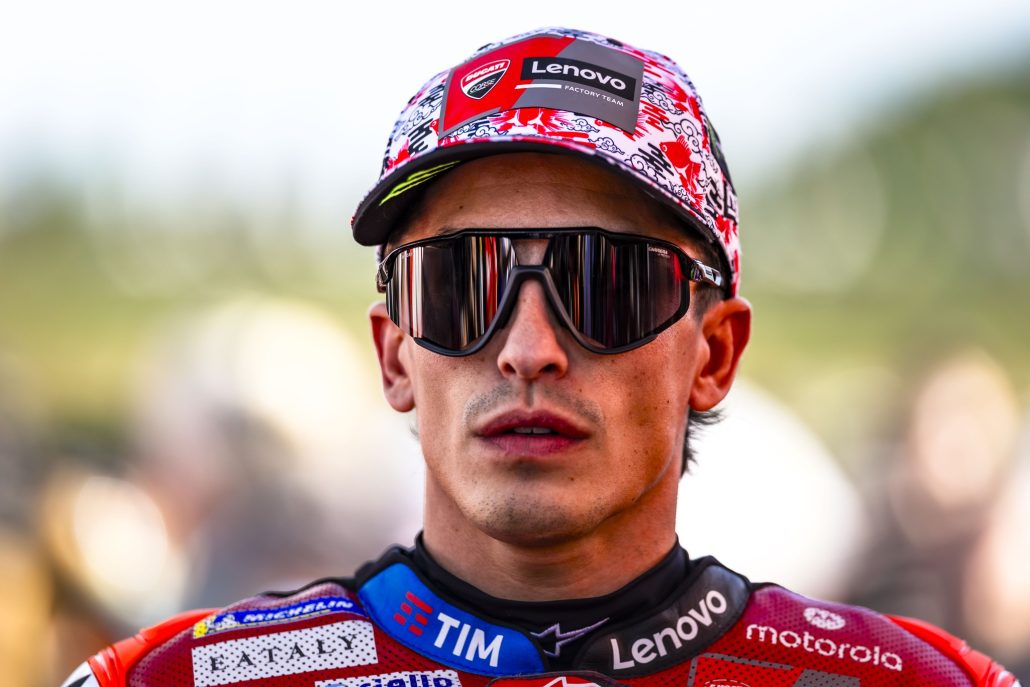
Marquez sees the Aragon Grand Prix as the turning point of his season. Since then he has felt very comfortable on the bike; only in Austria did brake problems hold him back.
“Since Aragon, the feeling on the bike has been very good. I’m always able to understand what I need to do,” said the Ducati rider. He writes off the weak weekend at the Red Bull Ring as an outlier. In Japan, there were no more problems with the brake. Motegi was his sixth Grand Prix win in nine race weekends and his fifth double of Sprint and Grand Prix. In total, it was his fourth premier-class win at Motegi.
His plan for the race was clear: take the lead as early as possible and then dictate the pace. The ideal place for that would have been the first corner. But this time Martin’s start was better than on Saturday, and his own was poor. Marquez therefore stayed patient in the opening laps. He only knew the hard rear tire from the warm-up and first wanted to understand where the limit was. After three laps he started to push. Once he was in front, he controlled the pace. Whenever Martin came closer, he pushed a little harder and then backed off again.
According to him, the feeling was already good on Friday. A small change before the Sprint made it even better. But he does not see the title fight as a foregone conclusion. The bike worked very well at Motegi; whether that will also be the case at the next tracks remains to be seen.
Why did Marquez send a lookalike to the kart race?
Marquez skipped the MotoGP riders’ kart race on Sunday morning because he needed to treat and ice his right arm after the extended warm-up. Instead of driving himself, he put a lookalike in his kart and received a reprimand from the championship for it.
The championship had promoted the kart race as a new program item days before the weekend. Because of Saturday’s tire problems, it was briefly in doubt. The teams wanted a longer warm-up, so the schedule was reshuffled. In the end, the warm-up extended to 20 minutes, the kart race and the parade lap still all fit into Sunday morning.
The race itself turned into a show. Pramac riders Toprak Razgatlioglu and Jack Miller entertained with their antics behind the wheel. Somkiat Chantra won ahead of Pedro Acosta. Most of the attention, however, went to the person wearing Marquez’s helmet and gloves. Of all people, Martin was right next to him in his kart and tried to flip up the visor. The supposed Marquez dodged him. A member of IRTA also tried to find out who was in the kart but got no answer either.
After the race, Marquez explained that he understood the show, but that his team is fighting for the championship and not karting for fun. After the warm-up he needed ice. Someone from the team then came up with the lookalike idea. He confirmed the reprimand. “But at this moment you have to be selfish and perform at your maximum when it matters, which is in the races.”
Martin saw through the swap immediately. “I spotted it quickly, I knew it wasn’t Marc.” Still, he showed understanding. He, too, had not been entirely convinced by the idea. A bump from behind could compromise a rider for the race. That’s why he quickly got out of the way at Turn 1 and ended up among the slow ones. Similar program items have been held several times this season. The tuk-tuk race in Buriram at the start of the season was particularly well received.
Why did no rider test the hard tire earlier?
At Motegi, the hard rear tire with a reinforced carcass was considered only an emergency option for the new asphalt. In practice, the teams therefore compared only the soft and medium tires, as usual.
The carcass is the inner structure of a tire and determines how stiff it is. The hard tire was available all weekend, but nobody paid attention to it. That only changed when the soft tire caused unexpected problems in the Sprint. Michelin then withdrew it and recommended the harder one for the Grand Prix. The teams ran it for the first time only in the extended warm-up on Sunday. In the end, all riders opted for the medium front and the hard rear tire.
In hindsight, the tire turned out to be by far the best choice. Fabio Quartararo summed it up: “It was funny because nobody used it, and at the end it was the best tyre, so a bit crazy.” Marquez went even further. He also considers the tire well suited for a fast lap in qualifying. Normally, everyone expects a different tire or a different carcass to bring more performance. The way the tire worked in the warm-up came as a big surprise to everyone, he said.
Martin was also impressed by the lap times. “I felt much more stability, a lot of grip, and yeah, it was a really good tyre.” He probably would not have used it in the Sprint, but he slightly regrets not having tried it earlier.
Alex Marquez shared an anecdote from the team briefing. “In the morning we were still joking in the team that if the tire worked, it would prove we all have no idea about motorcycles!” He also has an explanation for the good performance. Normally, Michelin combines a stiffer carcass with the hardest rubber compound of the weekend. This time, however, the stiffer carcass was paired with the soft compound. His team wants to keep that in mind for future races. The tire is also said to differ from the hard carcass used at Buriram, Spielberg and Mandalika, for example. Ogura reported that even in the warm-up, many riders had still expected to use the medium tire. Fernandez was likewise surprised at how well the tire worked.
What went wrong for Alex Marquez at Motegi?
Alex Marquez crashed in the Grand Prix because of a shifting error: instead of shifting down a gear, he shifted up twice while leaned over. The same mistake had already brought him down in the morning warm-up.
The weekend had started strongly for the Gresini rider. On Friday he was fastest in practice, and in qualifying he finished fifth, making him the second-best rider on a Ducati GP26. But in the Sprint, things went wrong on the very first lap. His move on Acosta at Turn 3 triggered a crash that also took down Fabio Di Giannantonio. For that, he received a double long-lap penalty. A long lap is a mandatory longer loop beside the racing line that costs time.
In the Grand Prix, the 30-year-old was fourth after the first lap. On lap 5 he served both penalties and dropped to eighth. He held that position until he crashed in the final laps. It was his third crash of the weekend. His explanation: “I didn’t put my foot where it belongs on the bike. That’s why I shifted up twice instead of down once while leaned over.” In the wrong gear, the bike pushed forward and he crashed. He cannot afford such mistakes, especially not twice on the same day. At least the speed was there.
The consequences are clear. Alex Marquez failed to score a single point all weekend and lost eighth place in the championship to Francesco Bagnaia. Next year he will ride for KTM.
How is Di Giannantonio after his Sprint crash?
Fabio Di Giannantonio rode the Grand Prix with pain in his ribs and right hip. He finished only 18th and, as in the Sprint, went away without points.
The VR46 rider had hoped he would feel much better after a night’s sleep. That was not the case. Especially on the right side, where the impact had hit him, he could not move freely on the bike. Even the normal things were difficult for him, he said. His hip did not allow a natural seating position. “At the end, when you bang the ribs, you always have a sort of knife pointed in all the day.” According to VR46 team boss Pablo Nieto, nothing was broken. The Italian is said to have taken painkillers, however.
Now a race against time begins for him. The race in Indonesia is the home race of Pertamina, his team’s title sponsor. Despite a tight schedule of flights and appointments, he wants to arrive in Mandalika as close to 100 percent as possible.
Battle for fifth: Fernandez saves fuel, Ogura thinks about the future
Raul Fernandez had only managed eighth in the Sprint. The Grand Prix went better, although his race also started slowly. Early on, his Trackhouse teammate Ai Ogura put him under pressure. When Bastianini passed Acosta, Fernandez used the gap and overtook the KTM factory rider as well. He could not match Bastianini’s pace, however.
From mid-race, the three-way battle with Ogura and Acosta developed. Acosta passed Ogura, and Fernandez countered shortly afterwards at Turn 9 with a hard move on the brakes. At times, the three ran side by side. Fernandez kept his nerve and brought fifth place home, 14.8 seconds behind Marquez. He could not push to the absolute limit right to the end, though. “In the last four or five laps we had to manage fuel because our consumption was high.” It was the first time he had felt really comfortable on a so-called stop-and-go track, meaning a circuit with many hard braking zones and acceleration phases. In the championship, Fernandez remains seventh with 216 points, 14 points behind Di Giannantonio.
For Ogura, it was a home race with a difficult start to the weekend. After the first day, the Japanese rider was not in the top ten; he made it into Q2 via Q1, but eleventh on the grid was the best he could do. In the Sprint he finished fifth, partly because Alex Marquez’s crash took three strong riders out of the race. In the Grand Prix he immediately passed Diogo Moreira, Di Giannantonio and Johann Zarco at the start. Ogura had only returned from injury in Austria.
He had made a plan to get past Fernandez, Ogura said. But he couldn’t carry it out because of Acosta, who passed him again. After that, Fernandez rode flawlessly to the finish. Sixth place is fine, but it could have been even better for the fans. He is already thinking about next year’s home race. With fifth and sixth place finishes, Ogura is now fifth in the championship.
Why is Toprak Razgatlioglu still without a chance in MotoGP?
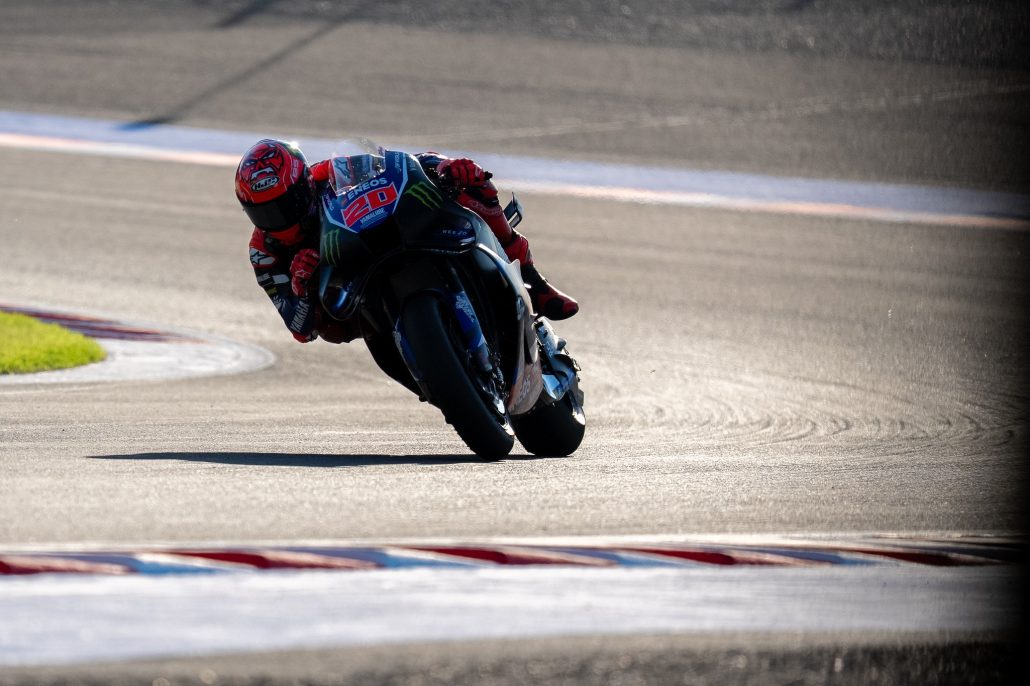
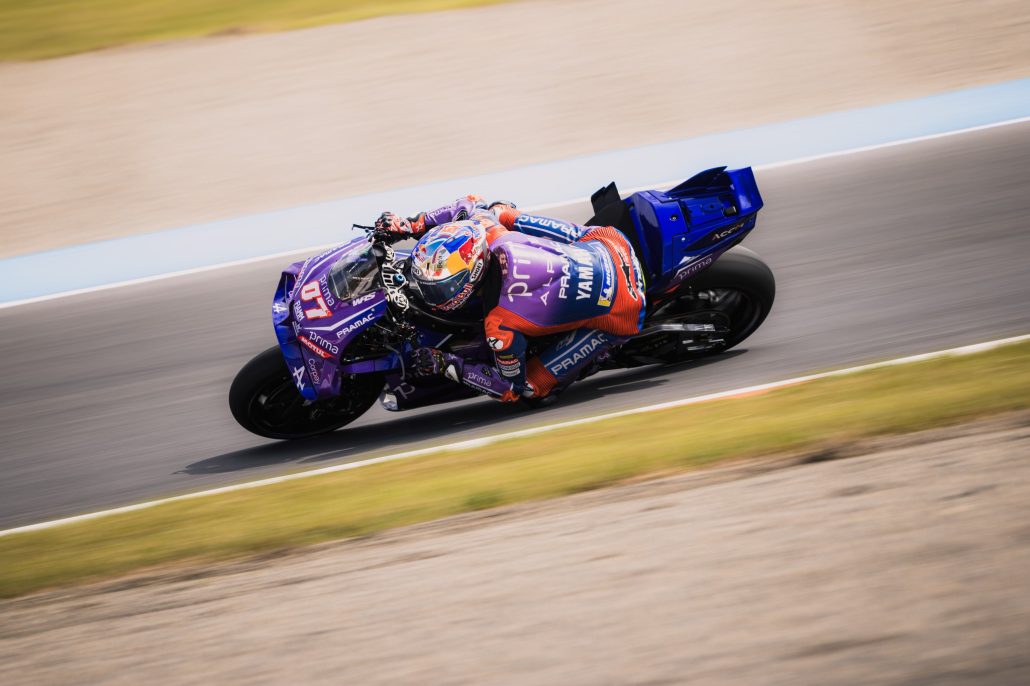
Toprak Razgatlioglu has been battling the same problems since the start of the season: he can’t get the most out of the Michelin tires, and the Yamaha doesn’t behave under braking the way he needs it to. Adapting his riding style is proving harder than he expected.
At Motegi, the rookie started from last place and finished 17th. Fabio Quartararo at least scored four points in twelfth, but was already more than 30 seconds behind Marquez. Razgatlioglu lost almost nine more seconds. Only Di Giannantonio and his Pramac teammate Jack Miller finished behind him. Even so, the three-time Superbike world champion was in surprisingly good spirits.
He spoke openly about his situation. He is improving, but only a little, because the front wheel keeps locking or bouncing. That is the package he has to ride with. “My best is not enough.” And further: “If I could ride more with my style and were more relaxed, I would be much stronger.” After 32 of 44 races, Razgatlioglu has 18 points and is 21st in the championship. Of the 22 regular riders, only Maverick Viñales, who was out injured for a long time and returned at Motegi, has fewer.
He had praise for Nicolo Bulega, the new Superbike world champion, who moves to MotoGP with VR46 Ducati in 2027. Bulega has tested a lot with the MotoGP bike and the Pirelli tires and is coming at the right time, he said. He is younger, and his riding style suits MotoGP better.
What does the 100th win mean for Ducati boss Dall’Igna?
With Marquez’s win at Motegi, Ducati celebrated its 100th MotoGP victory under Gigi Dall’Igna. That means Ducati has won almost every second race of the last 203 since 2016.
Dall’Igna joined Ducati at the end of 2013, when the factory was in a deep crisis. He is proud of the work of all Ducati employees, he said. The flip side of the number 100 is that he has gotten old. His most important memory remains the first win with Andrea Iannone in Austria. Closest to his heart is the 2015 Desmosedici, because it marked a real step forward, achieved under great pressure. Also important to him is the 2022 bike, with which Ducati won its first riders’ title.
The most important thing is the knowledge Ducati has built up over the years, he said. That’s why he is also optimistic about the future, even if the regulations change. Over the past ten years, the motorcycle has changed more than in all the years before. Ducati was a pioneer in aerodynamics and ride-height devices. For the new 850 cc era, the first development phase is almost complete. An important test is scheduled for next month, and he is especially looking forward to the Valencia test. He did not want to comment further on the concessions for rivals that have helped Aprilia catch up. He clearly calls the current era golden. “It is certainly a golden era for us, because we have achieved so many results and I think it is really difficult to do any better than this.”
After the race, Marquez paid tribute not only to Dall’Igna but also to his crew. He enjoys the work Dall’Igna has built up with his team, he said. Together they work on all the small details to compete against the two Aprilia riders.
Where does the MotoGP title fight stand ahead of Mandalika?
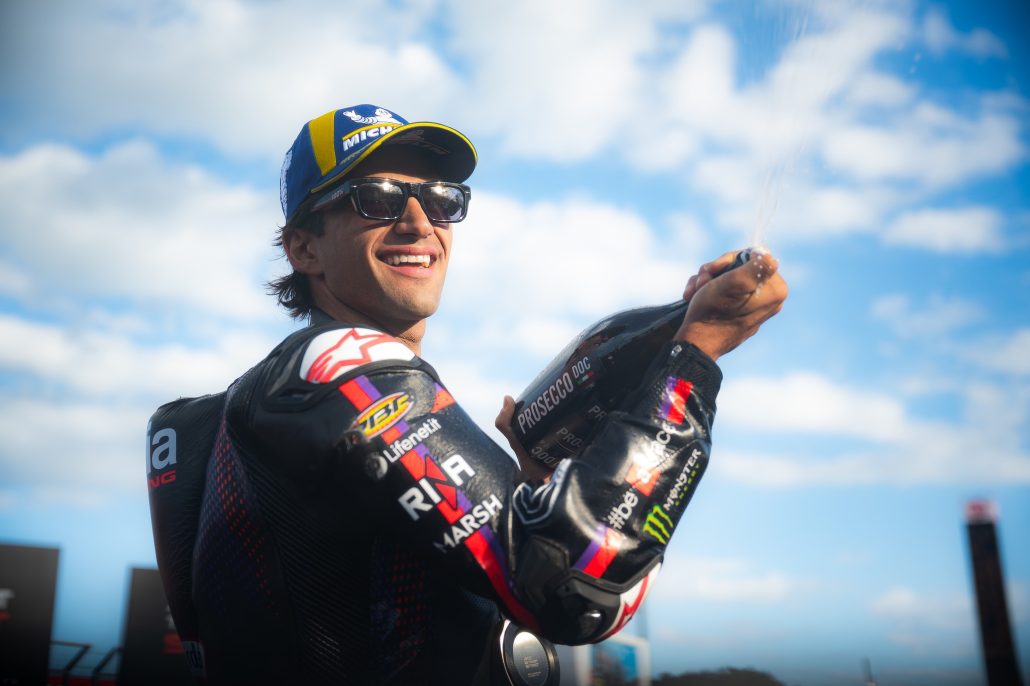
Jorge Martin leads the championship with 333 points ahead of Marc Marquez with 331 points. With 284 points, Marco Bezzecchi is the only rider who still has a reasonably realistic outside chance.
Both title contenders go into the final races with plenty of confidence. After two poles in a row and podiums in every race, Martin sees himself back on track. Something is still missing, but that is a question of work. “I’m confident that I’ll be faster than him in the next races.” It is a privilege, he said, to still be fighting one of the greatest riders in history at this point.
The next race takes place from October 9 to 11 in Indonesia. Ducati has been warning for weeks that Aprilia will be the clear favorite there. Mandalika is one of the tracks with the highest tire wear on the calendar and is said to suit Aprilia better than Ducati. For Marquez, the track is difficult anyway; in 2025 he was seriously injured there. “I’ve never been able to finish a race in Indonesia, I’ve always had a bit of bad luck there,” he said. After that, the series heads to Phillip Island for the last time, where Aprilia was clearly stronger than Ducati last year. At the same time, the track is considered one of Marquez’s signature circuits.
Bezzecchi is 49 points behind Martin and 47 points behind Marquez. Since his comeback after breaking his collarbone at the Sachsenring, he has been fast, but not as fast as the two at the front, he said. At the start of the weekends he lacks the confidence he had at the beginning of the season. Recently he has had to catch up on Friday and Saturday and was only fast on Sunday. His goal is to rediscover his form from the start of the season. In the team standings, Aprilia Racing extended its lead over Ducati Lenovo to 617 to 495 points.
Frequently Asked Questions
-
Who won the 2026 MotoGP race at Motegi?
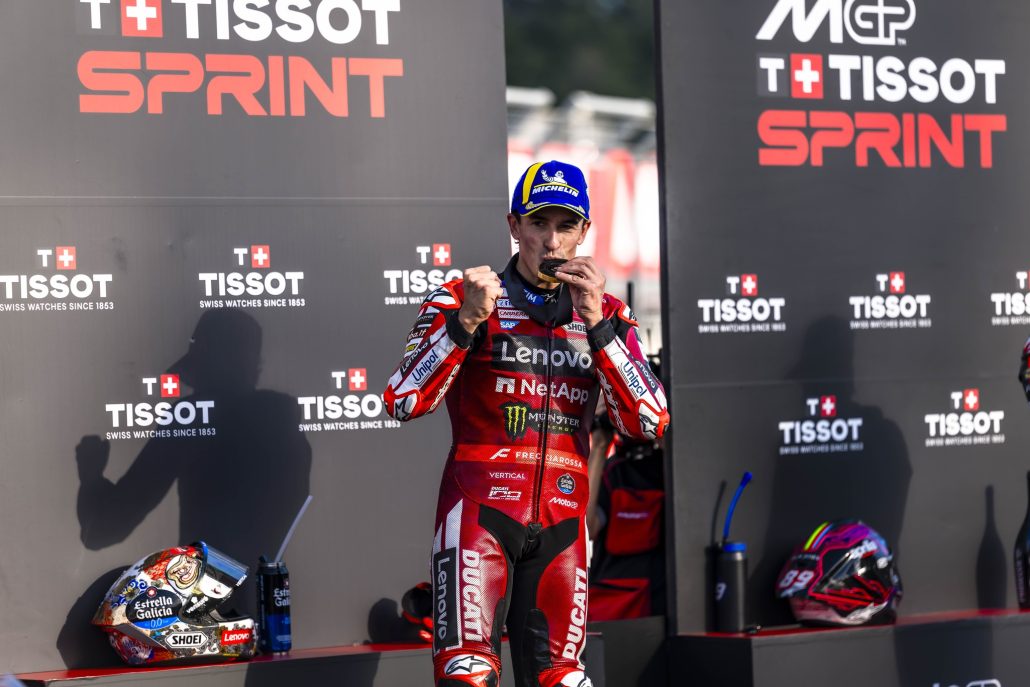
Marc Marquez won the MotoGP race at Motegi. He finished 1.363 seconds ahead of Jorge Martin, with Marco Bezzecchi third. Marquez had also won the Sprint on Saturday.
-
Why did Martin stand no chance against Marquez at Motegi?
Martin had to back off the pace during the race because of his fuel consumption, and Marquez passed him in that phase. According to Martin, Marquez was also clearly faster in Turns 8 and 9. Martin sees acceleration as a clear strength of the Ducati.
-
Why did a lookalike drive for Marc Marquez in the kart race?
Marquez needed to have his right arm treated and iced after the extended warm-up. Someone from the team therefore suggested putting a lookalike in the kart. The championship reprimanded him for it, and Marquez justified the decision with his focus on the title fight.
-
Why did Alex Marquez crash at the Japanese GP?
Alex Marquez placed his foot incorrectly while leaned over and therefore shifted up twice instead of down once. The same mistake had already brought him down in the warm-up. He scored no points all weekend.
-
When is the next MotoGP race after Japan?
The next MotoGP race takes place from October 9 to 11 at Mandalika in Indonesia. The track is said to suit Aprilia better than Ducati. Marc Marquez has never finished a race there.