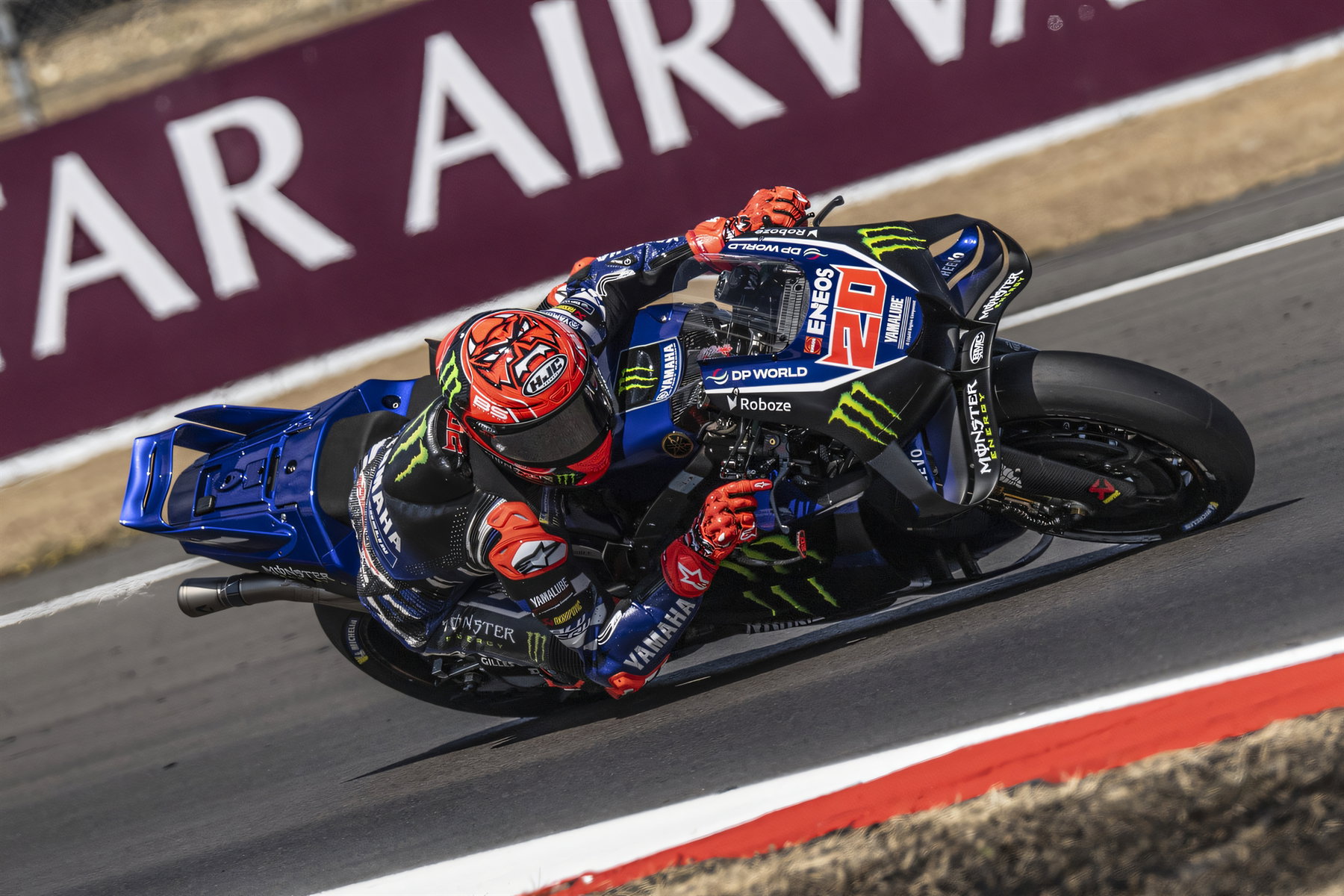
- A 16-second penalty costs Fabio Quartararo all his points and drops him to 16th
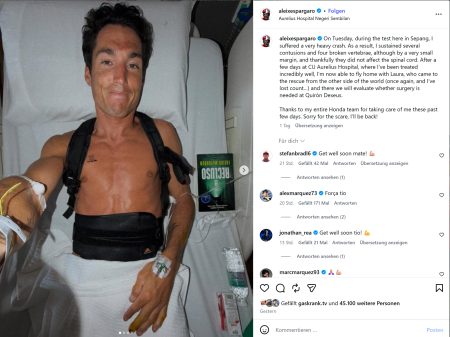
- Marco Bezzecchi rode the race with a surgically repaired collarbone and an open knee injury
- Fabio Di Giannantonio openly calls Ducati the second force behind Aprilia
While the riders at Silverstone were already deep into their interviews, technical control was still at work. What looked like a clear-cut result in the early afternoon was corrected in several places by the evening. At the same time, the riders supplied explanations that put the race day in a different light: the botched start of the two Aprilia riders in the first corner, Ai Ogura’s crash, the winner’s tyre strategy, and an injury that was far more serious than had been known until then.
How big was Quartararo’s penalty and why was it imposed?
Fabio Quartararo had 16 seconds added to his race time after the fact because his Yamaha had not recorded any valid front tyre pressure data throughout the entire race. That dropped him from 12th to 16th and he left Silverstone without a single point.
It was explicitly not a penalty for running too low a tyre pressure, but for missing data. The stewards’ statement says the bike was summoned to technical control after the race. It emerged there that the onboard receiver had not been configured correctly to receive the data from the front tyre sensor. The sensor’s identifier was not stored in the receiver’s database. Tyre pressure sensors on both wheels are mandatory in MotoGP, as is the continuous recording of the values. Breaches are punished according to a fixed penalty catalogue, which is why Quartararo received the same penalty as riders who fall below the minimum pressure.
For the Yamaha factory team, the weekend therefore ended with zero points. Alex Rins had already retired on the opening lap after a collision with Joan Mir. Quartararo now sits 14th in the riders’ standings, and it was the second year in a row that he left Silverstone without points.
What does the corrected classification look like?
From 12th place onwards, every rider moved up one position. The official classification lists Quartararo last with a race time of 40:28.813 minutes and a gap of 42.883 seconds.
The main beneficiary was Jack Miller, who finished 12th at 29.458 seconds and became the best Yamaha rider of the race. Pol Espargaro inherited 13th place and with it three points. The Spaniard was back on an RC16 at a Grand Prix for the first time since 2023, standing in for the injured Maverick Vinales. Toprak Razgatlioglu finished 14th, and Yamaha test rider Augusto Fernandez moved up to 15th, collecting the last championship point on offer.
For Razgatlioglu, the weekend remained sobering despite the reshuffle. Of the seven riders who crashed, only Cal Crutchlow ended up behind him, so the result flatters his actual performance. The three-time Superbike world champion named Silverstone’s long, sweeping corners as his main problem, saying he still picks the bike up too late and rides too much in Superbike style.
How badly injured was Marco Bezzecchi really?
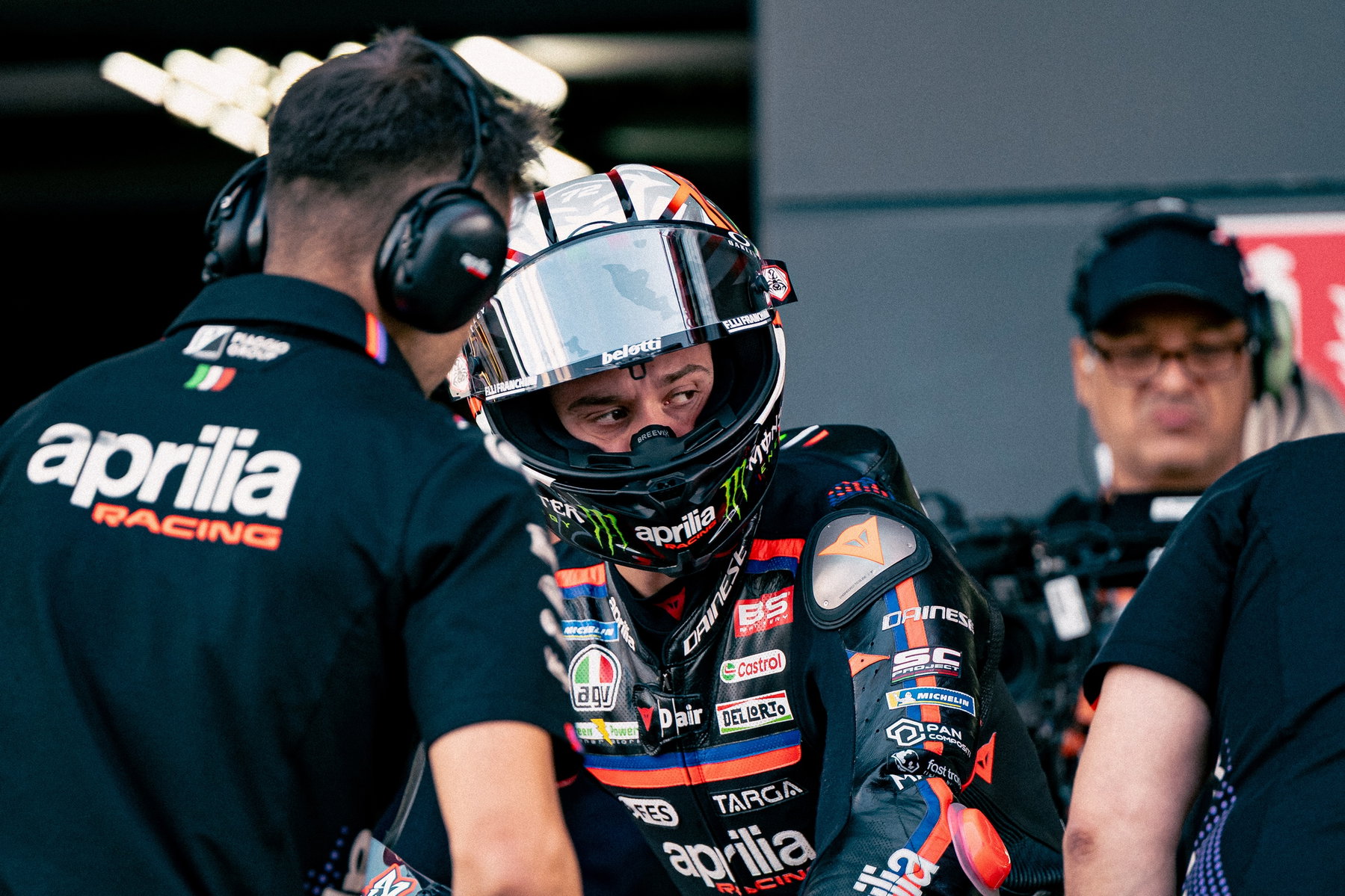
Marco Bezzecchi rode with a surgically repaired collarbone and a deep knee injury, with the knee being the bigger problem. Both injuries date back to a crash in qualifying for the German Grand Prix on 11 July, and both were operated on within a few days.
The Italian described the sequence in detail after the race. The wound on his knee was initially only stitched up in Germany so that he could fly home. Back home it had to be opened again, and it turned out that the bone was damaged as well. „I had a big, big hole in my knee,” he said. A small piece of bone was missing, the knee swelled up and could not be fully bent. That is exactly what made Silverstone, with its many changes of direction, such a strain. Qualifying alone had destroyed him, he said, and in the sprint he was physically finished four laps before the end.
Aprilia boss Massimo Rivola reported that his rider could barely walk on race morning: „When you see a rider that struggled to walk in the morning and had a race like that, you can imagine how big his heart is.”
Bezzecchi himself put his third place down to stubbornness: „I wanted it so badly; I couldn’t give up.” When Jorge Martin and shortly afterwards Alex Marquez passed him, he fell into a physical hole. Only Alex Marquez’s riding error at Turn 1 gave him a few laps of breathing space. At the press conference he had to take off his leathers because his left shoulder hurt too much. Bezzecchi also described the preceding weeks as mentally hard and pointed to the support of Rivola, of Aprilia owner Michele Colaninno and of trainer Carlo Casabianca, with whom he says he spent 22 hours a day. On the effect of the helmet he said: „when we put the helmet on, it’s like putting earplugs in.”
How did Raul Fernandez find the right tyre limit?
Raul Fernandez learned the limit of the medium rear tyre in Sunday morning’s warm-up, because he pushed too hard there out of frustration over his sprint crash. That insight took away his fear of a late drop-off in the race.
About his Saturday crash, the Spaniard said: „You are an idiot.” On Sunday morning he was, by his own account, angry with himself, and in the process he found that the limit lay at lap times around 1:58.4 to 1:58.5 minutes. In the race he therefore deliberately ran high 1:59s. His lead grew to more than four seconds at times. When Martin closed to around 3.6 seconds on lap twelve, he still had reserves and re-established the gap. On top of that he had to manage fuel consumption from the first lap onwards.
Trackhouse team-mate Ai Ogura confirmed the impression and explained that after looking at the warm-up data he had known this would be Fernandez’s day. The win also coincided with the contract extension Trackhouse had announced the week before, running to the end of the 2028 season. Team founder Justin Marks was present in person for the first time. Fernandez placed the RS-GP’s rise in a historical context and named technical director Fabiano Sterlacchini as the trigger: since his arrival, work had been done on many details, and Bezzecchi had additionally made the machine easier to handle in the previous season. In the championship, Fernandez is sixth, 56 points down, and he rules himself out of the title fight.
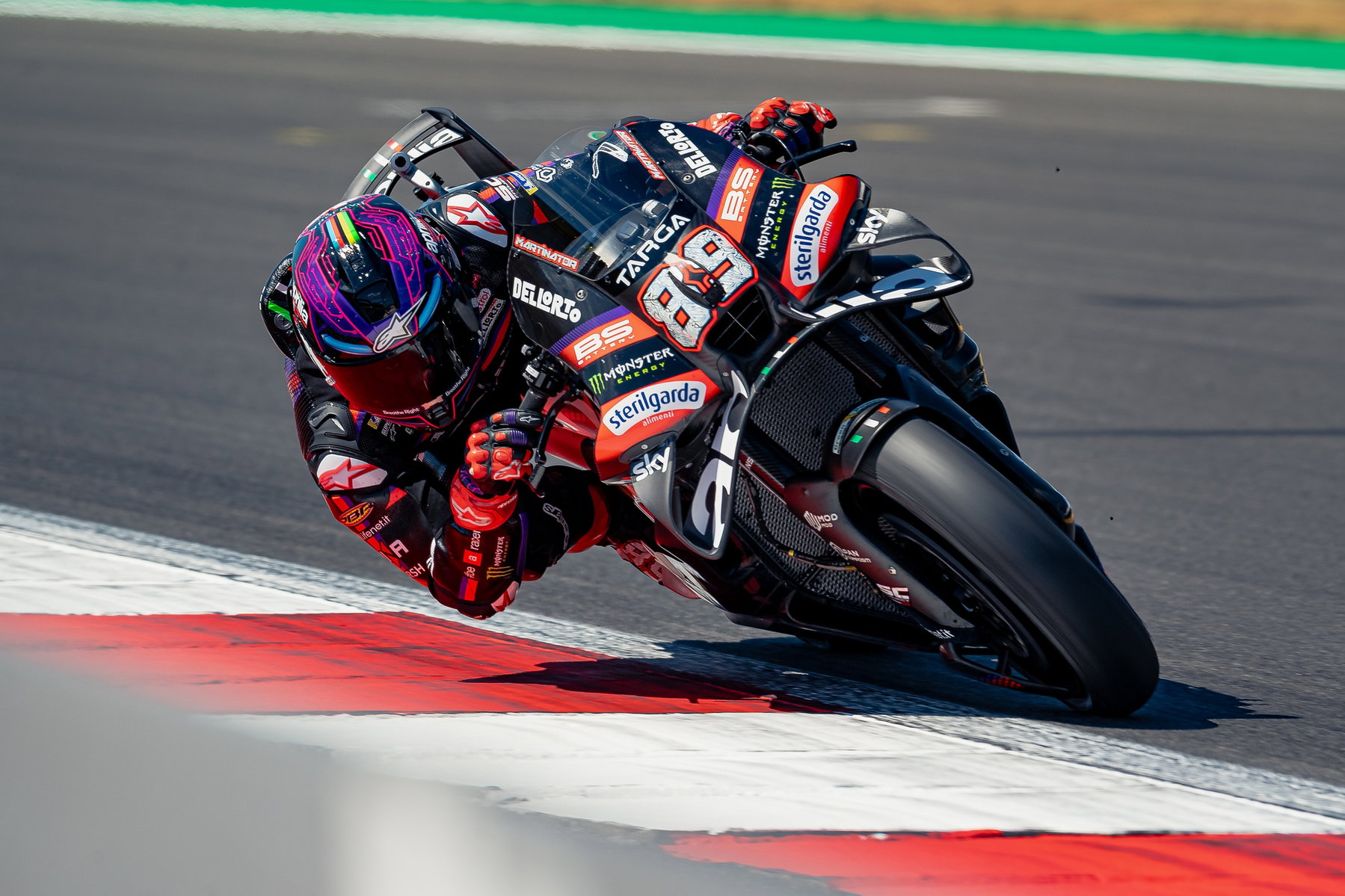
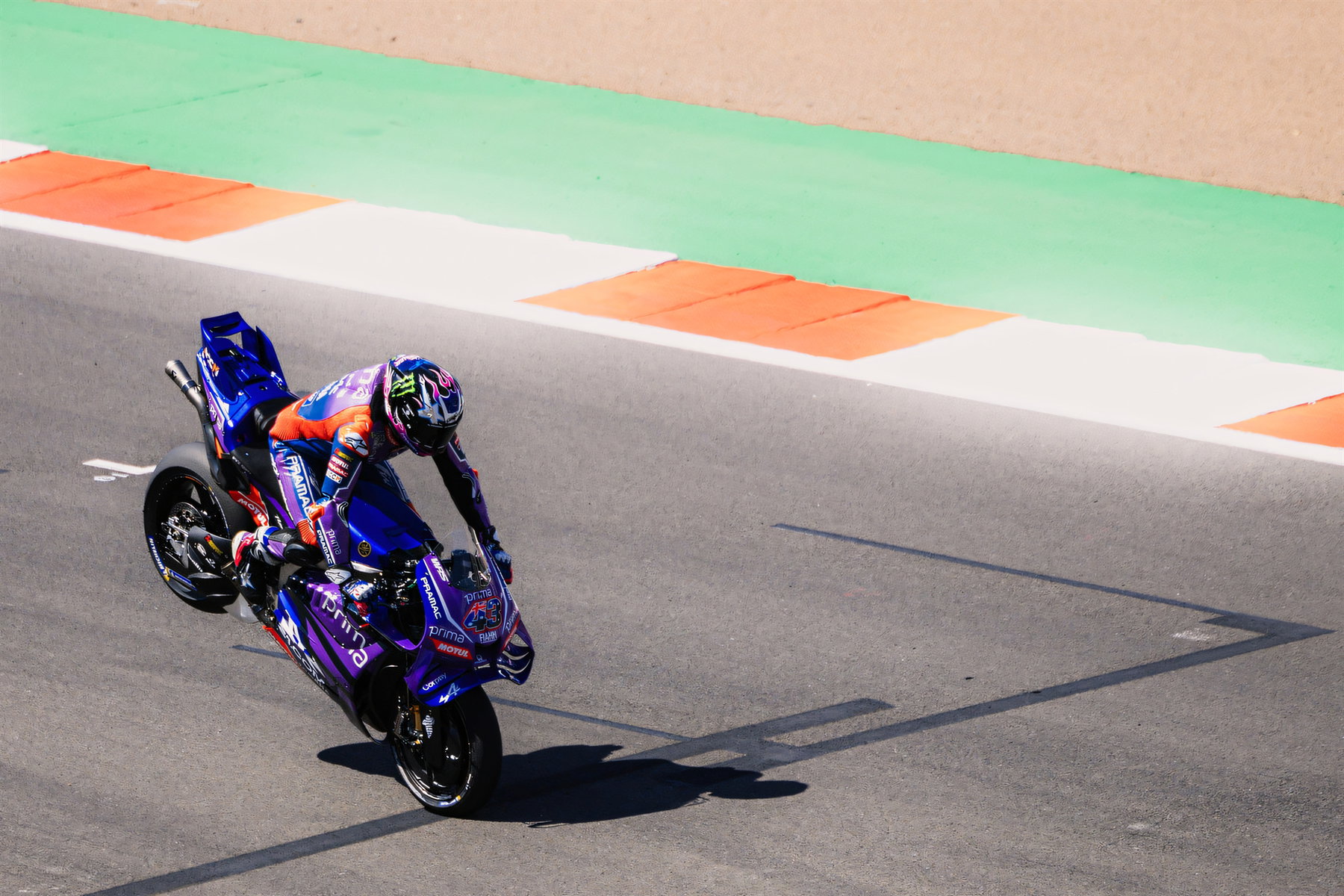
Why did Jorge Martin and Ai Ogura lose so many places at the start?
On both Aprilia riders the rear ride-height device stayed engaged through Turn 1 because they did not brake hard enough. There was no technical defect, and both riders took the blame themselves.
The background is track-specific. Abbey, the first corner at Silverstone, is taken very fast and there is barely any braking. The rear ride-height device lowers the bike to stop it wheelieing under acceleration and only releases again under a firm braking input. That braking input was exactly what was missing. Martin explained: „I wanted to hold on to first place and in doing so I did not brake enough. My rear device could not come back up.” Ogura described it in similar terms: „In doing so I forgot to brake hard enough to release the rear device.” The systems only released under the next hard braking at Turn 3, by which point Fernandez was almost two seconds up the road.
The link to the rule change is notable. The front holeshot devices were banned and removed during the 2026 season after the crash-strewn Catalan Grand Prix. The rear systems remained, because they are now an integral part of a MotoGP bike and cannot be removed without a complete redesign. The ban is already agreed for 2027. As an interim solution it would be conceivable to expressly prohibit their use at the start, since the lowering is clearly visible from the outside. No such decision has been taken so far. In addition, the spacing between riders on the grid has been increased from three to four metres since the German Grand Prix.
Ogura later crashed while running seventh. He named the cause clearly himself: „A bit more angle with the same amount of brake pressure.” It was his first genuine riding error of the season and cost him 20 points to Martin. Without the start problem he reckons he would have been fighting for fifth.
Ducati openly admits the deficit to Aprilia
Clearer than any lap-time comparison was Fabio Di Giannantonio’s assessment. The VR46 rider, sixth at Silverstone, said: „At the moment we are only the second force. Number one is Aprilia.” Aprilia had been operating at this level for around a year, he said, and all four of the brand’s riders were consistently at the front.
Di Giannantonio also described a tyre dilemma that he says has followed him all season. If he looks after the rear tyre, the front suffers, and vice versa. On Sunday the front let go ten to twelve times by his own count; in the sprint it was exactly the other way round. The package is good, he said, but the blanket is too short.
Marc Marquez finished seventh and was therefore only the third-best Ducati rider, behind his brother Alex and Di Giannantonio. He looked for no excuses: „It was down to me.” The world champion pointed to his stamina, which is still lacking after his shoulder injuries, and called it a muscular problem. In the time attack he had been able to ride well again for the first time. His deficit to Martin grew to 40 points, and he does not see himself as the title favourite. He had marked Silverstone in red beforehand; by his own reckoning, three or four circuits now remain on which he has to attack.
Alex Marquez was the best Ducati rider at 4.702 seconds, but was annoyed about the podium he missed. On lap ten he had already passed Bezzecchi, then braked too late and lost two positions. He called the mistake unacceptable. He named his seventh place on the grid as the real handicap. Between Turns 7 and 9 the Aprilia was gaining around one and a half to two tenths per lap, and he never got close enough for an attack before Turn 15.
For Francesco Bagnaia the weekend ended without points. The Italian crashed at the exit of Turn 7 just as he had worked his way up to the group around Brad Binder and Franco Morbidelli. Even after lengthy data analysis he found no explanation: „It was very strange, really. I’d never lost the front like that before, coming out of a corner.” His verdict was brief: „Sono estremamente deluso.” In English: „I am extremely disappointed.” Bagnaia has been complaining about a lack of rear grip since the season opener and rode at Silverstone on painkillers.
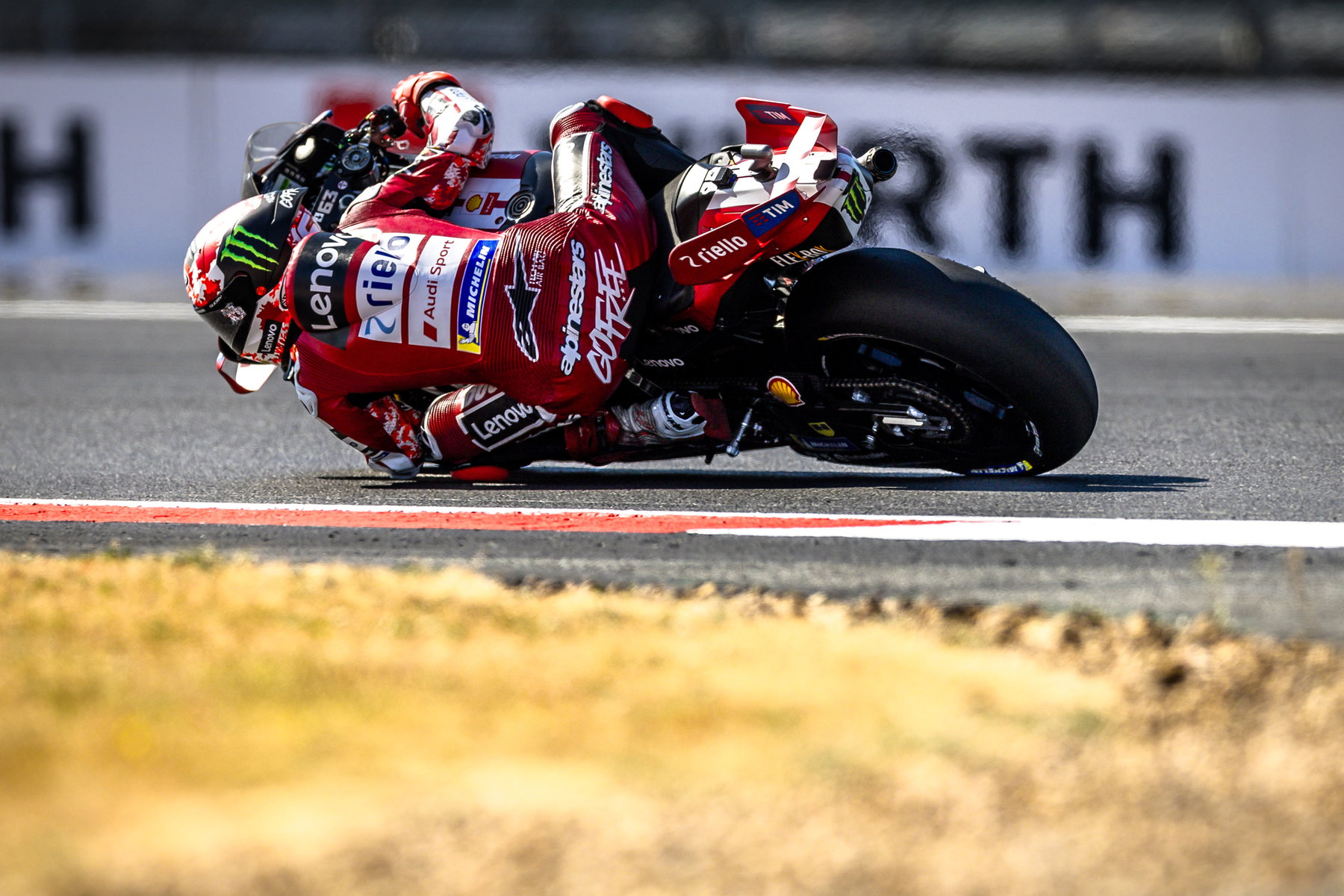
Why did only 16 of 23 riders finish?
The high attrition rate comes down, in the riders’ view, to the combination of track temperature and tyre choice. Every starter ran the hard front tyre and the medium compound at the rear, and the asphalt was hotter than usual.
Pol Espargaro described the mechanism. The front tyre was working at the limit while the rear degraded heavily. Because the medium compound is harder than the soft used the day before, additional support was missing, which made the front push more. All the crashes followed essentially the same pattern, he said. Jack Miller did not want to commit, but felt the track was more slippery on Sunday than before, possibly because of the temperature or the preceding Moto2 race.
With 16 classified riders, Silverstone is level with France, Hungary and the Netherlands at the joint second-lowest figure of the season. Only the German Grand Prix had fewer with 15 finishers. The collision between Joan Mir and Alex Rins on the opening lap went unpunished.
How does the championship continue after Silverstone?
Jorge Martin leads the standings after twelve of 22 weekends with 240 points, his advantage growing from 17 to 31. The season resumes from 28 to 30 August at Aragon.
Behind Martin come Bezzecchi on 209 points, Ogura on 203, Marc Marquez on 200, Di Giannantonio on 199 and Raul Fernandez on 184. In the team standings, Aprilia Racing lead on 449 points ahead of Trackhouse on 387 and the Ducati Lenovo Team on 343. For Aprilia it was the third Grand Prix clean sweep of the season after Le Mans and Assen, as well as the seventh win of the year. That means all four of the brand’s riders have won at least one race this season. Within the 2026 season, Silverstone marks the point at which the balance of power is reflected not just in individual races but in the overall table.
Martin himself was restrained. He had already won a title, he said, and above all wanted to keep working on the bike. Two years ago he had been obsessed with always being at the front, which costs a lot of energy. At the moment he is focusing on being the best possible version of himself.
Frequently asked questions
-
How big was Quartararo’s penalty at Silverstone?
Quartararo’s penalty was 16 seconds, added to his race time after the event. The reason was a technical breach: the onboard receiver did not record the data from the front tyre pressure sensor. That dropped the Frenchman from 12th to 16th and left him without points.
-
Who benefited from the penalty against Quartararo?
Jack Miller moved up to 12th and became the best Yamaha rider. Pol Espargaro inherited 13th place and three points, Toprak Razgatlioglu finished 14th and Augusto Fernandez took the last championship point on offer in 15th.
-
What injury did Marco Bezzecchi have at Silverstone?
Bezzecchi started with a surgically repaired collarbone and a deep knee injury, both from his crash in qualifying on 11 July. The knee was the bigger problem because a small piece of bone was missing and he could not fully bend the leg. Even so, he finished third in both the sprint and the Grand Prix.
-
Why did Jorge Martin drop back at the start?
Martin did not brake hard enough through the fast first corner, so the rear ride-height device stayed engaged and his bike dragged along the asphalt. The same happened to Ai Ogura. There was no technical defect in either case.
-
How do the 2026 MotoGP standings look after Silverstone?
Jorge Martin leads on 240 points ahead of Marco Bezzecchi on 209 and Ai Ogura on 203. Marc Marquez is fourth on 200, his deficit growing from 18 to 40 points. The season resumes at the end of August in Aragon.
➜ This article is part of our comprehensive overview: 2026 MotoGP Season: The Complete Overview – Teams, Riders, Calendar & Championship Standings. Find all key information on this topic in one place.