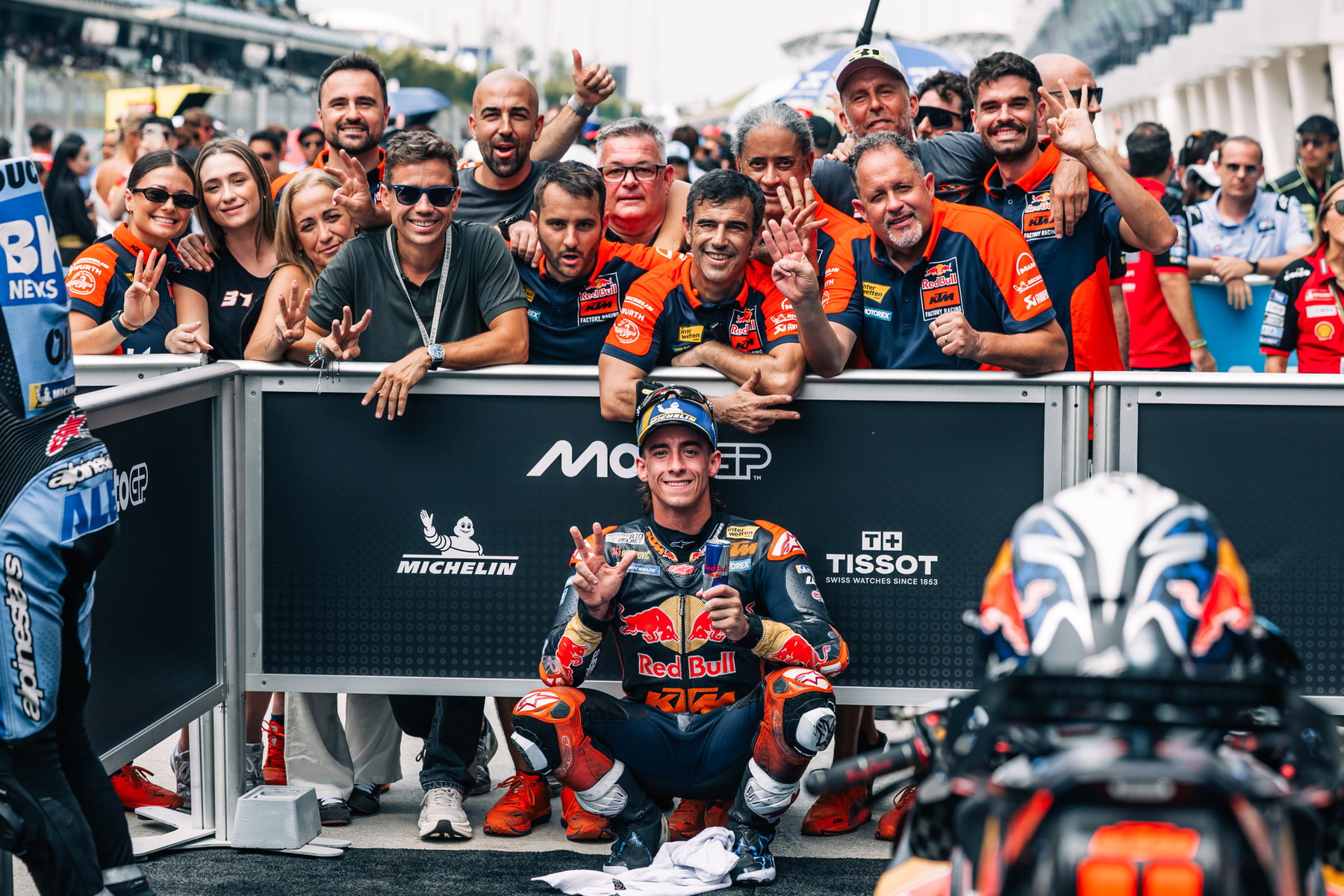
- Acosta wins by 0.578 seconds ahead of Marc Marquez, with Marco Bezzecchi third ahead of Ai Ogura
- Alex Marquez crashes out of the lead on lap three after starting from pole, Jack Miller’s bike swap goes wrong
- Marc Marquez leads the championship with 374 points ahead of Martin on 355 and Bezzecchi on 322
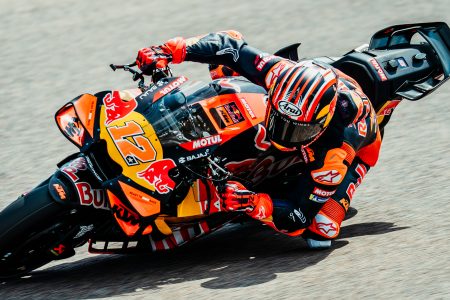
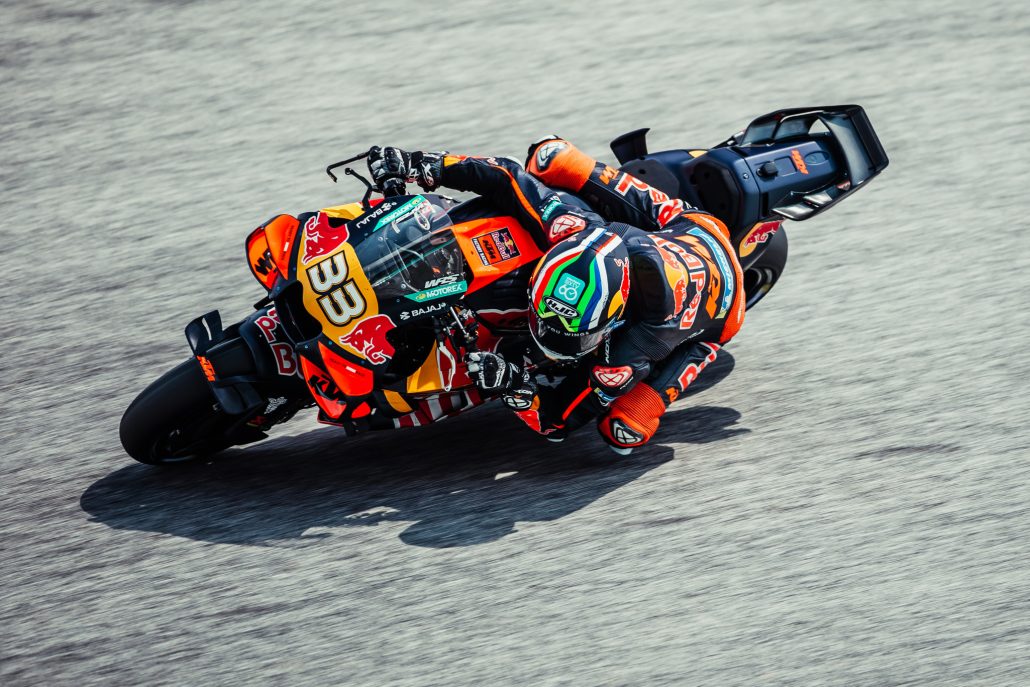
For Marc Marquez, Saturday in Malaysia began with news that pushed the title fight further in his direction. Jorge Martin withdrew after the morning’s free practice, as his broken wrist did not allow him to race. The ten-lap sprint that followed was anything but a quiet routine task, though. As early as lap two, the marshals showed the white flag because light rain was falling in some places. This allowed riders to swap to their wet-weather bike in the pit lane. Anyone who stayed on slicks had to turn into corners over damp patches without knowing how much grip was still there. In the end, Acosta came out on top of this nerve-racking contest on his factory KTM.
How did Pedro Acosta win the Sepang sprint?
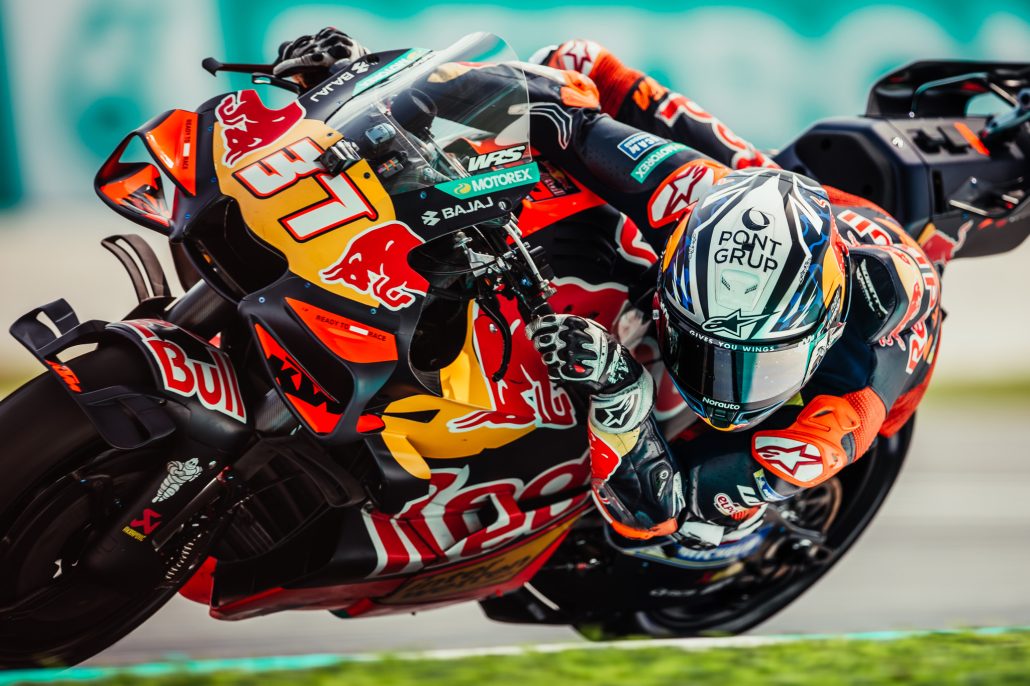
Acosta waited a long time behind race leader Ai Ogura and only struck on lap eight. He then built a small gap and crossed the line 0.578 seconds ahead of Marc Marquez.
The Spaniard had started from third on the grid. He showed early on that he had the pace to win. On lap two he set the fastest lap of the sprint with a 1:58.196, just twelve thousandths of a second quicker than Alex Marquez on the same lap. When the rain started, Acosta still waited patiently behind Ogura. He launched his first attack on lap eight at the Turn 9 hairpin. Ogura struck back at Turn 11, but Acosta got a better exit and took the lead back. This time for good. While Ogura and Marc Marquez fought over second place behind him, he gained a little breathing space. He needed 20:04.098 minutes for the 55.43 kilometres.
It is only the second sprint win of his career. He took the first at the season opener in Buriram, but only after a penalty for Marc Marquez. In Sepang, by contrast, he won the race on track. From 2027, the two will ride together in the Ducati factory team.
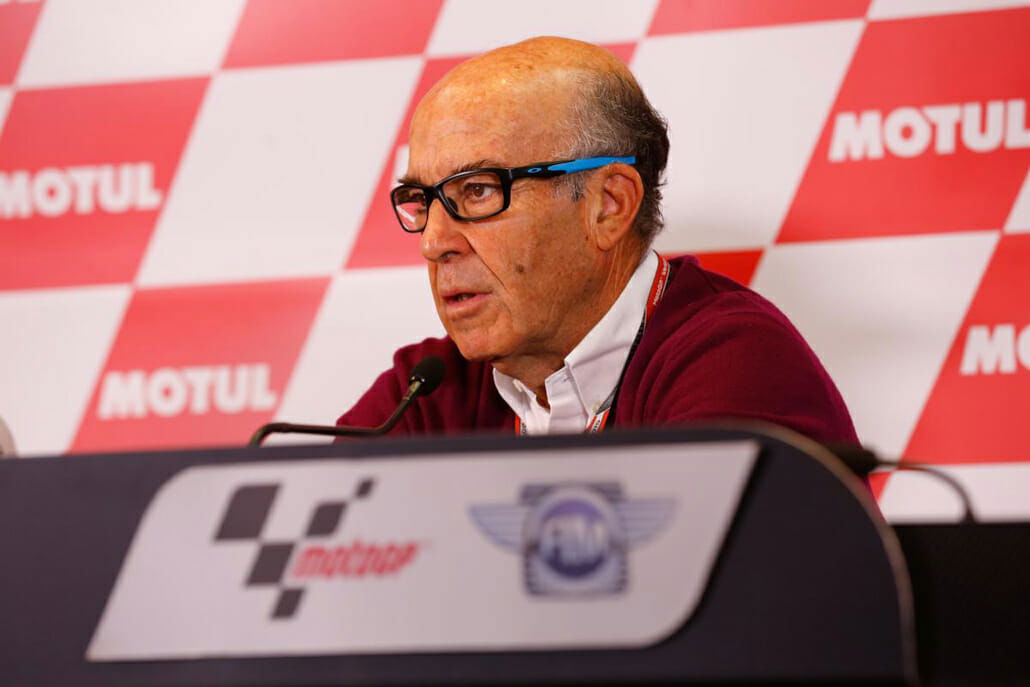
At first, it did not look like an easy weekend for Acosta. His crew chief Paul Trevathan said in a TV interview before the start that Acosta had had no feeling at all for the bike on Friday. The team worked on the setup overnight, and in qualifying it came together. After the race, Trevathan mainly praised his rider’s maturity. Acosta had waited until he was sure he had more pace and then used it. Acosta himself admitted that mixed conditions are not really his strength. But because he had nothing to lose and knew that Marquez behind him had to think about the championship, he gave it a go. He thanked his mechanics, who had worked on the front end of the bike.
Ogura against Marquez: A tough start and an early crash at the front
Alex Marquez had started from pole position. In qualifying he had beaten his brother by 0.070 seconds with a 1:56.493, while Acosta was just 0.084 seconds behind Marc Marquez. On the long run to the first corner, the Gresini rider took the lead.
Behind him, things got tight straight away. Ogura on the Trackhouse Aprilia passed Marc Marquez at Turn 1 from fourth on the grid. The two touched lightly at Turn 2, and Marquez had to pick his bike up. Acosta also used this gap. After a few hundred metres, the championship leader was only fourth.
Alex Marquez extended his lead to a good half a second by the end of lap two. On lap three, he then slid off at Turn 14. He was unhurt, and it was the only crash of the sprint. Whether the rain played a part is unclear. At that stage, the rain flags were mainly shown around Turn 6, on a different part of the track.
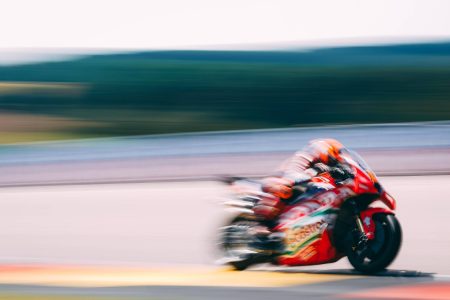
Ogura inherited the lead and held it until lap eight. After that, he lost positions one after the other to Acosta, Marc Marquez and finally, one and a half laps from the end, to Bezzecchi as well. Even so, he finished fourth, 3.260 seconds ahead of the next rider.
Why did Marc Marquez take no risks in the rain?
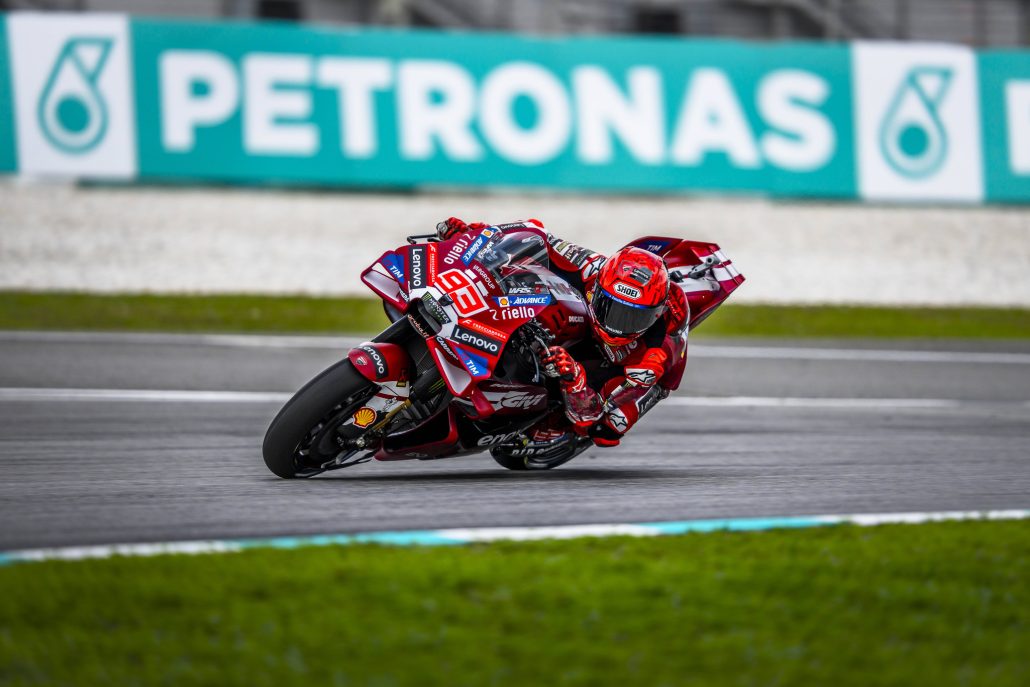
Marquez was riding with the championship in mind. Before the start, Ducati team manager Davide Tardozzi had set the goal of finishing the race and staying ahead of Bezzecchi if possible.
Tardozzi revealed in a TV interview before the sprint that he was keeping his fingers crossed above all for the first corners. In the sprint in particular, they are especially dangerous, he said. That is exactly where Marquez then had his closest moment with Ogura.
Marquez himself explained in a TV interview after the race that it had been a sprint in which it was easy to make a mistake. Riders who are not fighting for the title could take more risks. He had the pace, he said, but deliberately did not want to lead the race. In his experience, whoever is first to ride into a wet patch when rain starts is the most likely to crash.
He still had to fight hard against Ogura for second place. After Marquez had passed him on lap eight, Ogura attacked again at Turn 4 on the following lap. However, he ran too wide on the exit, and Marquez dived back up the inside at Turn 5. He missed out on his 25th sprint win, but took nine points for second place.
Why did the rain gamble not pay off for Miller and co.?
The rain stayed too light all the way to the chequered flag. Anyone who switched to rain tyres was much slower on the largely dry track than the riders on slicks. It only really poured on the cool-down lap.
Jack Miller was the first to react to the white flag and came into the pits on lap two. However, his Pramac team did not have the second bike ready yet. Miller waited in the garage, visibly angry, lost so much time that there was no point in carrying on, and retired.
After lap four, Joan Mir, Iker Lecuona and Franco Morbidelli followed. Mir and Lecuona chose the medium rain tyre at the front and the soft at the rear, while Morbidelli ran the medium compound on both wheels. All three were then several seconds per lap slower. Maverick Viñales switched after lap seven, and his first laps on rain tyres were more than 15 seconds slower than those of the leaders. In the result, the quartet finished 15th to 18th, with Viñales the best of them, 1:42.843 minutes behind. All other finishers ran soft slicks front and rear throughout.
Bezzecchi made the difficult conditions work for him. The Aprilia factory rider described in a TV interview how fierce the battles had been from the very first metres. He then settled into fifth place, knowing that he still had something left for the end. When the rain came, he saw the riders ahead of him getting into trouble and closed in step by step. By his own account, he came too late to attack Marquez, but he was still happy with the podium.
Bagnaia, Binder and Moreira: Who took the remaining points?
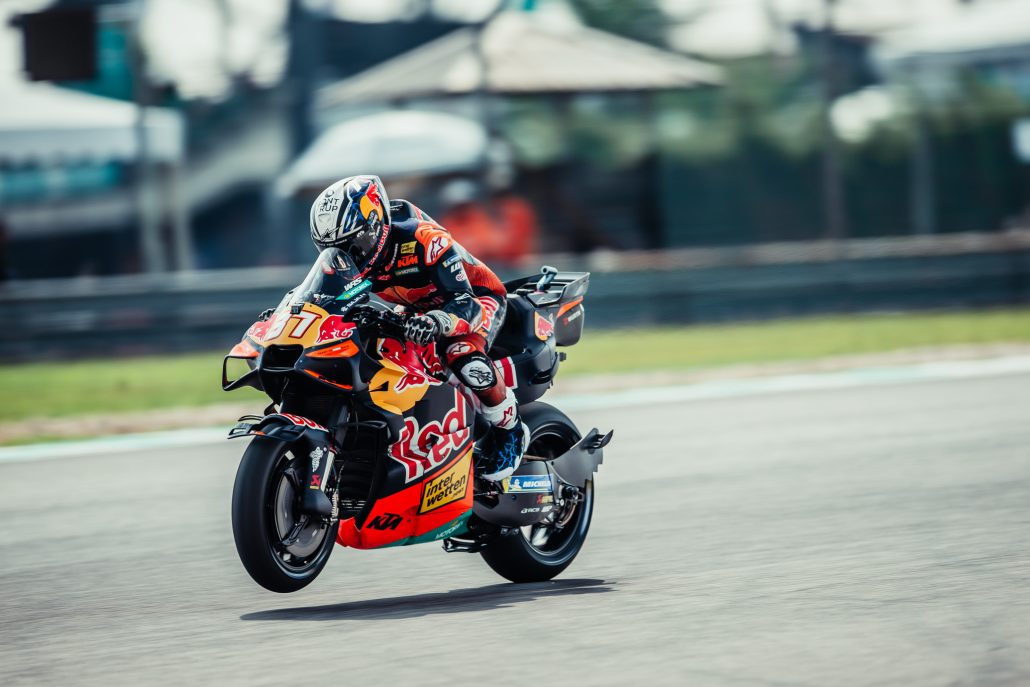
Fabio Di Giannantonio finished fifth on the VR46 Ducati. Pecco Bagnaia got away well from tenth on the grid, but dropped back from the front during the race and finished sixth. Brad Binder gained eight places on the second factory KTM, moving from 15th to seventh. Rookie Diogo Moreira came through from 14th on the grid to finish eighth as the best Honda rider, just 0.100 seconds ahead of Enea Bastianini, who took the last point. Johann Zarco narrowly missed the points in tenth.
It was not an easy afternoon for any rider. With an air temperature of 36 degrees Celsius and a track temperature of 51 degrees, the condition of the circuit also caused problems for many. The surface in Sepang is so worn that riders compare the conditions to a motocross track. According to Trevathan, this asphalt wears not only the rear tyre heavily, but the front tyre as well.
What are the MotoGP standings after the Sepang sprint?
Marc Marquez leads the world championship with 374 points. Jorge Martin follows with 355 points, with Marco Bezzecchi third on 322 points.
Before the sprint, the gap between Marquez and Martin had been ten points, now it is 19. Martin cannot fight back on Sunday. After Saturday morning’s free practice, Aprilia announced that he would sit out the rest of the weekend to continue his recovery. He aims to be back on the bike in Qatar. His fellow Aprilia rider Raul Fernandez is also missing through injury in Malaysia and, with 236 points, no longer has a mathematical chance of the title. Six riders are still theoretically in contention: Marquez, Martin, Bezzecchi, Acosta on 275 points, Ogura on 265 and Di Giannantonio on 257.
The manufacturers’ standings remain close. Aprilia leads with 516 points ahead of Ducati with 512.
In the 2026 MotoGP season, three race weekends remain after Sunday’s Grand Prix in Sepang: Qatar on 8 November, Portimão on 22 November and the finale in Valencia on 29 November. Because Martin is absent, Marquez extends his lead with every point he scores on Sunday.
Frequently asked questions
-
Who won the MotoGP sprint in Sepang?
Pedro Acosta won the MotoGP sprint in Sepang on the factory KTM. He finished 0.578 seconds ahead of Marc Marquez, with Marco Bezzecchi third. It was the second sprint win of Acosta’s career.
-
Why did Alex Marquez retire from the Sepang sprint?
Alex Marquez crashed at Turn 14 on lap three while leading the race. He had started from pole position and was unhurt in the crash.
-
Why did Jack Miller retire in Sepang?
Jack Miller came into the pits on lap two to switch to his wet-weather bike. However, his team had not yet prepared the second bike. Because he lost too much time as a result, he retired.
-
How big is Marc Marquez’s lead after the Sepang sprint?
After the sprint, Marc Marquez is 19 points ahead of Jorge Martin with 374 points. Martin has withdrawn from the rest of the weekend in Malaysia and cannot score any points on Sunday.