- ROADPOL Operation Two-Wheelers runs from 1 to 7 June 2026 in over 30 countries
- Four control areas: vehicle condition, protective equipment, visibility and riding behaviour
- The 2025 pilot phase already delivered concrete results from German police authorities
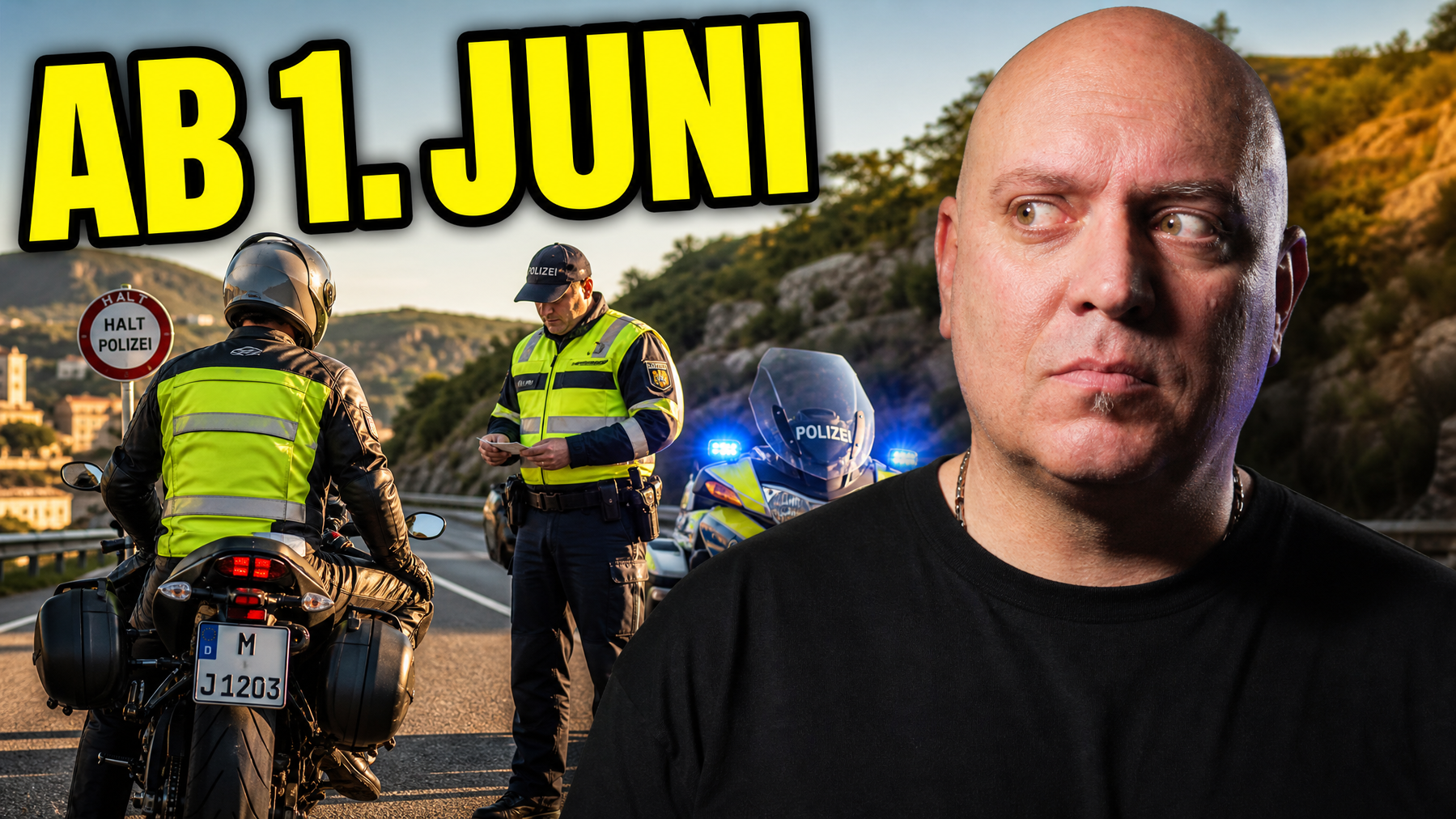
The European traffic police network ROADPOL has announced a coordinated control week for the first week of June 2026, targeting exclusively two-wheeled road users. Under the name “Operation Two-Wheelers”, police forces from member countries will check the technical condition of two-wheeled vehicles, riders’ protective equipment, their visibility in traffic and general riding behaviour for seven days. The operation is part of the official ROADPOL operations calendar 2026 and differs significantly from the familiar Speedweeks in April and August, which focus on speeding offences.
What Is the ROADPOL Operation Two-Wheelers?
Operation Two-Wheelers is a Europe-wide action week in which traffic police specifically target two-wheeled vehicles. It covers riders of motorcycles, mopeds, bicycles, pedelecs and e-scooters alike. ROADPOL, the European Roads Policing Network, coordinates the operation. The network unites traffic police authorities from over 30 European countries and organises several simultaneous control operations each year, including the Speed Marathon, focus weeks on alcohol and drugs, and truck-and-bus operations.
Unlike the Speed Marathon, where radar traps are the primary tool, ROADPOL defines four central control areas for the Two-Wheelers operation. The technical condition of the vehicle is checked — brakes, lighting, tyres and general roadworthiness. Riders’ protective equipment is also a focus: helmet, protectors, gloves and protective clothing, where required by law. In Germany, Austria and Switzerland, only a suitable protective helmet is legally required for motorcyclists. Additional protective clothing such as protectors, gloves or motorcycle boots is strongly recommended but not mandatory in any of the three countries. Additionally, officers check visibility in traffic — reflective elements, correct headlight settings and positioning in the traffic flow. The fourth area concerns riding behaviour — compliance with traffic rules, adapted speed and risky manoeuvres.
Why Are There Week-Long Two-Wheeler Controls for the First Time in 2026?
Operation Two-Wheelers launched in 2025 as a three-day pilot initiative from 21 to 23 May. According to ROADPOL, it was the first Europe-wide control measure focused exclusively on the safe use of all two-wheeled vehicles. The organisation announced as early as January 2025 that it would evaluate the results and feedback from participating officers and expand the operation for 2026 if the outcome was positive. The feedback was apparently positive, as the 2026 operations plan expanded the action from three days to a full week and included it as a permanent fixture in the annual calendar.
ROADPOL justifies its focus on two-wheelers with their growing importance as a means of transport and the simultaneously heightened accident risk for these road users. Two-wheeler riders are considered particularly vulnerable in road traffic. The topic of two-wheeler safety also played a role at ROADPOL beyond the operation itself: the ROADPOL Safety Days in September 2025 also chose two-wheelers as their focus.
What Happened During the 2025 Pilot Operation in Germany?
Several German police authorities participated in the three-day pilot phase from 21 to 23 May 2025 and subsequently published detailed reports. The results show how broadly the controls were designed and which priorities emerged in practice.
Saxony: 1,641 Two-Wheelers Checked
The Saxon police checked a total of 1,641 two-wheeled vehicles during the three control days. Of these, 542 were scooters, with 46 per cent being e-scooters. 775 bicycles were checked, of which 22 per cent were classified as e-bikes or pedelecs. 324 motorised two-wheelers were also on the control list. Officers identified errors in passenger transport in 14 cases and incorrect use of road sections in 75 cases. 24 riders were under the influence of alcohol or other drugs. The Saxon police cited rising accident figures as justification for the controls: the number of injured motorised two-wheeler users had risen by 19 per cent in 2024, and the number of injured cyclists by 2.1 per cent.
Rhineland-Palatinate: 614 Vehicles and 164 Offences
The Rheinpfalz Police Headquarters checked 614 vehicles in the same period. Of these, 56 were motorised two-wheelers, 333 bicycles including e-bikes and pedelecs, and 225 scooters. Officers identified a total of 164 offences. The headquarters supported the measure with concrete accident statistics: the number of motorised two-wheeler riders involved in traffic accidents in the headquarters’ area had risen by 13.3 per cent to 613 in 2024, compared with 541 the previous year. Five people were killed — two fewer than in 2023. Seriously injured numbered 111 (2023: 93), slightly injured 269 (2023: 263). E-scooter accident figures also rose significantly: from just 34 accidents involving e-scooters in 2020 to 141 in 2024, an increase of 17.5 per cent compared with the previous year alone.
Euskirchen: Dialogue and Prevention on Winding Roads
The Euskirchen district police authority conducted a special operation on 22 May 2025, checking 148 people and 140 motorised two-wheelers. The Euskirchen district is popular among motorcyclists for its scenic but winding routes. Alongside the standard checks, the police focused on prevention: for the first time, an airbag vest was demonstrated. At an information stand on the B265 federal road near Schleiden-Wolfgarten, a senior police officer demonstrated the function and benefits of this protective clothing in the event of a crash. Dialogue with motorcyclists and raising awareness for safe riding behaviour were central elements of the operation, according to the police report.
Rhein-Sieg District: Focus on Accident Hotspots
In the Rhein-Sieg district, targeted controls took place at accident-prone locations on 22 May. Around 20 officers from the Traffic Directorate conducted checks including at the “Schladernring” on the B256 federal road. In total, police recorded 100 traffic offences, of which approximately ten per cent involved two-wheeler riders. The majority of offences were committed by car and lorry drivers. On the B256, a laser speed gun caught a motorist doing over 110 km/h in a 70 km/h zone. A 7.5-tonne lorry was taken off the road because the tyres were not only below the minimum tread depth but the tread was already separating.
Hamburg: Modified Pedelec Reaching 45 km/h
Hamburg police participated on 22 May with checks across the entire city. Under the direction of the Traffic Directorate East, three bicycle squads checked a total of 52 people and 76 vehicles. A particular case attracted attention on Hermannstal street: a 35-year-old pedelec rider was checked, and signs of modification to his pedelec were found. The vehicle could apparently reach a speed of 45 km/h without the rider pedalling or operating the throttle. Since the pedelec therefore effectively qualified as a motor vehicle, investigations were initiated for suspected driving without a licence and violation of the compulsory insurance law.
How Does the Two-Wheelers Operation Fit Into the 2026 ROADPOL Calendar?
Operation Two-Wheelers is part of a comprehensive annual programme that ROADPOL published in October 2025. Several action periods in the overall calendar are relevant for motorcyclists. The calendar includes the following focus weeks for 2026: two Speedweeks with speed checks, the first of which ran from 13 to 19 April with a 24-hour speed marathon on 15 April and has already taken place. The second Speedweek follows from 3 to 9 August. Additionally, there are two alcohol and drug control weeks from 15 to 21 June and from 14 to 20 December, a seatbelt check from 9 to 15 March, three lorry and bus control weeks, Operation “Focus on the Road” against distraction from 5 to 11 October, and the ROADPOL Safety Days from 16 to 22 September.
For motorcyclists, this creates a particularly dense control period at the beginning of June.
What Does the Control Week Mean in Practice for Motorcyclists?
Anyone riding a motorcycle during the week of 1 to 7 June 2026 should expect targeted checks across Europe. The experiences from the 2025 pilot phase show that police authorities set different priorities. In rural regions with popular motorcycle routes, such as the Euskirchen district or at the Schladernring in the Rhein-Sieg district, controls were positioned directly at known accident hotspots. In major cities like Hamburg, the focus was more on e-scooters and pedelecs.
Checks are likely to cover not only speed but especially the technical condition of the machine: brakes, tyres, lighting and overall roadworthiness. Protective equipment will also be checked, although there is no general protective clothing requirement in Germany — the police focus on prevention and education instead. In the Rhineland-Palatinate, for example, the rising accident figures for motorised two-wheelers fed directly into the justification for the control measures.
In the United Kingdom too, the NPCC (National Police Chiefs’ Council) is expanding motorcycle checks in 2026: their “2Wheel Operation” runs for two full weeks, from 1 to 14 June, extending beyond the ROADPOL period. As early as March 2026, a separate “Engagement Operation for Motorcyclists” was planned there, targeting leisure riders returning to their machines after the winter break.
What Does the ADAC Say About the Control Weeks?
The ADAC (German automobile club) views the ROADPOL action weeks as fundamentally positive. The checks contribute to road safety by making road users aware of the dangers of speeding and raising awareness accordingly. This effect is created by the intensive media coverage and therefore affects not only those who are actually checked but a significantly larger group of people. However, a single campaign cannot permanently eliminate all risks in road traffic.
Ulrich Chiellino, traffic psychologist and head of ADAC traffic policy, emphasised the importance of setting an example in road traffic: “Speed must be adapted to the environment. In this sense, a speed limit should be understood as a limit, not a recommendation. Every road user should continually question their behaviour and change it if necessary. We are all called upon to show more consideration.”
Frequently Asked Questions
-
When does the ROADPOL Operation Two-Wheelers 2026 take place?
The ROADPOL Operation Two-Wheelers 2026 runs from 1 to 7 June 2026. Police authorities from over 30 European countries participate in the coordinated control week targeting all two-wheeler riders.
-
What is checked during Operation Two-Wheelers?
Police check four areas: the technical condition of the vehicle (brakes, tyres, lighting), protective equipment (helmet, protectors, gloves), visibility in traffic and general riding behaviour. It is not just about speed but a comprehensive inspection.
-
What experiences were there from the 2025 pilot operation?
The three-day pilot phase took place from 21 to 23 May 2025. In Saxony alone, 1,641 two-wheelers were checked; in the Rhineland-Palatinate, 614 vehicles with 164 offences identified. The positive experiences led ROADPOL to extend the operation to a full week in 2026.
-
Does Operation Two-Wheelers only affect motorcycles?
No, the checks target all two-wheeler riders. In addition to motorcycles and mopeds, bicycles, pedelecs and e-scooters are also checked. During the 2025 pilot operation, a significant proportion of checks involved scooters and bicycles.
-
Are higher fines imposed during the control week?
The regular fines and penalties for traffic offences apply. Operation Two-Wheelers does not introduce special fines but increases the density of checks. Anyone riding with technical defects, insufficient protective equipment or under the influence of alcohol or drugs must expect the usual consequences.