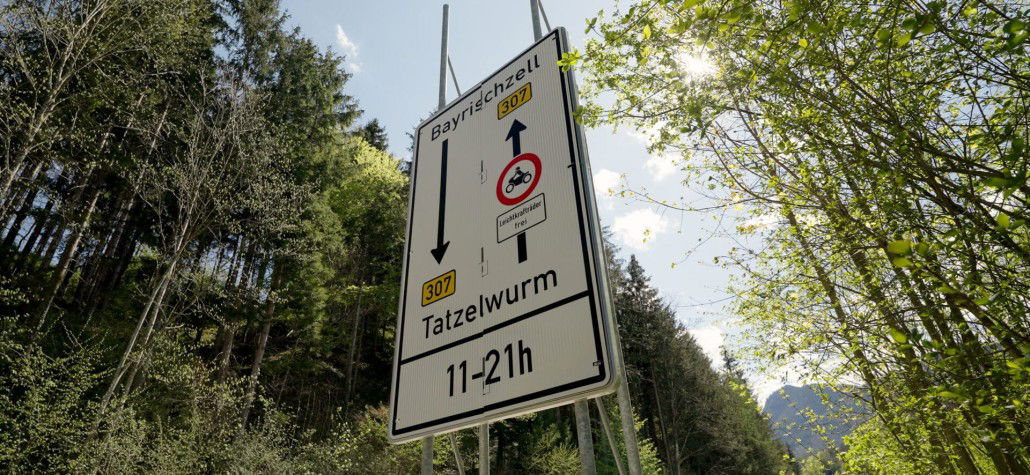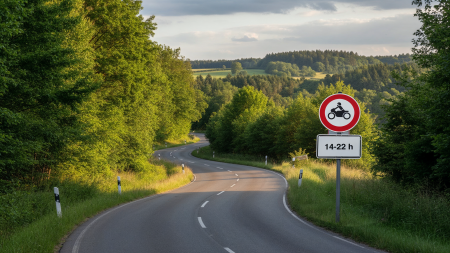
- Resolution No. 495/2026 of June 19, 2026, applicable on state and provincial roads under provincial jurisdiction
- Around 100 road sections individually listed in Annex A are affected, as well as areas above 1,600 meters in altitude generally; individual and vacation traffic remains permitted
- Violations carry a fine of 144 to 1,410 euros (about 165 to 1,614 US dollars) under provincial law 13/1992, in some cases up to five times that amount
- Under the official interpretation, tours run by travel operators, riding school and safety courses, and spontaneous rides by smaller groups are among the cases not covered
That South Tyrol is restricting organized rides on its mountain pass roads has been known since the provincial government’s resolution of June 19, 2026. At first, however, it remained unclear exactly where the rule applies and what a violation costs. The key documents are now available: the resolution with the full list of routes in Annex A, an official map, and a Q&A section from the province. This makes it possible, for the first time, to say in detail which roads are affected, when a ride counts as organized, and what consequences riders face. This article breaks down the new rules and lists all affected sections at the end.
What exactly did South Tyrol decide?
The provincial government’s Resolution No. 495/2026 bans organized motorsport events on certain state and provincial roads that fall under the province’s jurisdiction. Affected are roads in protected areas as well as areas generally above 1,600 meters in altitude.
The resolution was passed on June 19, 2026, and has applied since then. According to the provincial announcement, the province is implementing a concrete measure from the South Tyrol 2030 sustainability strategy and the South Tyrol 2040 climate plan. The legal basis for the altitude limit comes from the provincial law on spatial planning and landscape (No. 9/2018), under which areas above 1,600 meters are subject to enhanced protection. According to the province, individual traffic is explicitly not restricted. What’s new — and decisive in practice — is that Annex A to the resolution now provides a named list of the affected road sections, which had previously been missing. The resolution also applies to approval procedures that had not yet been concluded at the time it took effect, provided they concern the areas named in Annex A.
What is allowed on the routes, and what is banned?
Organized motorsport events are banned; private solo rides remain allowed. The line is drawn not between vehicle types, but between an organized event and an ordinary ride.
The ban is broader than the term motorsport might initially suggest. It covers two forms. The first is the competition-oriented event — anything involving scoring, timing, or rankings, from hill climbs to rallies. According to the resolution, this explicitly includes regularity rallies, where the goal isn’t top speed but hitting exact times. The second form is the organized ride without any competitive element — the club ride or the association outing. It doesn’t matter for the ban whether money is made from the ride; what matters alone is the organizational framework. One clarification the province only added at the end of July is important here: tours offered by travel operators, or rides taking place as part of an organized trip for which no permit or notification obligation toward the authority exists, are explicitly not covered by the ban. The volunteer-run association outing is therefore worse off than the commercial tour offering.
Every type of vehicle is covered. The resolution explicitly names motorcycles, mopeds, cars, and agricultural machinery, including vintage vehicles and vehicles of historic interest, regardless of drivetrain. An electric motorcycle therefore falls under the same rule as a combustion-engine machine. What remains allowed, by contrast, is a genuine private ride: alone, on vacation, or as a spontaneous outing with friends without a fixed plan. The same ride only becomes a banned event once it is fully organized.
When does a ride count as organized?
A ride counts as organized if it is planned in advance, advertised, coordinated, or carried out by a group following a fixed schedule with a shared route. The resolution does not sharply define the term organized event, which means it comes down to recognizable indicators.
Such indicators include an invitation or advertisement online, a fixed meeting point, a predetermined route, a timetable, registration, or terms of participation. Even a meeting point arranged in advance can point in this direction. So it doesn’t take a large organizer for a ride to move into the critical zone. In practice, however, the question remains whether and how organization can be proven. A spontaneous ride with no public trace is credibly individual traffic. The more visible signs of organization there are — such as a public announcement, unified registration, or an organizer behind the scenes — the more likely it is that a covered event exists. The provincial government is also inviting mayors to apply the ban to those approvals that fall under their own jurisdiction, so that the rule takes effect uniformly across the province.
Who is the ban not aimed at?
At the end of July 2026, the province expanded the Q&A section on the resolution with a list of exemptions. In response to an enquiry from motorcycles.news, the Office for Supervision and Advice of the Autonomous Province of Bolzano referred to it on July 29, 2026, and stated explicitly: “Travel agencies are not affected by this rule.”
Under the official interpretation, the ban does not apply in these cases:
- Individual traffic
- Rides by smaller groups without the character of an event, in particular spontaneous and informal gatherings
- Tours run by travel operators, as well as rides as part of an organized trip for which no permit or notification obligation toward the authority exists
- Rides as part of riding school or safety courses
- Transit rides to race circuits in Italy
- Rides for the production of commercials, as well as test rides for trade magazines, television programs, or comparable media formats
That shifts the picture considerably compared with the first weeks after the resolution: the commercial tour operator may carry on, the motorcycle club may not. One question the office did not answer on enquiry, however, is who is liable in the event of a violation — the organizer or the individual participants.
What penalties are at risk for a violation?
The actual violation consists of carrying out a motorsport event without the required permit. The underlying provincial law on public events, from 1992, sets a fine of 144 to 1,410 euros (about 165 to 1,614 US dollars) for this, which can rise up to five times that amount in certain cases.
It’s important to note the distinction: motorsport events are not banned for all time. Anyone wanting to hold such an event must apply for and obtain a permit. On the closed routes and above 1,600 meters, however, such a permit is unlikely to be granted going forward. The fivefold increase provided for in the law, which can theoretically reach up to 7,050 euros (about 8,070 US dollars), targets primarily serious, illegally conducted events. For a smaller organized tour, the base fine range is the realistic expectation. The provincial announcement itself only states that an administrative penalty will be imposed for non-compliance, without specifying an amount; the concrete figures come from provincial law 13/1992 in its current form.
How does an inspection work?
An inspection doesn’t necessarily lead to an on-the-spot fine. If law enforcement officers find something to object to, they first draw up a report, which goes to the responsible authority.
Only afterward is it reviewed whether a violation actually occurred, and only then does a possible penalty follow. So a notice can reach those involved later by mail. For the road, this means: anyone riding spontaneously in a pair or a trio realistically has little to worry about. In an inspection, though, the circumstances matter. Anyone who states that it’s a registered, fully planned club tour is providing the hallmark of organization themselves. In larger groups, this impression is hard to dispel, which is why increased enforcement is to be expected, with larger groups being the first to be pulled over.
Why is South Tyrol banning organized motorsport events?
The province justifies the ban with nature and climate protection as well as safety on the heavily traveled passes. According to the provincial government, organized motorsport events run counter to the goals of the sustainability strategy and the climate plan, because they cause additional noise, additional emissions, and additional traffic.
There is also the protection of the Dolomites UNESCO World Heritage Site, explicitly named in the resolution. Legally, the province relies, among other things, on the road traffic code, which allows the road owner to impose restrictions on roads running through UNESCO World Heritage sites. Provincial Governor Arno Kompatscher acknowledges at the same time that the rule alone isn’t enough: “We are aware that this rule alone does not solve the challenges on the pass roads. The high traffic volume and the widespread speeding there require additional, targeted measures, which we are already working on.” Further steps have thus been announced. The resolution fits into a trend observed in several Alpine regions and can be read as part of the ongoing dispute over traffic, noise, and resident protection in the Alps.
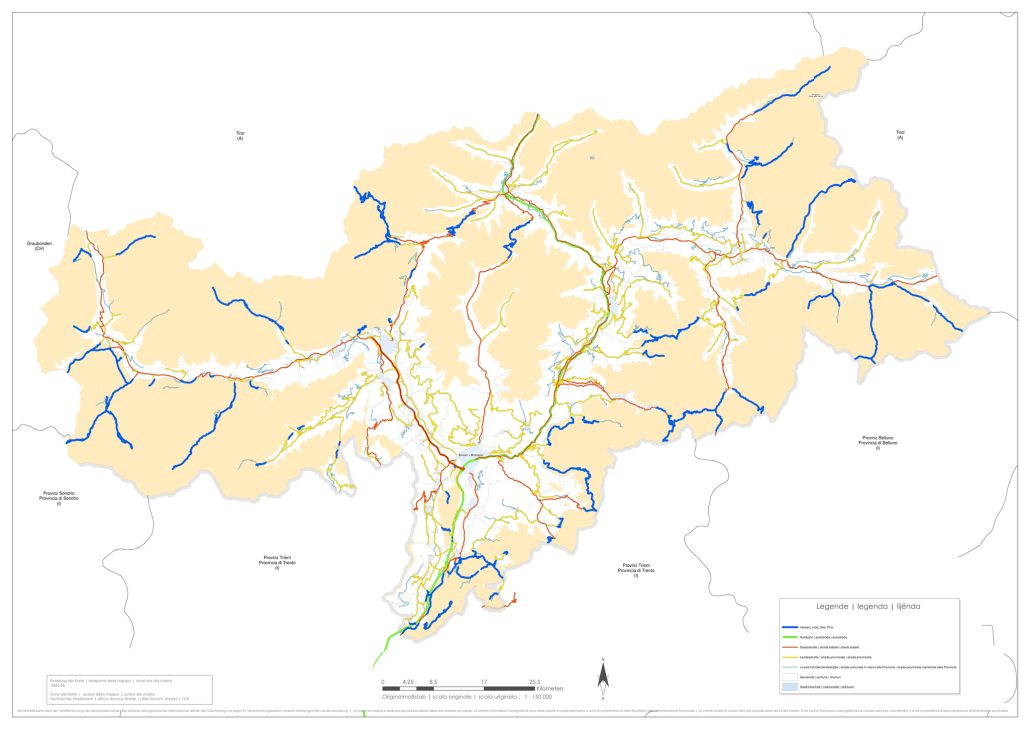
How should the official map be read?
The official map is easy to misread, because the colors of the roads say nothing about the ban. Only the thick blue line laid over the road network is affected.
Green, red, and yellow on the map only indicate the road type: green is the motorway, red is the state road, and yellow is the provincial road. Only where the blue line runs does the ban on organized events apply. That explains why a road shown entirely in red, like the Val Pusteria state road, is actually only covered on a short stretch marked in blue. For orientation, then: what matters is not the colors of the road types, but solely the blue marking and the kilometer-precise details in Annex A.
How are associations, organizers, and the Alpine Club reacting?
Reactions are mixed. While the motorcycle association, tour organizers, and the vintage vehicle scene sharply criticize the ban, the South Tyrol Alpine Club welcomes the measure and is calling for further steps.
The Italian motorcycle association FMI considers the resolution an unjustified restriction on freedom of movement. President Giovanni Copioli said: “Rimango stupito e perplesso da questa delibera.” In English: “I am surprised and puzzled by this resolution.” He points to the economic value of motorcycle tourism and says he has been in contact with the automobile club ACI and with political forces to have the decision corrected through institutional channels. Tour operators report that guided rides make up 30 to 40 percent of their revenue during the summer season, and argue that their offerings are not sporting events with regulations and timing, but guided rides conducted under road traffic rules. The vintage vehicle scene is also pushing back: the Veteran Club Bolzano, together with the umbrella organization ASI, has announced legal action and points out that it concerns only a few events per year at very low speeds. The South Tyrol Alpine Club, by contrast, views the resolution as an overdue first step and is pressing for consistent enforcement. So far there has been no court ruling against the ban. As a further signal, it is already set that the Gardena Pass will be completely closed to motorized traffic from September 1, 2026 to January 31, 2027 as a trial period.
Which routes are specifically affected?
Affected are the sections listed by name and precise kilometer marker in Annex A of the resolution, on state roads (SS) and provincial roads (LS/SP). The overview below organizes all sections by region and valley; the kilometer figures are given in the official notation of road-kilometer plus meters (for example, 124+400 means kilometer 124 plus 400 meters).
Stilfserjoch, Vinschgau and Side Valleys
- Stilfserjoch state road (SS.38): from km 124+400 to 150+250; from km 159+000 to 162+280; from km 166+090 to 166+750
- Sulden (SS.622): from km 000+000 to 011+630
- Münstertal (SS.41): from km 002+620 to 012+030
- Stilfs (LS/SP.6): from km 000+000 to 002+450
- Praemajur (LS/SP.34): from km 000+000 to 001+370
- Prad – Glurns (LS/SP.50): from km 000+000 to 006+820
- Langtaufers (LS/SP.49): from km 002+440 to 010+200
- Schlinig (LS/SP.22): from km 005+580 to 008+300
- Tschengls (LS/SP.108): from km 000+880 to 002+300
- Schluderns – Lichtenberg (LS/SP.106): from km 001+470 to 002+500
- Laatsch (LS/SP.104): from km 001+380 to 003+350
- Rojental (LS/SP.102): from km 002+640 to 008+131
- Tarsch (LS/SP.110): from km 000+180 to 002+230
- Martelltal (LS/SP.2): from km 000+500 to 022+760
- Schnalstal (LS/SP.3): from km 004+200 to 004+800; from km 007+100 to 023+800
- Katharinaberg (LS/SP.53): from km 000+000 to 001+310
- Karthaus (LS/SP.1): from km 000+000 to 000+750
- Gand – Tal (LS/SP.78): from km 000+000 to 001+620
Passeiertal: Timmelsjoch and Jaufenpass
- Timmelsjoch (SS.44Bis): from km 005+430 to 005+770; from km 006+730 to 014+166; from km 014+199 to 029+540
- Jaufenpass (SS.44): from km 013+910 to 015+680; from km 033+460 to 046+770
- Pfelders (LS/SP.114): from km 000+000 to 011+230
- Stuls (LS/SP.113): from km 000+000 to 000+530
- Rabenstein (LS/SP.112): from km 000+000 to 004+180
Burggrafenamt and Merano Area
- Vellau (LS/SP.119): from km 000+340 to 004+190
- Kuens (LS/SP.118): from km 001+440 to 002+380
- St. Moritz (LS/SP.122): from km 004+160 to 005+350
- Larchenberg (LS/SP.120): from km 005+050 to 006+500
- Breiteben (LS/SP.115): from km 005+610 to 006+590
- Falzeben (LS/SP.167): from km 004+030 to 004+870
Sarntal and Pfitscherjoch
- Sarntaler and Pfitscherjoch road (SS.508): from km 042+480 to 057+180
- Ruhmwald (LS/SP.107): from km 000+240 to 003+000
Eisacktal, Schlern and Eggental
- Eggental and Karerpass (SS.241): from km 023+640 to 026+140
- Dolomites road (SS.48): from km 003+230 to 016+410
- Dolomites road (SS.48Bis): from km 007+770 to 008+800
- Lavazejoch (SS.620): from km 009+020 to 011+570
- Obereggen (LS/SP.76): from km 003+960 to 006+850
- Aldein – Deutschnofen (LS/SP.72): from km 000+000 to 001+520
- Tiers (LS/SP.65): from km 008+130 to 029+670
- Seiser Alm (LS/SP.25): from km 003+170 to 009+130
- Blumau – Waidbruck (LS/SP.24): from km 005+570 to 007+270; from km 007+780 to 015+040
South Tyrolean Lowlands and Überetsch
- S. Lugano – Altrei (LS/SP.79): from km 000+000 to 000+030; from km 004+680 to 006+670
- Montan – Truden im Naturpark (LS/SP.59): from km 001+050 to 006+720; from km 008+500 to 010+375
- Montiggl (LS/SP.55): from km 001+690 to 003+920
- Aichholz (LS/SP.21): from km 000+410 to 000+540; from km 000+680 to 001+590
- Margreid (LS/SP.20): from km 000+000 to 001+380
- Montan (LS/SP.17): from km 000+180 to 001+550; from km 001+780 to 002+850
- Kurtatsch Handwerkerzone (LS/SP.166): from km 001+820 to 002+520
- Klughammer (LS/SP.162): from km 002+530 to 004+630
- Radein (LS/SP.130): from km 000+000 to 001+590; from km 006+080 to 007+330
- Salurn – Buchholz (LS/SP.129): from km 002+140 to 012+690
Gröden: Grödner Joch and Sellajoch
- Grödnerjoch (SS.243): from km 000+000 to 013+440; from km 013+930 to 015+160
- Grödental und Sellajoch (SS.242): from km 019+500 to 021+170; from km 022+210 to 030+880
Gadertal and Würzjoch
- Gadertal (SS.244): from km 029+240 to 033+090; from km 033+970 to 038+130
- Furkelpass (LS/SP.43): from km 007+130 to 013+500; from km 019+360 to 019+860
- St. Kassian (LS/SP.37): from km 001+110 to 010+280
- Afers – St. Martin in Thurn (LS/SP.29): from km 013+830 to 017+450; from km 018+380 to 033+110
- St. Peter – Würzjoch (LS/SP.163): from km 005+120 to 008+660
- Villnöss (LS/SP.27): from km 012+360 to 017+150
Pustertal, Tauferer Ahrntal, Antholz and Pragser Tal
- Ahrntal (SS.621): from km 017+460 to 019+060; from km 026+910 to 039+250; from km 039+650 to 043+010
- Pustertal state road (SS.49): from km 058+720 to 063+120
- Uttenheim – Tesselberg (LS/SP.81): from km 001+000 to 011+460
- Altprags (LS/SP.80): from km 000+000 to 002+490
- Rein (LS/SP.48): from km 000+680 to 002+920; from km 003+480 to 014+030
- Prags (LS/SP.47): from km 002+070 to 008+260
- Antholz (LS/SP.44): from km 000+720 to 023+190
- Ahornach (LS/SP.155): from km 000+000 to 002+081; from km 002+590 to 003+410; from km 004+190 to 005+840
- Weißenbach (LS/SP.154): from km 000+000 to 000+080
- Oberwielenbach (LS/SP.148): from km 003+190 to 004+070
Alta Pusteria Toward Cortina and Sexten
- Alemagna road (SS.51): from km 118+150 to 134+290
- Carnica road (SS.52): from km 110+090 to 114+531; from km 114+920 to 124+160; from km 125+130 to 126+090
Wipptal: Brenner Road
- Brenner state road (SS.12): from km 401+320 to 404+900; from km 407+100 to 414+710
Ultental
- Ultental (LS/SP.9): from km 030+550 to 032+150
- Ultental – Proveis (LS/SP.88): from km 007+490 to 008+020; from km 008+990 to 010+280
Additionally, the ban applies generally to areas above 1,600 meters in altitude, even where the road in question is not explicitly listed in Annex A. The resolution also provides that the ban can be extended to further roads or sections during the approval process if a road’s characteristics appear unsuitable or there are concerns regarding traffic safety and local traffic.
Frequently Asked Questions
-
Which routes are affected by the South Tyrol motorsport ban?
Around 100 sections individually listed in Annex A of the resolution are affected, on state and provincial roads, including the Stelvio Pass, Timmelsjoch, Jaufen Pass, Gardena Pass, Sella Pass, and Karer Pass, as well as numerous smaller provincial roads. The ban also applies generally to areas above 1,600 meters in altitude.
-
Are private rides and guided tours banned equally?
No. What’s banned are organized motorsport events, which includes club rides and association outings with a recognizable organizational framework. Private solo rides and spontaneous rides on vacation or with friends remain allowed as individual traffic. Under the official interpretation, tours run by travel operators and rides as part of an organized trip without a permit or notification obligation are also exempt.
-
What does a violation of the ban cost?
The violation consists of holding an event without the required permit. Under provincial law 13/1992, the fine ranges from 144 to 1,410 euros (about 165 to 1,614 US dollars) and can rise up to five times that amount in certain cases.
-
When does the South Tyrol motorsport ban take effect?
Resolution No. 495/2026 was passed on June 19, 2026, and has applied since then. It also applies to approval procedures that had not yet been concluded at that point.
-
How can I tell from the official map which road is affected?
What matters alone is the thick blue line over the road network. The colors green, red, and yellow only indicate the road type (motorway, state road, provincial road) and say nothing about the ban.
➜ All info & history of this road (German): Südtirol: Verbot organisierter Ausfahrten – alle betroffenen Strecken im Überblick
Updated on August 6, 2026: expanded to include the list of exemptions from the province’s official Q&A section (as of July 28, 2026) and the response from the Office for Supervision and Advice of the Autonomous Province of Bolzano dated July 29, 2026 (ref. 678361) to a press enquiry from motorcycles.news.