- Ruling of 29 July 2026: the Munich Administrative Court dismisses the lawsuit against the Sudelfeld riding ban
- The court regards the one-directional closure of the B 307 as a permissible trial measure
- The BVDM is examining further legal steps and does not rule out another demonstration
For motorcyclists in Upper Bavaria this is a setback. Since spring 2025 they have been allowed to ride one of the region’s best-known stretches of curves in one direction only, and for the time being nothing about that will change. The Munich Administrative Court has dismissed the lawsuit against the riding ban on the Sudelfeld route. The German Motorcyclists’ Federation (BVDM), which had supported the proceedings, says it is disappointed. What matters now is less this ruling itself than the question of what the responsible authorities will order in spring 2027.
What did the Munich Administrative Court decide about the Sudelfeld riding ban?
On 29 July 2026 the Munich Administrative Court dismissed the lawsuit against the motorcycle riding ban on the Sudelfeld route, thereby declaring the traffic order issued by the Rosenheim district authority lawful. The section affected is the stretch of the B 307 between Rosenheim and Bayrischzell.
Before reaching its decision, the court inspected the route itself during an on-site hearing. Representing the German Motorcyclists’ Federation at the hearing were the member who had filed the claim and lawyer Christina Frühe of GÖHMANN Rechtsanwälte, who handled the proceedings on the federation’s behalf.
The claim was brought by a single affected member of the federation, not by the BVDM itself. The reason lies in the legal framework: the federation has no collective right of action and therefore cannot go to court on behalf of its members. It supported the lawsuit financially and in principle instead.
Why does the court consider the closure lawful?
The court followed the district authority’s reasoning that averting danger takes precedence over the interests of motorcyclists in this case. Less restrictive measures, it held, would not have been equally suitable for defusing the situation.
This is precisely where the legal criticism begins. “We do not agree with the substance of the decision,” says lawyer Christina Frühe. “Even in the context of an exploratory measure, neither the statutory requirements for a route closure nor the question of proportionality have been given sufficient consideration. For the route in dispute, less restrictive measures were not tested adequately before such a far-reaching riding ban was imposed, even on a trial basis.”
The core of this objection is easy to summarise: an authority may test measures, but it must first demonstrate that less intrusive options are insufficient. In the claimant’s view, that proof has not been provided for the B 307.
How does the BVDM assess the ruling?
The German Motorcyclists’ Federation calls the decision a disappointment and criticises above all the fact that an entire group of road users has to answer for the behaviour of a few. “The vast majority of motorcyclists have to pay for the misconduct of a small minority through a blanket riding ban imposed on an entire group of road users,” says Michael Lenzen, chairman of the BVDM.
The federation takes particular issue with the legal classification as a trial. “We cannot follow the court’s assumption that this is an exploratory measure when the outcome has already been determined,” Lenzen says. “We will wait for the written grounds of the judgment and examine whether we will pursue further legal steps. We will continue to represent the interests of motorcyclists in Bavaria consistently.”
Why time for legal remedies has run short
There is barely any room left for appeals, because the trial phase is effectively coming to an end. According to the federation, the measure, originally scheduled to run for two years, was shortened by one month and will already end at the end of September 2026.
Even if the BVDM wanted to challenge the decision, the remaining time would be too short in its own assessment. Pursuing proceedings against a rule that is expiring anyway would no longer serve any practical purpose for the current season. The federation is therefore first waiting for the written grounds of the judgment. Only once these are available will it be possible to assess which arguments the court weighted and how, and whether this offers any starting points for later proceedings.
What does the federation criticise about a time-limited closure?
The BVDM considers a closure that applies only at certain times to be the wrong approach in principle. “Why should the same route be more dangerous for motorcyclists at the weekend than, say, on a Wednesday?” Lenzen asks.
The federation does not dispute that the probability of accidents rises when 1,500 vehicles pass along a route instead of 150. But that, it argues, is a purely statistical figure and says nothing about the actual hazard situation. The federation’s conclusion: if a route poses identifiable risks for motorcyclists, those specific spots need to be defused through construction work. A temporary closure does not solve the problem.
On top of that, the BVDM points to a displacement effect. Closures divert traffic onto other routes. Accidents are not prevented as a result, they simply happen elsewhere. The Sudelfeld therefore does not stand on its own but forms part of a nationwide dispute over route closures for motorcycles, in which the federation has repeatedly taken legal action for years.
How long has the motorcycle riding ban on the B 307 been in force?
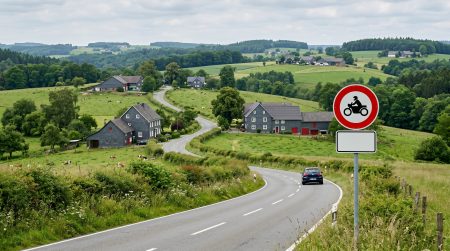
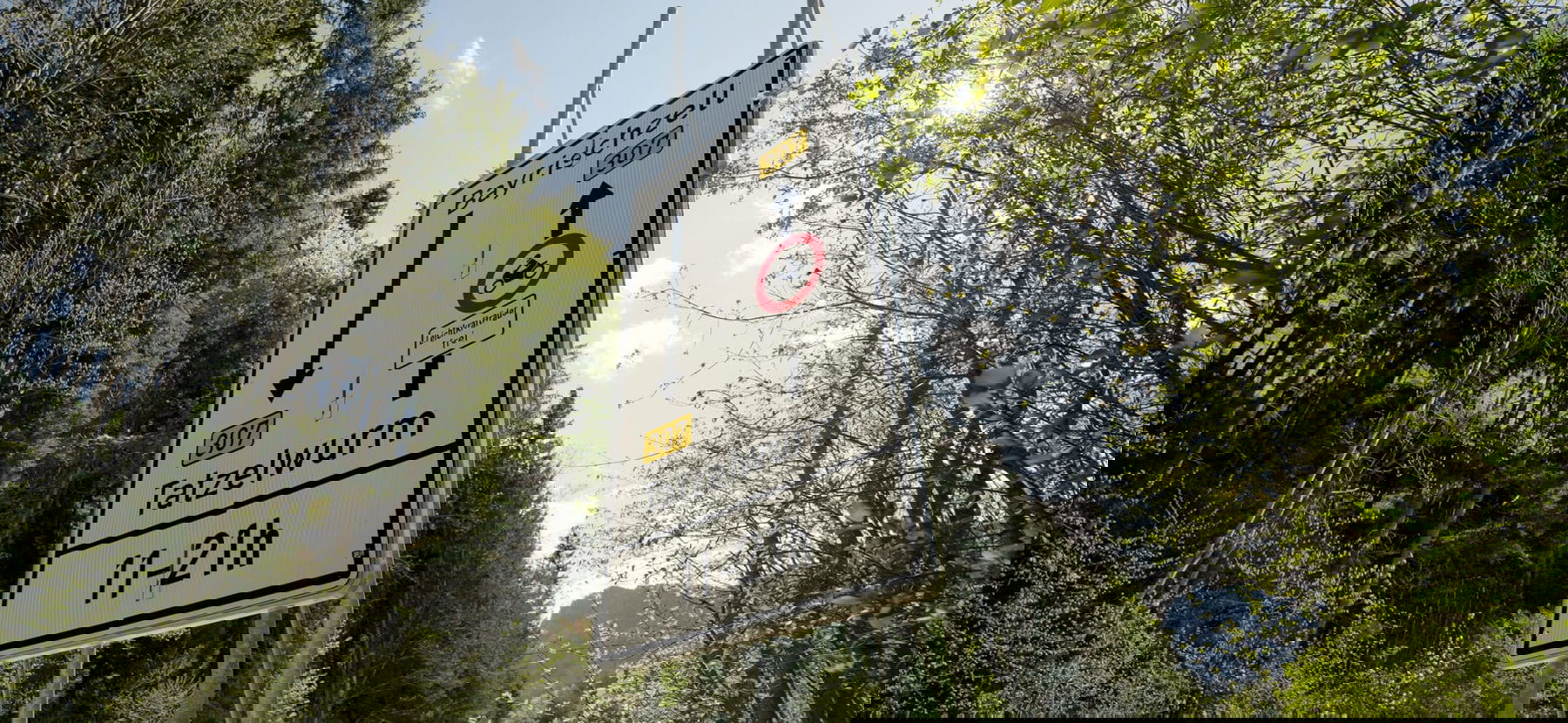
The one-directional motorcycle riding ban on the Sudelfeld route has applied since 30 April 2025. It was ordered by the Rosenheim district authority in coordination with the district of Miesbach, in each case for the motorcycle season as part of a traffic trial scheduled to run for two years.
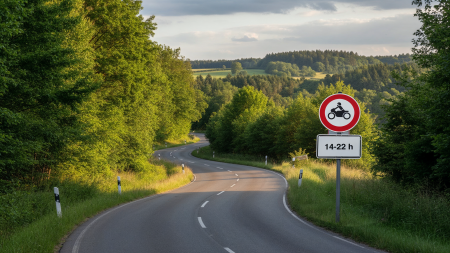
The measure was justified by a high number of accidents, most of which were attributed to excessive speed on the part of individual motorcyclists. According to official figures, 97 motorcycle accidents were recorded on this section between 2018 and 2024. Two people were killed, 40 were seriously injured and 58 sustained minor injuries. In practice, the rule means that motorcycles may only ride the section in one direction during the day between 11 a.m. and 9 p.m. Mopeds, small motorcycles and light motorcycles are exempt.
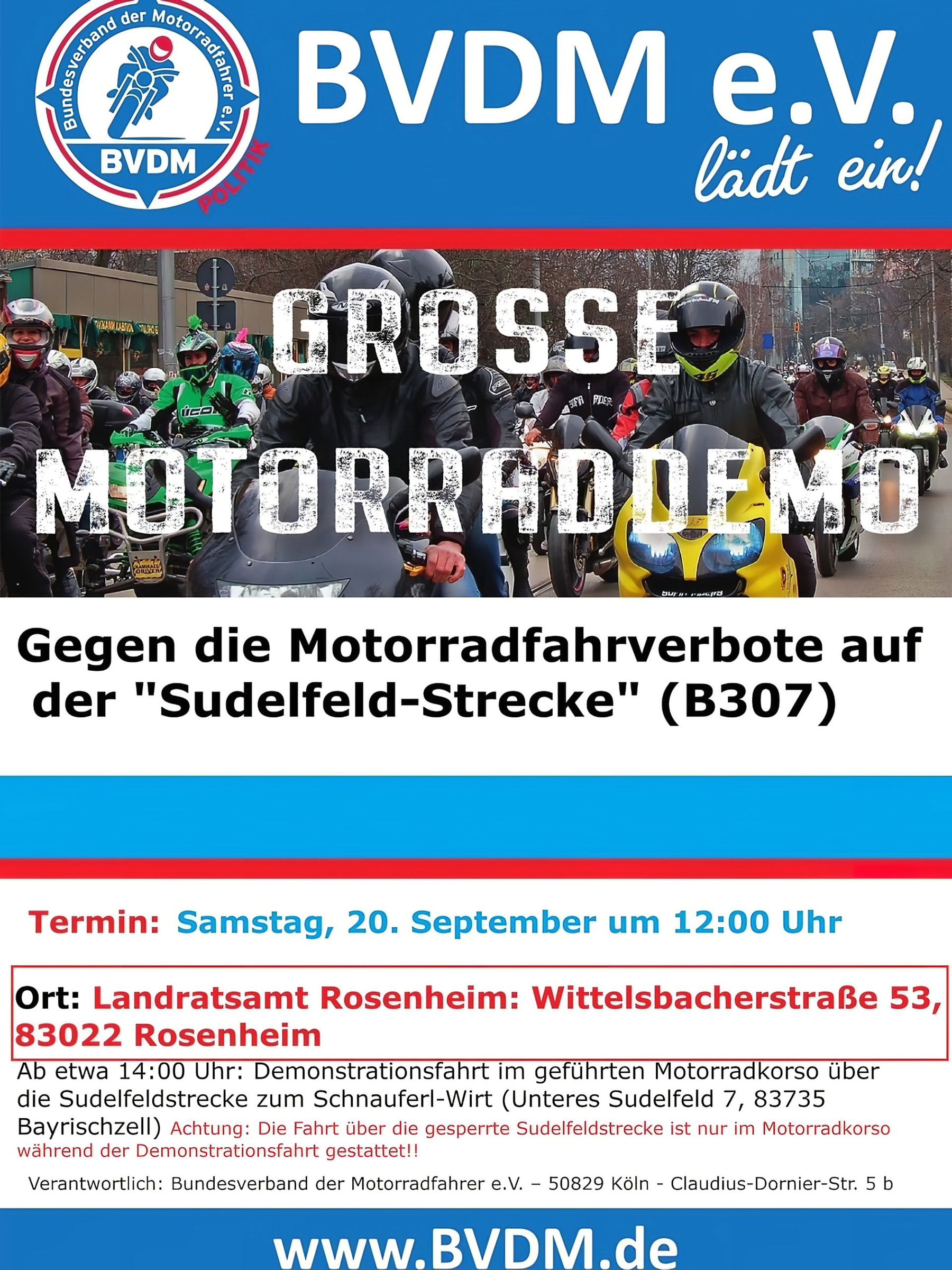
Opposition to it was visible from the outset. In September 2025 the BVDM called for a demonstration against motorcycle riding bans in Bavaria. Around 1,500 motorcyclists travelled to Rosenheim for it. The district administrator used the occasion to set out his position during the event.
What happens at the Sudelfeld in 2027?
The decisive course will be set at the start of the 2027 season. That is when it will become clear whether the Rosenheim district authority turns the traffic trial into a permanent closure.
The federation’s further course of action depends on that too. If a permanent rule is introduced, the BVDM intends to examine legal steps once again. In addition, the federation is considering calling for another demonstration, as it did the previous year. “We will continue to represent the interests of female and male motorcyclists in Bavaria consistently,” Michael Lenzen announces.
The German Motorcyclists’ Federation has represented the interests of motorcyclists in Germany since 1958 and campaigns for the concerns of powered two-wheeler riders in politics, public administration and the public sphere.
Frequently Asked Questions
-
Is the Sudelfeld riding ban final after the ruling?
No. The Munich Administrative Court merely confirmed that the previous order was lawful as a trial measure. Whether the closure becomes permanent will be decided by the Rosenheim district authority only after the traffic trial has ended.
-
When did the Munich Administrative Court rule?
The judgment was handed down on 29 July 2026. Beforehand, the court had inspected the route during an on-site hearing. The written grounds of the judgment were not yet available at the time of the federation statement.
-
Who filed the lawsuit against the closure of the B 307?
The claim was brought by an affected member of the German Motorcyclists Federation. The federation itself has no collective right of action and therefore supported the proceedings financially and in principle. The case was handled by lawyer Christina Fruehe of GOEHMANN Rechtsanwaelte.
-
What happens if the closure becomes permanent in 2027?
In that case the BVDM intends to examine legal steps once again. The federation also considers another demonstration possible, similar to the event in Rosenheim in September 2025 with around 1,500 participants.
➜ All info & history of this road (German): Sudelfeld (B307): Einseitige Sperrung für Motorräder – Überblick & Chronik
➜ This article is part of our comprehensive overview: Motorcycle Law & Policy: Regulations, Court Rulings and Developments for Riders. Find all key information on this topic in one place.