- Several interested parties came forward, but a sale as a going concern still fell through
- Around 273 redundancies, with only a small part of the workforce staying on for the wind-down
- The 2024 accounts show an operating loss of 16.1 million pounds (around 18.8 million euros / 21.4 million US dollars)
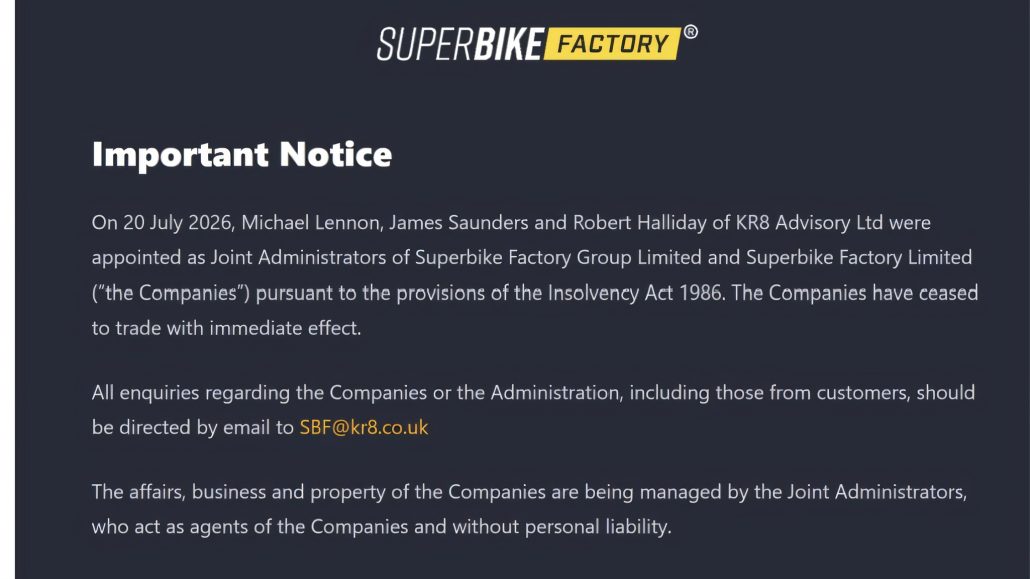
When the administrators took control on 20 July 2026, one question remained open: would a buyer still be found, or would the dealer be broken up? A week later, the answer is clear. Law firm KR8 Advisory has published an official statement offering the clearest view yet of the company’s demise. It explains why an accelerated sale process led nowhere, and makes clear that the focus now is solely on realising individual assets.
Why did the sale of SuperBike Factory fail?
There were several interested parties, but not a single deal ready for signature. Before entering administration, management had sought external advice and examined various options, including an accelerated sale process.
According to the administrators, the brand’s recognition and its position in the market meant that several parties did indeed come forward. In the end, however, a sale as a going concern could not be completed. That left administration as the only option, and trading was halted immediately.
The administrators cite four factors that combined over the past year: a sustained decline in new and used sales, a tighter consumer credit market, rising operating costs, and the still-unresolved situation in the UK motor finance sector. This is notable, since SuperBike Factory, as a pure high-volume used-bike specialist, seemed better positioned than a classic franchised dealer. In the end, that scale offered no protection.
How many employees are affected?
Around 273 employees have lost their jobs. Only a small number of staff were kept on to support the administrators in securing the business and selling the remaining assets.
Joint Administrator Rob Halliday describes the priorities as follows: “Approximately 273 employees have been affected by the appointment, and our immediate priority is to support employees through the redundancy process, including assisting them with claims to the Redundancy Payments Service, while securing and safeguarding the company’s assets for the benefit of creditors.”
The Redundancy Payments Service is a UK government body. It pays redundancy payments and outstanding wage claims when an insolvent employer is no longer able to do so itself. Claims are capped and depend on conditions such as length of service.
What do the accounts say about the collapse?
Revenue held up, but earnings collapsed. For the financial year to 31 December 2024, the accounts show revenue of around 82.2 million pounds (around 96.3 million euros / 109.4 million US dollars), up from 81.5 million pounds (around 95.4 million euros / 108.4 million US dollars) the year before. An increase, but a small one.
Over the same period, the operating loss widened from 3.9 million pounds (around 4.6 million euros / 5.2 million US dollars) to 16.1 million pounds (around 18.8 million euros / 21.4 million US dollars). The largest single item behind this is an impairment on investments in subsidiaries of 14.5 million pounds (around 17.0 million euros / 19.3 million US dollars). After tax, the company posted a shortfall of 18.28 million pounds (around 21.4 million euros / 24.3 million US dollars).
An impairment on investments is a pure accounting adjustment. It means a subsidiary is worth significantly less on the books than it was valued at on acquisition, and initially costs no cash. Its effect is nonetheless considerable, because it erodes equity and weakens the negotiating position with banks and financing partners.
That is exactly what the balance sheet shows. Fixed assets of just under 18.2 million pounds (around 21.3 million euros / 24.2 million US dollars) and current assets of 21.7 million pounds (around 25.4 million euros / 28.9 million US dollars) were offset by liabilities so high that the bottom line showed a shortfall of around 1.2 million pounds (around 1.4 million euros / 1.6 million US dollars). The company was therefore already balance-sheet insolvent at the end of 2024, a year and a half before the actual collapse.
What happens to the assets now?
The administrators are preparing to sell off the individual assets while simultaneously reviewing the financial position. Customers and sellers are to be contacted directly in the coming days and given instructions on how to proceed.
Everyone whose motorcycle, deposit or ongoing payment is still with the company is affected. Since trading was halted with immediate effect, deliveries, payouts to sellers and service commitments remain in limbo until this contact is made. Anyone with questions can reach the administrators only by email at SBF@kr8.co.uk.
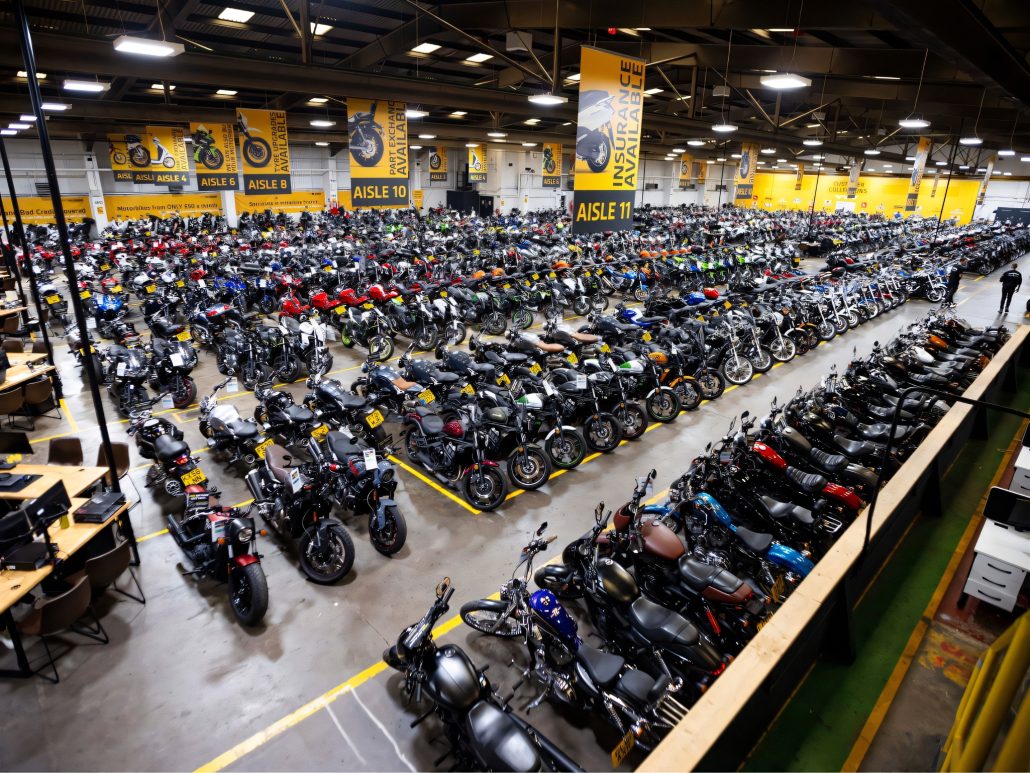
A warning sign for the European motorcycle trade
For the industry, there is an uncomfortable lesson in this case. It was not demand for motorcycles that brought SuperBike Factory down, but the combination of an in-house finance business under regulatory pressure and a balance sheet with no reserves left. The UK market has been recovering noticeably since the turn of the year, but for this company the recovery came too late.
The speed is also striking. Less than two weeks passed between the initial notice and the final wind-down. Dealers that depend heavily on finance commissions apparently have very little time to react once things turn serious. For other players in the European used-bike market working with similarly high volumes and similarly tight margins, that is a point worth noting well beyond the British Isles.
Frequently Asked Questions
-
Why did the rescue of SuperBike Factory fail?
Several parties were interested in a takeover, but a sale as a going concern could not be completed. The administrators attribute this to a sustained sales decline, rising operating costs, a tighter consumer credit market, and uncertainty in the motor finance sector.
-
How many jobs are being lost in the SuperBike Factory wind-down?
Around 273 employees are affected and were largely made redundant. A small part of the workforce remains for now to support the administrators in securing and realising the assets.
-
How large was SuperBike Factory’s loss in 2024?
The operating loss stood at 16.1 million pounds (around 18.8 million euros / 21.4 million US dollars), up from 3.9 million pounds the year before. After tax, the shortfall came to 18.28 million pounds, driven largely by an impairment on investments of 14.5 million pounds.
-
Will customers get their money or motorcycle back?
That is still unclear. The administrators are reviewing the financial position and plan to contact affected customers and sellers in the coming days with specific instructions; inquiries should go to SBF@kr8.co.uk.