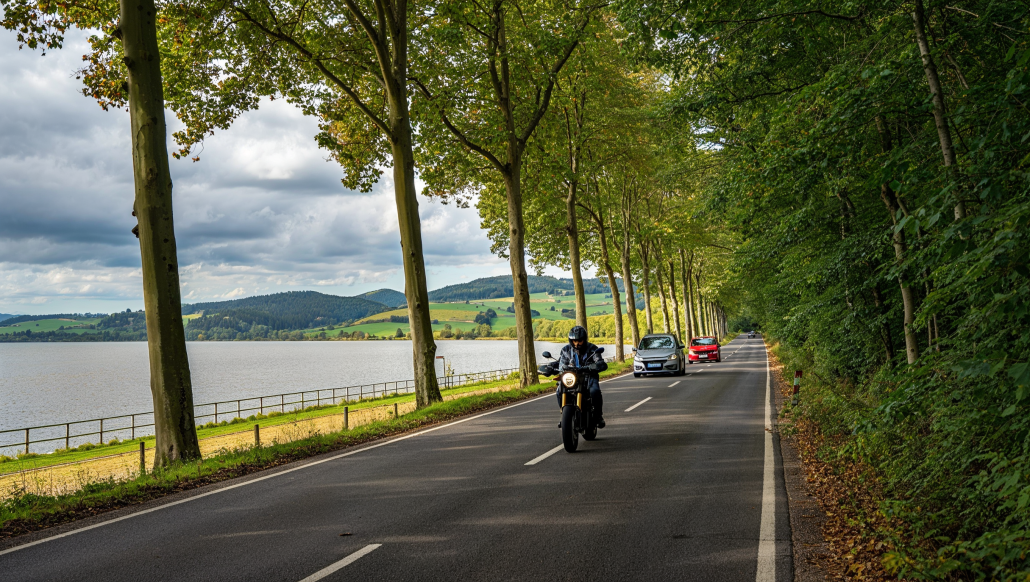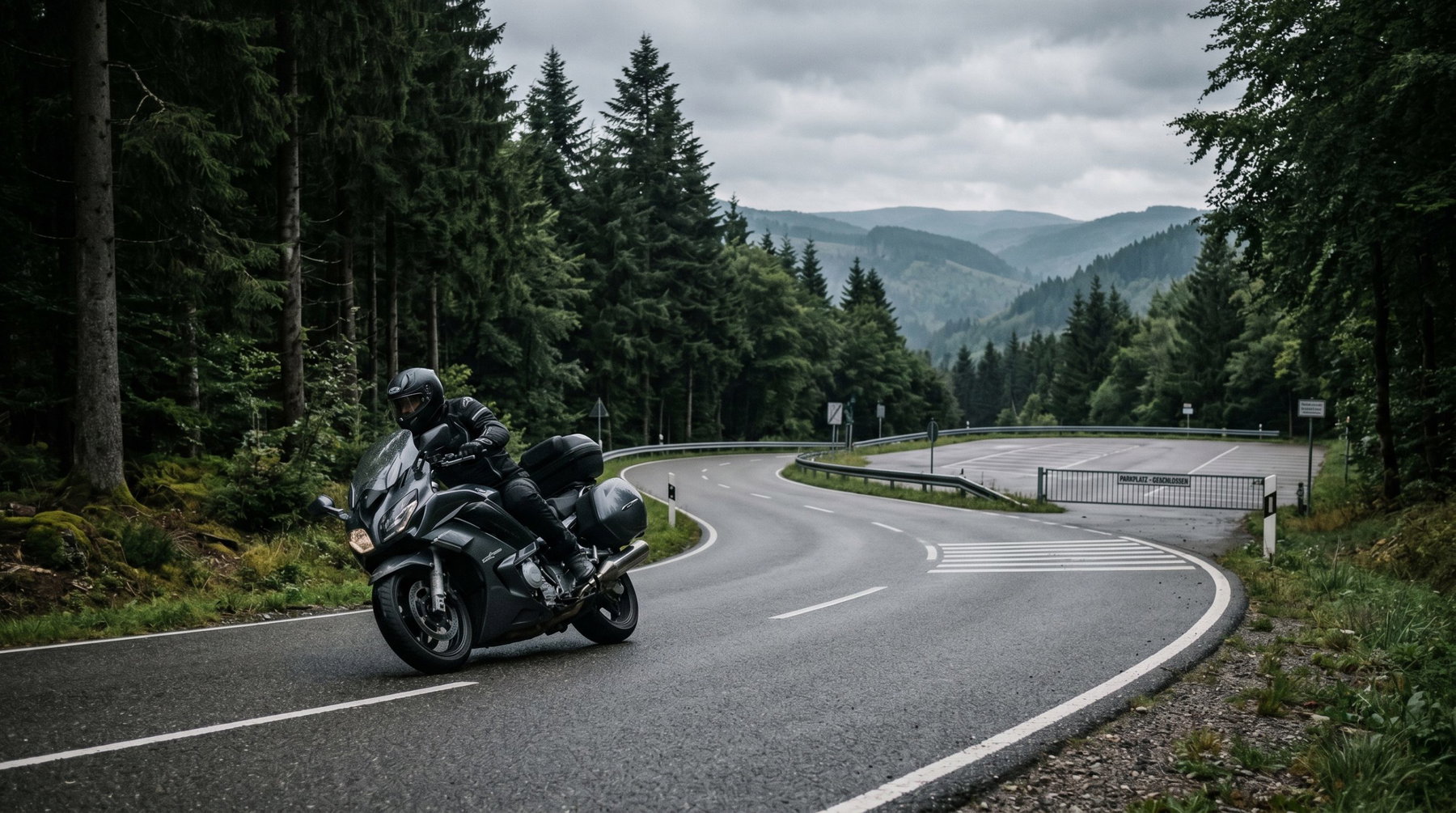
- 23 motorcycle crashes on the B500 through September 2026, four people killed
- Next meeting on 17 November, implementation planned for the start of the 2027 riding season
- The B500 is to serve as a pilot route for other roads in the region
With its countless bends, the Black Forest High Road (Schwarzwaldhochstraße) is one of the best-known motorcycle roads in Baden-Württemberg. At the same time, it has been an accident black spot for years. After a summer with several fatal crashes, representatives of authorities, municipalities and police met for a round table at Baden-Baden town hall on Tuesday, 22 September 2026. The outcome is a package of stricter enforcement, possible changes to the road layout and legal steps against riders who cannot be identified after an offence. Some of it is new. Other measures were already tried on the B500 years ago.
Who took part in the B500 round table?
The meeting was attended by the regional councils of Freiburg and Karlsruhe, the Ortenau district, the Rastatt district, the towns of Bühl, Achern, Gaggenau and Baden-Baden, and the police. This is according to a joint press release from the city of Baden-Baden and the Offenburg police headquarters.
The initiative came from Baden-Baden’s mayor Thomas Jung (independent) in early September. After three fatal crashes within a few days, he called on everyone involved to act quickly. By his own account, he invited all municipalities between Achern and Baden-Baden. The police also contacted him about the round table, which he said pleased him a great deal. Tuesday’s meeting was intended as a kick-off, with further rounds to follow. According to Jung, the state transport ministry and interior ministry in Stuttgart are also dealing with the issue.
How many motorcycle crashes were there on the B500 in 2026?
By September, police had recorded 23 crashes involving motorcycles on the B500 this year. Four people lost their lives.
In July, a 25-year-old female rider crashed in a left-hander between Zimmerplatz and Lichtental and hit the crash barrier. At the end of August, an 18-year-old female rider and a 41-year-old male rider were killed in a collision above Bühl. A few days later, a 58-year-old rider drifted into the oncoming lane in a long left-hand bend at the Helbingfelsen. He collided with an oncoming car and died at the scene. The two occupants of the car were unhurt. According to police, it was initially unclear why the man ended up in the oncoming lane.
Beyond the B500, the figures have also risen sharply. It is worth taking a closer look, however, as the numbers refer to different areas and periods:
- On the well-known hotspot routes in the northern Black Forest, namely the B500, the Murg valley and the road over the Kaltenbronn, the number of motorcycle crashes more than doubled by the end of July compared with the same period last year. It rose from 32 to 65.
- Across the entire Offenburg police headquarters area, there were seven fatal motorcycle crashes by the end of July. In the whole of the previous year there were three.
- In the first eight months of the year, a total of 33 people died on the roads in the police headquarters area, including 12 motorcyclists. That is more road deaths than in the whole of the previous year and as many as four years ago.
Police cite excessive speed as the main cause. Riding errors and alcohol often played a role as well. Heiko Baumgärtner, head of the Baden-Baden traffic police inspectorate, explains that a very high proportion of motorcycle crashes on the B500 in particular are always down to inappropriate or excessive speed.
What measures did the B500 round table agree on?
The participants agreed on a joint package. It provides for more consistent action against traffic offences, more intensive checks and a review of structural and traffic-law changes. So far, however, only the direction has been decided. Which specific steps will be implemented is not due to be settled until November.
Checks with drones and unmarked vehicles
In future, police intend to carry out more checks using unmarked vehicles and drones. The use of new types of speed cameras was also discussed at the round table. The background is a problem Jung described in an interview: as soon as a speed trap is set up, the “knee-draggers” know about it via WhatsApp channels within four minutes, he said.
An operation in September showed how such checks have been carried out so far. On a Saturday afternoon, police checked 26 motorcycles and 3 cars on the Black Forest High Road. Besides speed, the focus was also on the technical condition of the bikes. Officers recorded no speeding offences by motorcyclists that day. Most of the riders checked responded with understanding.
Rumble strips, road markings and one-way systems
Rumble strips and special road markings in bends are being considered. On sections with a particularly high number of crashes or conflicts, one-way systems could also be an option. Whether and where this will actually happen has not yet been decided.
Rumble strips are nothing new on the B500, however. As early as 2021, five strips per direction were laid ahead of the Helbing bend. They are meant to make riders brake in good time before the corner. The round table now discussed using such strips on other particularly dangerous sections.
Road markings also have a history. According to its own statements, the Baden-Württemberg transport ministry is examining a new type of road marking designed to show motorcyclists the ideal line through bends more clearly. This marking is already being trialled in North Rhine-Westphalia, and talks with the federal transport ministry are ongoing. Whether the bend markings mentioned at the round table refer to exactly this solution is not clear from the statement issued by the city and police.
More awareness campaigns
In addition, the city, police and municipalities want to step up their joint public outreach to make motorcyclists more aware of the risks on the route.
What is the difference between owner liability and a logbook order?
Under owner liability, the registered keeper of a motorcycle would be held responsible for offences even if the rider remains unknown. However, this would require a change in the law, which cannot be decided locally. A logbook order (Fahrtenbuchauflage), on the other hand, is a requirement that authorities can impose. This is exactly what the round table wants to examine.
The underlying problem is well known. Riders are usually not recognisable on speed camera photos. As a result, speeders often cannot be prosecuted. Until now, the keeper has generally not had to answer for it either.
Owner liability was probably the most concrete demand made by all participants at the round table. Mayor Jung describes a corresponding change in the law as an important step. Sonja Schuchter (CDU), mayor of Sasbachwalden, had already called for owner liability in early September. Via the owner of the motorcycle, the rider could then also be held accountable, she argued. Motorcyclists must be subject to checks in the same way as any car driver. She said she was convinced that the number of motorcycle crashes would fall if owner liability could be enforced in law.
Owner liability does not appear in the joint statement from the city and police. Instead, it refers to logbook orders imposed by the authorities. These are to apply when a rider cannot be identified after an offence despite investigations. The logbook order is therefore the part of the debate that authorities in the region can implement themselves. Owner liability remains a demand directed at the legislator.
Can motorcycles be confiscated on the B500?
The authorities intend to make consistent use of the existing legal options for confiscating motorcycles in the event of relevant offences. The city and police do not specify exactly which offences this refers to.
At the round table, Heiko Baumgärtner of the Baden-Baden traffic police inspectorate had phrased the issue more cautiously, saying that in extreme cases one must also think about how motorcycles can be confiscated. The later statement sounds more binding. It is no longer about considering new approaches, but about using the options that already exist.
Will there be a motorcycle ban on the B500?
A riding ban has not been decided at present. All parties involved describe it as a last resort.
The Baden-Württemberg transport ministry is cautious. A motorcycle ban would be a significant intervention in moving traffic and only possible under strict legal conditions. However, if other measures prove insufficient after legal assessment, the local traffic authority could issue such a ban, according to the ministry.
In the region, positions shifted over the course of September. At the start of the month, in light of the crashes, mayor Schuchter was still calling for a temporary riding ban for motorcyclists. A few days later, she said a ban should only be considered as an absolute last resort, because it would affect all motorcyclists and not just the few speeders.
Jung, who by his own account rides the route on his motorcycle himself, takes a similar view. For him, a ban would be “the very last of all options”. He points to tourism. Many motorcyclists come from the Netherlands or the UK to holiday in the region, not to race. These visitors must not be punished. The aim is to rein in the few who endanger themselves and others.
The debate is not new. Back in 2021, the city of Baden-Baden floated the idea of closing the road to motorcycles on certain days. At the time, there was no legal basis for this. Baden-Baden’s then deputy mayor Roland Kaiser (Greens) already said back then that a closure would be the last resort.
What safety measures already exist on the B500?
The Black Forest High Road already has a 50 km/h limit in some places, improved crash barriers with underride protection, rumble strips and the so-called Silent Kilometre. According to police and municipalities, these measures have not yet had the desired effect.
The underride protection is meant to prevent fallen riders from sliding underneath the crash barrier. In 2021, alongside the rumble strips, the car park at the Helbingfelsen and another car park between Sand and Baden-Baden-Geroldsau were closed. The speed limit was also lowered to 50 km/h. Today, a memorial at the Helbingfelsen car park commemorates motorcyclists who have died.
The Silent Kilometre was added around two years ago. The roughly one-kilometre stretch serves as both a memorial and a warning. Black signs showing the biker salute, a fist with index and middle finger extended, are meant to encourage slower riding. The idea came from Tobias Gaiser from Baiersbronn. He wanted to reduce the number of road deaths without warning signs, speed cameras or riding bans.
Jung draws a sobering conclusion. Especially in the area of the Silent Kilometre, the road surface is full of black marks showing that people ride far too fast there, he says. The 50 km/h limit, meanwhile, annoys many riders. He therefore also raises the possibility of structural changes: “I think we really have to consider whether we should scale back the roads where necessary.” But this would require thinking on a larger scale. If one road becomes unattractive, riders switch to others. That is why the neighbouring municipalities are involved in the talks.
As a further idea, Jung suggests street workers from the motorcycle scene. He has in mind cooperation with Rennleitung 110, an initiative of former and serving police officers who also care deeply about the issue.
What happens next after the B500 round table?
Over the coming weeks, the planned measures are to be fleshed out and examined. The next steps will be decided at a further meeting on 17 November.
The aim is to implement the agreed steps for the start of the 2027 riding season. Mayor Jung names March as the target. The B500 is to serve as a pilot route. Whatever proves effective there could later be transferred to other roads. Jung cites the Rote Lache and Loffenau as examples.
For motorcyclists, this means that the 2027 season on the Black Forest High Road is likely to start with more frequent checks. Whether structural changes, one-way systems or logbook orders will follow is due to be decided in November. The B500 is thus continuing a development that began with rumble strips, car park closures and speed limits in 2021 at the latest, and which has repeatedly raised the question of a road closure ever since.
Frequently Asked Questions
-
How many people have died in motorcycle crashes on the B500 in 2026?
So far in 2026, four people have died in motorcycle crashes on the B500. In total, police recorded 23 crashes involving motorcycles on the route by September. Three of the victims died within a few days at the end of August and beginning of September.
-
What did the B500 round table decide?
The round table agreed on a joint package of measures. It includes more checks using unmarked vehicles and drones, as well as examining rumble strips, bend markings, one-way systems and logbook orders. In addition, the legal options for confiscating motorcycles are to be used consistently.
-
Is a motorcycle ban coming to the B500?
A riding ban is not currently planned. Mayor Thomas Jung and mayor Sonja Schuchter describe it as a last resort. The transport ministry points to strict legal requirements.
-
When will the new measures on the B500 apply?
The measures are to be implemented for the start of the 2027 motorcycle season. The specific steps will be decided at a further meeting on 17 November.