- Traffic trial from July 2022 until the decision to end it in late November 2025 on district road 333
- Construction costs around 75,000 euros (approximately 86,700 US dollars), operating costs around 12,500 euros (approximately 14,400 US dollars)
- According to the Osnabrück district authority, no significant noise reductions could be demonstrated while the installation was active
When the Osnabrück district authority installed a barrier on a winding district road in the Osnabrück region in July 2022, it was the first of its kind in Germany. There were press appointments, photos and the expectation that other regions might adopt the model. The trial, by contrast, was ended without a press release, without a summary and without any public announcement. The editorial team became aware of the matter through a reader tip from Karsten, who runs the YouTube channel TeutoRider, lives in the area and filmed the location on site. When asked, both the Osnabrück district authority and the Lower Saxony Ministry for Economic Affairs, Transport and Building responded.
What was the traffic trial on the Borgloher Straße about?
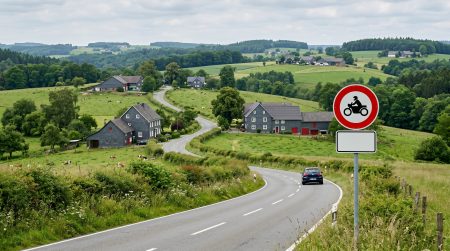
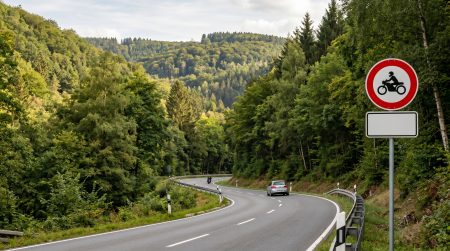
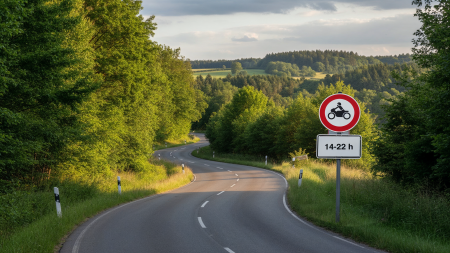
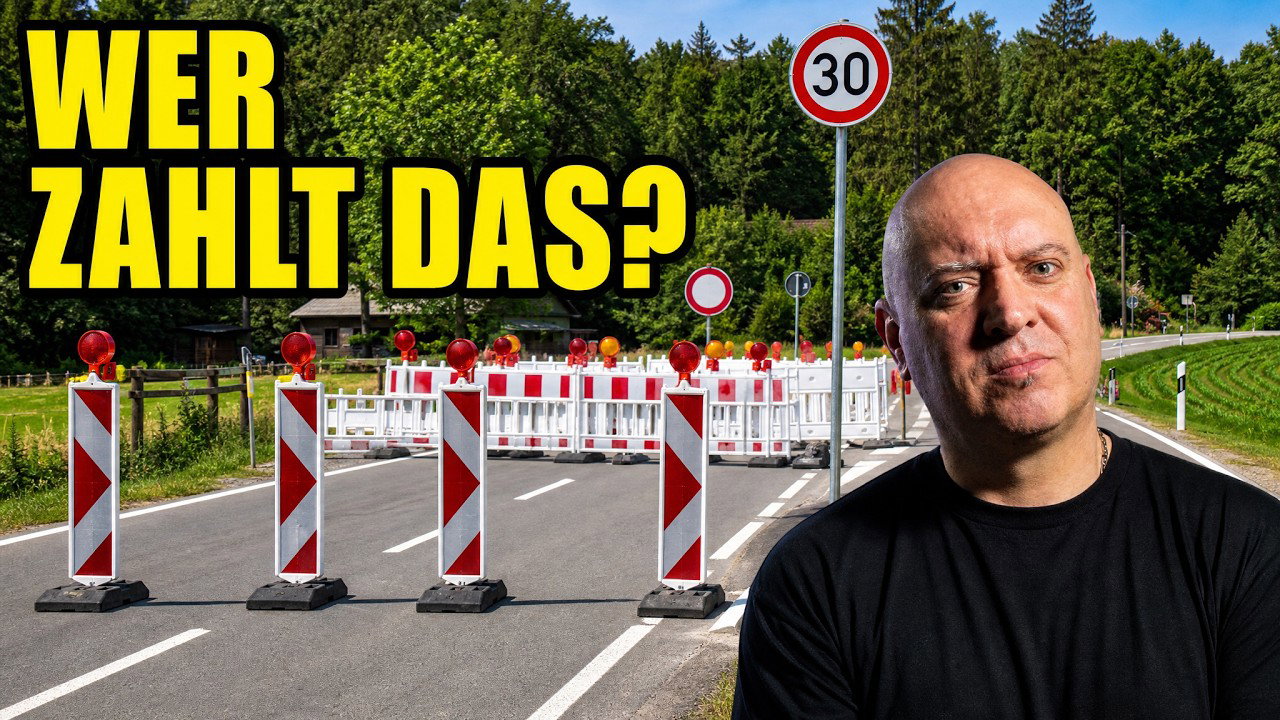
The Osnabrück district authority had a barrier closed on weekends and public holidays and diverted traffic onto a narrow temporary carriageway alongside it. The section affected was part of district road 333 near Georgsmarienhütte, between Holperdorper Straße and the old hill climb course.
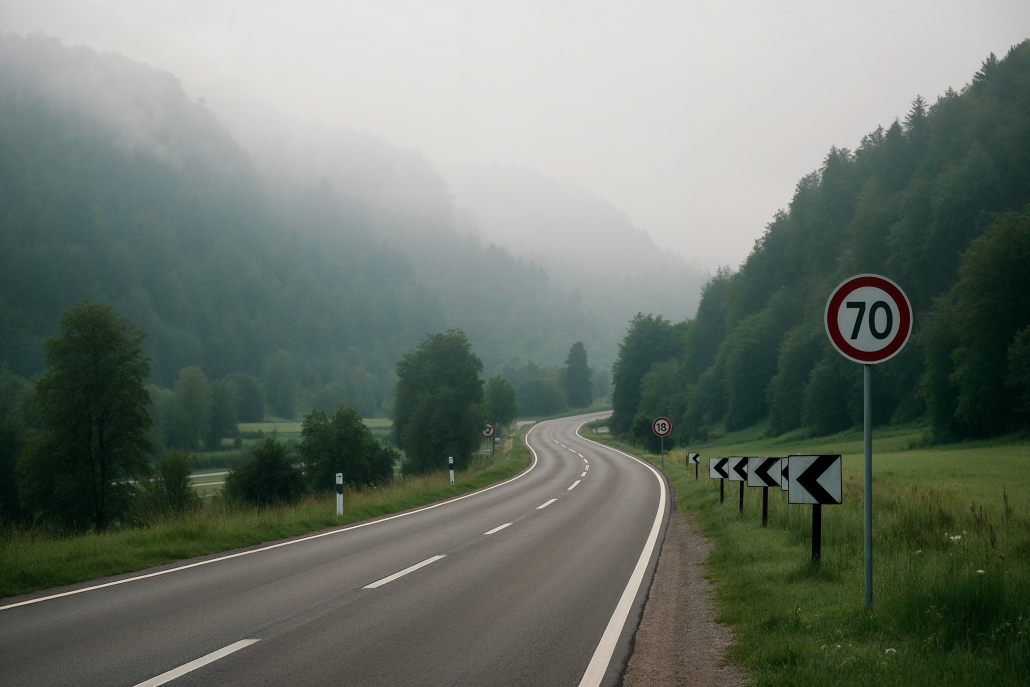
The route is winding, the normal speed limit there is 70 km/h, and it is popular with motorcyclists. For some residents it is accordingly considered a noise problem. The temporary carriageway was around 40 metres long and four metres wide, the speed limit was 30 km/h, rumble strips were set into the asphalt, and right of way was regulated in one direction. Anyone wanting to get through had to ease off the throttle and, if necessary, wait.
The district authority stresses that the route was never formally closed. No closure was involved, it says, “as traffic was diverted at weekends onto the temporary carriageway, which was fitted with rumble strips”. The measure was triggered by motorcycle noise, but it affected all traffic. Cars, vans and agricultural vehicles also had to pass through the bottleneck on those weekends.
How was the barrier supposed to reduce noise at all?
Neither authority provides an explanation. Neither the district nor the ministry states in its answers by what mechanism the measure was supposed to reduce noise.
The obvious assumption is that the bottleneck was meant to make the route less attractive to motorcyclists. Fewer motorcycles would then mean less noise. That intention is not documented in the answers available, however.
That also leaves open a very simple question that already arose back in 2022: around 40 metres were altered, the rest of the route remained untouched, with the same permitted speed as before. Vehicles were therefore slowed down once and then accelerated back up to 70 km/h. Depending on riding style, accelerating can be louder than travelling at a steady speed. There is also the location: a single building stands some distance away within sight of the barrier point, otherwise there is practically no residential development there.
What did the traffic trial achieve?
According to the Osnabrück district authority, no measurable effect could be established. A noise display installed by the town of Georgsmarienhütte recorded traffic volumes and noise levels, without any clear reduction being demonstrable while the installation was active.
Press officer Burkhard Riepenhoff writes verbatim: “The town of Georgsmarienhütte had installed a noise display in the area concerned, which recorded both traffic volumes and noise levels. Unfortunately, no significant reductions could be demonstrated while the bypass was active.”
The ministry’s response is even clearer. Asked for a retrospective assessment, the press office of the Lower Saxony Ministry for Economic Affairs, Transport and Building states that a general assessment of this specific traffic trial is not possible because no documentation of the trial exists. By its very name, a traffic trial is designed around data being collected and evaluated. After three years of operation, there is neither a final report nor an evaluation that could be presented to a supervisory authority. The only solid evidence is the town’s measurement, which shows no effect.
What did the barrier cost?
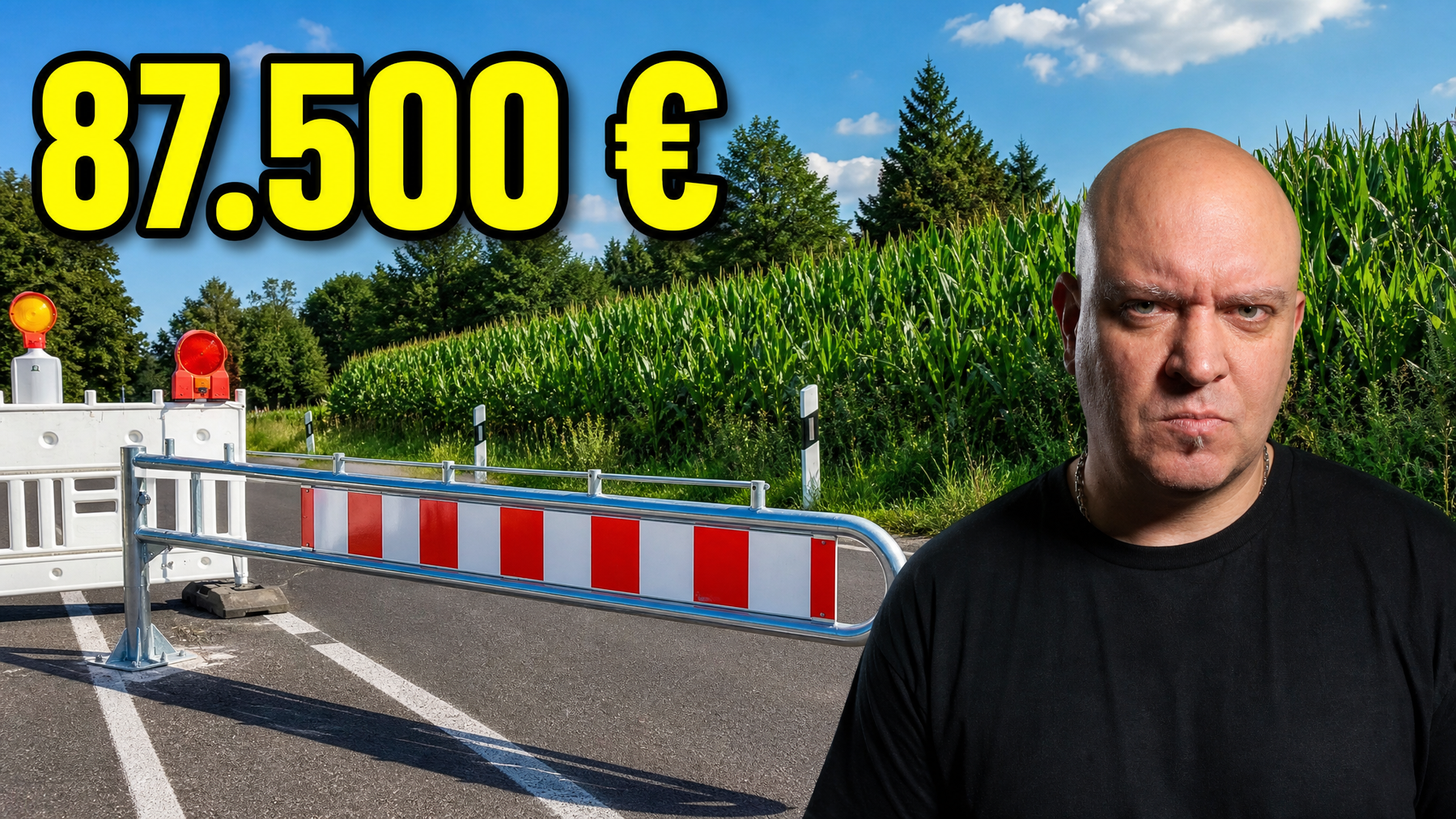
Construction costs came to around 75,000 euros (approximately 86,700 US dollars), the cost of ongoing operation from 2022 to 2025 to around 12,500 euros (approximately 14,400 US dollars). Both were borne by the Osnabrück district authority, because it is responsible for district road 333 and pays for its upkeep.
The district authority expressly confirms the figure that has been circulating since 2022 as accurate. The money went primarily into the additional traffic area, that is, into the temporary carriageway itself. The traffic signs and barrier equipment can be dismantled and reused.
On operating costs, the answer reveals a point that was not previously public: the installation was in use far less often than widely assumed. According to the district authority, the barrier was not closed every week but, depending on the weather and on how much staff was available, on up to around ten weekends per year. For the entire period, around 12,500 euros were incurred at the Süd district road maintenance depot, mostly staff costs.
Added together, that comes to around 87,500 euros (approximately 101,100 US dollars), spread over a maximum of 40 operating weekends across four seasons. That works out at a minimum of a good 2,000 euros (approximately 2,300 US dollars) for every weekend on which the barrier was actually closed. The choice of operating days also matters for how meaningful the trial is: the barrier was closed in good weather, in other words precisely when particularly large numbers of motorcycles are out. A comparison with the remaining weekends is therefore not possible.
Dismantling, by contrast, is cheap. Only the equipment is being removed, which according to the district authority two people can manage in one working day. The additional traffic area stays where it is. From the outset it was also intended for the road maintenance service and is to be used in future for parking vehicles and as storage space for bulk materials and brushwood.
Who ended the traffic trial?
The trial was ended by the Osnabrück district authority itself. At the end of November 2025 it decided independently to remove the barrier installation. There was no directive from the state.
It had previously been said in the region that the state had stopped the trial because the measure had been unlawful. According to the answers available, that was not the case. The sequence of events was different: in August 2025, a member of the public complained to the transport ministry. Only then, by its own account, did the ministry become aware of the matter at all. It had not been involved before the trial was set up. For three years, therefore, an installation unique in Germany stood there without the state’s highest transport authority knowing about it.
The ministry then discussed the case with the district authority. The ministry makes it expressly clear that it issued neither an order nor a directive to end the trial, and no decision that the measure was unlawful. The district authority describes the discussion as follows: it concerned the status of a traffic trial that had to be limited in time and the question of whether the findings obtained were sufficient for a permanent solution. “Taking these conditions and the staffing effort to date into account, it made sense to end the trial.”
That establishes only the date of the decision, not the last actual use of the barrier and not the completion of the dismantling.
The legal sticking point: a set of rules for construction sites
The answer to the question about the legal basis is remarkable. The district authority applied for a traffic order from the traffic authority of the town of Georgsmarienhütte. By its own account, the concept was based on standard plan C I/10 in accordance with RSA 21. This produced, it says, “a legal basis that is also used for construction sites”.
RSA 21 stands for the guidelines on traffic safety measures at road works, and part C contains the standard plans for country roads. It is therefore the set of rules for construction sites. A noise protection measure designed to be permanent and aimed at motorcycle traffic was thus operated for a good three years under a construction site standard plan.
That matters because traffic restrictions for protection against noise have a high bar to clear under section 45 of the German road traffic regulations. The ministry itself puts it in its answer as requiring evidence of an atypical traffic situation or a particular danger situation. What is meant is: the situation on the ground must differ clearly from the normal case, and that must be documented. Such evidence cannot be provided via a set of construction site rules, because those are about securing a work site and not about noise protection. It should be expressly noted that no court has examined the construction, and no authority has declared the measure unlawful.
What happens next on the Borgloher Straße?
The route is passable normally again. As of August 2026, the equipment had yet to be dismantled, so the installation is still in place.
It has clearly not been in use for some time. The signs are twisted, leaves and sand lie on the temporary carriageway. On future noise protection along the route, the district authority answers briefly: further options for reducing noise generated by motorcycles exist through traffic authority measures and police checks. That leaves the tools motorcyclists know from numerous other regions: speed limits, route bans and checkpoints.
Why the case is of interest beyond Georgsmarienhütte
The Borgloher Straße joins a long list of route closures and sanctions against motorcyclists that have been ordered in several German states in recent years. The case differs from them in one respect: here there is a statement from the authority about what the measure achieved, and that statement is unambiguous.
The difference in public communication is also striking. The launch in 2022 was communicated widely, as a model unique in Germany that might also be an option for other regions. The decision at the end of November 2025 to end the trial came without a press release, without a summary and without an evaluation. What sticks in public perception is therefore mainly the loud part, while the result goes unnoticed.
The review was set in motion by two private individuals: by the member of the public who complained to the ministry in August 2025 and thereby first alerted the supervisory authority to the matter, and by the reader tip that led to this investigation. Without them both, the matter would probably have gone unnoticed.
Frequently Asked Questions
-
Where exactly was the barrier on the Borgloher Straße?
The installation stood on district road 333 near Georgsmarienhütte, on the section between Holperdorper Straße and the old hill climb course. The regular speed limit there is 70 km/h. On weekends and public holidays, traffic was diverted onto a temporary carriageway around 40 metres long and four metres wide with a 30 km/h limit.
-
What did the traffic trial on the Borgloher Straße cost in total?
Construction costs came to around 75,000 euros (approximately 86,700 US dollars), operating costs from 2022 to 2025 to around 12,500 euros (approximately 14,400 US dollars). Together that is around 87,500 euros (approximately 101,100 US dollars). The costs were borne by the Osnabrück district authority as the responsible road authority.
-
Did the barrier reduce motorcycle noise?
Not measurably, according to the Osnabrück district authority. A noise display installed by the town of Georgsmarienhütte recorded traffic volumes and noise levels, and no clear reduction could be demonstrated while the barrier was closed.
-
Was the traffic trial declared unlawful?
No. The Lower Saxony Ministry for Economic Affairs, Transport and Building states expressly that there was neither a directive nor a decision on unlawfulness. The Osnabrück district authority decided independently at the end of November 2025 to remove the installation.
-
Is the Borgloher Straße freely passable again?
Yes, the route is fully passable again. As of August 2026 the barrier installation was still standing but was no longer in use. Dismantling of the equipment had not been completed at that point.
➜ All info & history of this road (German): Borgloher Straße bei Georgsmarienhütte: Schrankensperrung beendet – Überblick & Chronik