- Both applications were filed with the USPTO on the same day, 29 July 2026
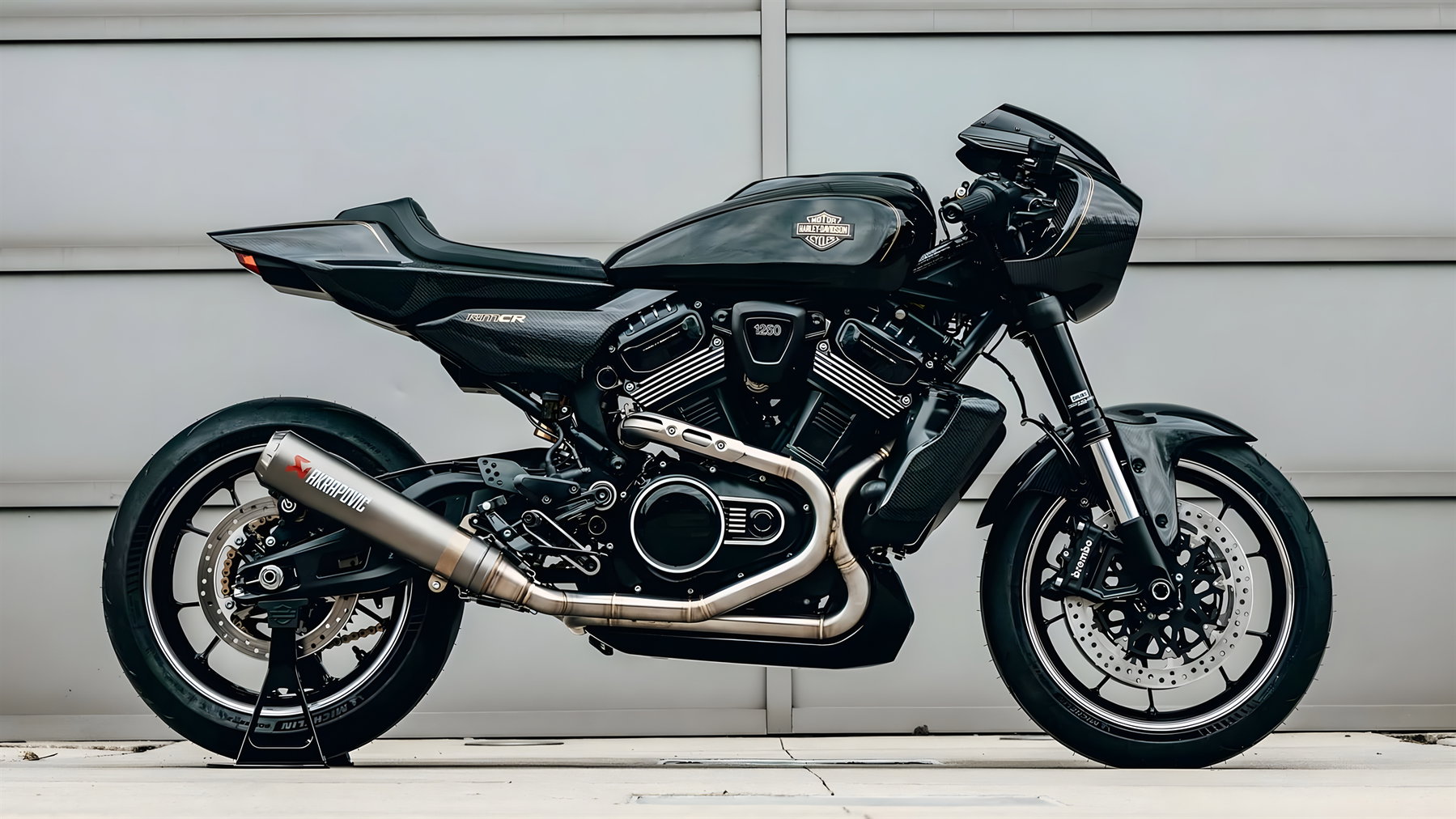
- The RMCR uses the 1,250 cc Revolution Max V2 with around 150 hp (110 kW)
- The last cafe racer from Milwaukee was the XLCR, built from 1977 to 1979
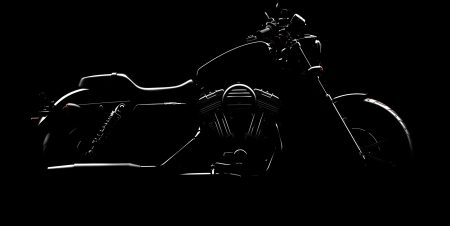
When Harley-Davidson put a black carbon motorcycle called the RMCR on stage at the Mama Tried Motorcycle Show in Milwaukee back in February, it remained unclear whether anything more than a one-off would ever come of it. The manufacturer itself described it as a concept with no production plans. Five months on, the picture looks different. Two trademark applications suggest that concrete models are being worked on in Milwaukee.
Why is a trademark application more than a formality?
A trademark application is not a promise of a production model, but it costs money and leaves an official trail. Companies usually secure naming rights once a product is far enough along in development to justify the effort.
The applications for RMCR and RMXR were filed with the US Patent and Trademark Office on 29 July 2026, both on the same day. The RM abbreviation stands for Revolution Max, the brand’s liquid-cooled V-twin family. CR means cafe racer, while XR points to the company’s flat-track tradition.
A degree of caution is still warranted. According to media reports, by no means every protected name makes it into production. The best-known counter-example at Harley-Davidson is the Bronx, a naked bike on the Revolution Max platform that was announced in 2019 and cancelled again in 2020. A cafe racer and a scrambler from that same announcement round also disappeared back into the drawer at the time.
What is the RMCR like technically?
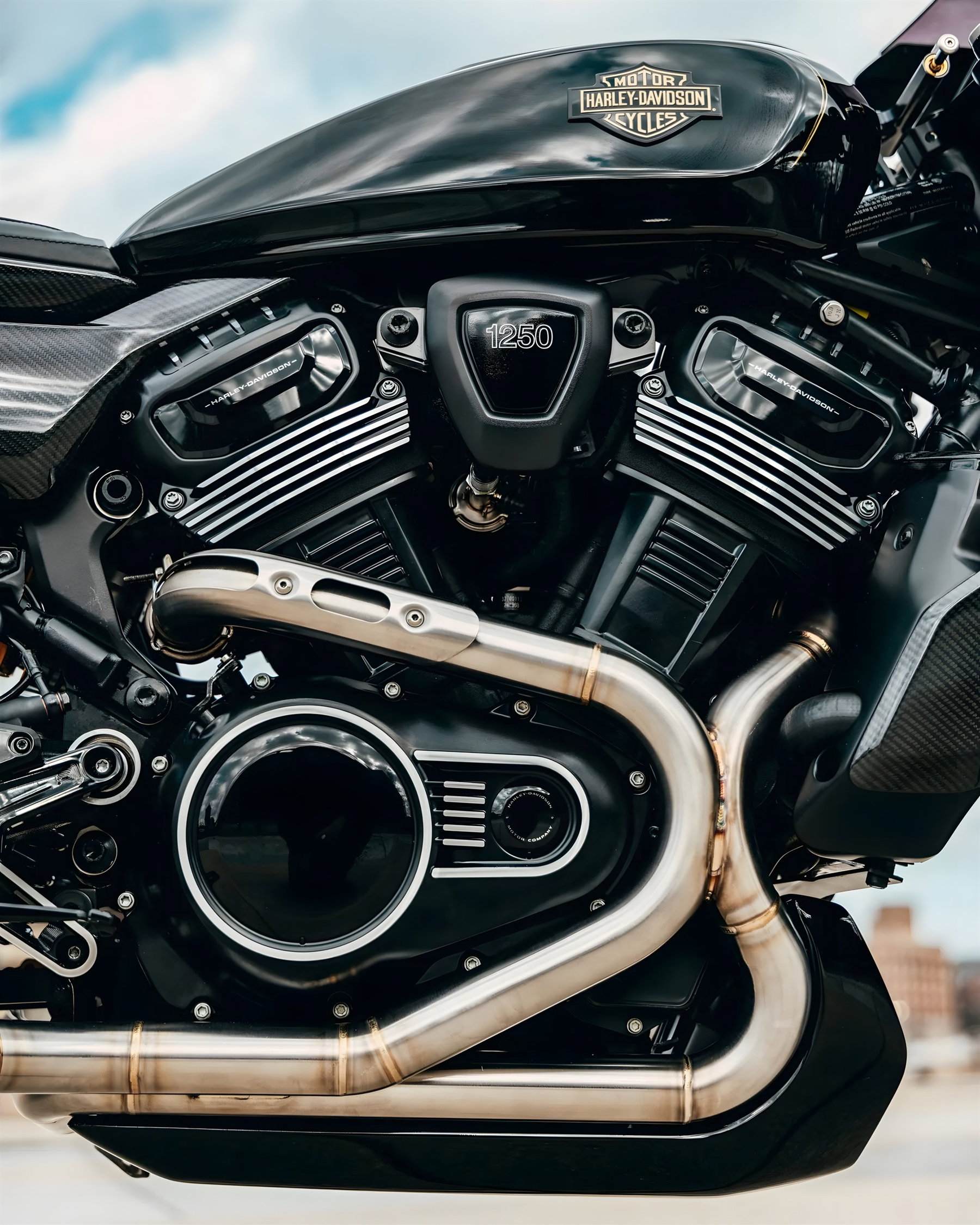
The frame houses the 1,250 cc Revolution Max V2 with around 150 hp (110 kW) and roughly 127 Nm (94 lb-ft). The engine is a stressed member, which means it forms a load-bearing part of the structure, just as it does in the Pan America and the Sportster S.
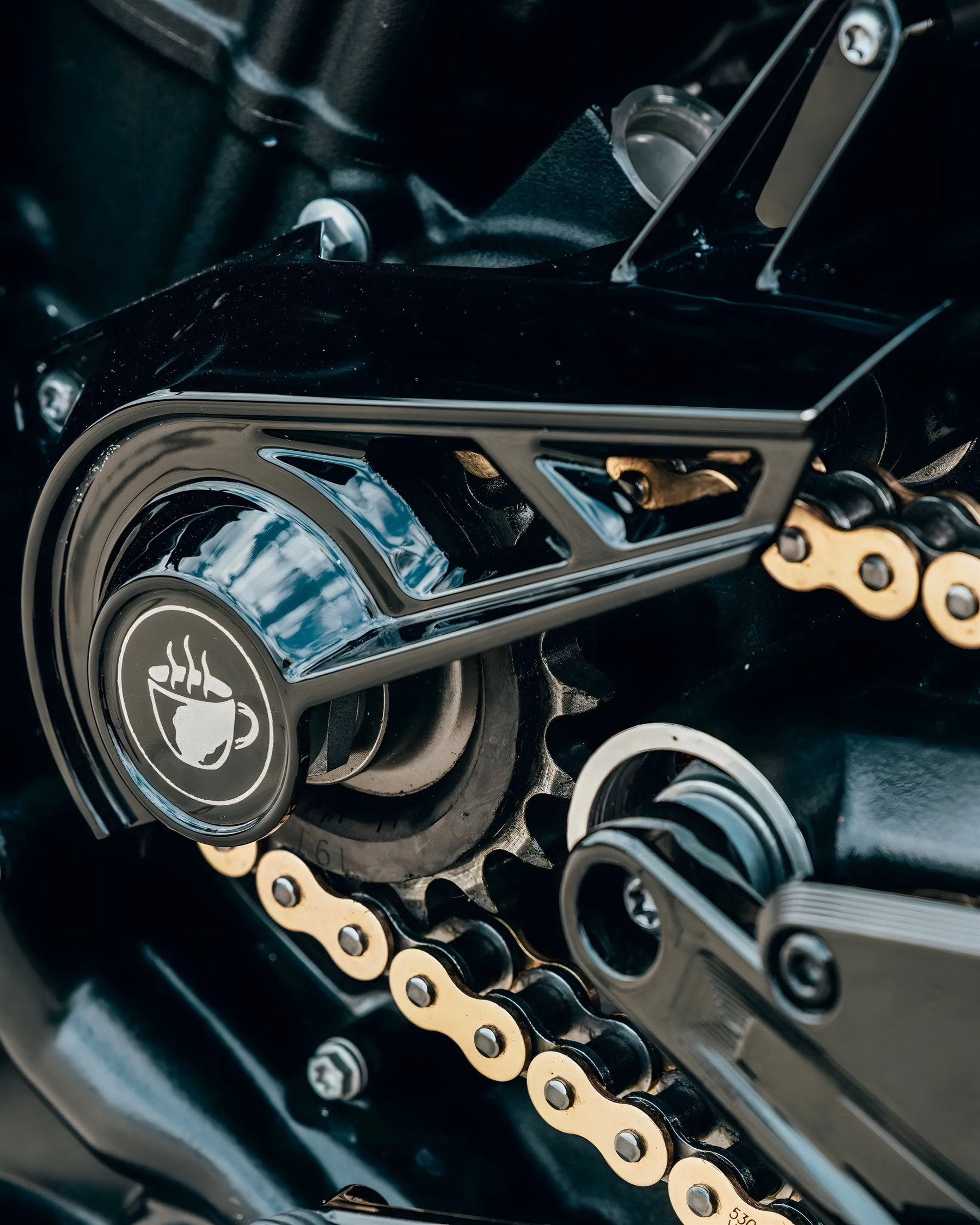
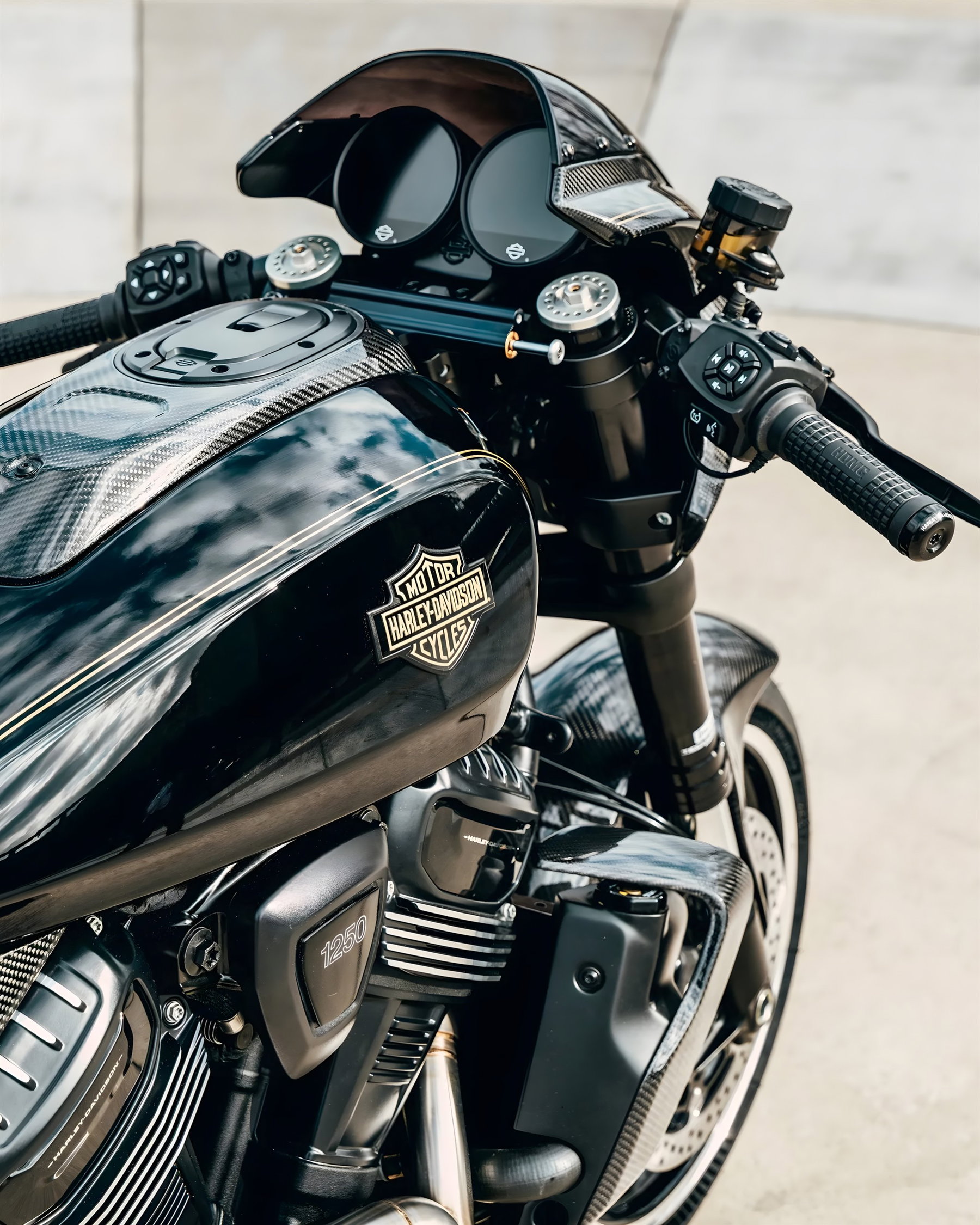
The chassis is unusually sporty for a Harley model. Up front there is a fully adjustable upside-down fork from the Öhlins Black Series, at the rear an equally adjustable shock from the same brand. A steering damper sits between the low-mounted clip-on bars, and Brembo supplies the brakes. Added to that are 17-inch wheels with Michelin Power GP2 supersport tyres and rearset footpegs that allow for more lean angle.
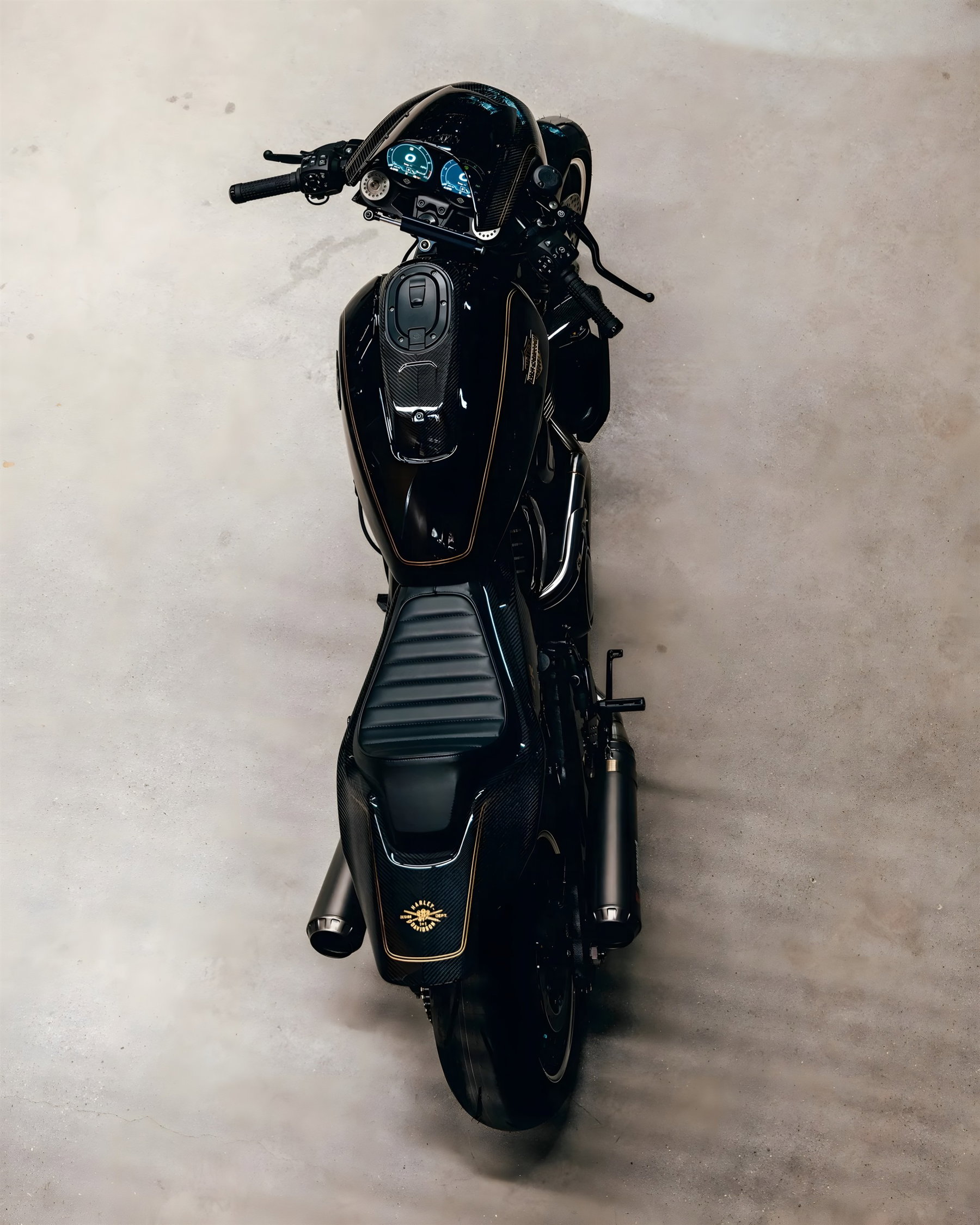
The bodywork is largely made of carbon, from the small headlight fairing with its round LED unit through to the abbreviated tail. Gold-coloured details provide accents. The exhaust system comes from Akrapovic and is designed as a 2-into-2 setup with two separate end cans, partly made of titanium. For a production model, the silencers would probably need a little more volume in order to meet the current Euro 5+ emissions standard.
There are no official weight figures. The Sportster S weighs 228 kg (503 lbs) ready to ride, and the RMCR, with its shorter subframe and more compact aluminium swingarm, is said to come in below that.
What role does the XLCR from the 1970s play?
The XLCR is the historical template for the entire project. Harley-Davidson built it from 1977 to 1979 and sold fewer than 2,000 units in that time.
It was penned by Willie G. Davidson, grandson of one of the company founders and for decades the defining designer at the firm. The XLCR stood out at the time because its slim silhouette and black paintwork did not fit in at all with the brand’s heavy cruisers. Commercially the attempt failed; today the XLCR is a sought-after collector’s item.
The difference in output shows how far apart the two machines are. The XLCR produced 57 hp (42 kW) and around 92 Nm (67.9 lb-ft), while the RMCR with its modern V-twin achieves almost three times the power.
Bjorn Shuster, head of design at Harley-Davidson, frames the project as a tribute. He describes the RMCR as the work of the design team, intended to celebrate the capability of the Revolution Max platform: “Looking at our history and our legacy, we really wanted to celebrate the iconography that’s in Willie’s original XLCR.”
What is known about the RMXR?
So far there is no concept bike and no imagery of the RMXR. The name itself provides most of the clues.
At Harley-Davidson, XR traditionally stands for flat track. The XR750 is regarded as one of the brand’s most successful race bikes, and the XR1200 and XR1200X carried that look over to a production model between 2006 and 2013. Those machines still used the air-cooled Sportster engine. The RM in the new name indicates that the planned revival will rely on the liquid-cooled Revolution Max.
Displacement remains an open question. Either the 1,250 cc of the RMCR or the smaller 975 cc variant used in the Nightster and Nightster S would be possible. That decision will also determine which price segment the model would land in.
How does all this fit Harley-Davidson’s strategy?
Both models would slot directly into the programme Harley-Davidson is running under the name “Back to the Bricks”. The manufacturer presented the plan on 5 May 2026, naming it after the historic company headquarters on Juneau Avenue in Milwaukee, known internally as “the Bricks”.
CEO Artie Starrs has built the strategy on five pillars. These include closer ties to the dealer network, winning back market share in the core business and a more stable financial footing. For the motorcycle business, the company is targeting EBITDA of more than around 304 million euros (350 million US dollars) in 2027. Dealers are expected to double their profitability in 2026 and to double it again by 2029.
Starrs himself mentioned the RMCR when presenting the quarterly figures, without committing to anything. He noted that the concept had been shown at the Mama Tried Show, then in Daytona and at the MotoGP round in Austin, and that the feedback from the riding community had been exceptional: “you might see that from us in the market.”
When could the RMCR and RMXR reach the market?
There is no official date. According to media reports, the timeline from the strategy presentation suggests the RMCR could be unveiled in the autumn as a 2027 model year machine.
For the RMXR the schedule is more open. A prototype premiere at the same time and a production launch only in 2028 would be conceivable. On pricing, too, there are only rough indications so far. In the US the Pan America costs between around 17,350 euros (19,999 US dollars) and around 23,000 euros (26,499 US dollars) depending on specification. Market observers expect the RMCR to sit within that range.
That places the topic within the model offensive with which Harley-Davidson is reshaping its line-up for the 2027 and 2028 model years. The return of the air-cooled Sportster and the entry-level Sprint model are part of it as well. A cafe racer and a flat tracker on the Revolution Max platform would be the sporting counterweight to the classic cruisers.
Frequently Asked Questions
-
What does the abbreviation RMCR mean at Harley-Davidson?
RMCR stands for Revolution Max Cafe Racer. RM refers to the liquid-cooled Revolution Max V-twin engine family, while CR denotes the cafe racer body style. Following the same pattern, RMXR points to a model in the brand’s flat-track tradition.
-
How much power does the Harley-Davidson RMCR have?
The RMCR uses the 1,250 cc Revolution Max V2 with around 150 hp (110 kW) and roughly 127 Nm (94 lb-ft). The same engine powers the Pan America and the Sportster S. There are no official weight figures for the concept.
-
Will the Harley-Davidson RMCR really go into production?
That has not been confirmed. Harley-Davidson has merely registered the name as a trademark and has not published any production plans. The application is regarded as a clear signal, however, because manufacturers usually take this step only once development is well advanced.
-
When was the last cafe racer from Harley-Davidson?
That was the XLCR, built from 1977 to 1979. Fewer than 2,000 examples were made in those three years. If the RMCR went into production, it would be the brand’s first cafe racer in almost 50 years.
➜ This article is part of our comprehensive overview: New Motorcycles 2026: All Models, Releases, and Highlights at a Glance. Find all key information on this topic in one place.