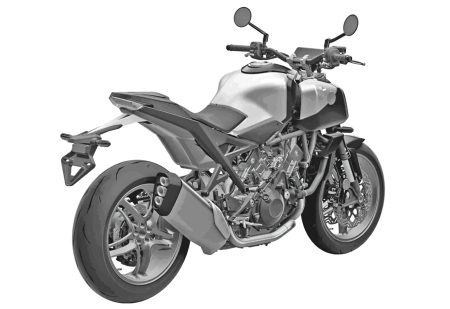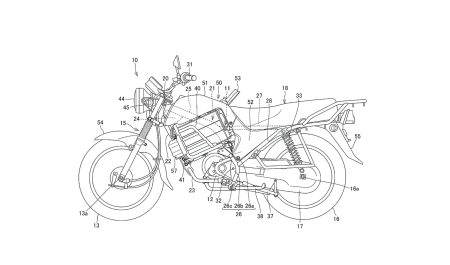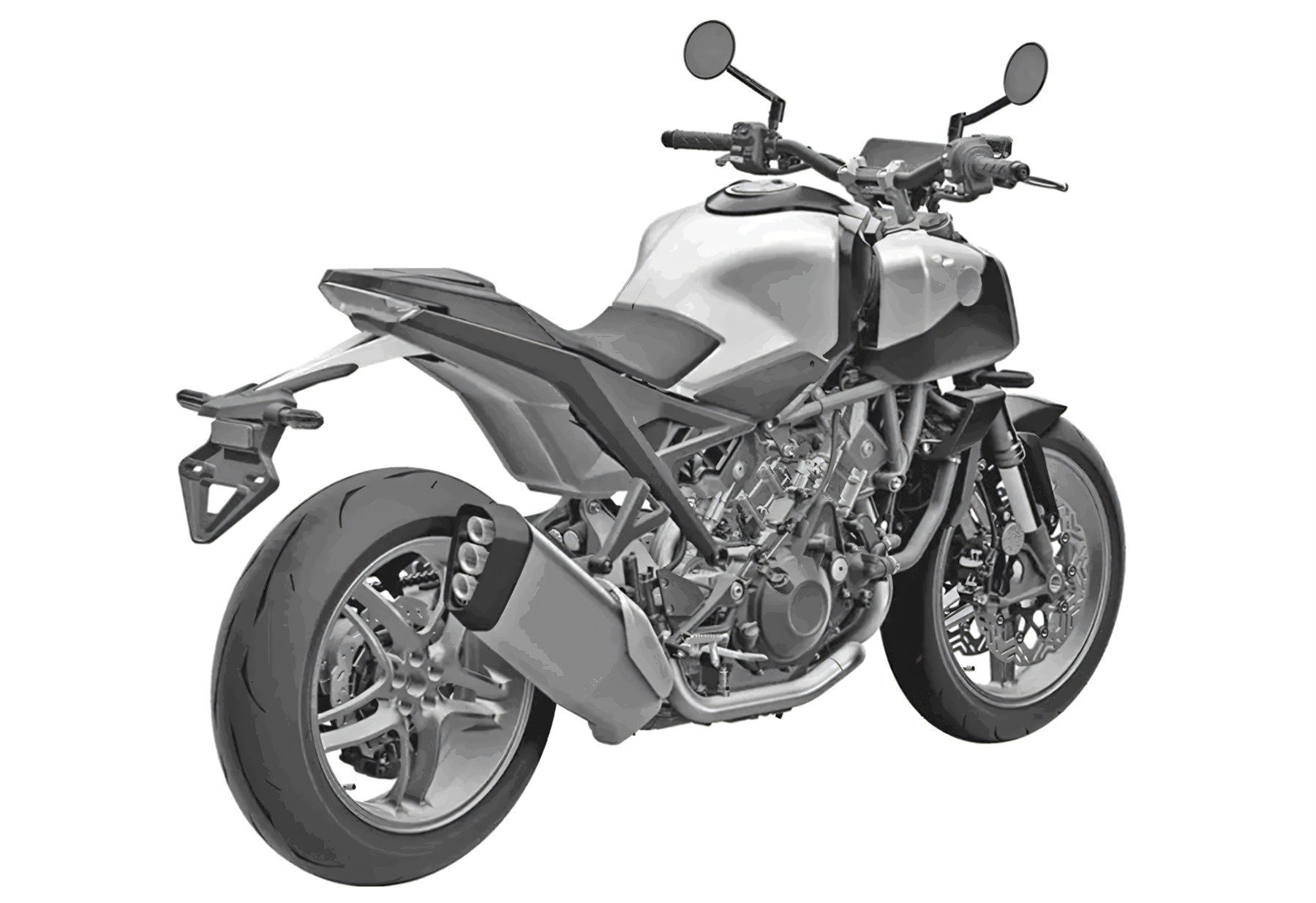
- Production styling visible for the first time, including mirrors, turn signals, reflectors and license plate holder
- V3 engine with 900cc and electronically controlled compressor, output expected to match a 1200cc machine
- Official unveiling with full specifications expected in November at EICMA
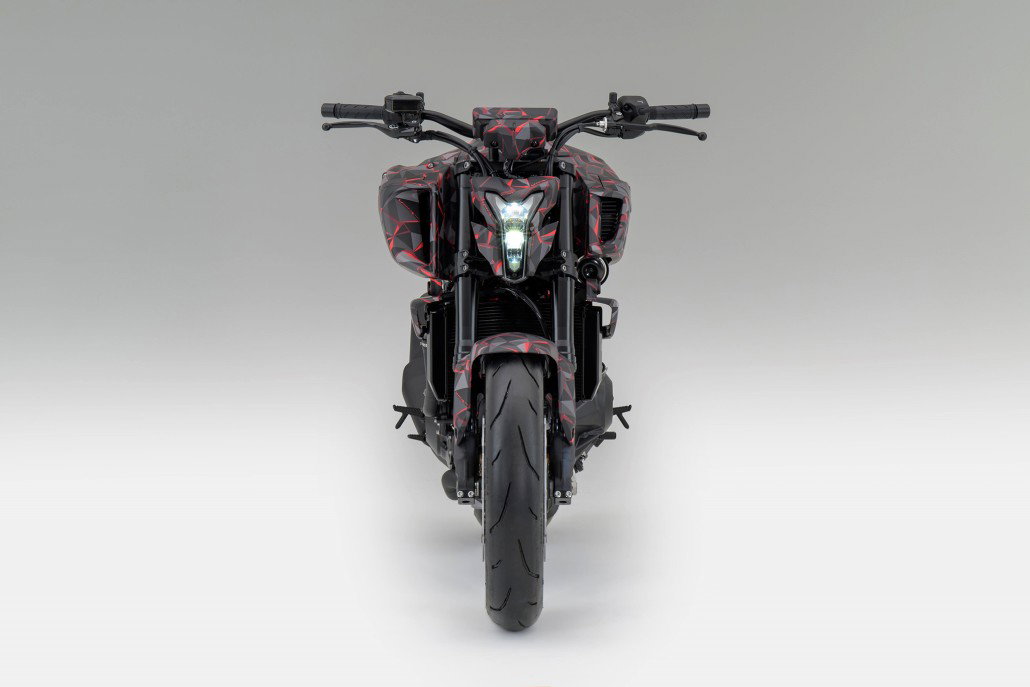
For a long time, the Honda V3R 900 E-Compressor could only be seen under camouflage wrap and in the protected spotlight of the show floor. Now, images from a design patent filing offer a much clearer look at the machine that is set to hit the road. The grey-toned drawings show a motorcycle that stays very close to the prototype, but carries all the parts required for street homologation. That places the V3R 900 among the most exciting motorcycle debuts of the year.
What Do the New Images of the Honda V3R 900 Show?
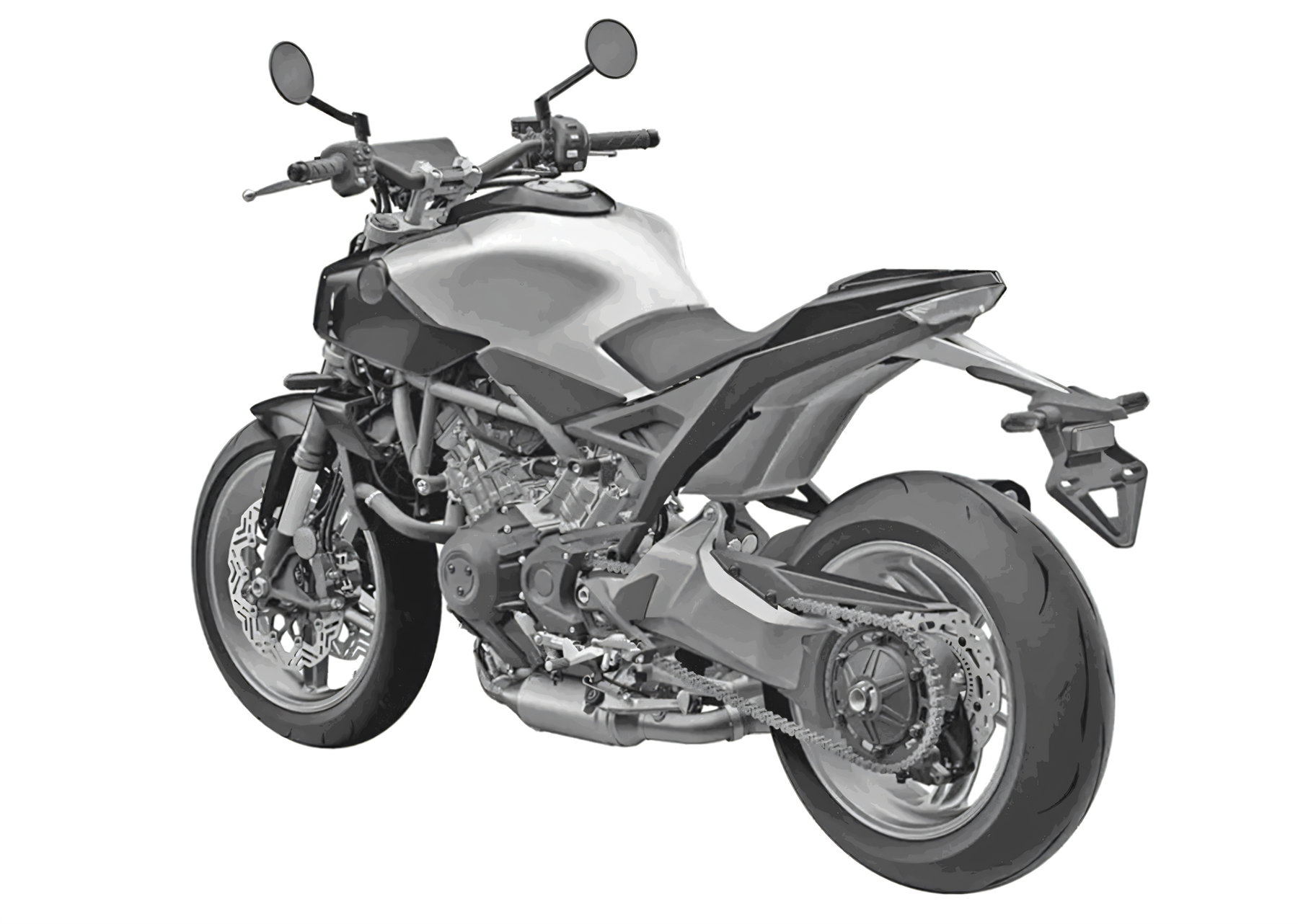
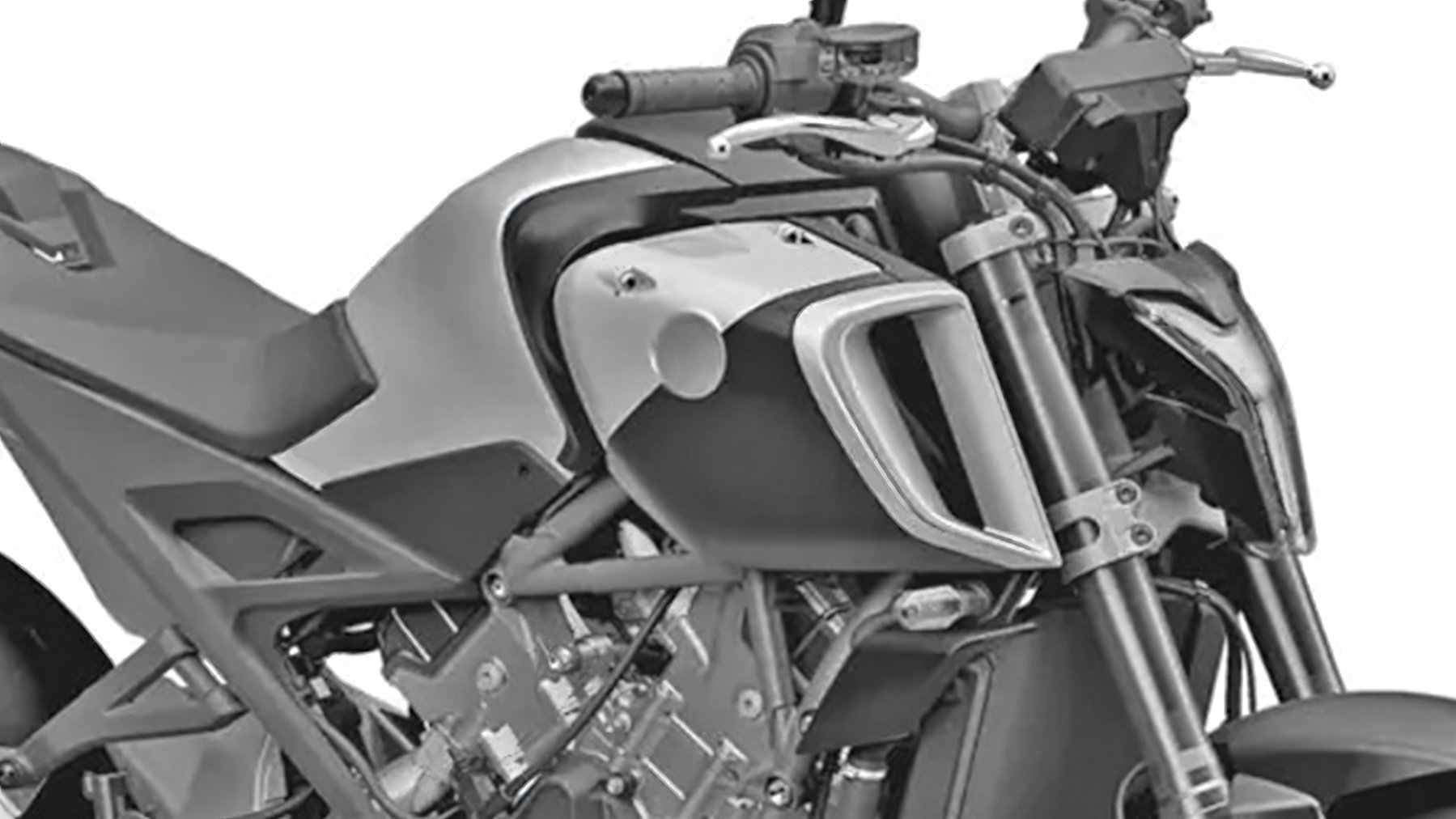
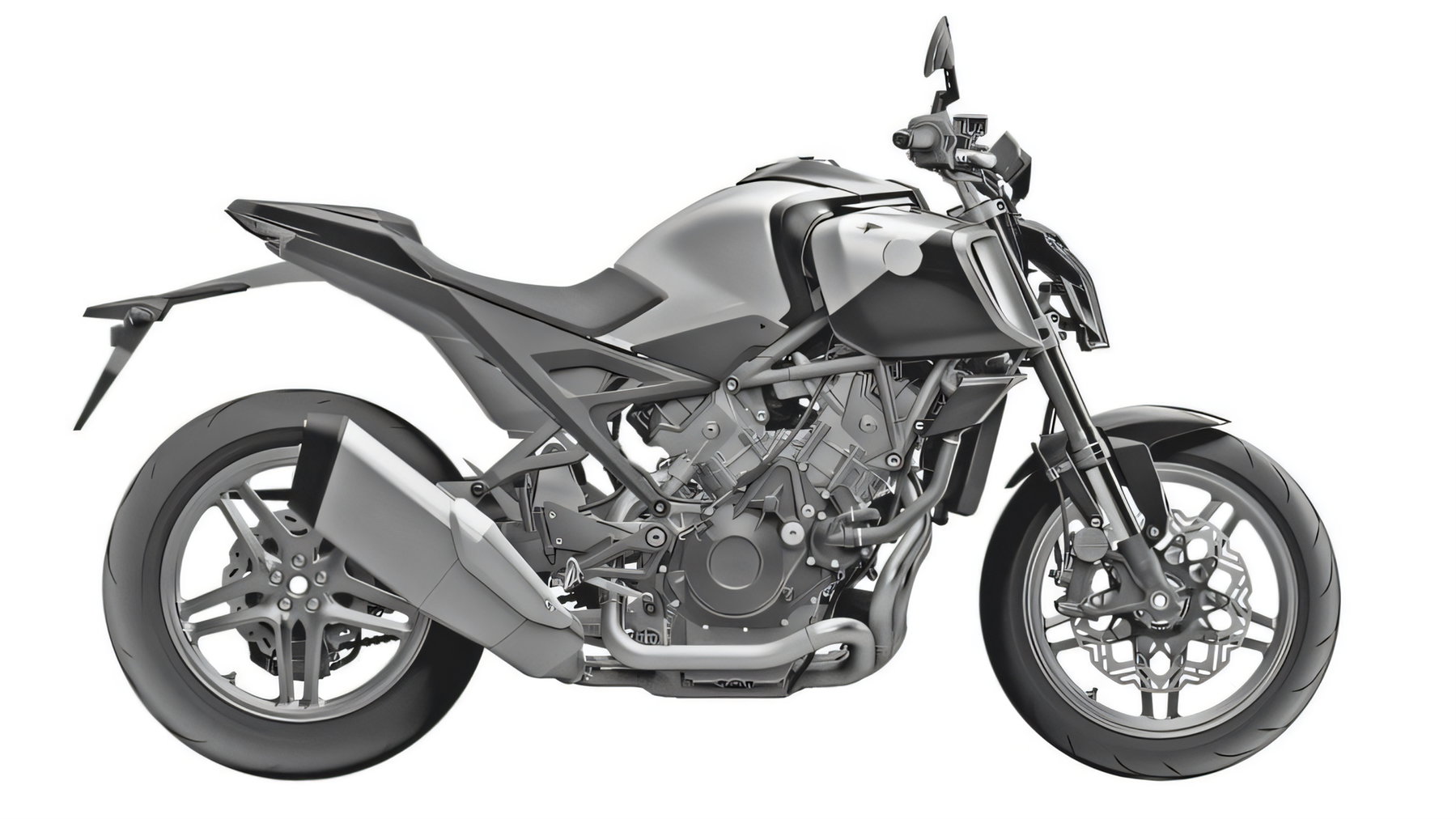
The images show the production-ready V3R 900 with full road-going equipment and without the prototype’s camouflage pattern. The design was filed on March 26, 2026 with the Australian patent office, but only became public now. The documents also reference an earlier filing in Japan from October 2, 2025, which remains under wraps.
What stands out is how little has changed compared with the concept. The single-sided swingarm remains, as does the large air intake that feeds the electrically driven compressor. The narrow, Y-shaped headlight and the trellis frame also carry over. The production machine thus keeps the concept’s promise instead of watering it down. That hasn’t always been the case at Honda in the past — the CB750 Hornet Concept from EICMA 2021, for instance, arrived a year later in a noticeably tamer production form.
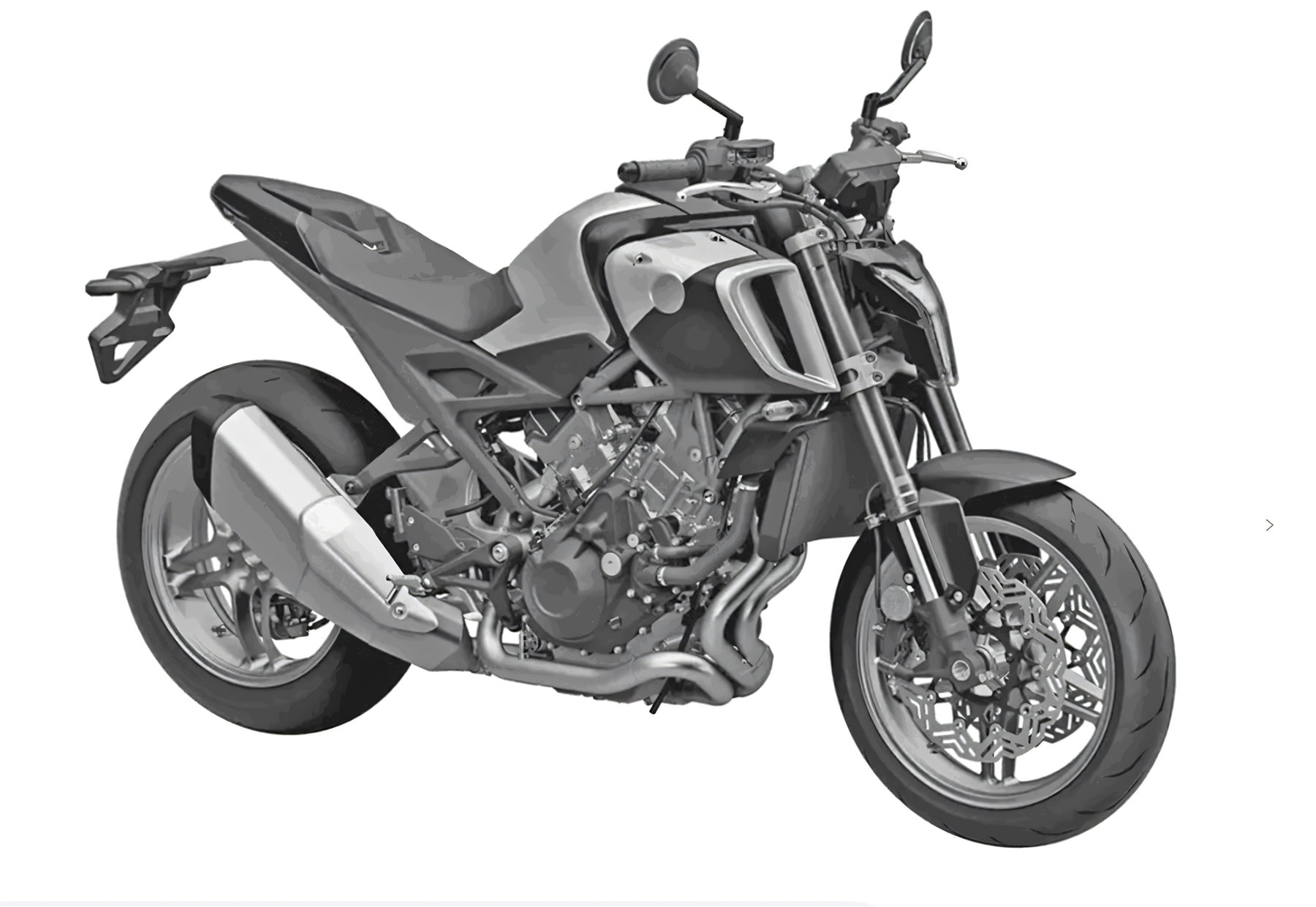
Without the wrap, the individual bodywork panels made of plastic and aluminum are now visible. The side fairings are deliberately asymmetric. The right side is larger than the left because it doubles as the air intake and airbox. A parting line follows the trellis frame’s path up to the steering head. On this line sits a circle where Honda will place the new flagship wing tank emblem set to mark its top-tier models going forward. Up front, an upside-down fork and two radially mounted brake calipers do the work, likely the same Nissin calipers as on the prototype. At the rear, a Honda Pro-Link system supports the single-sided swingarm. The brake discs stand out with a finely detailed cutout pattern that differs from the usual round-drilled discs.
How Does the V3R 900’s E-Compressor Work?
The E-Compressor is an electrically driven supercharger that pushes extra air into the engine on demand. Unlike a classic supercharger, it isn’t linked to the crankshaft and is therefore independent of engine speed. That lets the rider access strong thrust even at low revs, and the dreaded turbo lag should largely be eliminated.
A carefully engineered air system sits behind the technology. The air filter is mounted nearly vertically behind the right-hand air intake. The intake tubes curve upward to separate rainwater from the incoming air. Behind that sits an airbox with two outlets. One leads sideways to the supercharger, which is mounted above the front cylinder bank just behind the steering head. The other leads to a plenum chamber inside the V of the cylinders. That allows the engine to run either as a classic naturally aspirated 900cc unit or switch into boosted operation. As soon as the supercharger kicks in, an electronic valve closes the intake path so the compressed air can’t escape. At wide-open throttle, the electric motor pushes roughly 30 percent more air into the engine than it could draw in on its own. The result is meant to match the output of a 1200cc motorcycle.
The V3 Engine and Its Unusual Layout
The V3 engine is a water-cooled three-cylinder unit with a 75-degree V-angle and 900cc of displacement. Two cylinders face forward, with one sitting alone in the rear bank. It is the first four-stroke V3 in a production motorcycle.
The layout brings a practical advantage. The engine is only as wide as a 600cc parallel twin, yet offers 50 percent more displacement. The supercharger sits centrally on the vehicle’s longitudinal axis so its weight doesn’t upset the balance. For the same reason, the air filter moved out to the right side. On the left, a smaller air duct cools the control electronics. An intercooler isn’t needed with this system. Because the engine spends most of its time running as a small naturally aspirated unit, with the supercharger only kicking in on demand, fuel consumption and emissions are expected to be lower than with a permanently boosted engine. Honda sums up the character under the concept of a “non-railed roller coaster,” meant to deliver promised thrills while still conveying a sense of safety.
How Does the E-Compressor Differ From a Classic Supercharger?
The key difference lies in how it’s driven. A classic supercharger, such as the one used by the Kawasaki Z H2, is mechanically linked to the crankshaft and works depending on engine speed. Honda’s E-Compressor, by contrast, is driven by its own electric motor.
This allows the extra volume of air to be precisely matched to actual demand, independent of engine speed or exhaust flow. A turbocharger, meanwhile, draws its energy from the exhaust and is rare on motorcycles. Honda’s approach combines the advantages of both worlds with precise electronic control.
Will the Technology Also Appear in Other Honda Models?
It’s possible. In 2026, nine patent documents were published describing an expansion of the E-Compressor technology to other engine layouts. Among those named are the Gold Wing’s boxer engine, the CBR 1000RR Fireblade’s inline four, the Africa Twin’s parallel twin, the VFR 800’s V4, and single cylinders like the one in the CRF300L.
The patents mostly focus on the most efficient arrangement of components such as the air filter, supercharger and plenum chamber, rather than on the technology itself. The goal appears to be a system that can be adapted to different engines and frames with as short an intake path as possible. The documents explicitly mention variants ranging from two-cylinder to six-cylinder units. On paper, that spans everything from a boosted 600cc V-twin to an 1800cc V6, provided they’re all built on the 900cc V3’s base architecture. Such a modular kit would be cheaper than individual solutions, similar to how Honda has already handled its dual-clutch transmission.
When Will the Honda V3R 900 Reach the Market?
A firm sales date hasn’t been set yet. The official unveiling of the production model, complete with full technical data, is expected in November at EICMA, where Honda had previously shown the prototype and the original engine concept.
The fact that the design images were already filed back in March and have only now gone public is seen as a strong sign of an approaching production launch. Honda, however, is staying tight-lipped on the exact timeline. A Honda spokesperson explains: “We’re making progress with this very innovative technology. We don’t have a date set for mass production, but development towards this is ongoing.”
Frequently Asked Questions
-
What is the Honda V3R 900 E-Compressor?
The Honda V3R 900 is a naked bike with a novel V3 engine and an electrically driven compressor. The three-cylinder engine displaces 900cc, but thanks to forced induction it is expected to deliver the output of a 1200cc motorcycle. It is the first production motorcycle with a four-stroke V3.
-
How much displacement does the Honda V3R 900 have?
The Honda V3R 900’s engine displaces 900cc. It is water-cooled and has a 75-degree V-angle with two cylinders at the front and one at the rear. Thanks to the E-Compressor, it is expected to be as powerful as a 1200cc engine despite its smaller displacement.
-
When will the Honda V3R 900 be unveiled?
The official unveiling with full technical specifications is expected in November at EICMA. Honda has not yet announced a concrete sales date. The design documents were already filed in March 2026.
-
What is the difference between the E-Compressor and a turbocharger?
A turbocharger is driven by exhaust gases, while a classic supercharger is driven by the crankshaft. Honda’s E-Compressor, by contrast, uses its own electric motor and therefore works independently of engine speed and exhaust flow. This allows the extra air to be dosed more precisely, and turbo lag should largely be eliminated.
➜ This article is part of our comprehensive overview: Motorcycle Patents and Future Technology: What Manufacturers Are Developing. Find all key information on this topic in one place.