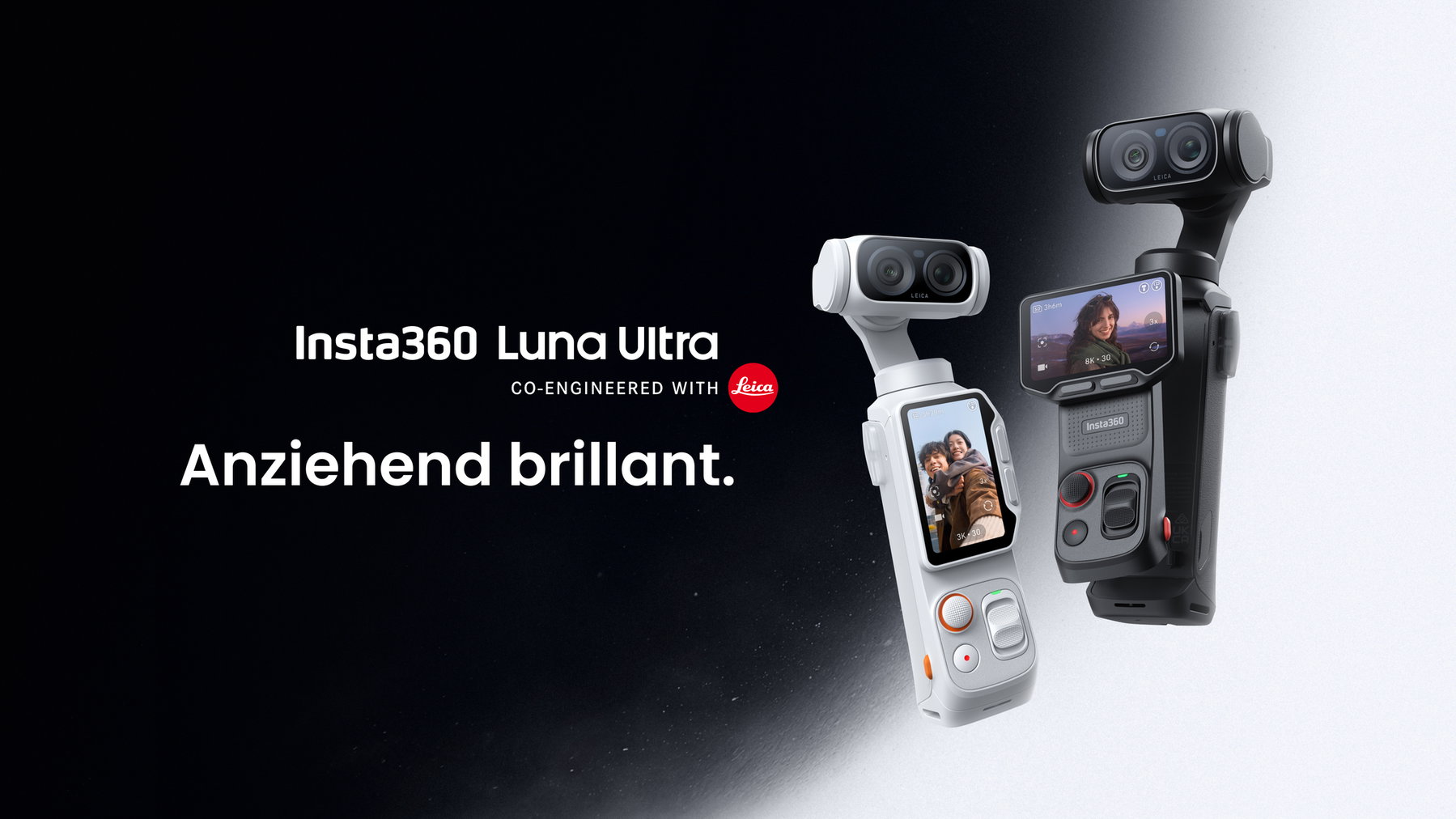
- Two Leica Summicron lenses: 1-inch main sensor (20 mm, f/1.8) and a telephoto with 1/1.3-inch sensor (60 mm, f/2.0)
- 8K at 30 frames per second, 4K up to 120 fps, plus 10-bit I-Log and Dolby Vision
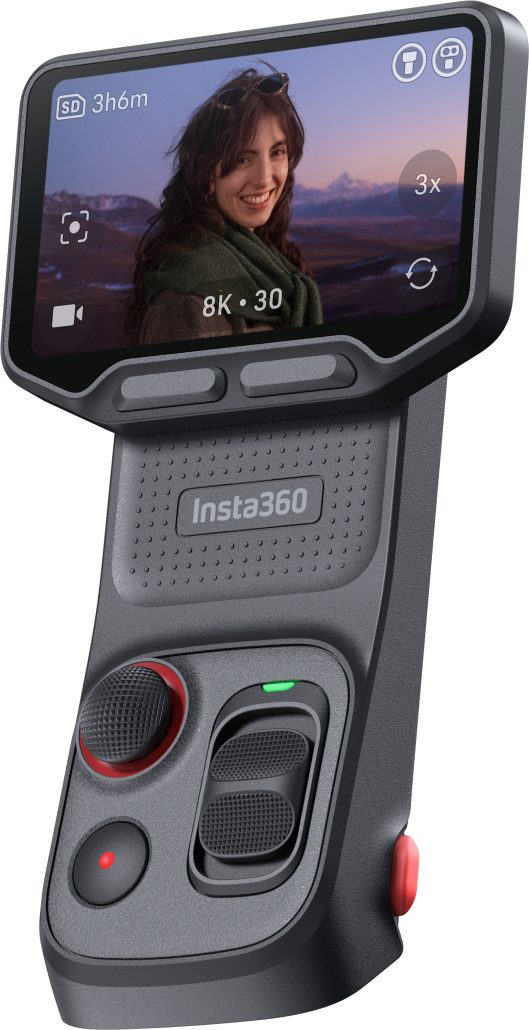
- Detachable 2-inch OLED touchscreen doubles as a remote control over up to 20 meters (65 ft), priced from 729 euros ($769.99)
With the Luna Ultra, Insta360 enters a market segment long dominated by DJI. The camera features a dual-lens system, a three-axis gimbal and a detachable screen that doubles as a wireless remote control. It was developed in partnership with Leica and unveiled at Leica’s headquarters in Wetzlar, Germany. Insta360 has consistently placed emphasis on motorcycle and motorsport content across its camera lineup. How the Luna Ultra performs in that context will likely be explored in a future test, as the camera is not primarily designed as an action cam. Nonetheless, it should prove suitable for many motorcycle-related applications.
What Can the Insta360 Luna Ultra Do?
The Luna Ultra is a compact gimbal camera with two lenses that combines photo and video capabilities with professional aspirations in a device weighing just 233 grams (8.2 oz). According to Insta360, it pairs high-resolution imaging with mechanical three-axis stabilization and a range of creative tools available directly on the camera.
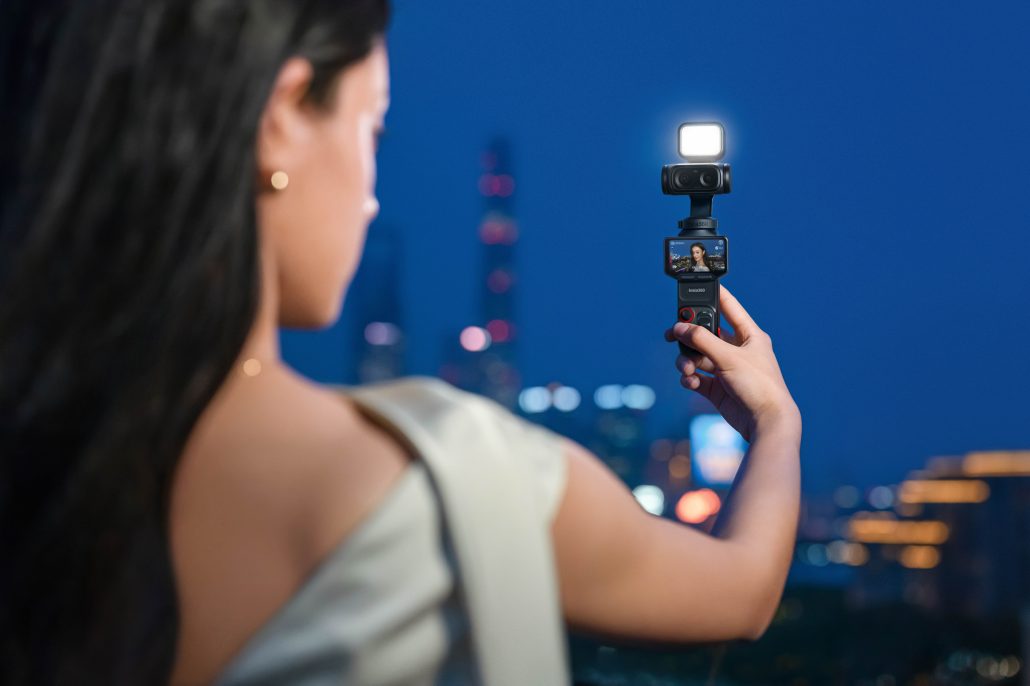
The concept targets users who film alone and need to be both in front of and behind the camera. This is precisely where the detachable touchscreen comes in, enabling operation from a distance. Insta360 co-founder and marketing chief Max Richter describes the move as an entry into a new product category, noting that the company wants to make capturing moments simpler, safer and more authentic.
What Technology Powers the Two Cameras?
At the core are two separate camera systems with different sensors and focal lengths. The main lens uses a 1-inch sensor with an f/1.8 aperture and a 20 mm focal length (35 mm equivalent), while the telephoto lens features a smaller 1/1.3-inch sensor with an f/2.0 aperture and a 60 mm focal length. According to media reports, the main sensor measures approximately 128 square millimeters, while the telephoto sensor covers about 69 square millimeters.
Both lenses record 8K at up to 30 frames per second. In 4K, up to 120 fps is possible, while Full HD supports up to 240 fps for slow motion. The manufacturer claims the system covers up to 14 stops of dynamic range and can record in either a 10-bit I-Log profile or Dolby Vision, with even the standard mode operating at 10 bits. For photos, a 37-megapixel mode and panoramas of up to 200 megapixels are available. Recording uses the H.265 codec at a maximum bitrate of 120 Mbps, with an ISO range from 100 to 6400.
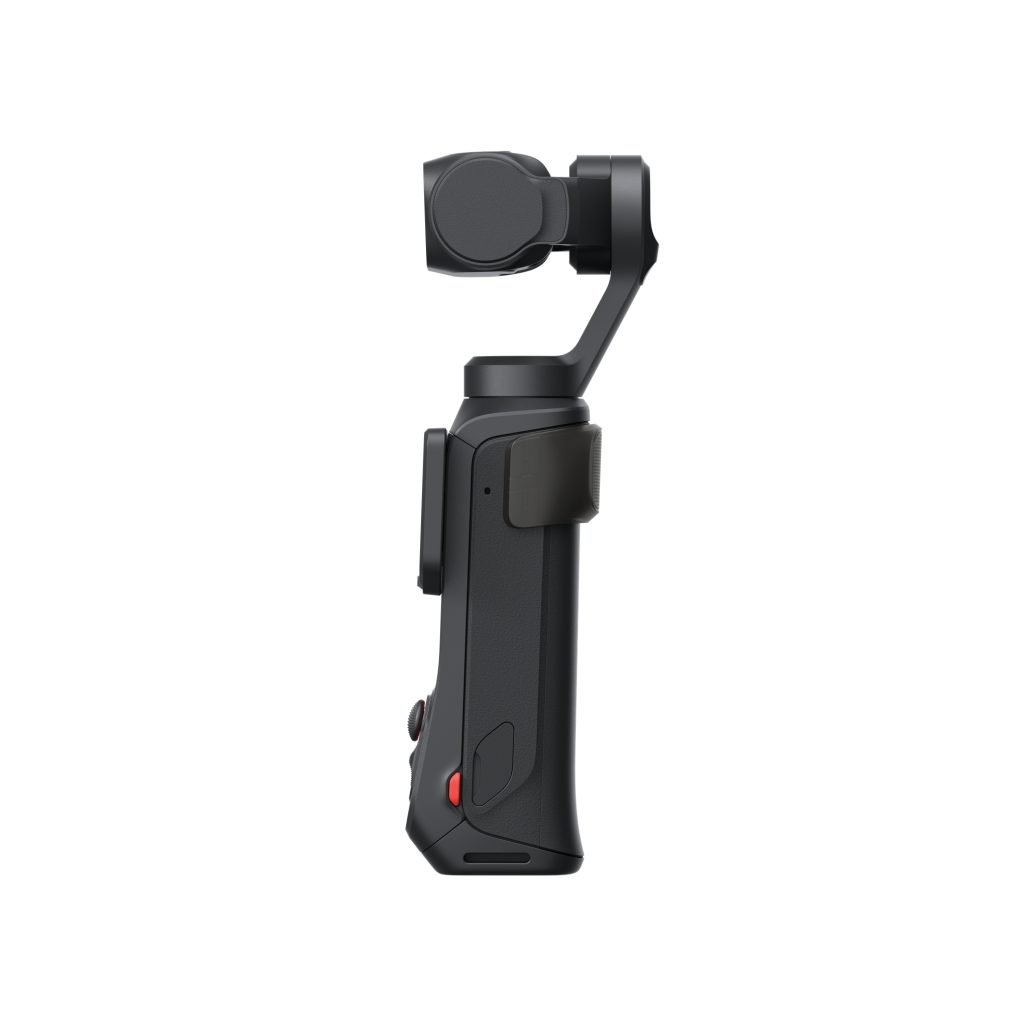
For zoom, the camera combines both lenses. Up to 6x zoom, quality remains virtually lossless according to consistent assessments from early reviews, because a true 3x optical zoom via the telephoto lens works in tandem with sensor-based zoom. Beyond 6x, the camera crops more aggressively into the sensor, which becomes noticeable especially in detail-rich scenes. The maximum 12x zoom is therefore best considered a reserve. In practice, the switch between the two lenses around 3x zoom can be apparent, for example through a slight color difference in the sky.
How Does the Detachable Touchscreen Work?
The 2-inch OLED touchscreen can be detached from the body and used as a wireless remote control with HD image transmission over up to 20 meters (approximately 65 feet). This allows the camera to remain at a fixed position while the user controls framing, zoom and recording from a distance.
The module contains its own microphone, allowing voice recordings to be captured even when the camera is positioned further away. The detachable screen is widely regarded as a significant advantage for solo shooting. However, the preview resolution is currently somewhat reduced once the screen is removed, making the image appear slightly less sharp. This point has been noted as a criticism in some reviews. Additionally, a histogram is only available through the smartphone app.
There is also criticism regarding the preview in I-Log mode. Many users miss a display adjustment that would provide a rough impression of the final result and make corrections easier. Currently, the camera displays only the flat color profile when I-Log is active. This issue could likely be addressed through a future firmware update.
What Do Early Reviews Say About Image Quality?
In early independent reviews, image quality stood out positively for a device of this size, particularly in the I-Log profile and in low light. The PureVideo mode reduces noise and brightens dark scenes but only works up to 4K at 60 fps and cannot be combined with I-Log.
Regarding resolution, reviewers found that 8K offers only a marginal advantage over 4K and can actually exhibit more image noise in high-contrast scenes, which is why 4K is recommended in many cases. For battery life, Insta360 claims up to four hours, measured at 1080p with 24 fps and the screen and Wi-Fi turned off. Under intensive use with 8K and slow motion, reviewers achieved closer to two hours in practice, while one test recorded about two hours and 47 minutes at 4K with 24 fps. No overheating occurred at 4K with 24 fps, but at 4K with 120 fps the camera shut down after about 44 minutes, and at 8K with 24 fps after around 49 minutes. It should be noted that the camera has two batteries, one in the body and one in the detachable control module, both of which need to be charged.
Another noted strength is close-up photography: at 6x to 7x zoom, the Luna Ultra achieves nearly a 1:1 reproduction ratio, enabling true macro shots. A technical note concerns the frame rate: the camera operates at a true 24 frames per second rather than the more common 23.976, which must be accounted for when mixing footage with material from other cameras in post-production.
Leica Partnership and Color Profiles
The Luna Ultra is the fifth jointly developed product from the now six-year collaboration between Insta360 and Leica. It incorporates Leica Summicron lenses along with color profiles such as Leica Natural, Leica Vivid and Leica Chrome, supplemented by cinematic filters. For more demanding workflows, the camera supports professional color workflows including ACES as well as integrated timecode for multi-camera synchronization.
Marius Eschweiler, Vice President of the Mobile Business Unit at Leica Camera AG, describes the result: “Together with Insta360, we have developed a camera system that combines optical precision, intuitive operation and the distinctive Leica imaging aesthetic in a compact form factor.” On the audio side, the camera features a total of four microphones and a windscreen on the front microphone. Up to two wireless microphones can be connected directly to the camera, or up to four via the Mic Pro system over USB, including 32-bit float backup recording.
DJI Dispute: Where Does the Luna Ultra Fit in the Market?
The Luna Ultra enters a market that DJI has long dominated with its Osmo Pocket lineup and is regarded as the first serious competition in this segment. DJI is preparing its own dual-lens model with the Osmo Pocket 4P, so a direct comparison is still pending.
The launch is accompanied by a legal dispute. According to media reports, DJI sued Insta360 for alleged infringement of several Osmo Pocket patents, prompting Insta360 to file a countersuit claiming five patent violations of its own. A particular dynamic exists in the US market: since DJI products are effectively unavailable through regular channels there, the Luna Ultra is currently one of the few readily available dual-lens gimbal cameras in the United States. The sales launch was apparently moved up after retailer listings went live prematurely and a buyer was able to purchase the device before the official release date.

How Much Does the Insta360 Luna Ultra Cost and When Is It Available?
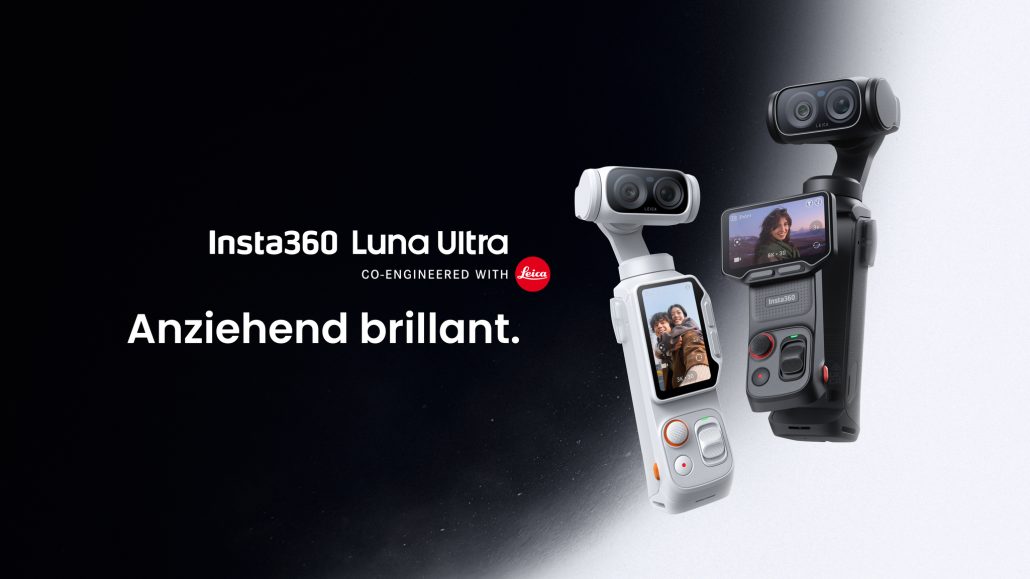
The Luna Ultra is priced at 729 euros ($769.99) for the Standard Bundle and 929 euros ($979.99) for the Creator Bundle. The camera is available in Night Black and Astral White. The Standard Bundle includes the camera, a windscreen, a protective case, a wrist strap and a grip with a 1/4-inch thread. The Creator Bundle adds a Mic Pro transmitter, a battery grip with an additional battery, a wide-angle lens and a carrying case.
Internationally, the Luna Ultra has been available since June 10 through the Insta360 Store, Amazon and select retailers, with sales in Germany starting on June 30. The specifications include 47 GB of internal storage expandable via microSD card up to one terabyte, a USB-C 3.0 port and fast charging to 80 percent in approximately 23 minutes. A separate accessory lineup includes a POV head tracker for hands-free recording, black mist filters, a wide-angle lens with a field of view up to 108 degrees and ND filters.
-
How much does the Insta360 Luna Ultra cost?
The Insta360 Luna Ultra is priced at 729 euros ($769.99) for the Standard Bundle and 929 euros ($979.99) for the Creator Bundle.
-
How much zoom does the Insta360 Luna Ultra offer?
The camera offers up to 12x zoom, with up to 6x zoom showing no visible quality loss. This is achieved by combining a true 3x optical zoom via the telephoto lens with sensor-based zoom.
-
What video resolution does the Luna Ultra support?
The Luna Ultra records 8K at up to 30 frames per second, 4K at up to 120 fps, and Full HD at up to 240 frames per second for slow motion.
-
How long does the Insta360 Luna Ultra battery last?
Insta360 claims up to four hours of battery life, measured at 1080p with 24 fps. In practice, intensive use with 8K and slow motion yields closer to two to three hours depending on the mode.
-
Who developed the Luna Ultra?
The Luna Ultra was developed jointly by Insta360 and Leica and is the fifth collaborative product from the two companies. It was unveiled at Leica’s headquarters in Wetzlar, Germany.