- Five traffic offences between December 2024 and September 2025, three of them for unnecessary noise
- The authority ordered an MPU in January 2026, no report was ever submitted, and the licence was revoked in May 2026
- The Koblenz Administrative Court rejected the urgent application on 7 October 2026 (ref. 4 L 948/26.KO)
Short stretches, lots of throttle, loud music and the same attitude at every police check: he claimed he had done nothing wrong. For one young driver, that combination was enough to lose his licence. Normally, offences of this kind are first handled by the Flensburg points system with its staged measures. The licensing authority did not wait for that. It demanded a medical-psychological assessment (MPU) at an early stage. The Koblenz Administrative Court upheld this approach in summary proceedings and spelled out clearly when individual offences turn into fundamental doubts about someone’s fitness to drive.
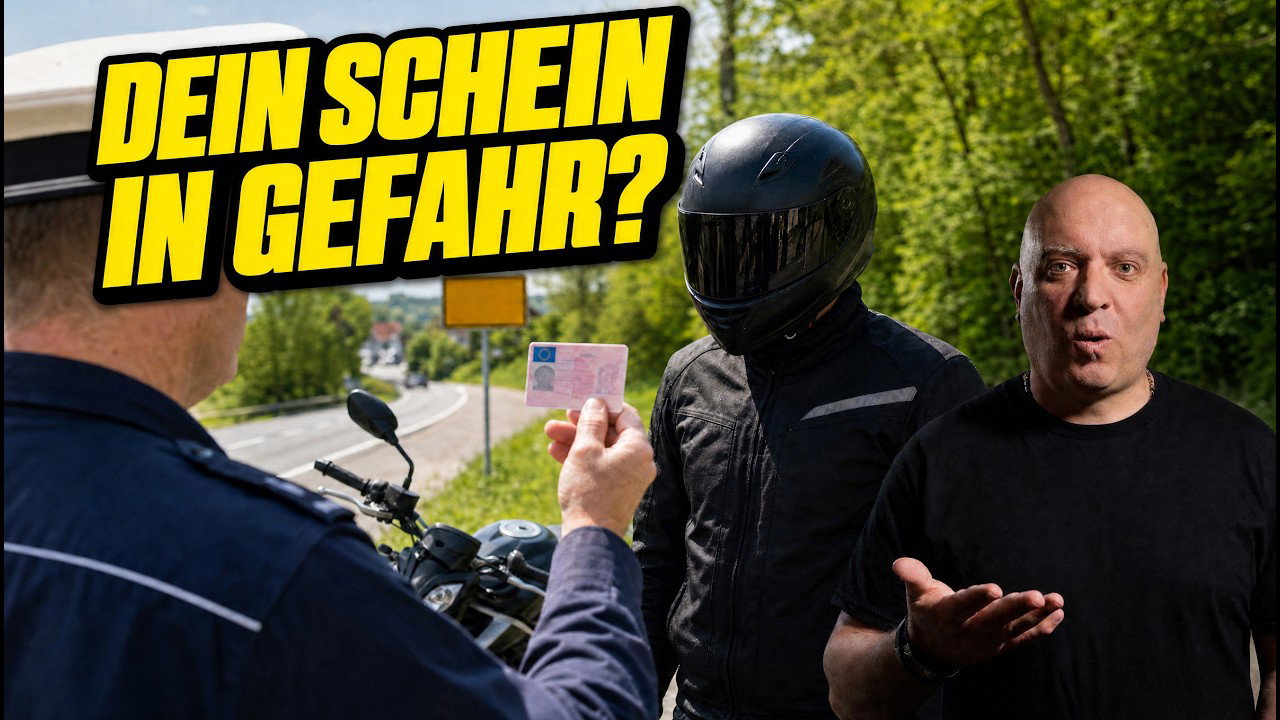
Video language available in English and German
What did the car poser in Koblenz do?
Between December 2024 and September 2025, the man was caught committing traffic offences five times, mostly behind the wheel of rental cars. Three cases involved unnecessary noise from hard acceleration, one involved speeding and one a missing vehicle document.
It started in December 2024 with a rental car in which he drove 56 km/h in a 30 km/h zone in town. In March 2025, at around 11 pm, police officers watched him accelerate a rented Audi so hard on a street in the city centre only 350 to 400 metres long that the engine could be heard loudly. During the subsequent check, he made a dismissive hand gesture at the officers. He claimed not to know why he had been stopped. As soon as the check was over, he floored it again and made even more noise.
In June 2025 he was out in a rented Lamborghini and did not have the vehicle registration document with him. Officially, the document is called Registration Certificate Part I. In August 2025 he turned a corner in a rented Mercedes-Benz convertible so fast that the tyres squealed. After about 200 metres he turned around and drove back with the music blaring. He told the police he was allowed to play his music as loud as he wanted. The squealing was not intentional, he said; the car’s acceleration had surprised even him.
The last incident dates from September 2025. In a residential area, he accelerated a Mercedes-AMG C43 so hard between two traffic lights that considerable noise was produced. Once again, by his own account, he was not aware of any wrongdoing. All five offences ended with legally binding fines. He initially failed to pay two of them, and they had to be collected by enforcement. He had only held his licence since November 2021.
Why was the authority allowed to demand an MPU straight away?
The German Driving Licence Regulation (FeV) allows authorities to demand an MPU report in the event of a serious offence or repeated offences against traffic regulations (Section 11(3) sentence 1 no. 4 FeV). In the Koblenz case, the key point was that the court considered an exception to the points system to be justified.
The driver fitness rating system, i.e. the points system under Section 4 of the Road Traffic Act, generally takes precedence. Anyone who collects points is first supposed to go through the staged support measures of that system. This alone is not meant to trigger an assessment of fitness to drive. An authority may only deviate from this if it explains precisely why a case differs significantly from that of an ordinary road user with the same number of points. The decisive factors are the driver’s personality and the nature, frequency and exact circumstances of the offences.
In the court’s view, the authority did exactly that to a sufficient degree. It pointed to the three noise incidents in which the man showed no remorse and reoffended immediately after a police check. It classified the speeding in the 30 zone as particularly dangerous. Added to this were the short time frame, the licence that was only a few years old and the unpaid fines. The authority itself even counted nine offences in five months. The court based its assessment on the five incidents described. The authority argued that it could not wait until eight points had accumulated in the driver fitness register.
What does the court accuse the driver of in terms of character?
The court sees in the 23-year-old an entrenched attitude of disregarding traffic rules in order to get attention. The decisive factor was above all the three noise incidents within a short period, in which earlier warnings did not make him change his ways.
In the judges’ view, the man subordinates the rules of the road and the interests of other road users and the public to his desire for attention. The ruling states that his behaviour shows a tendency “to place his own exaggerated need for recognition above the applicable law”. This, the court says, is typical of so-called car posers.
It is not just about noise. The court points out that hard acceleration without reason in the middle of town can endanger pedestrians and other road users, because they have no reason to expect it. In doing so, the man violates the basic rule of mutual consideration in Section 1(1) of the German Road Traffic Regulations (StVO). Even the missing registration document plays a small role. On its own it carries little weight. In the chamber’s view, however, it confirms that the driver is indifferent to the rules. The court concludes that even the measures of the points system would not have got him to drive in compliance with the rules.
What happens if the MPU report is not submitted?
If someone fails to submit a required report on time, the authority may conclude that the person is unfit to drive motor vehicles (Section 11(8) FeV). The prerequisite is that the order explicitly pointed out this consequence.
In the Koblenz case, the authority’s letter of 5 January 2026 contained this notice. The deadline ran until 5 April 2026. No report had been submitted by then, nor by the time of the revocation decision on 27 May 2026. If someone is unfit, the authority must revoke the licence. It has no discretion in this.
The MPU itself is not a punishment. Fines penalise an offence. The medical-psychological assessment, by contrast, is only meant to clarify whether someone is fit to drive a vehicle. It is only justified if there are concrete indications of shortcomings in that fitness.
Does this also apply to motorcyclists?
The Koblenz case concerns cars only. However, the regulations on which the authority and the court relied are not limited to cars. They refer generally to vehicles and motor vehicles.
This applies, for example, to Section 30(1) StVO. It prohibits unnecessary noise, avoidable exhaust nuisance and the unnecessary running of engines when using vehicles. It also prohibits unnecessarily driving back and forth in built-up areas if this disturbs others. The MPU provision of the Driving Licence Regulation is likewise linked generally to violations of traffic regulations.
There is, however, no automatic MPU for anyone who is too loud on one occasion. In 2021, a petition to the German Bundestag called for the MPU to be introduced as a standard measure for car posers. The Petitions Committee rejected this in December 2021. Its reasoning: the existing options are sufficient. In the case of frequent offences without points, what matters is an overall assessment of the individual case. This must reveal an entrenched, indifferent attitude towards traffic regulations. The Koblenz ruling shows what such a case-by-case assessment can look like in practice.
What happens next in the Koblenz proceedings?
The decision was made in summary proceedings. An appeal to the Higher Administrative Court of Rhineland-Palatinate is possible. Because the authority ordered immediate enforcement and the court confirmed this, the revocation already takes effect now, even before it becomes final.
The man had lodged an objection to the revocation at the beginning of July 2026. In these proceedings, the court only ruled on the urgent application. After a preliminary review, it considers the objection likely to fail. An appeal would have to be lodged within two weeks of notification of the decision and substantiated within one month. This requires a lawyer or another person authorised to represent him.
Frequently Asked Questions
-
Can you be ordered to take an MPU for car posing?
Yes, if there are repeated or serious violations of traffic regulations. In the case before the Koblenz Administrative Court, five offences in around nine months, including three noise incidents, were enough. The driver’s lack of remorse was decisive.
-
When can the authority order an MPU before eight points are reached?
Only in exceptional cases, because the points system generally takes precedence. The authority must explain precisely why the case differs significantly from that of an ordinary road user with the same number of points. Reasons can be the nature, frequency and circumstances of the offences.
-
What happens if you do not submit a required MPU report?
The licensing authority may then assume a lack of fitness to drive and revoke the licence. The prerequisite is a corresponding notice in the order. The Koblenz driver lost his licence in exactly this way.
-
Is the MPU a punishment for traffic offences?
No, offences are penalised with fines. The MPU only clarifies whether someone is fit to drive a vehicle. It requires concrete indications of shortcomings in that fitness.