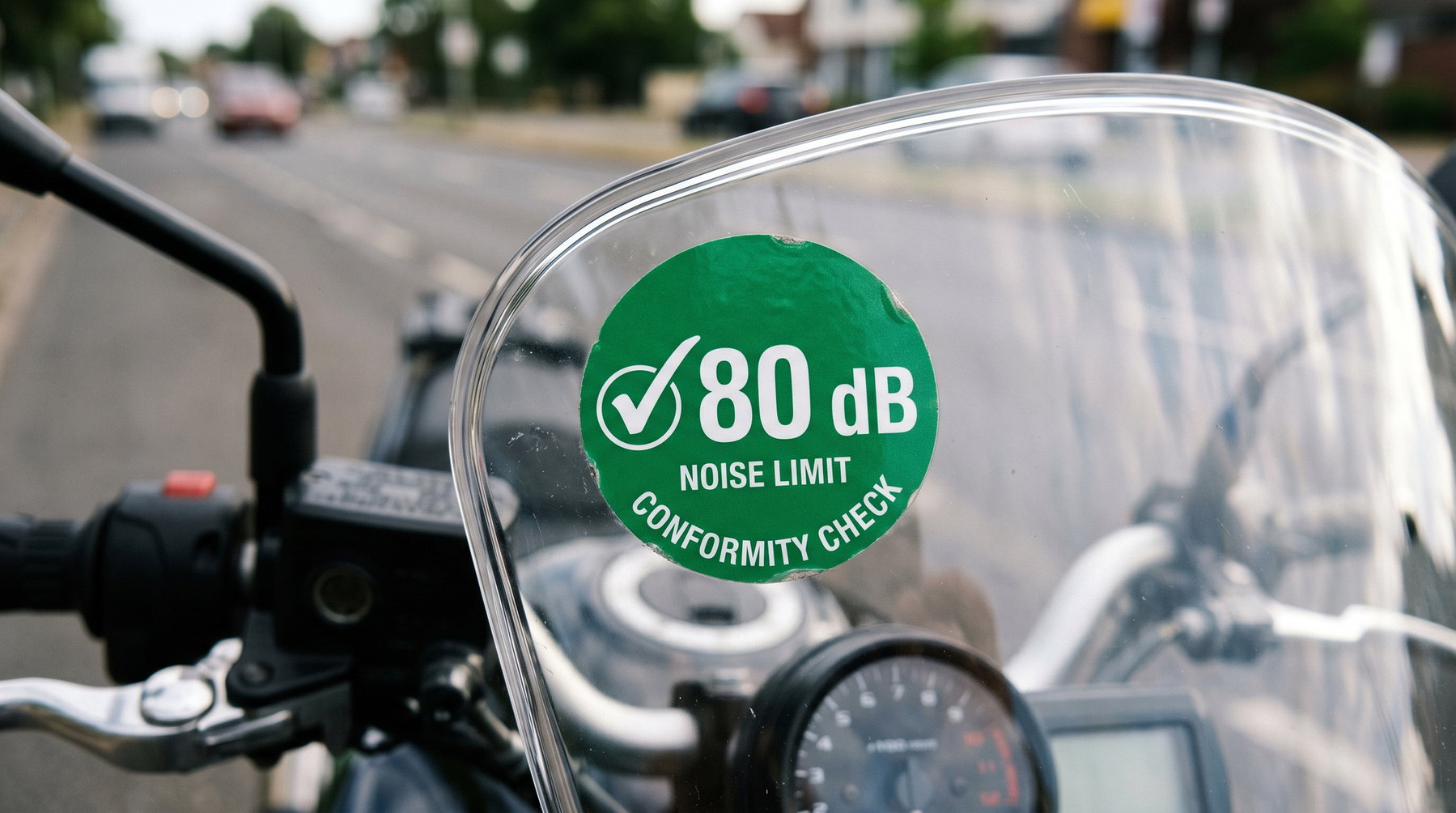
- The demands include a noise limit of 80 dB(A), noise protection zones with a badge requirement, and a ban on exhaust flaps and factory-installed sound generators.
- The proposal originates from an application by the Federal Association Against Motorcycle Noise to the Transport Ministers’ Conference, supported among others by Deutsche Umwelthilfe.
- The Tyrolean model serves as a benchmark, already closing certain roads to motorcycles with a stationary noise level above 95 dB(A).
A debate is gaining momentum in Germany that could have far-reaching consequences for motorcyclists. Several organizations want to permanently close particularly affected roads to loud vehicles and regulate access through a badge on the vehicle. Unlike the familiar Sunday and public holiday closures, such a system would apply permanently and could be introduced across state borders. This places the initiative within the ongoing noise debate, which also includes the annual road closures in Tyrol and pilot projects such as those in the Lower Saxony district of Holzminden.
What exactly are the environmental groups demanding?
At their core, the organizations are demanding a noise limit of 80 dB(A), stricter controls, higher fines, and a badge system for noise protection zones. The 80-decibel demand goes back to an application by the Federal Association Against Motorcycle Noise to the Transport Ministers’ Conference, published under the motto “Getting loud so it gets quieter” in late February 2026. According to the association, it is supported among others by Deutsche Umwelthilfe, the Silent Rider association with Nideggen Mayor Marco Schmunkamp, and the United Working Groups Against Motorcycle Noise led by Holger Siegel.
Deutsche Umwelthilfe goes even further in its own catalog of demands. It calls for a ban on factory-installed exhaust flaps and sound generators, stricter requirements for vehicle inspections, stronger owner liability, so-called noise cameras modeled on the French approach, and noise displays for awareness. Additionally, the DUH advocates for a combustion engine ban for motorcycles from 2030 onward. The organization justifies this by stating that “noise peaks from motorcycles and sports cars endanger health and quality of life.”
What does the stationary noise level actually mean?
The stationary noise level is not the loudness at idle, but is measured at a precisely defined, elevated engine speed. Under current regulations, police measure the stationary noise at half the rated speed if the rated speed exceeds 5,000 rpm, and at three-quarters of the rated speed if it falls below that threshold. For a machine with a rated speed of 7,500 rpm, for example, the measurement is taken at approximately 3,750 rpm.
The measurement method itself also matters. The microphone is positioned at the height of the exhaust outlet, at a distance of half a meter and at a 45-degree angle to the exhaust opening. Because the measurement is taken so close to the exhaust, the numerical value of this near-field level is significantly higher than the pass-by noise, which is recorded from several meters away during a drive-by. The stationary noise value is recorded in the vehicle registration document under item U.1, while the pass-by noise is found under U.3. The stationary noise level serves primarily as an easily verifiable control criterion at the roadside.
What does a limit across all operating conditions mean?
A limit across all operating conditions means that a vehicle must remain quiet in every combination of gear, engine speed, and load, not just within a narrow test window. The technical term for this is a not-to-exceed limit. To put the demand in context, it helps to look at how noise and power are related in a combustion engine.
Engine noise increases with speed and load. The more power is demanded, the more combustion events occur, the higher the gas throughput and mechanical movement, and the louder the vehicle becomes. Modern motorcycles are therefore designed to remain quiet in the most common everyday situations, such as constant-speed riding or city traffic, where many people are in close proximity. At these operating points, noise levels are deliberately kept low, which simultaneously limits the power available at that moment.
However, power is not only needed in the city. During acceleration or on an incline, the engine operates in higher speed and load ranges where it is physically louder. This is not avoidable additional noise but a consequence of the power being demanded, which cannot be arbitrarily reduced without compromising rideability. These are precisely the operating conditions that were only partially captured in previous type approval procedures. Earlier versions of the UNECE regulation focused on individual scenarios such as acceleration at town exits or urban traffic. Outside these tested ranges, vehicles could be louder while remaining fully compliant.
This is where the Additional Sound Emission Provisions, or ASEP, come in. They were introduced because originally only a single driving condition was tested. With UNECE Regulation R 41.05, in effect since January 2025, these requirements have been significantly expanded: values must now be maintained up to 80 percent of maximum engine speed, in the speed range of 10 to 100 km/h, and in all gears. The actual limit for pass-by noise remains unchanged at 77 dB(A) for approximately 80 percent of motorcycles. A uniform upper limit across all operating conditions, as demanded by the organizations, would go beyond even these already expanded test ranges.
Is this manipulation like the diesel scandal?
A direct comparison with the diesel scandal does not quite hit the mark. In the diesel scandal, the engine control unit detected the test bench and deliberately switched to a lower-emission mode to deceive the measurement. Such detection of the test cycle by the engine control unit has been explicitly prohibited for motorcycles since the 2016 reform. The fact that a vehicle was louder outside the tested range was therefore not necessarily based on illegal deception, but on the fact that the procedure simply did not measure these operating conditions. Added to this is the physical relationship between load and noise, which requires no manipulation.
The noise protection organizations nonetheless see the focus on technical design. According to the Federal Association Against Motorcycle Noise, manufacturers have deliberately calibrated engine management and exhaust flaps to the legal test parameters, so that the flaps open outside the test window and the vehicle becomes louder. The association also criticizes that ASEP values are predominantly confirmed under manufacturer self-responsibility and that real-world road emissions are barely monitored. What remains contentious is how far the higher noise under load is an unavoidable physical effect and how far it results from deliberate technical design.
Are 80 dB(A) even achievable for motorcycles?
Whether the limit is realistic depends crucially on which measurement parameter the 80 dB(A) refers to, and it is precisely at this point that interpretations diverge. In public coverage, the demand is sometimes understood as a pure stationary noise ceiling. The Deutsche Umwelthilfe concept, however, envisions two values: one to be maintained across all operating conditions and an additional one for the stationary noise level.
If the 80 dB(A) were applied as a stationary noise limit, the threshold would fall below what virtually all currently available motorcycles achieve. Even the Honda SH125i, a comparatively quiet 125cc scooter, registers 82 dB(A) stationary noise under current rules. For comparison: the Austrian Tyrolean model sets the limit at 95 dB(A) stationary noise and already excludes a significant number of factory-standard, legally approved machines. A mark of 80 dB(A) would, by this measure, affect virtually the entire current fleet.
Even as a not-to-exceed limit across all operating conditions, the value is considered very demanding. At full acceleration and high engine speeds, a motorcycle can hardly be quiet due to its design. Unlike a car, it has no enclosed engine bay and very little room for sound insulation, because weight and space are tightly constrained and the powertrain is largely exposed. The power demanded during acceleration or on an incline inevitably generates noise. A level that remains very low even under such load could hardly be achieved through tuning alone but would noticeably reduce usable power. Trade publications also point out that motorcycles in normal road traffic are often no louder than cars, and in some situations even quieter. The debate therefore ignites less around the traffic average than around individual load situations at high engine speeds.
How would the badge system with noise protection zones work?
The proposed badge system is modeled on the environmental badge: only vehicles that meet the established values would receive a badge and be allowed to enter designated noise protection zones. According to DUH, the option to close individual roads or areas to loud vehicles already exists. A badge is intended to simplify the implementation and enforcement of such regulations.
Under the plans being discussed, the zones would primarily affect winding roads, mountain passes, and village through-roads — classic excursion routes. Such zones could be established permanently and could in principle be extended across multiple federal states. This distinguishes them from time-limited weekend or public holiday closures.
What would a badge system mean for touring riders?
For touring riders, such a system could mean that popular travel regions would only be fully accessible with a sufficiently quiet vehicle and the appropriate badge. From low mountain ranges to alpine valleys, these are precisely the areas where noise protection initiatives are most active.
Should noise protection zones be designated there, access would depend on whether a motorcycle falls below the required limit. Grandfathering provisions for already registered machines are not included in the current proposals.
Why is the Tyrolean model so controversial?
The Tyrolean model is controversial primarily because it uses the stationary noise level as its criterion, even though this value says little about actual noise during riding. In Tyrol, a riding ban has been in effect since 2020 from April 15 to October 31 on several roads in the districts of Reutte and Imst for motorcycles with a stationary noise level above 95 dB(A). According to ADAC, violations can result in a fine of 220 euros, which under certain circumstances can reach up to 726 euros.
The decisive point of criticism is the meaningfulness of the measured value. Stationary noise and pass-by noise are measured completely differently — the former at a fixed engine speed in the near field, the latter at varying speeds during a drive-by. The correlation between the two values is weak. In practice, this leads to paradoxical results: there are motorcycles with low stationary noise that are perceived as significantly louder during riding, and conversely machines with high stationary noise that are comparatively quiet on the road. An analysis by the trade magazine MOTORRAD found that of 414 models examined, 321 are permitted to ride in Tyrol, including models considered extremely loud during riding. Machines with unremarkable pass-by noise whose stationary noise exceeds the limit — perhaps due to age — remain excluded.
Additionally, the stationary noise level is not legally regulated as a limit value at all. It actually serves only as an easily verifiable control criterion that can be used at the roadside to investigate suspected manipulation of the exhaust system. Industry associations such as Arge 2Rad therefore criticize that an inherently non-binding value has been made the basis for permanent riding bans. The European Commission, however, sees no legal violation in the regulation. Supporters argue that particularly high near-field levels characterize those noise situations that residents perceive as disturbing.
What is the political status in Germany?
The initiative targets the Transport Ministers’ Conference, but concrete federal legislative changes have yet to materialize. The Federal Association Against Motorcycle Noise points to a Bundesrat resolution from 2020 (motion 125/20) that has not been implemented to this day. North Rhine-Westphalia’s Transport Minister Oliver Krischer is quoted by the association as saying that politicians must finally act, calling for structural solutions to reduce noise pollution. How far a German model would ultimately reach and which measurement parameter would be used remains an open question.
Frequently Asked Questions
-
What is the noise badge for motorcycles?
The noise badge is a vehicle marking demanded by environmental organizations, comparable to the environmental badge. Only motorcycles that meet specified noise levels would be allowed to enter designated noise protection zones. No legal basis for this currently exists.
-
How is the stationary noise level measured on a motorcycle?
The stationary noise level is measured at a defined elevated engine speed, not at idle. For engines above 5,000 rpm, this is half the rated speed; below that, it is three-quarters of the rated speed. The measurement is taken in the near field, half a meter from the exhaust outlet at a 45-degree angle.
-
Does the stationary noise level say anything about riding noise?
Only to a very limited extent. Stationary noise and pass-by noise are measured differently and correlate only weakly. A motorcycle with low stationary noise can be louder during riding than one with high stationary noise.
-
Who is demanding the 80 dB limit for motorcycles?
The demand for a noise limit of 80 dB(A) comes from an application by the Federal Association Against Motorcycle Noise to the Transport Ministers Conference. According to the association, it is supported among others by Deutsche Umwelthilfe, the Silent Rider association, and the VAGM.
-
How loud can a motorcycle be in Tyrol?
In Tyrol, certain roads in the districts of Reutte and Imst are closed to motorcycles with a stationary noise level above 95 dB(A). The regulation runs annually from April 15 to October 31. Violations can result in fines from 220 euros up to 726 euros.
➜ This article is part of our comprehensive overview: Motorcycle Law & Policy: Legislation, Court Rulings and Developments for Riders. Find all key information on this topic in one place.