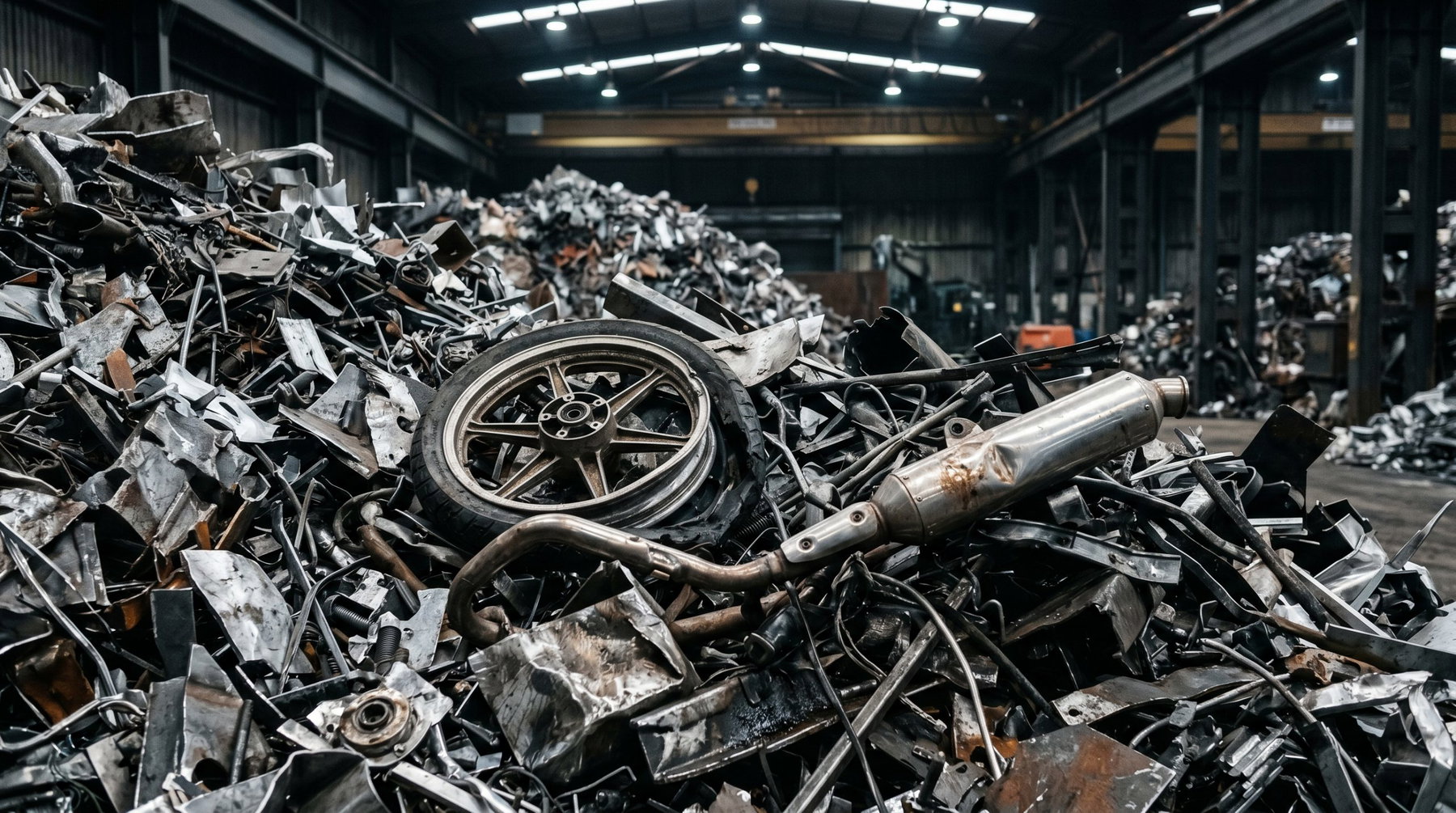
- A valid vehicle inspection certificate is sufficient proof that a vehicle is not scrap – no additional expert report is needed
- A vehicle whose repair is not financially worthwhile is still not scrap – the owner may keep or repair it and has five years to do so
- The legal situation remains unclear when selling individual parts from a vehicle dismantled by its owner
The European Parliament approved the new law on 18 June 2026 in Strasbourg, with almost 80 per cent of the votes cast. Its official title is the Regulation on circularity requirements for vehicle design and on the management of end-of-life vehicles. One small formal step remains – confirmation by the Council of the EU – after which the law will be published. For ordinary vehicle owners, what matters most is what changes when selling a vehicle, after an accident, and when dealing with older machines.
Why is the EU introducing a new end-of-life vehicle law?
The background is the demand for raw materials. Cars and motorcycles contain large quantities of steel, aluminium, plastic and increasingly expensive raw materials such as copper and rare earths, found for example in electronics and electric drivetrains. The EU wants to recover and reuse these materials at the end of a vehicle’s life rather than losing them. Each year, around 6.5 million vehicles in the EU reach the end of their lifespan, out of approximately 285.6 million vehicles on the roads.
A second problem concerns so-called missing vehicles. These are vehicles that disappear from the official system because they are not properly scrapped but instead, for example, illegally dismantled or shipped abroad as supposedly roadworthy used vehicles when they are actually scrap. This is exactly what the EU wants to curb. The law therefore sets out, among other things, when a vehicle counts as scrap and who must prove in which cases that it is not. Instead of the two older EU directives from 2000 and 2005, there will now be a single law that applies directly in all EU countries.
An important note upfront: this law is not about vehicle inspections and not about road safety. A possible inspection requirement for certain motorcycles is indeed being discussed in Brussels as well, but that is a separate process and has nothing to do with the end-of-life vehicle regulation.
The key distinction: used vehicle or end-of-life vehicle?
To understand the entire law, you need to know one single distinction. A used vehicle is a normal, still usable vehicle. It may be driven, sold and bought as usual. An end-of-life vehicle, by contrast, is a scrap vehicle in the eyes of the law. It is classified as waste and must be properly treated at an authorised facility – meaning disposed of and recycled. Such a facility is called a treatment facility in the law. There, all hazardous operating fluids such as oil, petrol and brake fluid are first removed before the vehicle is dismantled and recycled.
The decisive question behind almost everything that follows is always: is the vehicle still a normal used vehicle, or has it already become an end-of-life vehicle, i.e. scrap? Only by keeping this distinction in mind can you understand why proof is needed in some cases but not in others.
When is a vehicle actually classified as an end-of-life vehicle?
Not just anyone can decide on a whim whether a vehicle is scrap. The law contains a fixed set of criteria, referred to as Annex I in the legal text. This list is structured in two tiers.
The first tier covers clear-cut cases. If any of these apply, the vehicle is definitely an end-of-life vehicle. Examples include a vehicle that has already been dismantled into parts, a burnt-out vehicle, a vehicle that was submerged so deeply that the engine or electrics are destroyed, or a vehicle whose structural components such as the frame, steering or brakes can no longer be technically repaired or replaced.
The second tier covers indicators that on their own are not sufficient. These include, for example, a vehicle that has been abandoned, a missing vehicle identification number, or a repair that would cost more than the vehicle’s value afterwards. If such an indicator applies, the vehicle is examined more closely, but it is not automatically scrap. What this means in everyday life becomes particularly clear in the section on total loss below.
What is the proof requirement when selling?
Because the EU wants to prevent scrap vehicles from being secretly resold as normal used vehicles, the law requires proof in certain sales situations. This proof, called a certificate in the law, is simply meant to show that the vehicle being sold is not an end-of-life vehicle, i.e. not scrap.
This proof can be provided in two ways. The first is a valid vehicle inspection – the equivalent of a TÜV certificate in Germany or an MOT in the UK. Passing the inspection provides written confirmation that the vehicle is roadworthy and therefore not scrap. The second is a report by an independent vehicle expert who assesses the vehicle against the law’s criteria. It is an either/or requirement. No one has to provide both.
Crucially, this proof is not required for every sale, only in certain cases. Commercial sellers – i.e. dealers – must provide proof with every sale, regardless of the method. A private individual selling their own vehicle only needs to provide proof in two situations. First, if an insurance company has classified the vehicle as an economic total loss after damage. Second, if the vehicle is sold entirely online and shipped without the buyer and seller meeting in person for a physical handover.
A simple example: if you advertise your motorcycle on an online portal and then hand it over to the buyer in person, no proof is required. If you sell the same motorcycle purely online and ship it by freight carrier without ever meeting the buyer, you must provide proof.
Is the existing vehicle inspection enough, or is an expert report needed?
A valid vehicle inspection is sufficient. No additional expert report is needed, and there is no second examination. The vehicle inspection is already one of the two accepted forms of proof. Only when there is no valid inspection and one of the above cases arises does the second option come into play. The seller must then either have the inspection carried out or commission an expert report. Here too, one of the two is enough.
Can you sell a vehicle privately without a valid inspection?
Yes, that remains possible. An expired inspection does not automatically make a vehicle scrap, because a missing inspection is not on the criteria list for end-of-life vehicles. If a private individual sells their vehicle normally with a personal handover, no proof is required, even if the inspection has expired.
An example: a roadworthy, complete motorcycle without a current inspection is sold privately and handed over on site. No proof is prescribed here. There is only one minor caveat: if an authority has reasonable doubts about whether a vehicle might actually be scrap, it may still request proof.
Total loss: does the vehicle have to be scrapped?
This is where the biggest misconception lies. A total loss does not automatically mean that a vehicle is scrap and must be disposed of. The law distinguishes two types of total loss.
A technical total loss means the vehicle cannot be saved technically – for example because the frame is bent beyond repair or because the vehicle has burnt out. A technical total loss falls under the clear-cut cases and makes the vehicle an end-of-life vehicle. In that case, it must indeed go to a treatment facility.
An economic total loss, by contrast, merely means that a repair is not financially worthwhile because it would cost more than the vehicle’s value. Technically, however, the vehicle can be repaired. Such an economic total loss does not make the vehicle scrap.
An example: a motorcycle is badly damaged in an accident but could be repaired. The insurance company says the repair is not worthwhile and classifies it as an economic total loss. In this case, it is not an end-of-life vehicle. The owner may keep the motorcycle, repair it even if the cost exceeds its value, and sell it. They even have five years to do so. Only if they fail to restore it to a roadworthy, inspectable condition within those five years does it become an end-of-life vehicle afterwards. The situation is different only in the case of a technical total loss. The expert or insurer does not decide at their discretion but must determine the type of damage based on the law’s criteria.
Can you still strip an old vehicle yourself and sell the parts?
This is the most uncertain point in the entire law, because a clear permission is missing. As long as a vehicle is not an end-of-life vehicle, it may be passed on as a used vehicle or parts donor. However, once a vehicle is dismantled in order to use or sell its parts, it is classified as an end-of-life vehicle under the clear-cut criteria. And an end-of-life vehicle must go to an authorised treatment facility – even the professional removal of parts before scrapping is reserved for these businesses. An explicit right for private individuals to dismantle a vehicle themselves and sell the parts individually is not included in the law.
An example: someone buys an older, defective motorcycle to take it apart and use or sell the usable parts for another bike. According to the wording, dismantling turns the vehicle into an end-of-life vehicle that should properly go to a specialist company. This widespread practice of home wrenching, often called home recycling, is seen as being at risk by motorcycle associations. The Federation of European Motorcyclists’ Associations, or FEMA, the European umbrella organisation for motorcyclists, points out that in Nordic countries over 60 per cent of motorcycle parts are reused, compared to under 15 per cent for cars. The association calls for private dismantling for personal use to be explicitly permitted. According to FEMA, this point remains unregulated. Especially for old and rare machines, this could lead to a shortage of used parts.
What about old vehicles sitting deregistered in a garage?
A deregistered vehicle is not automatically scrap. If a complete vehicle with a visible vehicle identification number is stored dry and protected in your own garage, it meets none of the criteria for an end-of-life vehicle. The case of an abandoned vehicle mentioned in the law refers to vehicles that have been left somewhere without permission or in a neglected state – not a vehicle that someone stores at home.
An example: a motorcycle that has been deregistered for years sits dry and complete in a private garage. It is not an end-of-life vehicle as long as it is identifiable, stored in a protected environment and not dismantled. The law only becomes relevant when the machine meets a scrap criterion or when it is sold and one of the two proof cases applies.
What about pure racing vehicles without road registration?
Pure racing vehicles that were never registered for road use are a special case that the law does not clearly address in every respect. Vehicles of particular cultural interest, which can expressly include racing vehicles, may be entirely exempted from the law. For this, the competent authorities must recognise their special value.
An example: a pure, unregistered racing motorcycle sits in a garage and is only used on the track. If the authority recognises it as culturally significant, it falls entirely outside the law. Without such recognition, the rules mainly attach to registration and only become practically relevant when the vehicle meets a scrap criterion or is sold.
Can you still sell a vehicle abroad?
When selling abroad, it depends on whether the vehicle is roadworthy. A roadworthy used vehicle may be sold to countries outside the EU. An end-of-life vehicle, however, is classified as hazardous waste and may not be exported to certain countries outside the EU. The explicit ban on exporting non-roadworthy vehicles to such third countries takes effect five years after the law enters into force.
Where could ordinary owners face problems?
Several points remain tricky for private individuals. The clearest concern is parts recovery, because a self-dismantled vehicle becomes scrap and private stripping therefore stands on shaky legal ground. For pure online sales without handover, it remains unclear how the proof requirement can actually be enforced for private sales. If there is no valid inspection and proof is needed, costs may arise for an expert report. In addition, individual EU countries may regulate certain areas differently – for example regarding mopeds and small motorcycles, or who appoints the experts. And for pure racing vehicles without registration, a clear line is missing as long as no official recognition exists.
When does all of this take effect?
With Parliament’s approval, the decision has been made – formally, only the confirmation by the Council of the EU is still outstanding. After that, the law will be published and enter into force twenty days later. Because it is a regulation, it then applies directly in all EU countries without each country having to transpose it into national law first. However, most of its provisions will only be applied two years after entry into force, and for motorcycles and certain other vehicle types the start is pushed back even further. Some requirements have even longer timelines – for example, the obligation for manufacturers to use recycled plastic in new vehicles, which increases gradually over six to ten years.
So there is still time until actual application. Environmental organisations such as the European Environmental Bureau and Deutsche Umwelthilfe generally welcome the law but see remaining gaps and emphasise that much depends on implementation in individual countries. Motorcycle associations criticise that the specific characteristics of two-wheelers have not been sufficiently considered.
Frequently Asked Questions
-
Has the EU End-of-Life Vehicles Regulation been adopted?
The European Parliament approved the law on 18 June 2026. Only the formal confirmation by the Council of the EU and publication remain. After that, it enters into force and will largely be applied two years later.
-
What is the difference between a used vehicle and an end-of-life vehicle?
A used vehicle is a normal, usable vehicle that may be sold and driven. An end-of-life vehicle is classified as scrap and must be treated at an authorised facility. Most of the law’s rules revolve around this distinction.
-
Do I always need proof when selling?
No, only in certain cases. Dealers must always provide proof. Private individuals only need it in the case of an economic total loss or a purely online sale without personal handover. For a normal private sale with handover, no proof is needed.
-
Is the vehicle inspection sufficient as proof?
Yes, a valid vehicle inspection is sufficient proof that the vehicle is not scrap. No additional expert report is required. An expert report only becomes necessary without a valid inspection and in a proof case.
-
Does a vehicle have to be scrapped after a total loss?
Only in the case of a technical total loss where the vehicle can no longer be repaired. An economic total loss, where the repair is simply not financially worthwhile, does not make the vehicle scrap. The owner may repair or keep it and has five years to do so.