- 502 cc inline four with 72 hp (53.0 kW) at 11,000 rpm, A2 version with 35 kW
- Honda E-Clutch as standard, three riding modes plus two freely configurable USER modes
- Available in the UK from January 2027 for £6,999 (approx. €8,310 / $9,330)
For a long time it was unclear whether Honda’s new small four-cylinder would ever come to Europe. It was first shown in China, later followed by a 400 cc version in Japan. Now the matter is settled: the CBR500R Four is one of Honda’s new models for the 2027 model year and will also be offered in Europe. This means Honda’s small sports class will soon include two motorcycles with almost identical names but completely different engines. The Four suffix makes all the difference.
What sets the CBR500R Four apart from the familiar CBR500R?
The key difference lies in the engine: the existing CBR500R uses a 471 cc parallel twin, while the CBR500R Four gets a newly developed 502 cc inline four. Both models are set to remain in the line-up side by side.
On top of that, the Four has its own chassis and considerably more electronics. It gets a new steel tube frame, the E-Clutch as standard, riding modes and adjustable traction control. Visually, it also goes its own way. In terms of price, however, the two siblings are very close. In the UK, the Four costs only £100 (approx. €120 / $135) more than the twin-cylinder version.
Honda itself describes it as a sports motorcycle for a new, younger generation of riders. The bike is meant to deliver sporty fun at the weekend while remaining practical for everyday use.
What engine does the 2027 Honda CBR500R Four have?
The CBR500R Four has a newly developed 502 cc inline four which, according to Honda, produces 72 hp (53.0 kW) at 11,000 rpm. Peak torque of 47.4 Nm (35 lb-ft) arrives at 9,750 rpm, and the red line only starts at 12,500 rpm.
The figures already show where this is heading: power and torque come high up in the rev range. Honda nevertheless stresses that the engine should also pull cleanly from low revs. Anyone who wants to use the full performance will have to work the gearbox, though.
For riders with an A2 licence, Honda offers a factory version with 35 kW (48 hp).
How is the new four-cylinder engine designed?
The liquid-cooled engine has double overhead camshafts and four valves per cylinder. Bore and stroke measure 60 and 44.4 millimetres, and the compression ratio is 12.3:1. The bore is therefore significantly larger than the stroke. An engine like this is called oversquare and loves to rev.
Technically, the 500 is a bored-out version of the new 400 cc engine from the CB400 Super Four for Japan. In moving to a larger displacement, Honda made improvements in several areas:
- The cylinder walls are coated with nickel silicon carbide. As a result, the engine needs no separate liners, which saves weight and reduces friction.
- In the valve train, a diamond-like carbon (DLC) coating reduces friction.
- The shafts in the engine are arranged so that it is shorter from front to back. This concentrates mass at the centre of the motorcycle.
Air enters a 5.8-litre airbox through two ram-air ducts beneath the headlights. The airbox sits directly above the combustion chambers, so the air flows into the engine from above. Honda calls this a downdraft intake. It is said to respond more quickly to throttle inputs than a horizontal layout. The intake funnels have different lengths, 70 millimetres on the outer and 90 millimetres on the inner cylinders. Above all, this is meant to create a distinctive intake sound.
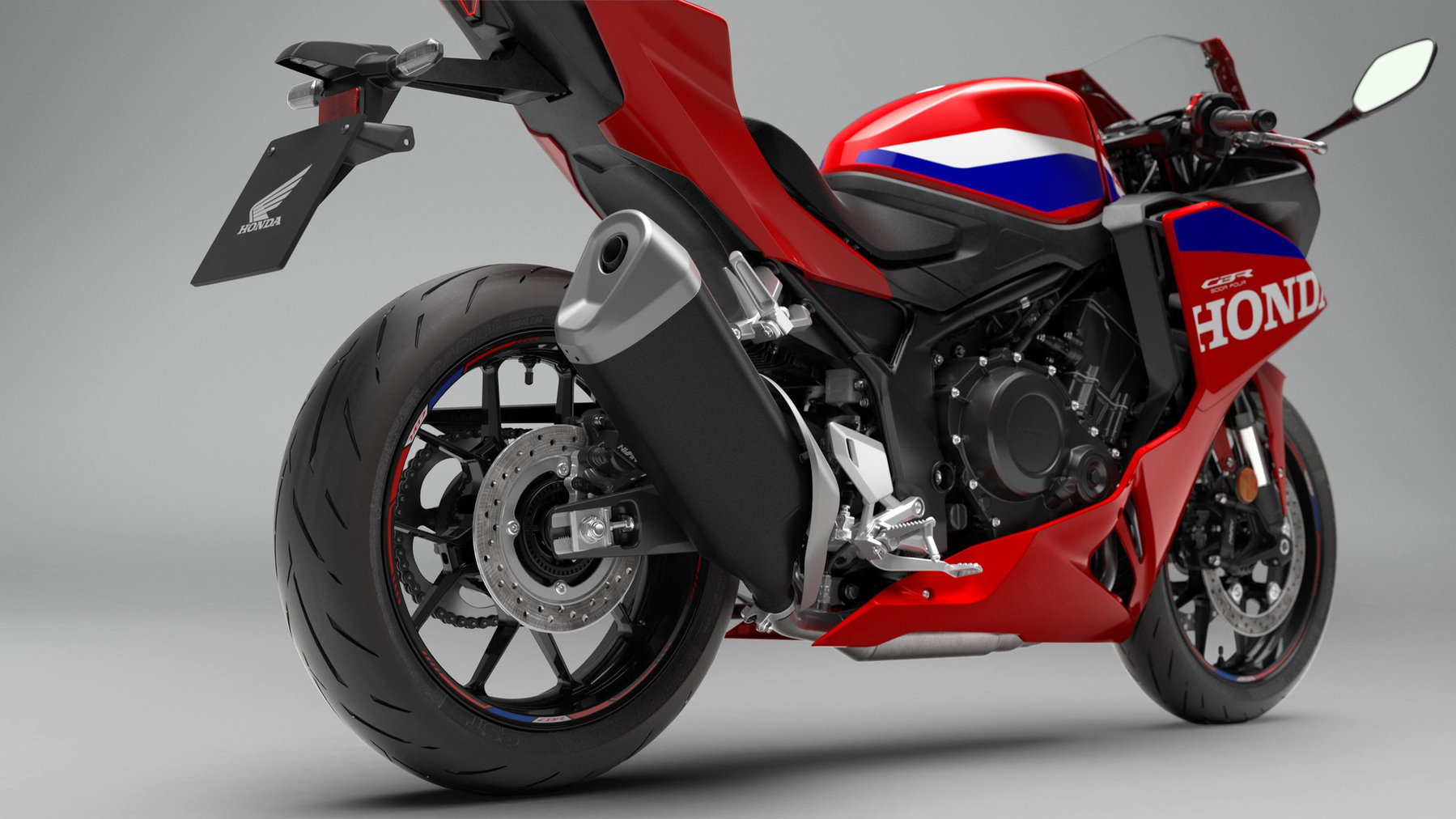
With the exhaust, Honda nods to its own history. The 4-2-1 system with side-routed headers draws on the 1975 CB400F, the first four-cylinder motorcycle in the 400 class. The two-chamber silencer, on the other hand, is a new design. A closed-loop catalytic converter and two lambda sensors ensure compliance with the Euro 5+ emissions standard.
How does the E-Clutch work on the CBR500R Four?
The E-Clutch automatically handles the clutch when pulling away, shifting and stopping. The rider still selects gears with the foot shift lever but no longer has to pull the clutch lever.
The clutch is operated by two small electric motors. They sit in a unit under a cover on the left side of the engine. When engaging and disengaging, the electronics simultaneously adjust ignition and fuel injection. To do this, the system evaluates speed, engine revs, throttle position, selected gear and pressure on the shift lever, among other things. According to Honda, even hill starts work without stalling the engine. Gear changes are said to be faster and smoother than with a conventional quickshifter.
Because the throttle is also electronic, the E-Clutch can blip the throttle briefly when downshifting. This better matches engine speed to rear wheel speed. If the system detects that the rear wheel starts to hop during hasty downshifts or hard braking, it intervenes via the clutch and settles the motorcycle. Mechanically, there is also an assist and slipper clutch.
The gearbox has also been adapted. In the first two gears, seven shift dogs engage, from third gear upwards eight. This shortens shift travel and reduces play between the gears.
Can the E-Clutch be switched off?
Yes, the E-Clutch can be completely deactivated via a switch on the handlebar. This is done at a standstill in neutral, and the display then shows an M for manual operation.
The clutch lever remains on the handlebar anyway and can be used at any time. If the rider pulls it while riding, the automatic system switches itself back on afterwards. At higher speeds this takes less than a second, at low speeds five seconds. It is also possible to set how much force is required at the shift lever. There are Hard, Medium and Soft settings, separately for upshifts and downshifts. A gear indicator in the cockpit alerts the rider when too high a gear is selected.
Riding modes, traction control and wheelie control
The CBR500R Four has three preset riding modes and two freely configurable ones. Each mode combines three settings: power delivery (Engine Power), engine braking when closing the throttle (Engine Brake) and the HSTC traction control. Each of these values has three levels.
- STANDARD uses the middle level for all three values and is intended for everyday riding.
- SPORT delivers power most directly (level 3) and combines this with the lowest level of engine braking and traction control.
- URBAN delivers power most gently (level 1), combined with engine braking at level 2 and the strongest traction control at level 3.
In the USER1 and USER2 modes, all three values can be freely combined. Only here can traction control be switched off completely. Custom settings are saved and do not need to be reselected after switching off the ignition. According to the spec sheet, the bike also has wheelie control, which limits unwanted lifting of the front wheel.
Chassis, brakes and weight at a glance
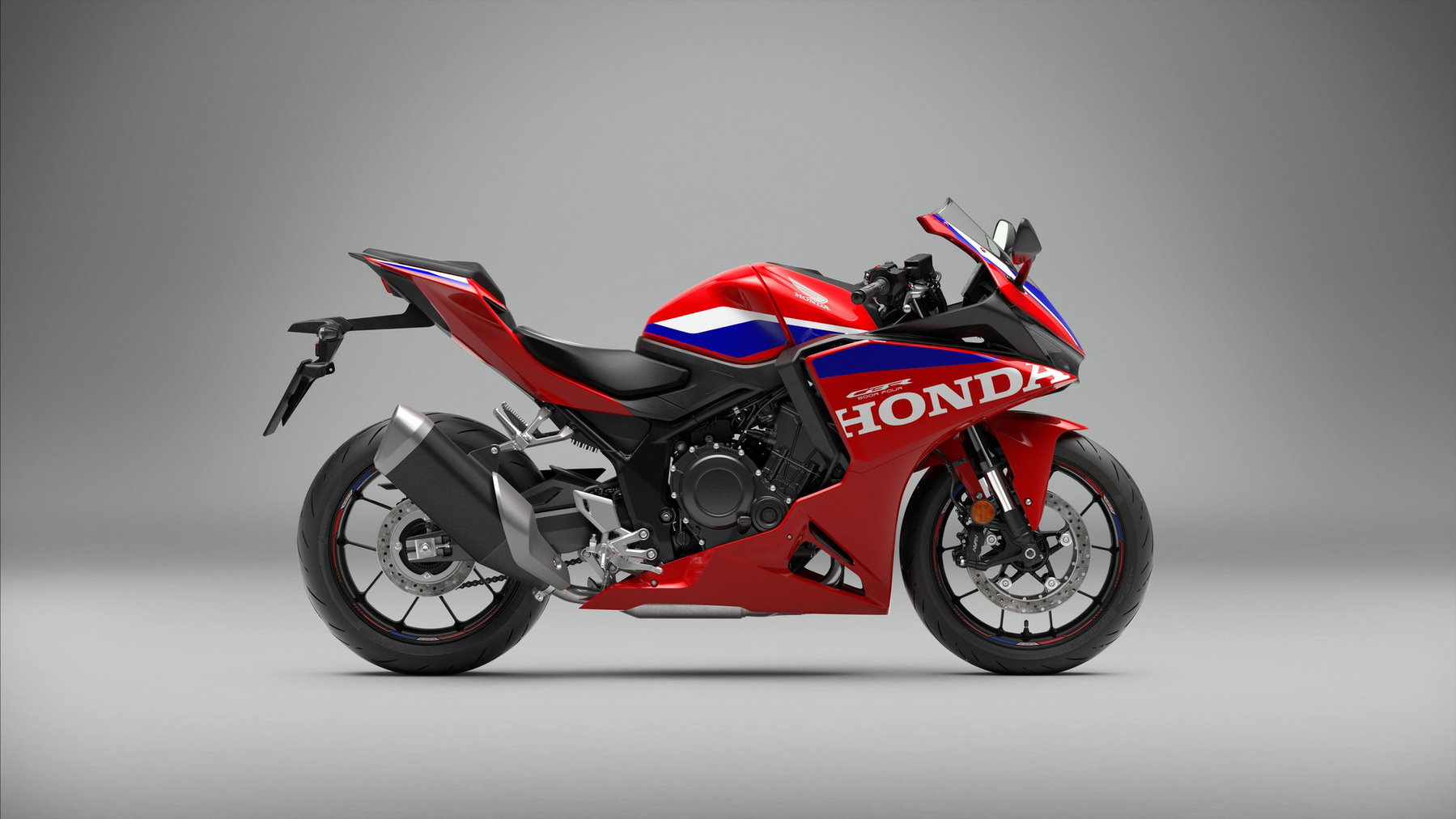
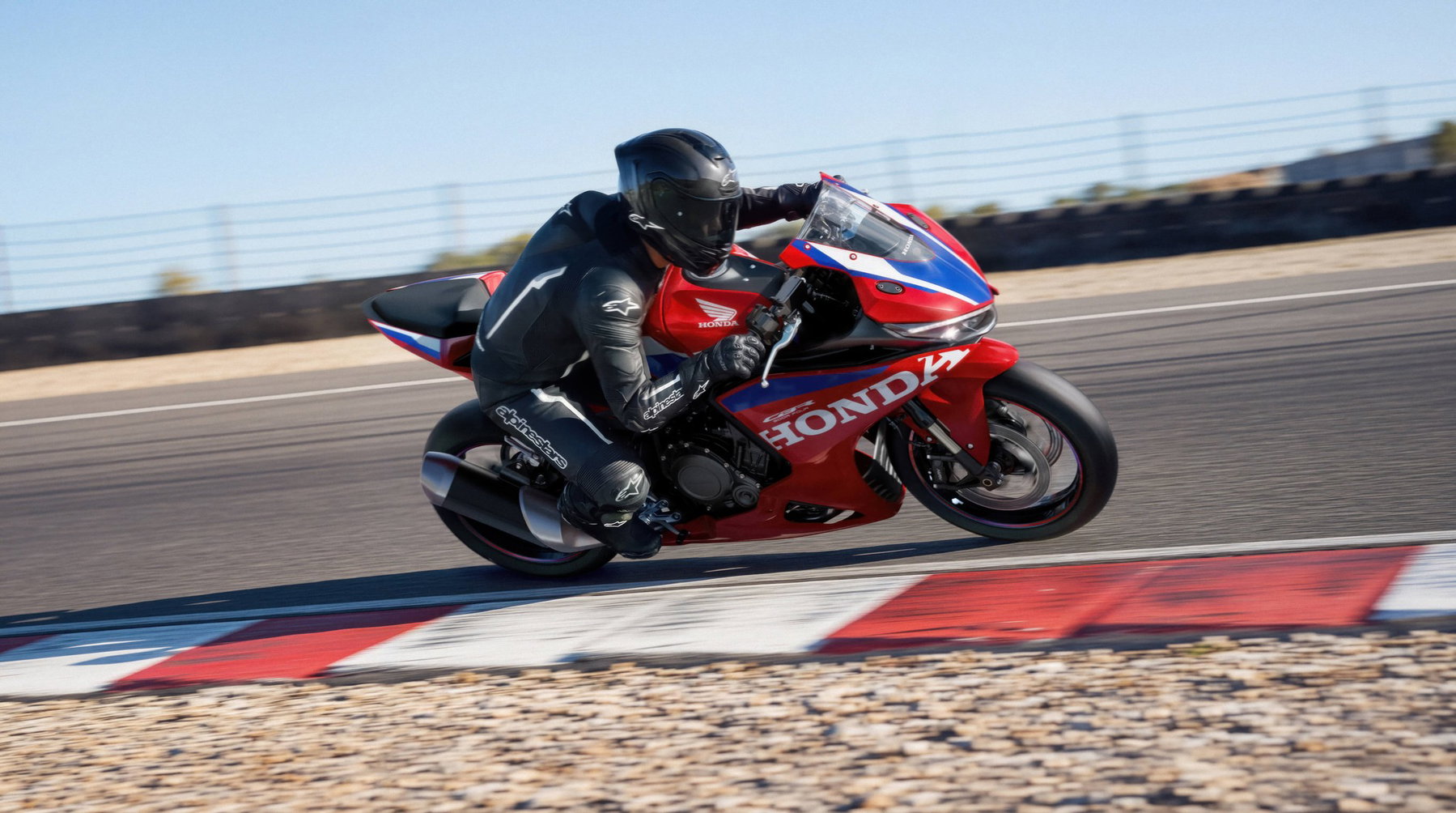
The new steel tube frame uses the engine as a stressed member. This saves weight, as the frame itself weighs only 14 kg (31 lbs). Fully fuelled, the CBR500R Four tips the scales at 189 kg (417 lbs). The wheelbase is 1,412 millimetres, the rake 25 degrees and the trail 99 millimetres.
At the front, a 41-millimetre KYB upside-down fork with 109 millimetres of travel does the work. It is not adjustable. At the rear, a monoshock works via a Pro-Link linkage on an aluminium swingarm. Here, preload can be adjusted in five steps, and travel is 119 millimetres.
Braking is handled at the front by two floating 296-millimetre discs and radially mounted Nissin two-piston calipers. At the rear, a 240-millimetre disc with a single-piston caliper is used. Two-channel ABS is standard. The cast wheels with five Y-shaped spokes are fitted with Pirelli Diablo Rosso IV tyres in 120/70-ZR17 at the front and 160/60-ZR17 at the rear.
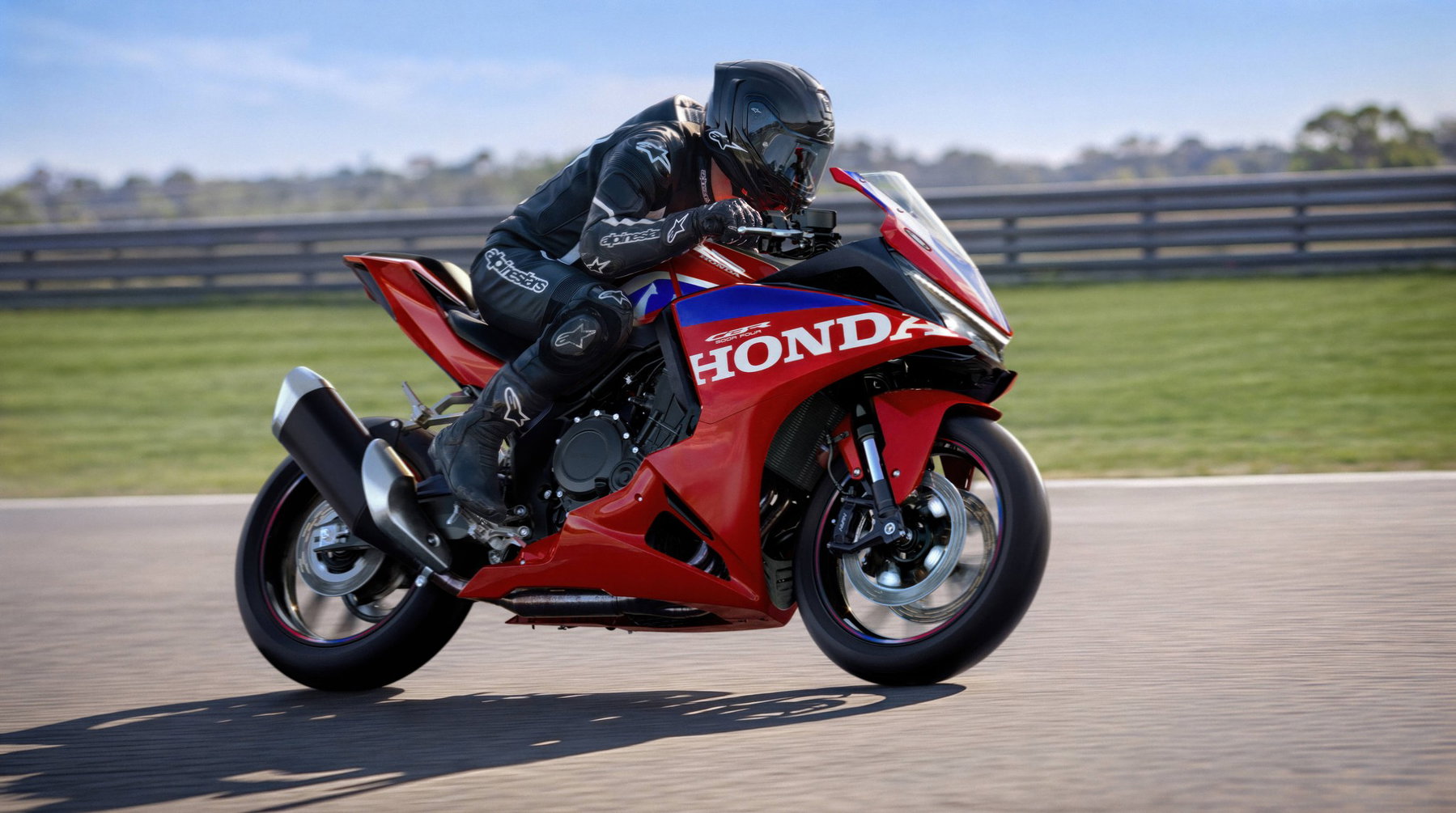
With clip-on handlebars, the riding position is clearly sporty and leaned forward. At 780 millimetres, however, the seat is low, and the slim frame is meant to make it easier to get both feet on the ground. The turning circle of 2.9 metres is designed for city traffic and beginners.
Cockpit, lighting and design of the CBR500R Four
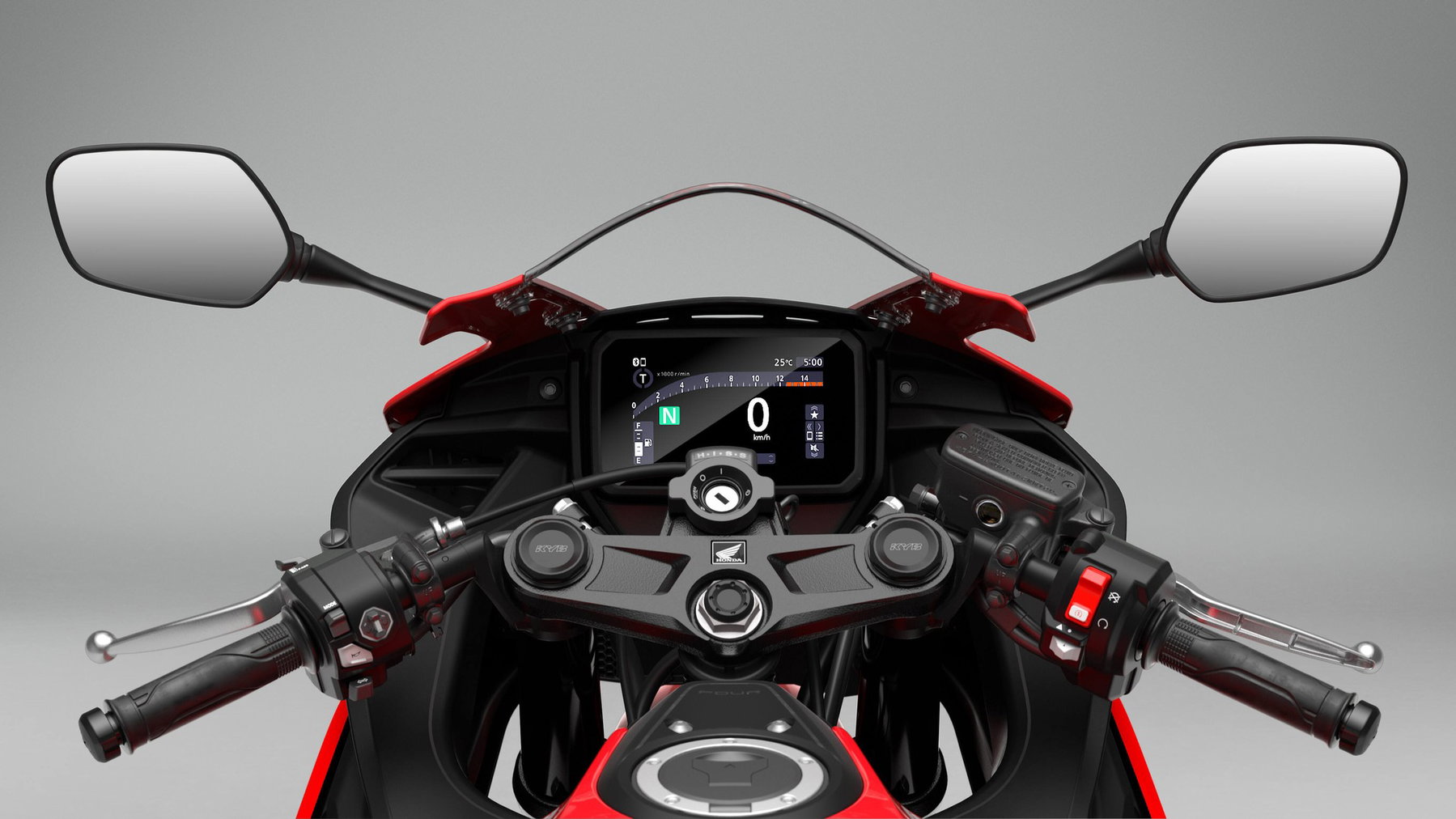
The cockpit features a 5-inch colour display. Honda has sealed the gap between the glass and the screen with a resin. This technology is called optical bonding and is designed to reduce reflections in sunlight. The display offers three views: bar, circle and a simplified layout.
Everything is operated via an illuminated four-way switch on the left handlebar. A smartphone running iOS or Android can be paired via Honda RoadSync. The display then shows turn-by-turn navigation, and phone calls and music can be handled via a Bluetooth headset in the helmet. A USB-C socket at the bottom right of the display charges the phone. The equipment also includes the HISS immobiliser and an Emergency Stop Signal.
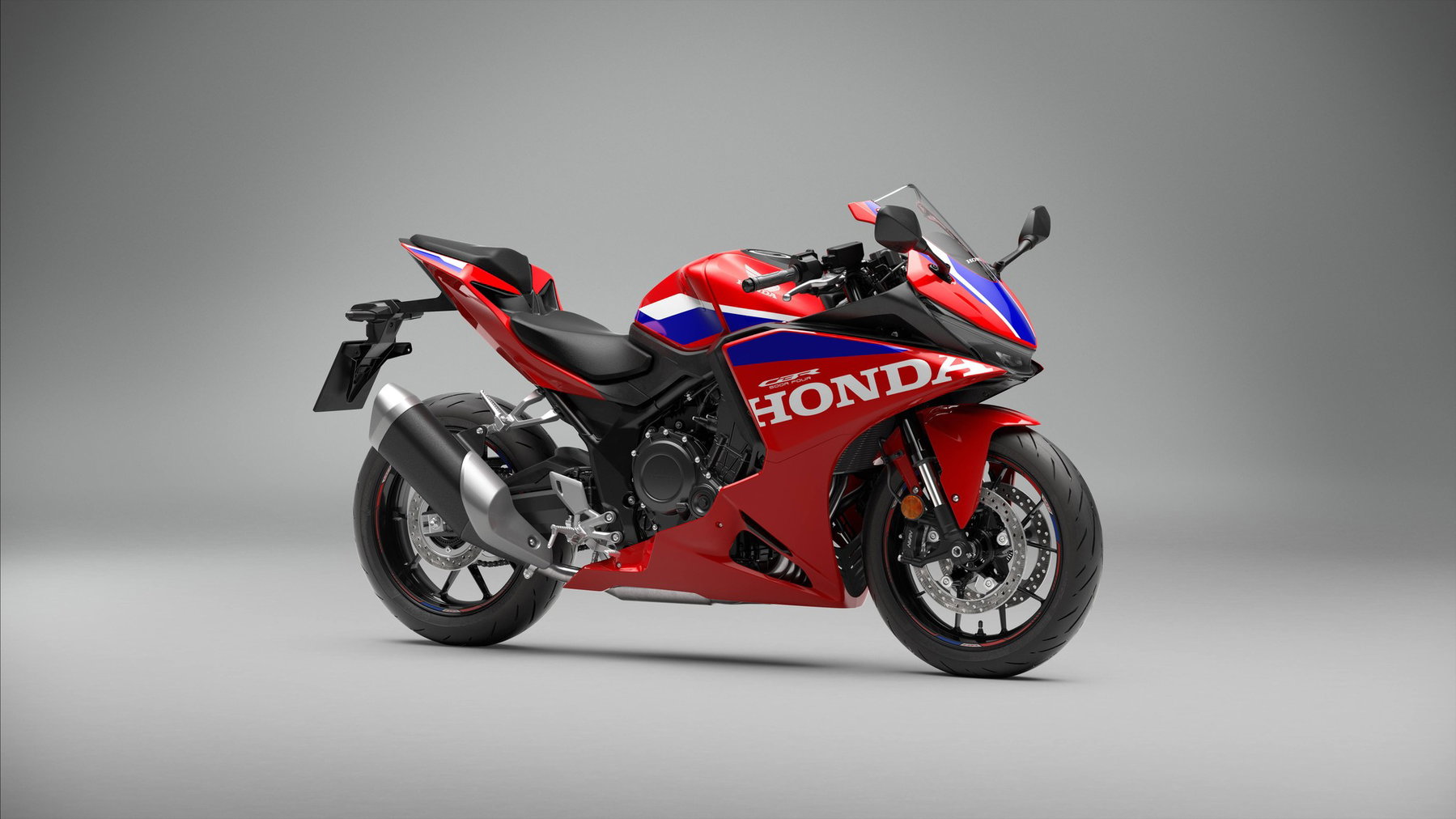
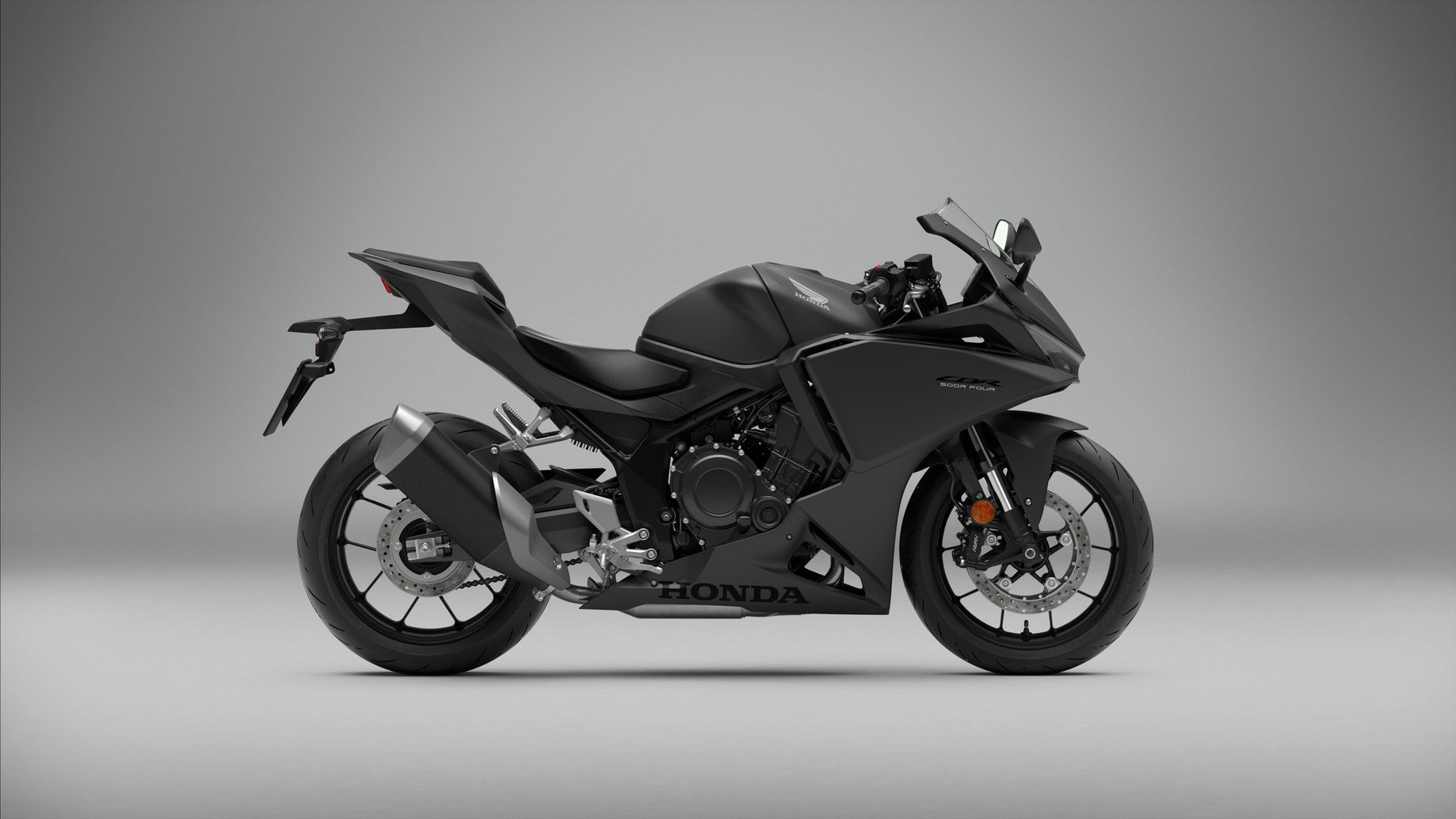
Visually, the CBR500R Four is meant to bring the look of Honda’s big supersports bikes to the middle class. At the front, two LED projector headlights sit beneath a slim daytime running light, and the indicators are integrated into the fairing. The side panels are multi-layered and are designed to channel air through the motorcycle in a targeted way. At the rear, the tail rises sharply and ends in an LED tail light. The fuel tank holds 14 litres.
Where does Honda’s new four-cylinder come from?
The engine has a fairly long backstory. Honda first showed the CBR500R Four and its naked sibling, the CB500 Super Four, in September 2025 at the CIMA show in China. No technical data was released at the time. Only at the end of 2025 did the first figures appear in Chinese homologation documents. In addition, Honda registered the CBR500R Four name as a trademark in the EU, which already pointed to a European launch.
In March 2026, the CB400 Super Four and the CBR400R Four with 399 cc followed at the Osaka Motorcycle Show as near-production concepts for Japan. In July 2026, Honda confirmed production of the two 400s, which went on sale at selected Japanese dealers from August and September. At that time, the manufacturer said nothing about Europe.
The CB400 Super Four has a long tradition in Japan. It was in the line-up there for more than 30 years before production ended in 2022. After a four-year break, it returned in 2026 with a new engine. The CBR500R Four is now the larger version of this new family for a broader market.
When is the CBR500R Four coming and how much does it cost?
In the UK, the CBR500R Four arrives at dealers in January 2027 and costs £6,999 (approx. €8,310 / $9,330). Honda has not yet announced a price for Germany.
The bike is offered in two colours:
- Ignition Red (Tricolour) with large white Honda lettering, blue areas and white stripes on the tank
- Mat Ballistic Black Metallic as a much more understated version with dark lettering
In its class, the CBR500R Four competes with the Kawasaki ZX-4RR, the Kove 450RR and the ZXMoto 500RR, among others.
What accessories does Honda offer for the CBR500R Four?
At launch, Honda offers a small selection of genuine accessories. These include a pillion seat bag, heated grips, a taller windscreen, a tank pad and knee grip pads. For theft protection, there is also an alarm system with an acoustic signal.
Frequently Asked Questions
-
How much horsepower does the 2027 Honda CBR500R Four have?
The 2027 Honda CBR500R Four produces 72 hp (53.0 kW) at 11,000 rpm. Peak torque is 47.4 Nm at 9,750 rpm. There is a 35 kW version for the A2 licence.
-
How much does the Honda CBR500R Four cost?
In the UK, the CBR500R Four costs £6,999, which is approximately €8,310 or $9,330. That is £100 more than the twin-cylinder CBR500R. Honda has not yet announced a German price.
-
When will the Honda CBR500R Four be available?
The CBR500R Four is a 2027 model. In the UK, it will be at dealers from January 2027.
-
Can you ride the CBR500R Four with an A2 licence?
Yes, Honda offers a factory version with 35 kW (48 hp) for the A2 licence. This means it meets the power limit for this class.
-
Do you still need to use the clutch on the CBR500R Four?
No, the standard E-Clutch handles the clutch when pulling away, shifting and stopping. Gears are still changed with the foot. However, the clutch lever remains on the handlebar and can be used at any time.