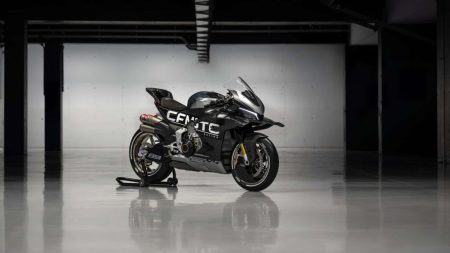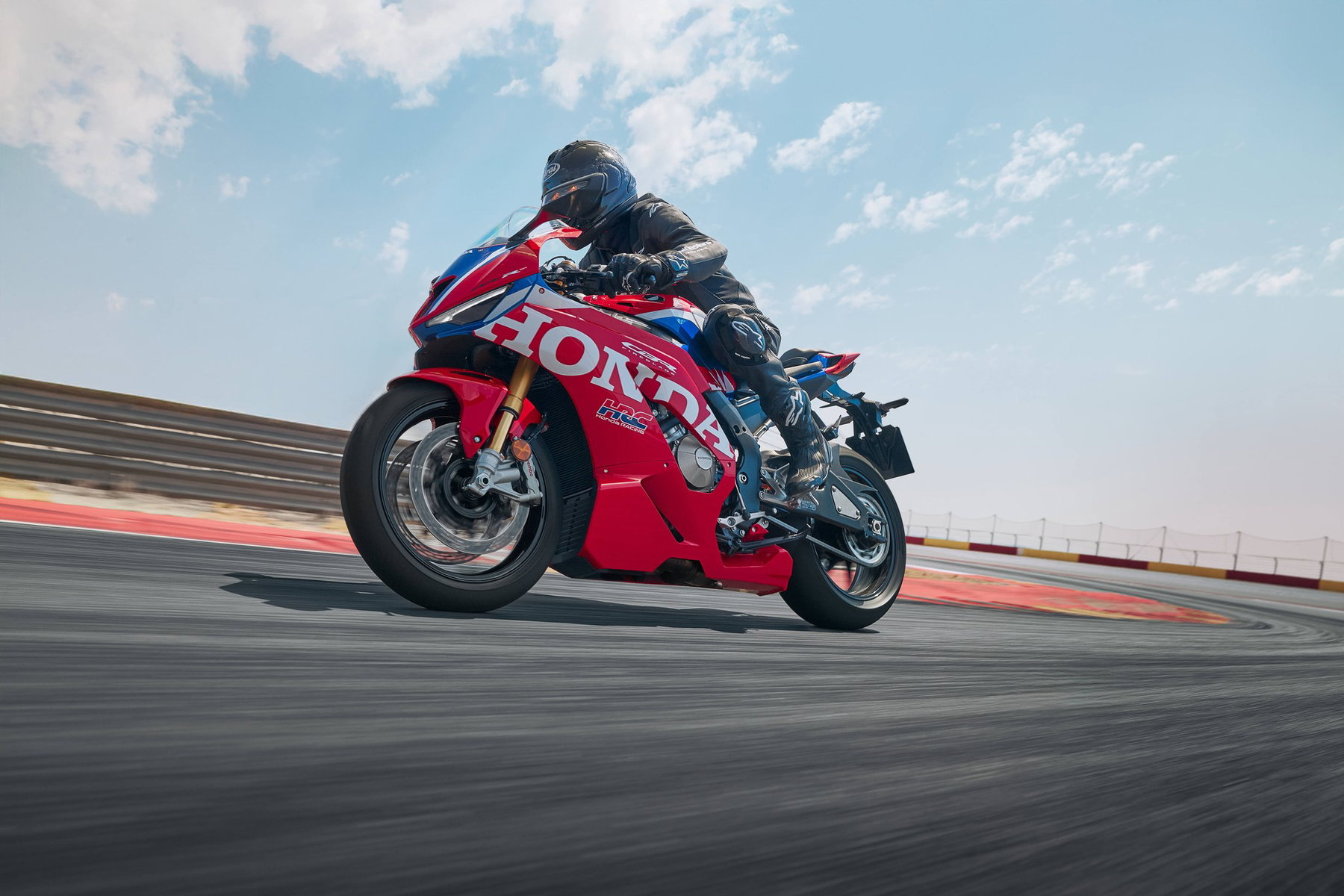
- New aluminium frame with 20 percent less lateral stiffness, more load on the front wheel and a raised seating position
- 217.6 hp (160 kW) at 14,000 rpm, 114 Nm and, for the first time on a Honda production motorcycle, variable intake funnels
- Three versions: base model with Showa suspension (199 kg), SP with electronic Öhlins (201 kg) and HRC Works Edition with carbon winglets (200 kg)
Honda has been building the Fireblade since 1992, and for a long time it was primarily a road motorcycle from which race bikes were later derived. With the 2020 generation, the CBR1000RR-R moved closer to MotoGP technology, 2022 brought detail improvements for its 30th birthday and 2024 a revised engine with two throttle actuators. For the 2027 model year, Honda is now reversing the order. Together with its racing department HRC and the factory team from the World Superbike Championship, the requirements for the race bike were defined first, and only then was the production version developed. The new Fireblade family is therefore one of the supersport newcomers for 2027 that Honda is showing at EICMA 2026 in Milan.
Why did Honda develop the 2027 Fireblade from racing first?
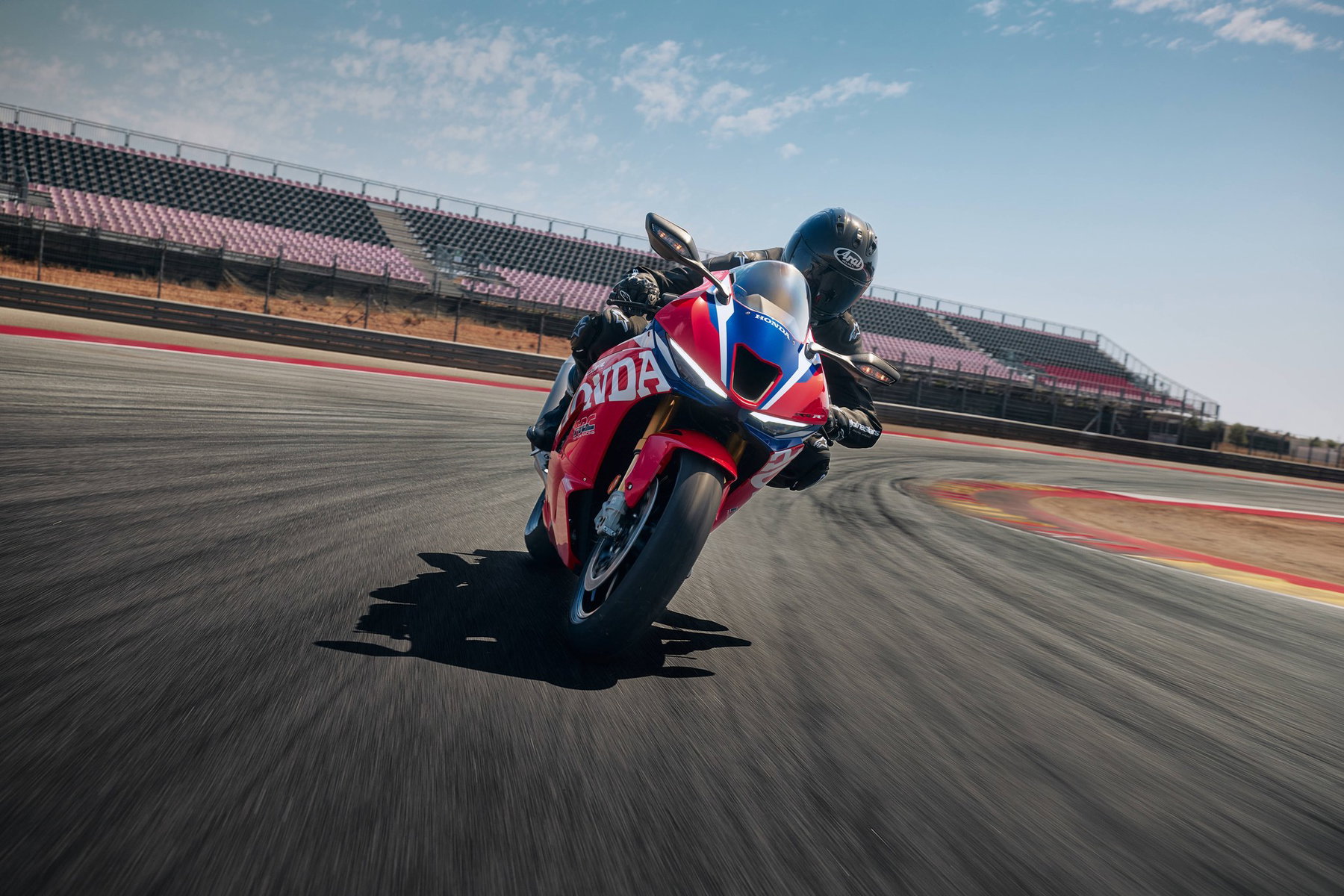
Honda wants to give the Fireblade a better basis for racing at the highest level without losing its road homologation. The focus was on three phases of every corner: turn-in, mid-corner speed and corner exit.
Added to this is the goal of saving weight. Peak power therefore remains almost unchanged. The work lies in the chassis, the aerodynamics and many small components that each save a few grams. The new approach is most evident in the HRC Works Edition. It serves as the basis for a race bike in the World Superbike Championship and can be modified at the steering head and swingarm in ways that were previously only possible in racing with conversion parts.
How do the Fireblade, Fireblade SP and HRC Works Edition differ?
All three versions share the engine, frame and new fairing. They differ mainly in suspension, brakes and aerodynamics.
The base Fireblade uses mechanically adjustable Showa suspension. At the front is a 43 mm Big Piston upside-down fork, which is slightly longer to leave more room for track set-up. At the rear sits a fully adjustable Showa BFRC Lite shock. With this twin-tube damper, damping is generated in a separate unit rather than at the piston, which is said to provide more consistent response. Braking is handled by radially mounted Nissin four-piston calipers. According to Honda, the base model weighs 199 kg (439 lbs) fully fuelled. A quickshifter is only available as an accessory.
The Fireblade SP receives the latest generation of electronically controlled Öhlins suspension. At the front is a 43 mm NPX fork with Smart Electronic Control S-EC3.0, at the rear a TTX36 shock. Both use spool valve technology, in which a spool valve regulates the oil flow. The front and rear can be adjusted via the OBTi interface in the display. Up to three custom set-ups can be saved, for example for rain, worn tyres or an almost empty tank. Spring preload remains manually adjustable, but the display suggests values to suit the rider’s weight. For the brakes, Brembo Hypure four-piston calipers replace the previous Stylema calipers, along with a new master cylinder and a new brake lever. The Hypure calipers are designed to maintain consistent performance even at the high temperatures of racing. The SP weighs 201 kg (443 lbs) fully fuelled and comes with a quickshifter as standard.
The HRC Works Edition adopts the engine and frame of the SP but uses purely mechanical Öhlins components. It also gains adjustable geometry, carbon winglets and a single-seat layout. It weighs 200 kg (441 lbs).
Why is the new Fireblade frame less stiff?
The new aluminium twin-spar frame is designed to give the rider more feel for grip and to remain more stable at lean. That is why Honda has reduced lateral stiffness by 20 percent compared with its predecessor.
The frame is gravity die-cast, a process in which molten aluminium flows into a metal mould without pressure. This allows wall thicknesses of just 2 mm, and the frame weighs 9 kg (20 lbs). The engine mounting has also changed. At the front of the cylinder block, it is now held by a bolted-on strut instead of a reinforcement cast into the frame. At the bottom, the shock no longer mounts to the frame but to the rear of the engine casing.
This goes hand in hand with new geometry. On the SP, the wheelbase grows by 5 mm to 1,450 mm. The rake is now 24.0 degrees (previously 24.1 degrees) and the trail 101 mm (previously 101.9 mm). In its base setting, the HRC Works Edition starts with 23.8 degrees and 99.8 mm. At the same time, weight shifts forward, with the front wheel now carrying 53.3 instead of 52.8 percent. The crankshaft sits 5.2 mm higher, at 432.5 mm. The SP’s seat rises from 831.5 to 843 mm, while on the HRC Works Edition it is 847 mm. This is meant to let the rider move more freely and control the bike better during quick changes of direction.
The swingarm is also new. At 620.6 mm, it is 1.2 mm shorter and 200 grams lighter, and its axle now measures only 17 instead of 20 mm. Lateral stiffness drops by 12 percent, while torsional stiffness remains the same. In addition, there are new cast wheels with seven hollow spokes that save 190 grams at the front and 590 grams at the rear. The narrower 520 chain replaces the previous 525 chain and saves another 270 grams. Less unsprung mass here means that the wheels follow bumps more easily and the tyres maintain better contact. Tyre sizes remain 120/70-ZR17 at the front and 200/55-ZR17 at the rear.
Why does the Fireblade SP do without winglets?
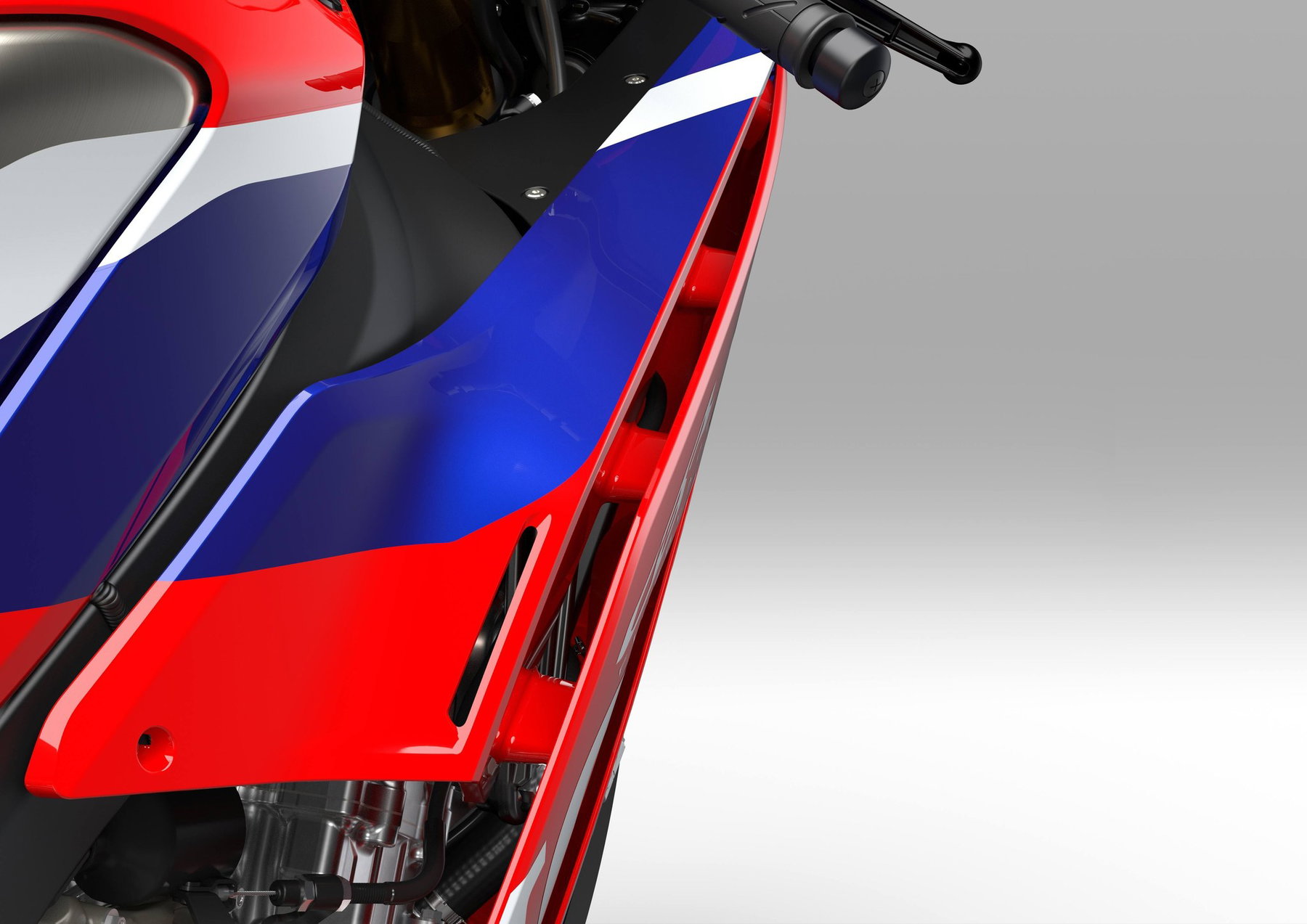
The new fairing is designed to generate the same downforce as the previous wings without the need for separate winglets. At the same time, drag is meant to fall and wind protection for the rider to improve.
This is made possible by so-called sidepods in the lower part of the fairing. These elements are based on ideas from MotoGP and create an additional effect at lean that is intended to improve cornering performance. A revised front spoiler works together with the rest of the fairing. The frontal area has grown slightly to give the rider more room when riding hard. Honda developed the shape using computer flow simulations, clay models and test rides on race tracks.
Further changes concern the lights and the tank. The new LED headlight with daytime running light can be removed for track days, and at the rear sits a smaller, lighter LED tail light. The 16.6-litre titanium tank is now exposed, and the plastic cover of earlier models has been dropped. According to Honda, this saves 1.4 kg (3.1 lbs).
What changes on the engine of the 2027 Fireblade?
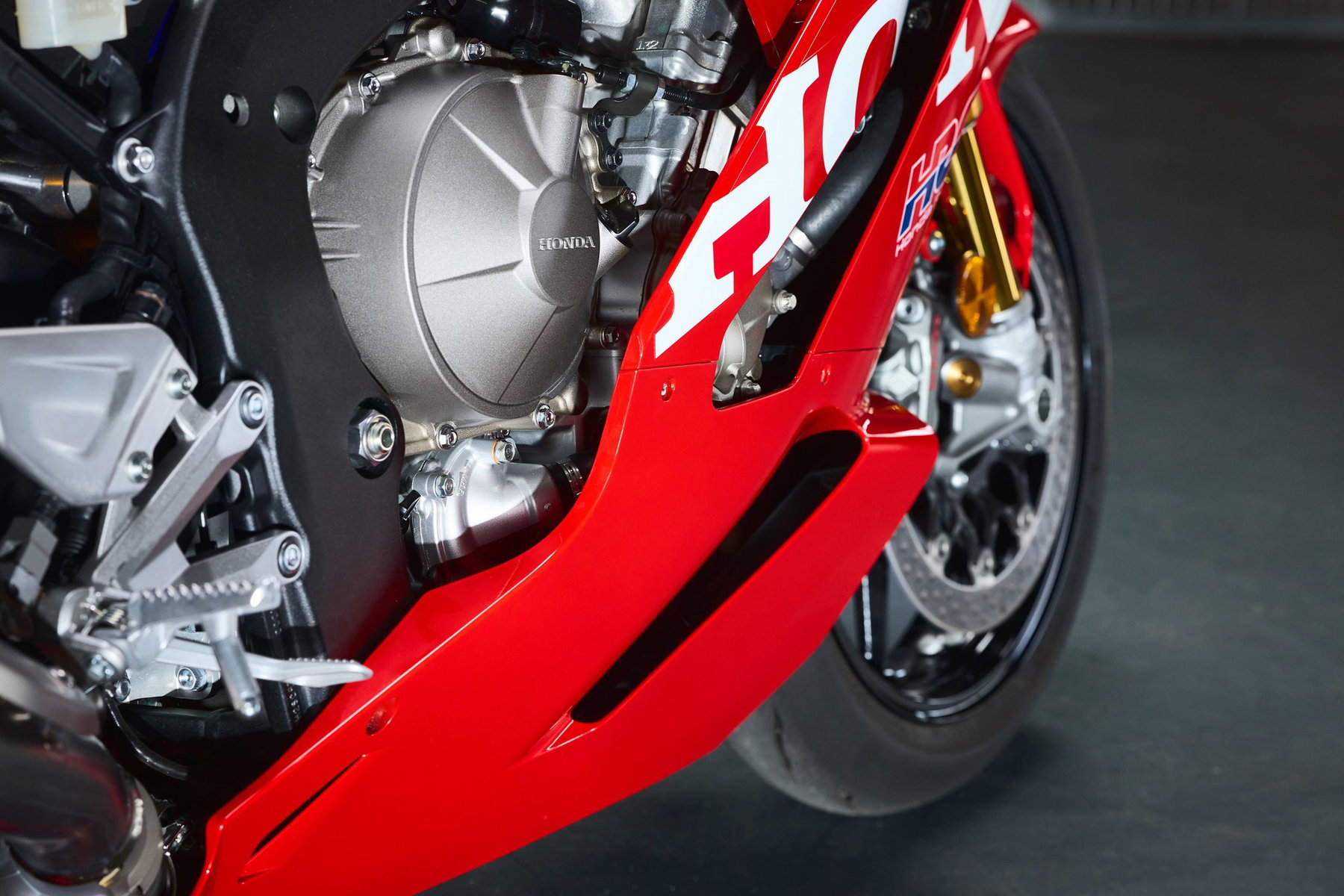
The inline four-cylinder still produces 217.6 hp (160 kW) at 14,000 rpm but gains strength in the mid-range. Maximum torque is now 114 Nm (84 lb-ft) at 10,500 rpm, one newton metre more than before.
The most important innovation is two-stage variable intake funnels, which Honda is using on a production motorcycle for the first time. Below 11,750 rpm they are in the long position so that the cylinders are filled better in the mid-range. Above that, they switch to the short position, which ensures high flow speeds and therefore peak power. The two throttle actuators remain. One controls cylinders one and two, the other cylinders three and four. With little throttle, only one pair opens at first, which makes torque easier to meter. When braking with the throttle closed, the electronics use the second pair to increase engine braking.
Bore and stroke remain unchanged at 81 x 48.5 mm. More precisely manufactured piston crowns and combustion chambers raise the compression ratio from 13.6:1 to 13.8:1. There are also revised valve timings, a larger adjustment range on the cam sprockets and more durable valve springs. Magnesium helps with weight: the cylinder head cover, clutch cover, right crankcase cover and oil pan are no longer made of aluminium. 35 aluminium bolts replace steel bolts and save 215 grams. In total, the engine becomes 1,099 grams lighter, not including the lighter crankcase. A revised strainer in front of the oil pump is designed to prevent the oil from foaming.
In the gearbox, the main shaft and countershaft are now 68 instead of 65 mm apart. This gives race teams more freedom when choosing gear ratios. First gear is five percent taller on all versions, which is intended to make pulling away easier. Changes to gear ratios or valve timing are not permitted on public roads and jeopardise the warranty. The package is rounded off by a compact titanium silencer from Akrapovič. Honda quotes a top speed of 299 km/h, WMTC fuel consumption of 6.7 litres per 100 km and 155 g of CO2 per kilometre.
2027 Fireblade electronics: riding modes, ABS and launch control
A six-axis inertial measurement unit from Bosch constantly records the motorcycle’s attitude, acceleration and rotational movements. All rider aids and the electronic Showa steering damper rely on this data. For 2027, all settings have been adapted to the new engine and chassis, including feedback from HRC factory riders.
Three riding modes are available. Power can be adjusted in five levels and engine braking in three. Wheelie control works in three stages or can be switched off, and the HSTC traction control has nine levels and can also be deactivated. For race starts, launch control limits revs to 6,000, 7,000, 8,000 or 9,000 rpm so that the rider only has to concentrate on the clutch. Cornering ABS offers Standard, Track and Race modes. In Race mode, the ABS no longer intervenes at the rear wheel, where the rider modulates braking force alone.
Everything is operated via a 5-inch TFT display and a four-way switch on the left handlebar. When the engine is cold, the red zone on the rev counter starts at 8,000 rpm and only moves up to over 14,500 rpm once the coolant is warm. The Smart Key system replaces the conventional ignition key. Because there is no ignition lock, Honda can fit a lighter top yoke and route air more freely to the airbox.
What does the HRC Works Edition offer for the track?
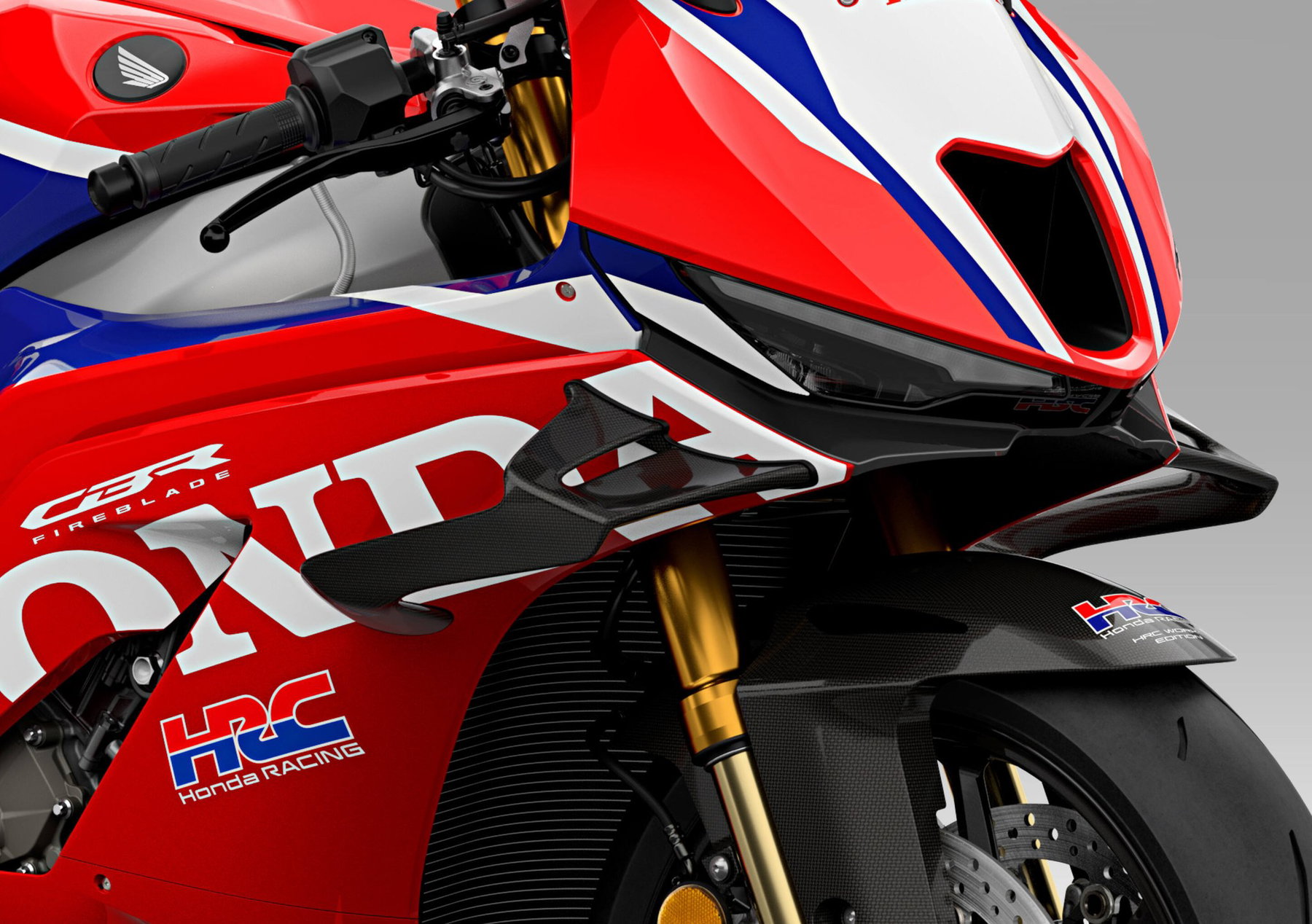
The HRC Works Edition is adjustable at the steering head and swingarm pivot. This allows a team to adapt the geometry to the track, tyres and rider.
The rake is changed using inserts in the upper and lower triple clamps. The swingarm pivot can be used to adjust how much the rear squats under acceleration and rises under braking. Experts call this anti-squat and anti-lift. Both adjustments are not permitted on public roads and void the warranty.
Instead of electronic suspension, the Works Edition uses mechanical, fully adjustable Öhlins racing components: a 43 mm NPX fork and a TTX36 shock. At the front, Brembo Hypure Sport calipers do the braking and are 32 grams lighter than the previous Stylema calipers. Ground clearance rises to 135 mm. Passenger footpegs and their brackets are omitted, and the bike is designed as a single-seater. When switched on, the display shows an HRC logo instead of the CBR lettering.
The Works Edition takes its own route on aerodynamics. It additionally carries two-piece carbon fibre winglets. The upper wing has 2.4 times the surface area of the previous version. At 299 km/h, the winglets are said to generate 3.5 times as much downforce as the standard 2027 Fireblade. Air ducts in the tail and a shaped carbon fibre front mudguard complete the package. They are designed to keep the front wheel on the ground under acceleration and increase pressure in corners. With optional HRC parts, a shift pattern with neutral at the very bottom can also be set up. Neutral can then only be reached after releasing a lock and cannot be accidentally engaged between first and second gear during a race.
Colours, accessories and launch of the 2027 Fireblade
The base Fireblade comes in Pearl Deep Mud Gray. The SP is available in Ignition Red and Mat Ballistic Black Metallic, the HRC Works Edition only in Ignition Red. All three versions meet the Euro 5+ emissions standard. Honda has not yet announced prices or a date for the market launch.
Honda offers its own Sport and Track packs for all versions. The Sport packs feature a new tinted screen, tank pads, frame protectors and rim stickers. The Track packs include, among other things, an HRC oil filler cap, covers for the mirror and licence plate holder mounting holes and, on the SP, a sport seat. On the base version, the quickshifter is also part of both packs. As a pack, the parts are said to be 10 percent cheaper than when bought individually. Items available individually include an HRC sticker set, a USB socket and a folding indoor garage.
Frequently Asked Questions
-
How much horsepower does the 2027 Honda Fireblade have?
All three versions produce 217.6 hp (160 kW) at 14,000 rpm. Maximum torque is 114 Nm (84 lb-ft) at 10,500 rpm. New variable intake funnels are mainly intended to strengthen the mid-range.
-
What sets the Fireblade SP apart from the base version?
The SP has electronically controlled Öhlins suspension, Brembo Hypure brakes and a quickshifter as standard. The base model uses mechanical Showa suspension and Nissin brakes, with the quickshifter only available as an accessory. Fully fuelled, the SP weighs 201 kg and the base model 199 kg.
-
Does the new Fireblade still have winglets?
The base model and SP do without winglets. Their fairing with sidepods is designed to generate the same downforce as the previous wings. Only the HRC Works Edition additionally carries two-piece carbon fibre winglets.
-
How heavy is the HRC Works Edition?
The HRC Works Edition weighs 200 kg (441 lbs) fully fuelled, one kilogram less than the SP. It is designed as a single-seater without passenger footpegs and has a seat height of 847 mm.
-
How much does the 2027 Honda Fireblade cost?
Honda has not yet announced prices for the new Fireblade family. There is also no information on the market launch so far.
➜ Find all technical specifications for these models in our motorcycle database: Honda CBR1000RR-R Fireblade SP 2027 and Honda CBR1000RR-R Fireblade HRC Works Edition 2027.
➜ This article is part of our comprehensive overview: New Motorcycles 2027: All Models, Releases and Highlights at a Glance. Find all key information on this topic in one place.
➜ More on this topic in our overview: EICMA 2026: All New Models and Premieres from Milan at a Glance.