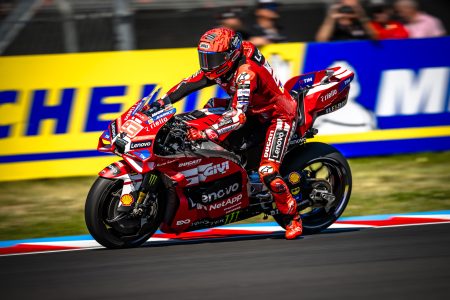
- Michelin brought a stiffer soft compound to Silverstone, yet the drop-off still arrived far too early
- Marc Marquez felt the collapse as early as lap four and set off his airbag during a big slide
- Fabio Quartararo puts Aprilia’s advantage down to lower tyre temperatures
Ten laps is a short distance. Even so, it was enough to expose a problem in the twelfth round of the 2026 season that nobody had on the radar during practice. While the three Aprilia riders were able to control the degradation, the factory Ducatis became the slowest bikes on track over the closing laps. The riders and Michelin have offered different explanations for it.
What went wrong with the soft rear tyre at Silverstone?
The soft rear tyre dropped off considerably earlier than Michelin had expected. The French manufacturer had planned for the decline to start around two laps from the end; in reality it began for many riders after just four laps.
Michelin had brought a revised soft variant to Silverstone because the 2026 race takes place in August. Racing manager Piero Taramasso describes the change like this: “At the rear, the soft option has evolved. With increased stiffness, in order to cope better with potentially higher temperatures.”
Taramasso puts the failure of that calculation down mainly to the pace. “In the first four or five laps the riders, especially those at the front, pushed very, very hard. So that is certainly one reason. On top of that the track temperature was quite high.” He points to the times as evidence: the sprint was a second quicker than the 2024 record, and the fastest lap was six tenths below it.
There is a second point. On Friday several riders had completed ten to eleven laps on the soft compound without seeing the phenomenon. However, they ran those laps in two separate stints rather than back to back. That difference is likely to have been decisive.
Only Jack Miller and Brad Binder started the sprint on the medium rear tyre. For Sunday’s 20 laps, that compound is considered the clear choice.
Why did it hit Ducati harder than Aprilia?
In Fabio Quartararo’s view, the difference was not wear but temperature. The Yamaha rider, fourteenth himself, sees that as the real strength of the RS-GP.
“I think it is less about tyre wear than about the fact that you overheat the tyre quite quickly,” Quartararo says. “When you have more grip, you can play with the throttle and keep the temperature a bit lower. I believe that is exactly where Aprilia is stronger than everyone else, because in my opinion they manage to keep the rear tyre temperature lower and can therefore hold a strong pace for longer.”
Ai Ogura would neither confirm nor deny the theory. The runner-up simply replied that he only knows the Aprilia. He did openly admit that he was affected too. He said he had not known whether he could even finish the race, and that he had no explanation for the severe degradation: in qualifying you do two or three fast laps, not ten. On Saturday morning everyone had been out on used soft tyres, in some cases for more than ten laps, without the phenomenon showing up so strongly.
Jorge Martin indirectly confirms the temperature theory. Asked how he had managed his tyre, the winner answered simply: “Not opening the throttle a hundred percent and waiting until the grip is there.”
How does Marc Marquez explain his collapse?
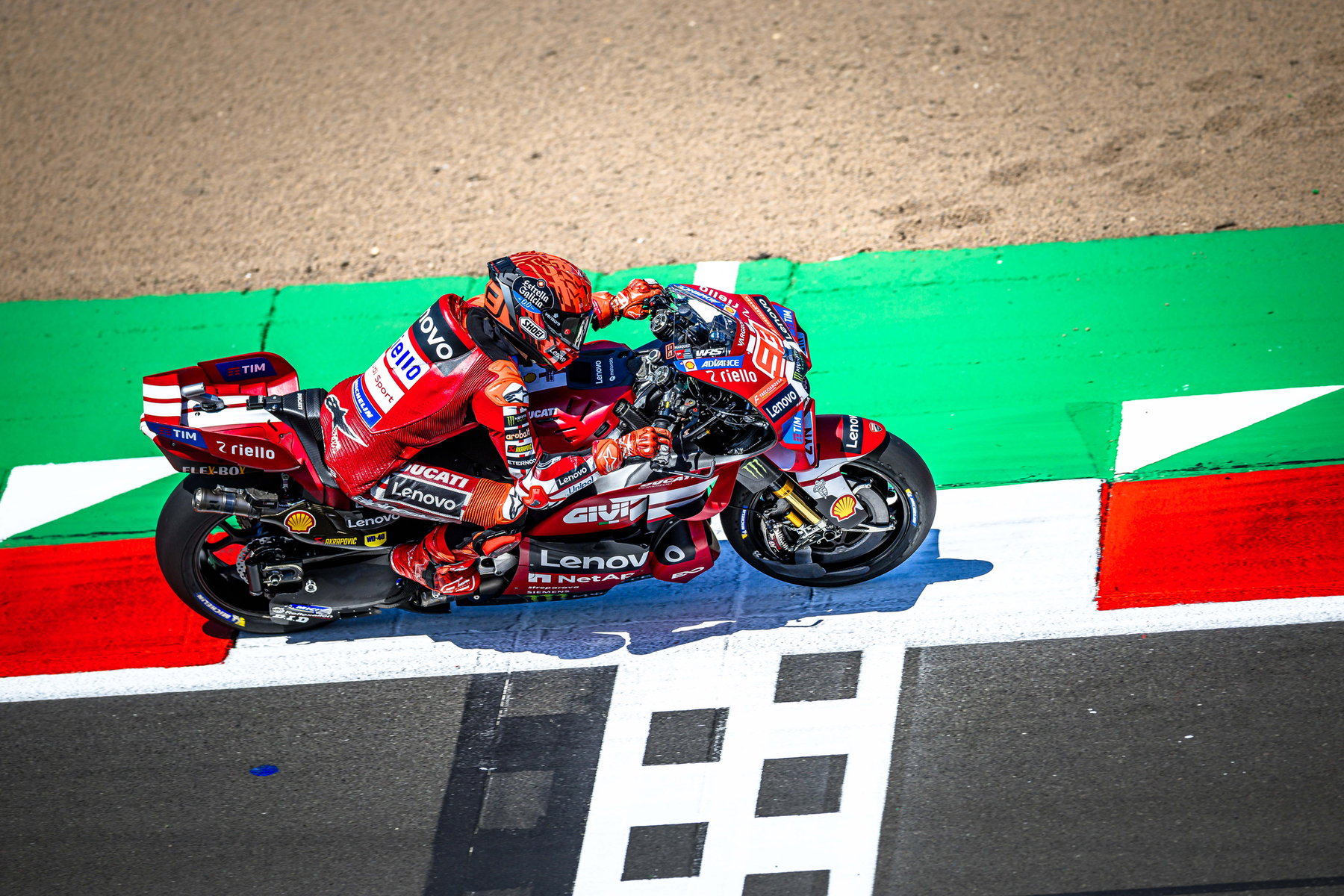
Marc Marquez does not talk about wear, but about graining. In this phenomenon rubber tears out of the tread and settles back onto the tyre, creating an uneven surface.
“The problem was not tyre wear, it was graining, and when you have graining it is as if the rubber is not working at the right temperature,” says the world champion. He has no explanation for the cause: “I cannot answer that.”
He explicitly takes Michelin out of the firing line. “It is not that Michelin brings the wrong compound, because when you compare the tyre temperature with the track temperature, it is the right one. We are in the right window.”
Two details show how serious the situation was out on track. Marquez ran his penultimate and final laps in the 2:02 range, while Martin was still on a 1:59.6 on his second-to-last lap. And during one slide the airbag in his leathers deployed. “There was a huge slide, that is when it happened. But it was not a big problem. The important thing was that I did not crash.”
His conclusion is correspondingly sober: “It felt pretty dangerous to go into the corner and risk a highsider. Then I decided to simply finish the race, because I do not want to injure myself.”
His reference point is, of all people, his brother. Alex Marquez finished fourth on the same specification and had already experienced the problem in Saturday morning practice. “I think that was the best practice for the race,” said the Gresini rider, who was able to save his tyres early on behind Raul Fernandez and Marco Bezzecchi while others tried to follow Martin.
Bagnaia and Di Giannantonio: two more Ducatis in trouble
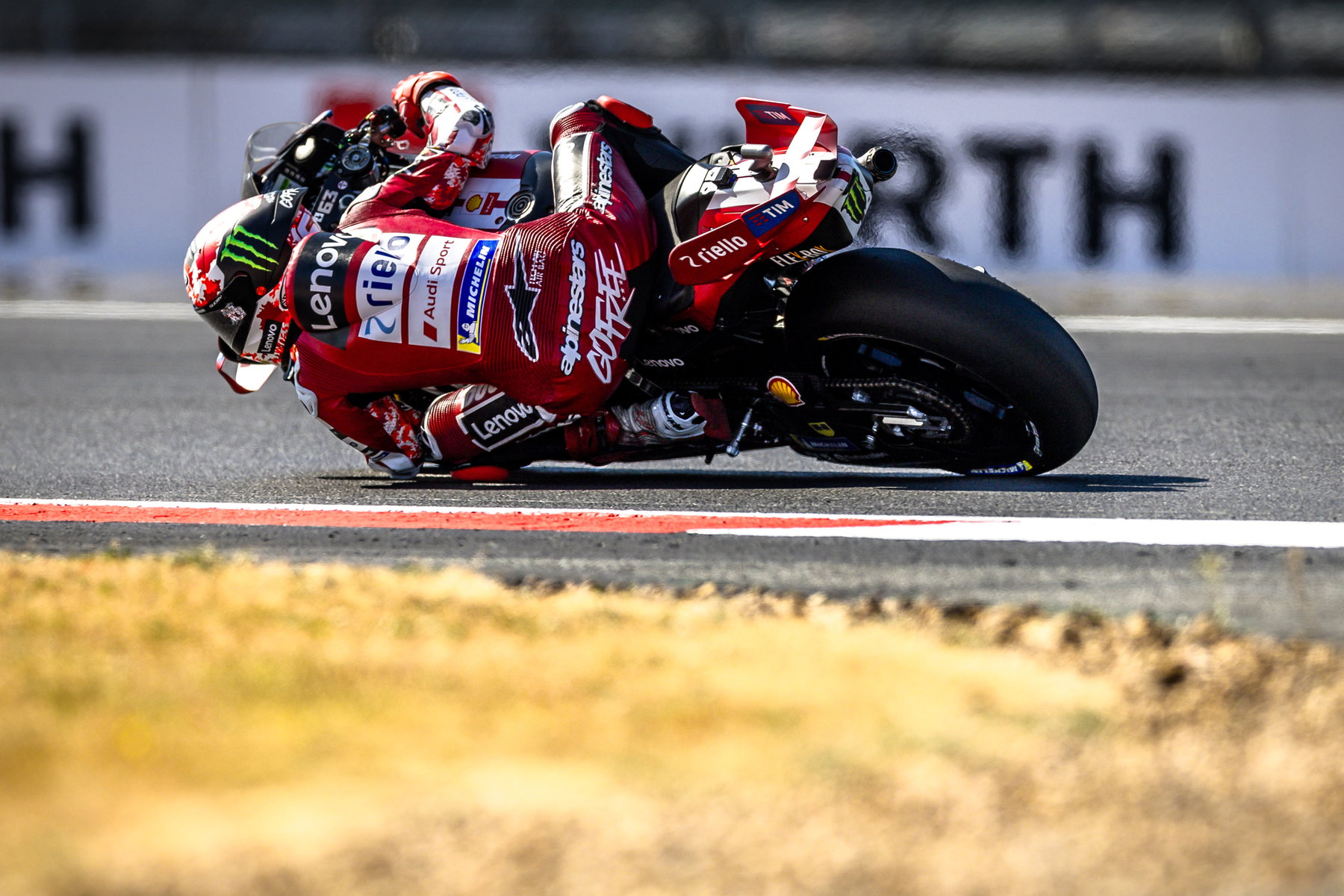
Francesco Bagnaia crossed the line seventeenth and describes a pattern similar to Marquez’s: “The lack of rear grip was huge, and after four laps I started going backwards, not forwards.”
The right-hand side of the tyre was completely finished by the end, Bagnaia said, but he does not see the problem in the tyre so much as in his own bike, which cannot find the grip. He expects only modest relief from the medium rear tyre, roughly four more laps by his estimate. Over the final two laps he could no longer get his knee down on the right-hand side at all.
Fabio Di Giannantonio ran third in the sprint at one stage before slipping back to fifth. “But then after the fourth lap I started to lose the rear in the entry to the corners. So it was really difficult then to manage the situation, and I went into survival mode.”
His own assessment is notable. He usually counts himself among the riders who look after their tyres best. He sees the key to Aprilia’s advantage in corner entry, because it allows their riders to be more relaxed on the throttle.
What did Jorge Martin do differently?
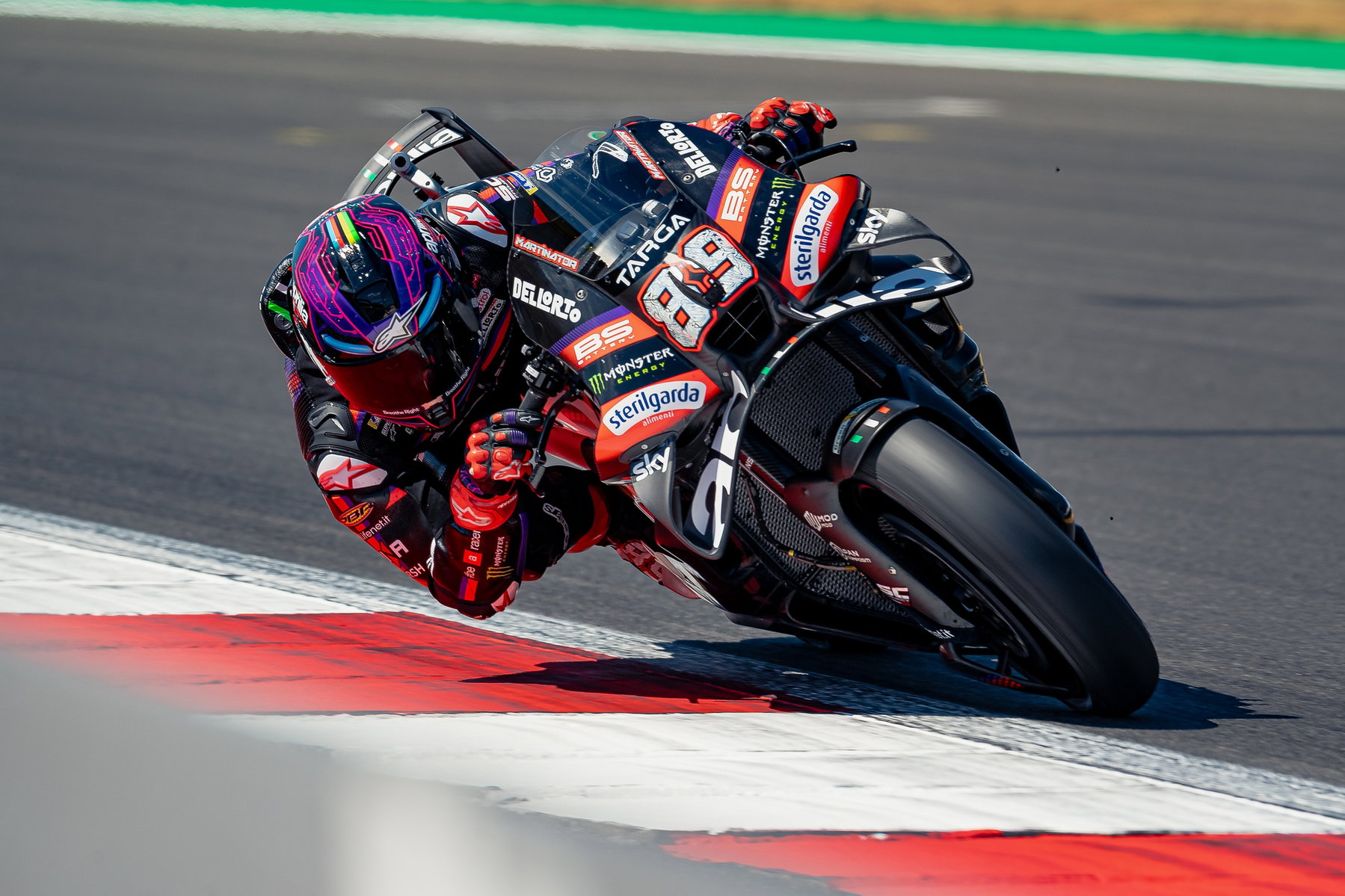
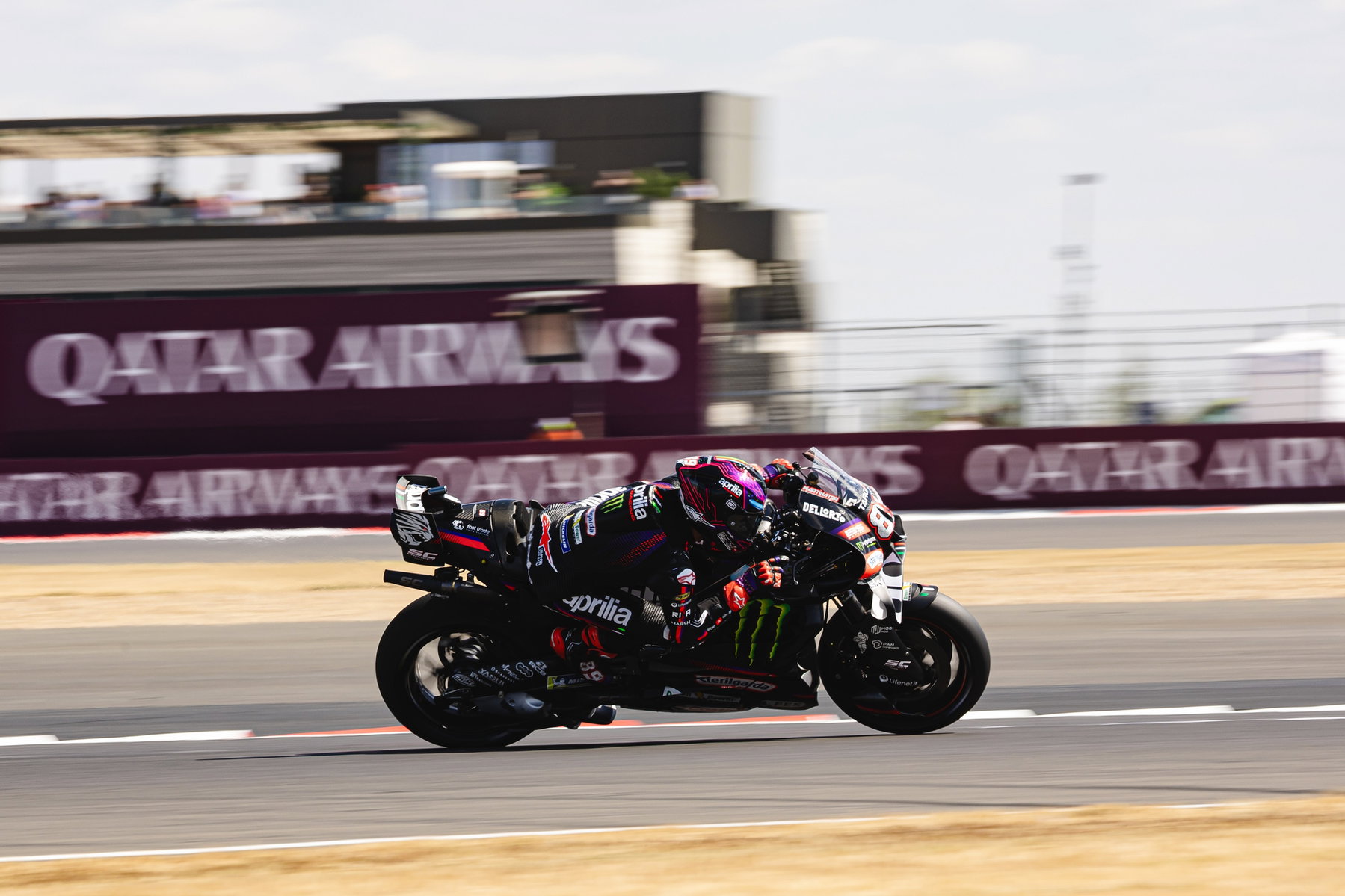
For Silverstone, Jorge Martin went back to the old base setup he last used when he won at Le Mans. On top of that comes a new aero part that no other Aprilia rider is running.
“It is the same bike we used at Le Mans. Sure, we now have some new parts, you will see that on the aerodynamics. But the setup level is the same as at Le Mans,” he explains. The effect shows above all in the balance: when front and rear match up, he does not have to overwork the front wheel to get the bike into the corner. That is precisely what saved the tyres.
His sprint was less comfortable than it looked from the outside. From lap four he no longer felt at ease with the rear tyre and expected Ogura to catch him. When the gap stayed stable anyway, he concluded that the others were in even worse shape.
He warns against jumping to conclusions himself: “It is not that we have now won Silverstone and everything is fine. We will have to confirm this in the coming races.”
How is Marco Bezzecchi really doing?
Marco Bezzecchi rode the sprint in considerable pain and did not expect his own result. His broken collarbone and the knee injury from the Sachsenring were operated on around a month ago.
“When I woke up this morning I felt much worse than on Friday, and qualifying then finished me off. I was completely destroyed,” he says. Over the final four laps he felt a clear drop in his physical performance.
The limitations affect his entire left side. He lacks strength in his upper body, he was barely able to train the leg before travelling, and downshifting produced an unusual sensation in his foot. Because he has to compensate on the left, it affects the right-hand side as well.
Which incidents occupied the riders after the sprint?
Three riders did not see the chequered flag, and in two cases there were some clear words afterwards. Raul Fernandez takes the blame for his crash, but points to a technical cause beforehand.
“Well, the crash was 100% my mistake.” He had noticed that Bezzecchi was struggling in the left-handers and therefore wanted to set up turn five. In turn four he opened up the line and turned in too aggressively. He traces the situation back to a botched start from second on the grid: as he released the clutch he felt vibrations, a problem that had already shown up in the morning.
Iker Lecuona retired after contact with Franco Morbidelli and still does not understand the move. He said he had passed him three times, was clearly quicker, and lost the rear after turning in on a dirty part of the track. Morbidelli describes it more harmlessly: he ran a little wide, as did Lecuona, probably on a dirty section. The two talked it over afterwards. The stewards investigated the incident and issued no penalty.
For Toprak Razgatlioglu, an unsuitable setup came on top of the tyre problem. The Yamaha rider finished twentieth, 34.332 seconds down. “But I did not expect the tyre to drop off that quickly. That was very strange,” he says. On the final lap his time was a 2:04. He said he could barely turn the bike any more and nearly lost the rear several times.
What does this mean for Sunday’s Grand Prix?
Over the double distance of 20 laps, the medium rear tyre should be the preferred choice. Whether that solves the problems is an open question, because Marc Marquez expects significant degradation with that compound too.
His reasoning is technical: on paper, soft and medium are very similar tyres. The left-hand compound is identical, the right-hand one comes from the same family and is only one step harder. It is an asymmetric tyre with a harder compound on the right-hand shoulder, because Silverstone runs predominantly to the right.
Alex Marquez does not rate his chances highly under these circumstances. With all the Aprilias on track, fifth is the maximum he can fight for. Bezzecchi, meanwhile, is hoping for a slower opening pace at the front, because that would let him last one or two laps longer. For Ducati and Michelin, Saturday evening meant work in front of the data screens either way.
Frequently Asked Questions
-
Why did the MotoGP Silverstone tyre problems start so early?
Michelin points to the high early pace and the high track temperature as the main reasons. The sprint was a second quicker than the 2024 record and the fastest lap six tenths faster. The drop-off had been expected only around two laps from the end.
-
What is graining on a MotoGP tyre?
With graining, rubber tears out of the tread and settles back onto the tyre. This creates an uneven surface and the rubber no longer works in its correct temperature window. Marc Marquez describes exactly this phenomenon as the cause of his collapse.
-
Why did Aprilia cope better with the soft rear tyre?
Fabio Quartararo puts it down to tyre temperature. With more grip a rider can work the throttle more finely and keep the temperature lower, and Aprilia is currently stronger at that than the competition. Fabio Di Giannantonio sees the advantage in the RS-GP corner entry.
-
What did Jorge Martin change on his Aprilia?
Martin has gone back to the base setup from Le Mans and combines it with a new aero part that no other Aprilia rider uses. According to him, this restores the balance between front and rear, which reduces tyre wear.
➜ This article is part of our comprehensive overview: 2026 MotoGP Season: The Complete Overview – Teams, Riders, Calendar & Championship Standings. Find all key information on this topic in one place.