- 45 percent of respondents experienced at least one critical situation on a country road within the past two years
- 89 percent are aware of the high risk, yet 72 percent still consider riding there safe
- 57 percent have never taken part in a rider safety training course
For many riders, the country road is the finest stretch of tarmac there is. Tree-lined avenues, blind crests, a long sweeping curve through the forest. But it’s precisely there that the most severe accidents happen. A representative Forsa survey commissioned by the German Road Safety Council (DVR) among 501 motorcyclists reveals just how far lived experience, knowledge and gut feeling can diverge. The results were released to launch the nationwide “Hartes Pflaster: Landstraße” (“Rough Ground: Country Roads”) campaign.
How many motorcyclists experience critical situations on country roads?
45 percent of respondents have experienced at least one situation in the past two years in which an accident was only just avoided. Seven percent were even involved in at least one accident on a country road during that period.
This is no fringe phenomenon — it affects nearly half of all respondents. For many riders, the near-miss has become part of everyday riding, without ever being registered afterwards as a warning sign.
Why do so many riders feel safe despite knowing the risk?
89 percent of respondents know that most fatal motorcycle accidents happen on country roads. Yet 72 percent still consider riding there to be safe.
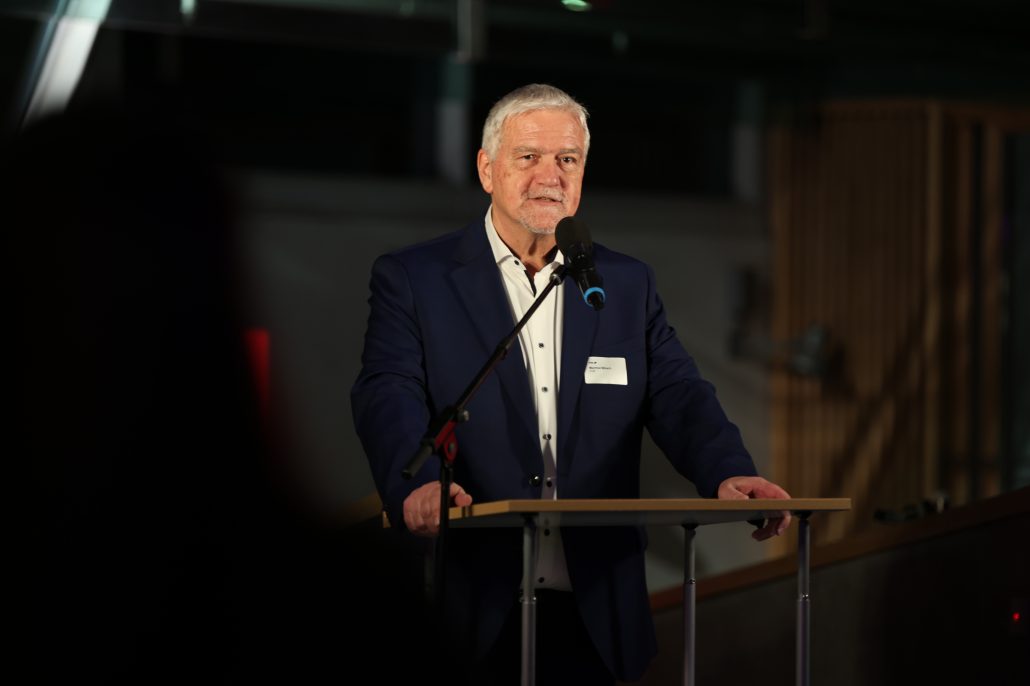
For the DVR, this gap between knowledge and gut feeling is one of the survey’s central findings. DVR President Manfred Wirsch puts it this way: “The survey shows that people tend to underestimate their own risk. Every accident-free ride can reinforce the feeling of being infallible and having every situation under control. Routine and self-confidence are important companions on a motorcycle — but they are no life insurance policy.”
Which dangers do motorcyclists mention most often?
Right at the top is the condition of the road surface. 93 percent cite poor road conditions as a risk, closely followed by wet or slippery surfaces at 91 percent.
Here is the complete picture:
- poor road conditions: 93 percent
- wet or slippery surfaces: 91 percent
- wildlife crossing the road or other obstacles: 90 percent
- risky overtaking manoeuvres by other road users: 89 percent
- dangerous manoeuvres by other motorcyclists: 84 percent
- cars tailgating: 84 percent
What stands out is that most of these factors come from outside. Riders’ own behaviour barely features in this list at all.
The corner as a blind spot
Only 56 percent of respondents see a risk in winding roads. That puts precisely the type of stretch that is statistically most critical for motorcyclists at the bottom of the list. The DVR points out that the accident figures paint a very different picture from riders’ perception.
Wirsch notes that cornering is what gives motorcycling its special appeal, but that it is precisely there that a rider’s safety is decided. In his view, there is no room for overconfidence in corners, because only a cautious riding style reliably gets you to your destination.
How does riding in a group change the risk?
68 percent of respondents agree that some motorcyclists ride more riskily in a group. Among 18- to 39-year-olds, the figure rises to 76 percent.
Behind this lies a social mechanism. 48 percent feel that good riding skills should also be demonstrated on the road. 26 percent say that riding noticeably more cautiously within a group quickly draws negative attention. By contrast, only 15 percent believe that risk is fundamentally part of motorcycling — in the younger age group, that figure is 23 percent.
Wirsch describes the pressure within a group as enormous. Younger riders in particular are more often tempted into manoeuvres they would never risk alone. For him, true skill is shown not by keeping up with the group, but by knowing your own limits and riding at your own pace.
Impatience and following distance: what riders say about themselves
The majority of respondents rate their own behaviour as responsible. Yet typical risk patterns still emerge in the details. 32 percent become impatient when they have to ride behind slower vehicles — among 18- to 39-year-olds, that figure is 47 percent. 17 percent admit to following more closely than a safe distance would allow, rising to 26 percent in the younger group.
Impatience and too little following distance are exactly the ingredients that produce spontaneous overtaking manoeuvres on country roads. It becomes especially critical before corners, blind crests and junctions, where the road ahead cannot be seen.
Why do so few riders attend a rider safety training course?
It’s not a question of usefulness: 88 percent of respondents are convinced that rider safety training helps avoid critical situations. Yet 57 percent have still never taken part in one.
Ten percent have completed a training course in the past two years, 13 percent in the past five years. A clear link emerges with annual mileage. Among motorcyclists who cover more than 5,000 kilometres a year, more than half have already done a training course. Among those covering fewer than 3,000 kilometres a year, it’s only around a third. Those who have taken part once also rate the benefit more highly.
For Wirsch, experience makes the difference here. He argues that in an emergency there is no second chance to get the reaction right — but that reaction can be trained in advance.
What do the accident figures say about country roads?
Country roads are the type of road with the most traffic fatalities. According to final figures from the Federal Statistical Office (Destatis), 2,832 people died in road traffic in Germany in 2025, 56 percent of them on country roads. In absolute terms, that is 1,580 people.
The ratio is striking: only around 26 percent of all injured people were recorded on country roads, yet they account for more than half of all fatalities. Accidents there happen less often, but end fatally far more frequently. The Federal Statistical Office cites higher speeds, the lack of a physical barrier from oncoming traffic, poor overtaking opportunities, and unprotected obstacles such as roadside trees as contributing factors. Excessive or inappropriate speed remains the most common cause of fatal accidents. On country roads in 2025, around a third of deaths were attributed to it — 532 fatalities.
For motorcyclists, the overall picture looks somewhat different than for most other road users. In 2024, 513 riders of registered motorcycles were killed. For 2025, the Federal Statistical Office reported provisional figures for the January-to-November period showing a decline of 41 fatalities, or around eight percent. These figures are explicitly provisional and may differ from the final tally.
What is behind the “Hartes Pflaster: Landstraße” campaign?
“Hartes Pflaster: Landstraße” (“Rough Ground: Country Roads”) is the latest stage of a campaign that the DVR has been running together with the Federal Ministry of Transport (BMV) and the German Social Accident Insurance (DGUV) since 2021. The new round started on 20 July 2026.
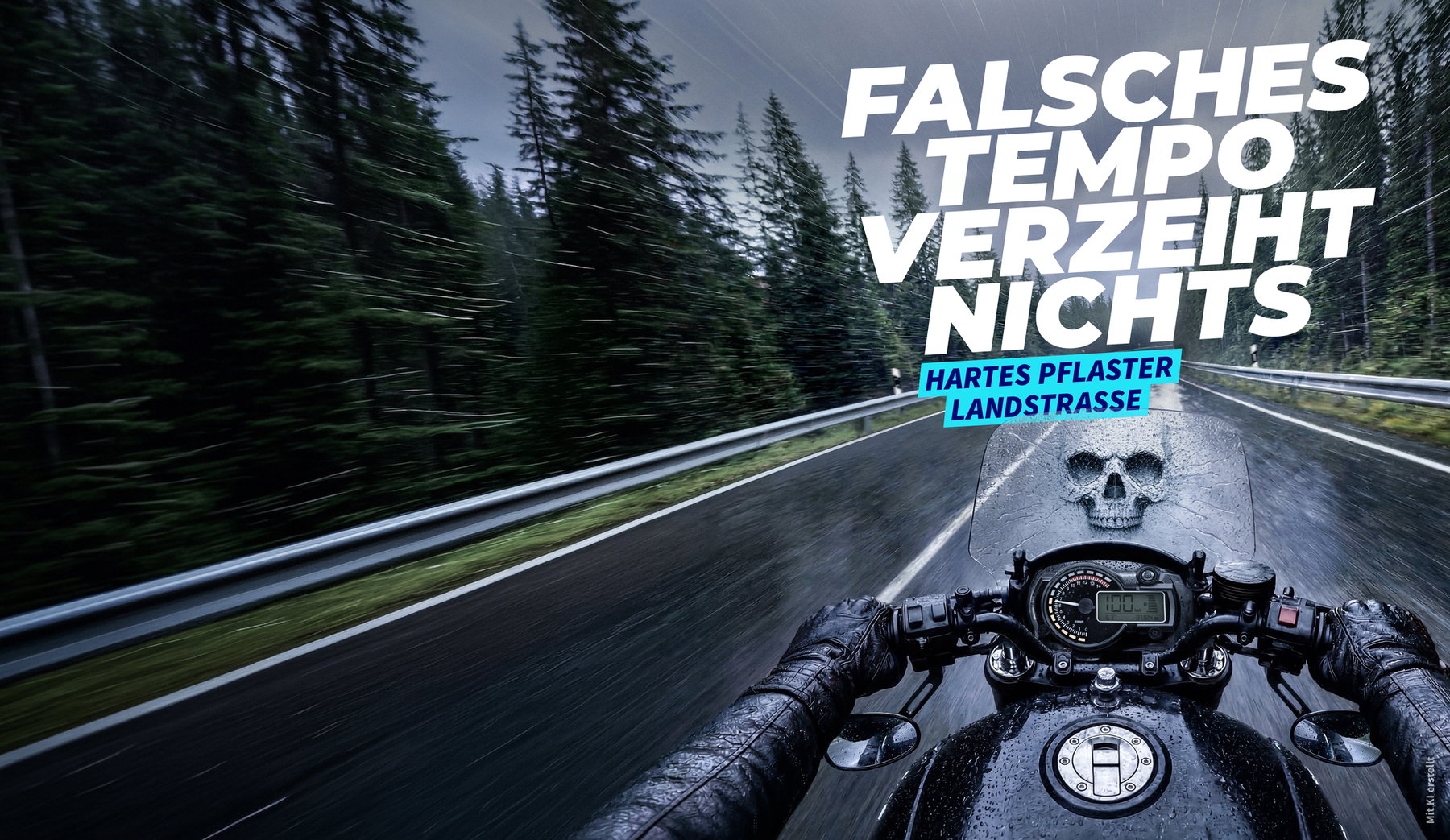
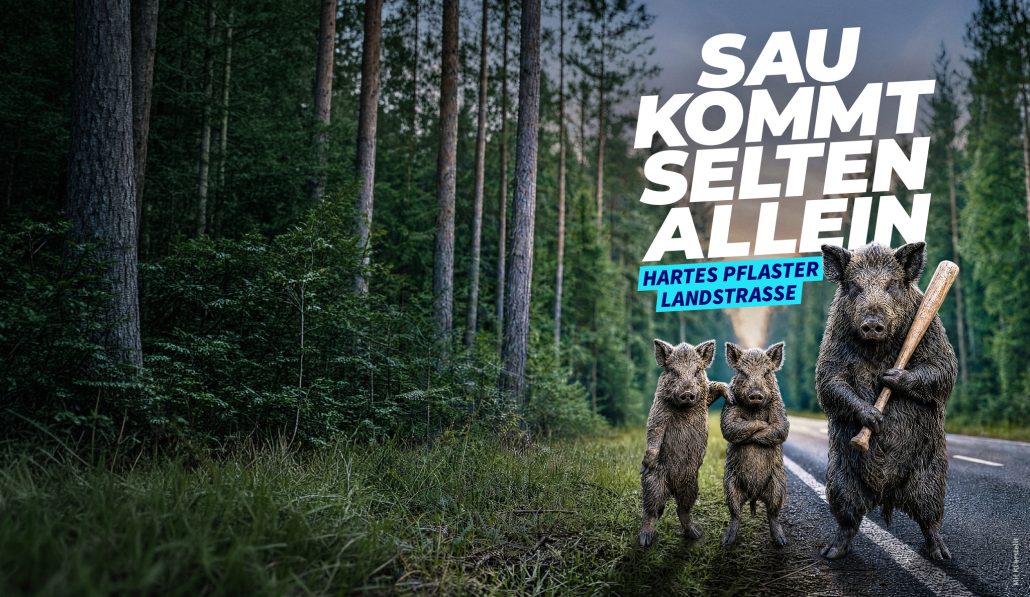
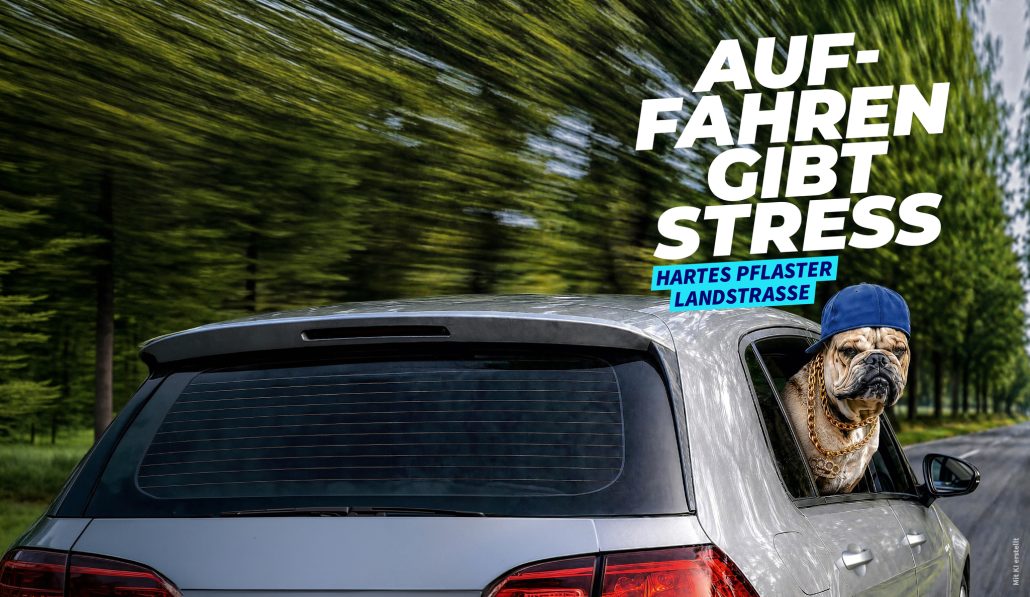
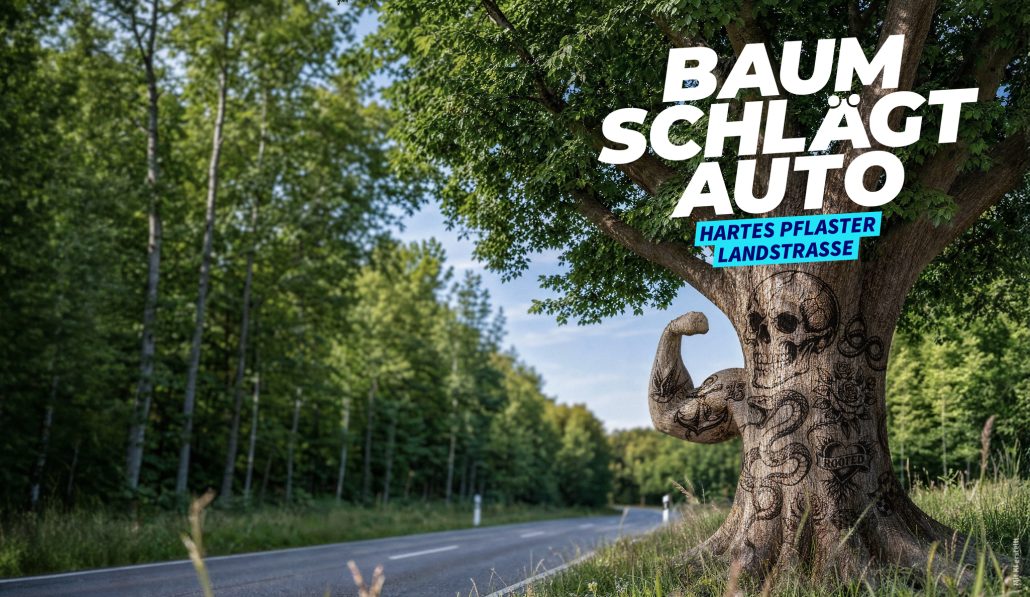
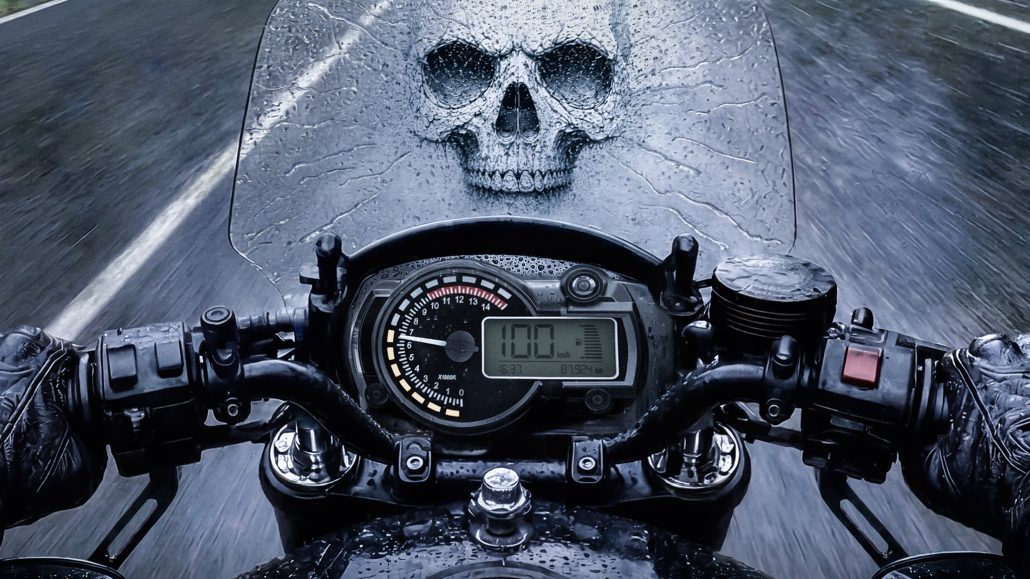
At the centre are four poster motifs that pick up on typical dangerous situations, deliberately with a wink. The motifs run under the titles “A Boar Never Comes Alone,” “Tree Beats Car,” “Tailgating Causes Stress” and “Wrong Speed Forgives Nothing.” The motorcycle motif shows the ride along a country road from the rider’s perspective, with a skull on the windscreen of the oncoming vehicle.
The posters are on display at more than 1,000 locations across Germany along country roads, on large-format billboards and at petrol stations in rural regions. They are accompanied by a video series, radio spots, social media activity and collaborations with influencers. The campaign is explicitly aimed not just at motorcyclists but at all road users on country roads. All content is available via the campaign site sichere-landstrasse.de, and the DVR also provides the material as a downloadable campaign kit.
Wirsch sums up the approach like this: “Road safety is rarely decided in big moments. It comes from many small decisions: a little less speed, a little more distance, and a brief moment of patience.”
Frequently Asked Questions
-
How dangerous are country roads for motorcyclists really?
Country roads are the type of road with the most traffic fatalities in Germany. In 2025, 1,580 people died there, accounting for 56 percent of all traffic deaths. At the same time, only around 26 percent of all accidents involving injuries happen there, meaning the consequences of accidents are disproportionately severe.
-
How many motorcyclists have already had a near-miss?
45 percent of the 501 motorcyclists surveyed have experienced at least one critical situation in the past two years in which an accident was narrowly avoided. Seven percent were involved in at least one accident on a country road during the same period.
-
Why is the risk of corners underestimated?
Only 56 percent of respondents see a danger in winding roads, while poor road conditions or wet surfaces are cited by more than 90 percent. The DVR points out that the accident figures tell a different story, and that cornering is particularly risky for motorcyclists.
-
Does rider safety training really help?
88 percent of respondents are convinced that training helps avoid critical situations. Those who have already taken part rate the benefit even higher. Even so, 57 percent have never attended such a training course.
-
When does the “Hartes Pflaster: Landstraße” campaign run?
The current campaign round started on 20 July 2026. The country-roads campaign itself has been running since 2021 and is carried by the DVR together with the Federal Ministry of Transport and the German Social Accident Insurance.
➜ This article is part of our comprehensive overview: Motorcycle Law & Policy: Regulations, Court Rulings and Developments for Riders. Find all key information on this topic in one place.