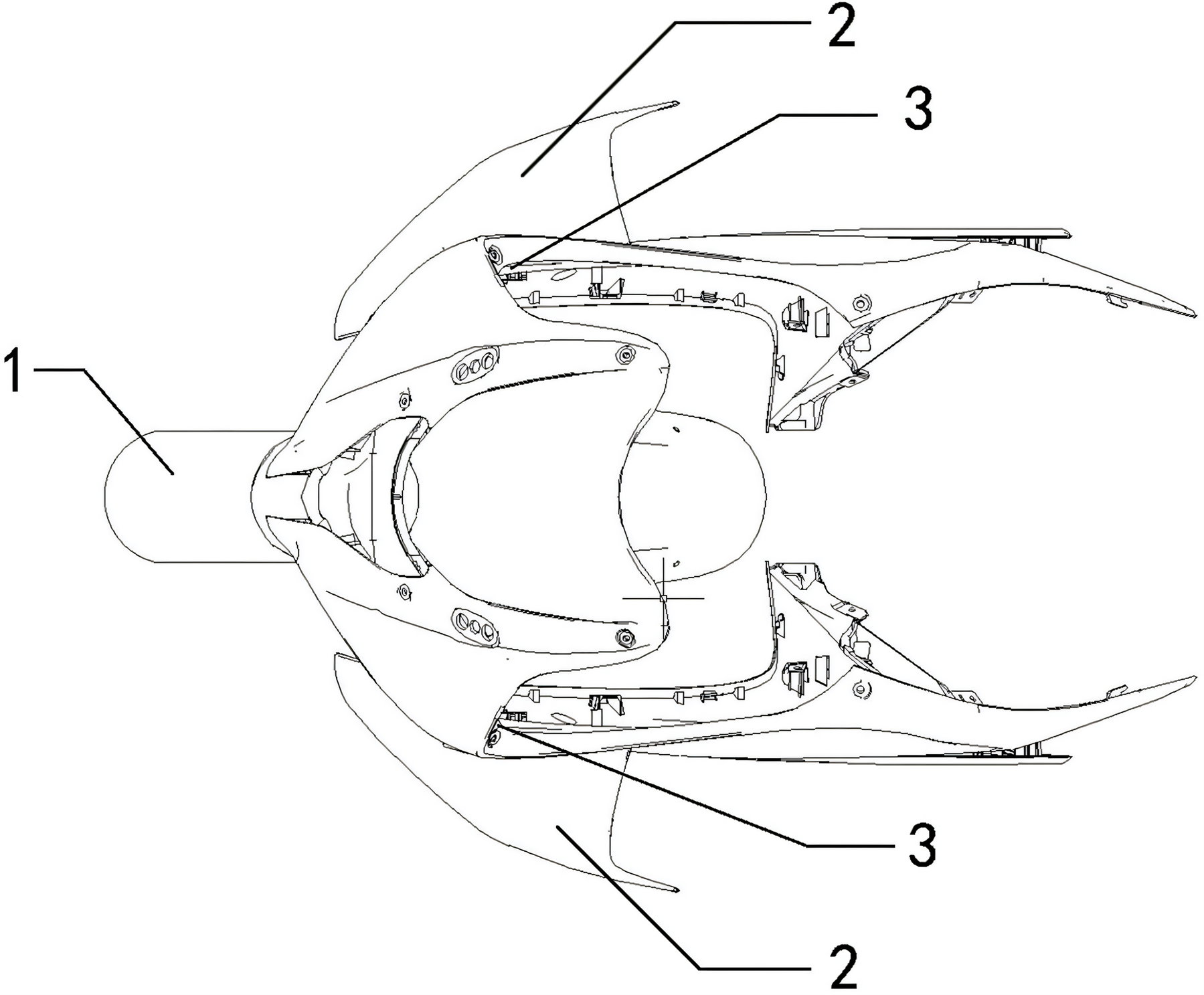
- The patent shows large, swept-back winglets whose left and right sides operate independently of each other.
- The control system relies on the six-axis IMU already fitted to the bike, which tracks lean angle, acceleration, and braking behavior.
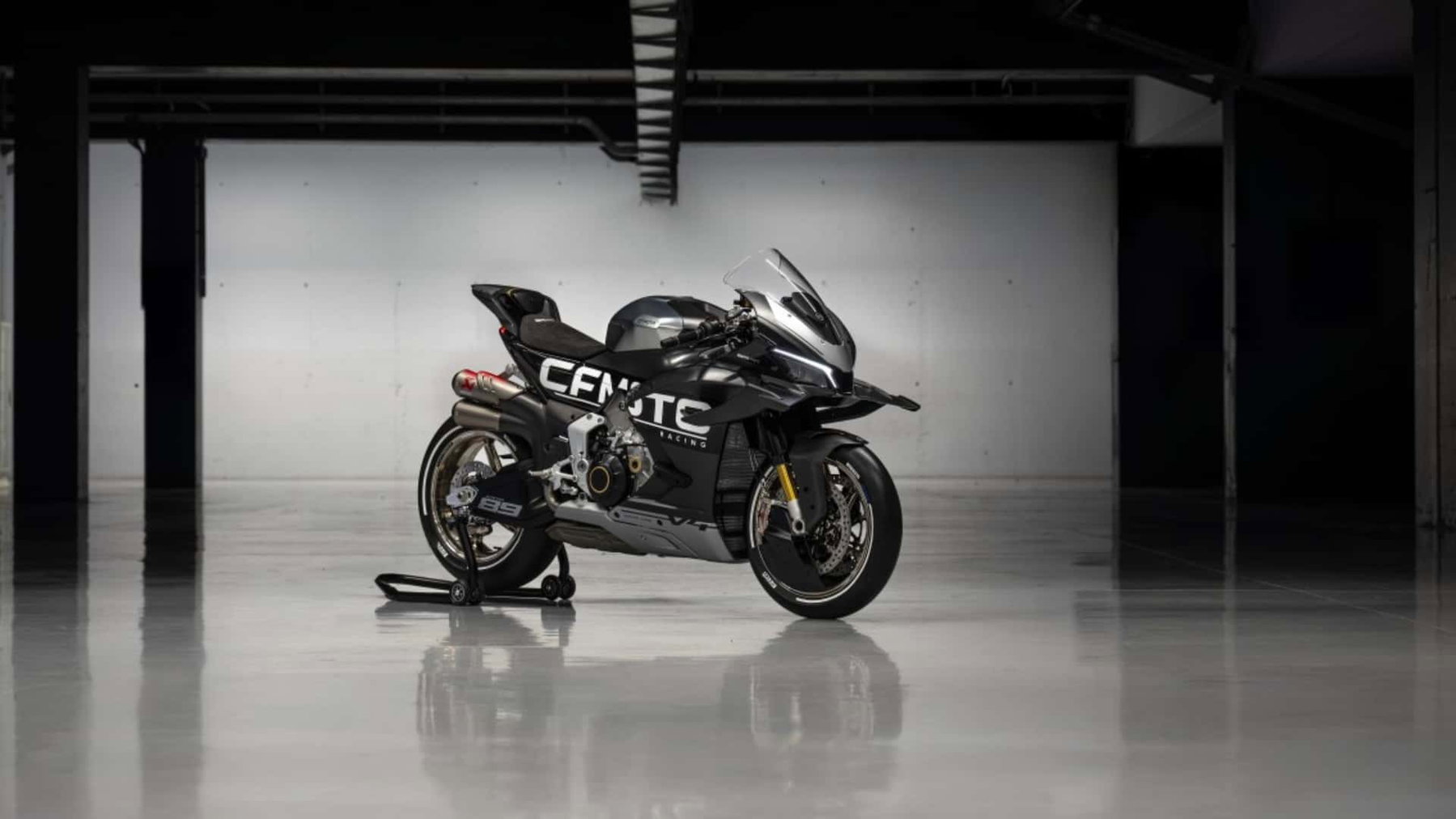
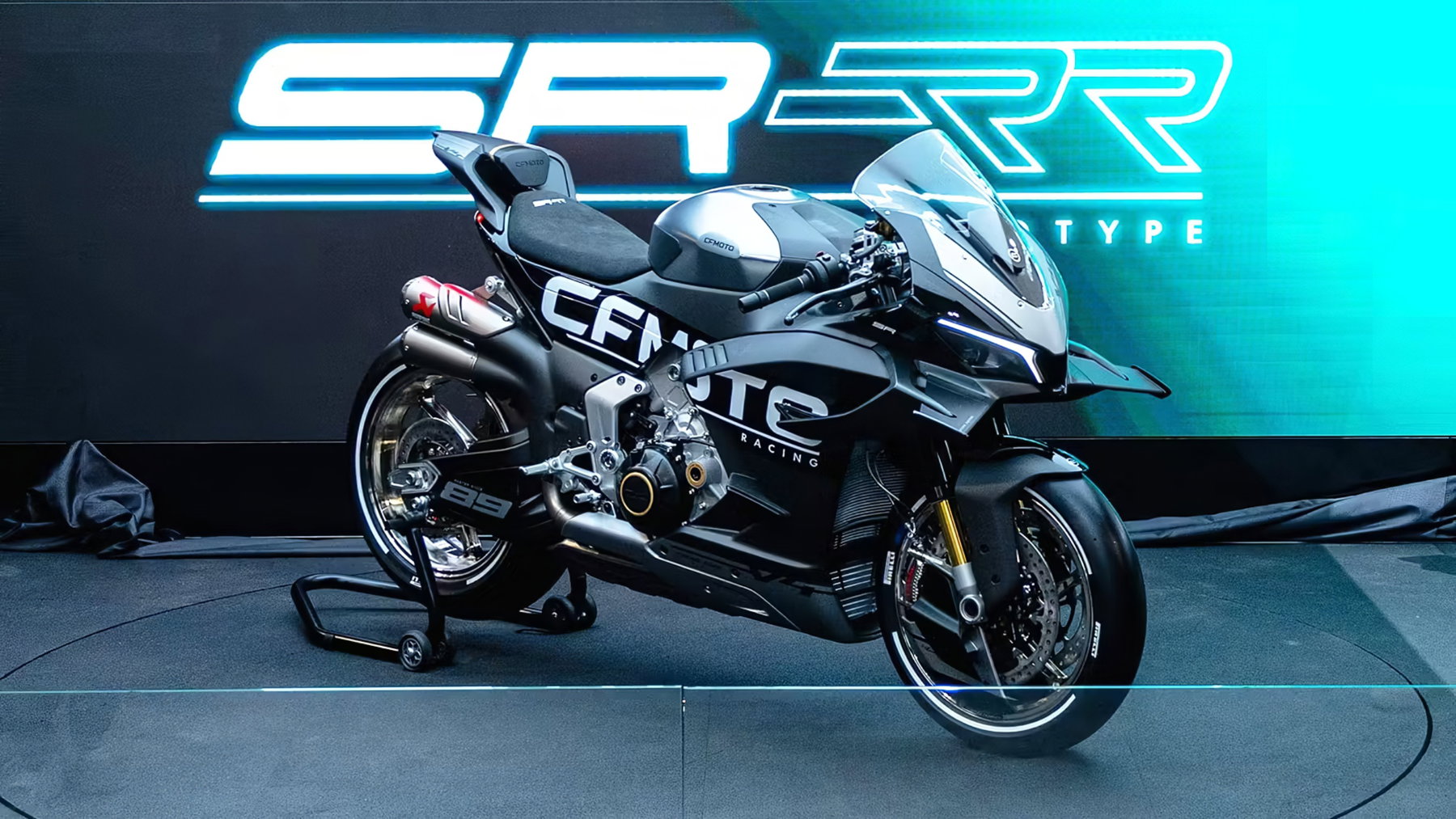
- The rival is the CFMoto V4 SR-RR, announced with more than 207 hp (about 152 kW) and a top speed above 300 km/h.
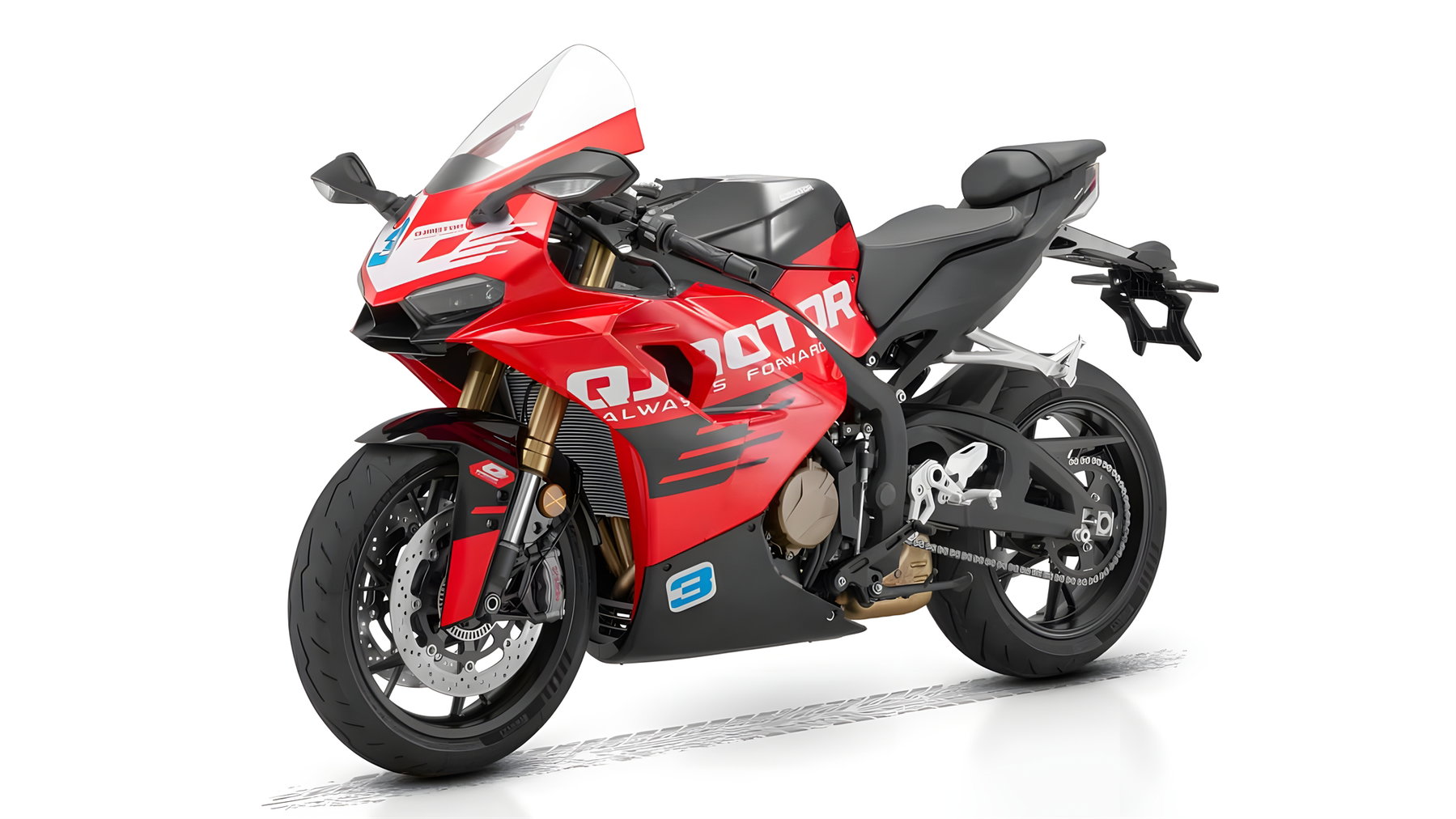
Winglets have become a standard feature on sport motorcycles, and development is now taking the next step. More and more brands are working on movable wings that change their effect depending on the riding situation, instead of sitting rigidly on the nose. QJMotor is now pushing into this field as well: a newly published patent shows that the manufacturer is working on a superbike with active aerodynamics, one that technically takes its cues from a rival in its own home market.
What does the new QJMotor patent show?
The patent shows a top-down view of the front section of a superbike with large, swept-back winglets, which is what the document is about. The complete motorcycle is not depicted in it. QJMotor describes a “control method and system for motorcycle wings,” which monitors the state of the motorcycle and adjusts the position of the wings accordingly. The approach recalls the CFMoto V4 SR-RR, which was shown as a prototype at EICMA in Milan last year.
How do the movable winglets work?
The winglets can be adjusted independently on the left and right, so each side can take a different angle. This makes the system work similarly to an aircraft’s ailerons and lets it influence the motorcycle’s roll and lean angle. Fixed winglets, and even movable wings that only adjust together, mainly prove useful on the straights, where they keep the front wheel planted and dampen the bike’s tendency to lift under acceleration. Independent control, by contrast, makes the aerodynamics usable in corners too, for example to generate extra downforce or pull the front wheel through a turn. So far, the Bimota KB998 Rimini is the only production motorcycle to use movable wings, and in a comparatively limited form: they only change their angle of attack, to deliver more downforce at low speed and under braking, and to reduce drag at high speed.
What role does the six-axis IMU play?
The necessary data comes from the six-axis IMU, which is already fitted to modern motorcycles anyway. These measurement units already supply information for cornering ABS and lean-angle-sensitive traction control, capturing acceleration, braking behavior, and pitch, roll, and yaw movements in real time. Combined with values such as speed, throttle position, and brake pressure, this provides all the data a computer-controlled wing system needs.
How does the system react during braking and wheelies?
During emergency braking, the system positions the winglets so that downforce increases and the wings additionally act as an air brake. The patent includes a flowchart showing the checks and reactions the computer runs through several hundred to a thousand times per second. If the system detects a wheelie, it changes the angle so that the front is pushed back down. In corners, the left and right sides work independently, depending on the motorcycle’s lean angle and roll rate.
How does QJMotor compare to the CFMoto V4 SR-RR?
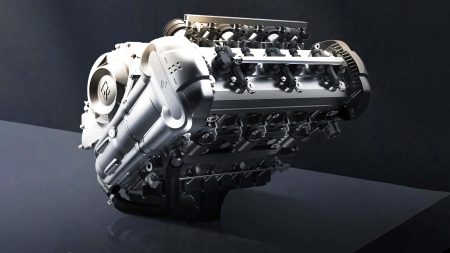
On paper, the CFMoto V4 SR-RR is clearly ahead, which is why QJMotor is working on an upgraded machine. The V4 SR-RR was shown as a prototype with a 997cc V4 engine and is claimed to produce more than 207 hp (about 152 kW). Its active aerodynamics are meant to react to speed and riding situation in real time, provide stability, reduce drag, and enable a top speed above 300 km/h (186 mph). At the show stand, the large wings moved independently of each other. In its simplest form, the CFMoto control system sets a shallow angle of more than 0 but less than 10 degrees when pulling away, to keep drag low. At high speed, the angle increases to 10 to 20 degrees to offset lift at the front. Under braking, the wings tilt to 45 to 90 degrees, increasing downforce and deceleration.
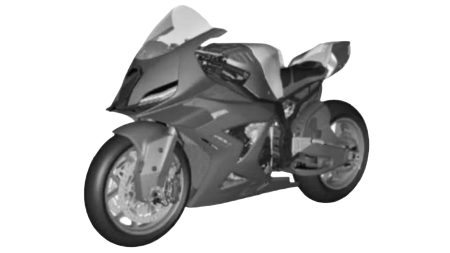
QJMotor was the first Chinese brand to show a liter-class superbike, initially under the name SRK1000RR. The model now carries the designation SRK1051RR and is based on the former inline-four engine from MV Agusta, whose production rights QJMotor acquired a few years ago. The SRK1051RR has not yet reached production, and earlier images showed it without aerodynamic add-ons.
What does QJMotor’s current inline-four lineup look like?
QJMotor has recently expanded its sport lineup with three inline-four models: the SRK 800, the SRK 800RR, and the SRK 921. They were unveiled through the racing structure QJMotor-MSi during the MotoGP round in Catalonia. The SRK 800 is positioned as a versatile naked bike with a 778cc inline-four that produces 95.2 hp (70 kW) and 75 Nm (55 lb-ft). The SRK 800RR moves closer to the supersport world, takes styling cues from the brand’s superbike, and wears an aerodynamically shaped fairing with front winglets. It uses the same inline-four, plus an aluminum monocoque with a stressed-member engine as well as a six-axis IMU and cornering ABS; QJMotor quotes a 0-100 km/h sprint of three seconds. At the top sits the SRK 921, a streetfighter with a 921cc inline-four producing 129.3 hp (95 kW) and 93 Nm (69 lb-ft), making it the most powerful naked bike the brand has built so far. It was styled by Adrian Morton of the design studio C-Creative, which has historic ties to MV Agusta.
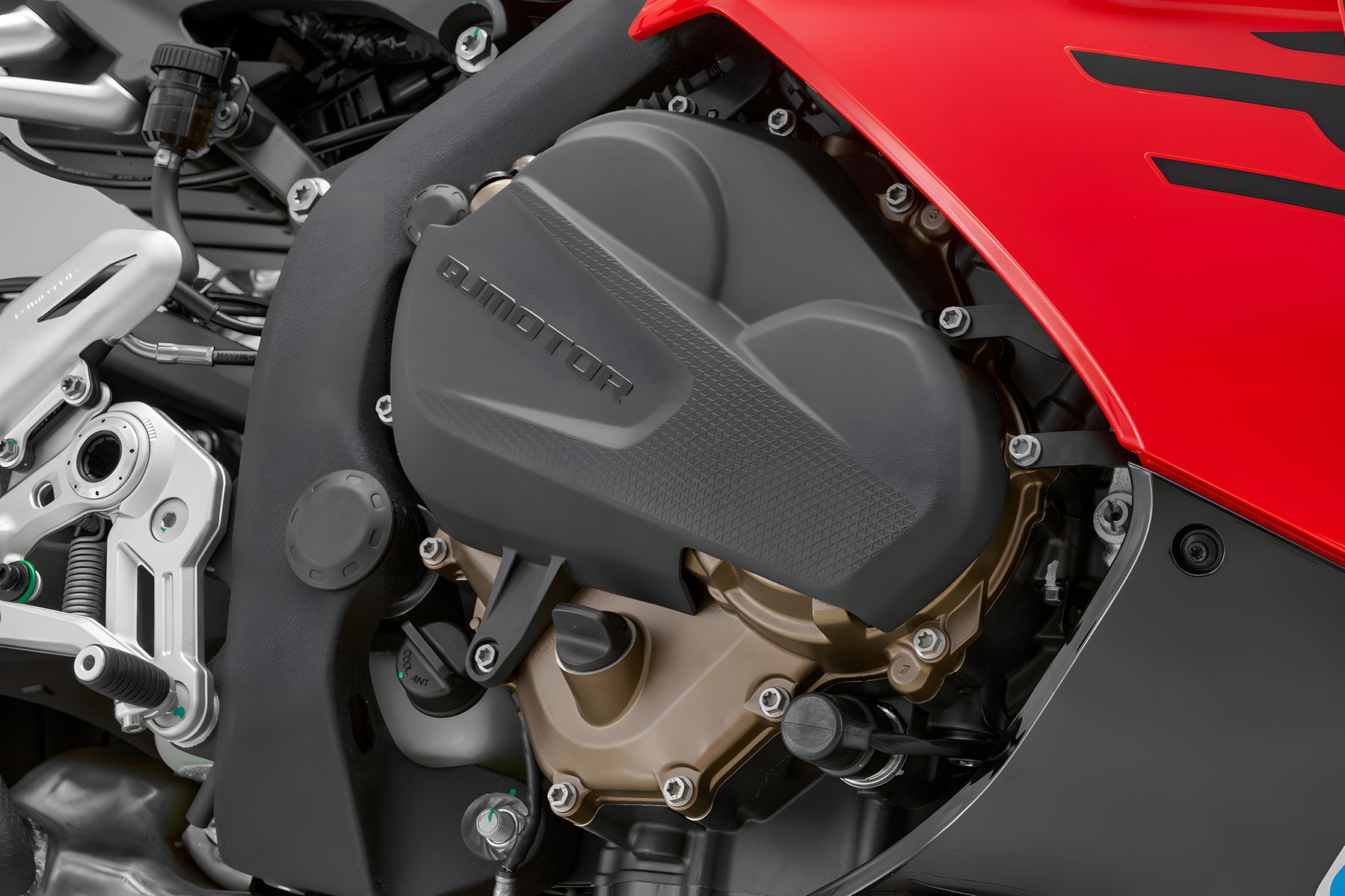
The SRK 800 is set to launch first on the Spanish market, starting at 7,499 euros (about 8,580 US dollars), while the SRK 800RR and the SRK 921 are due to follow in July. For the entire SRK range, the manufacturer quotes a six-year factory warranty.
Why are established manufacturers holding back?
So far, established manufacturers from Japan and Europe have not responded with their own production models, even though two Chinese brands are already pushing this technology forward. It remains open whether the competition is waiting and holding back its own models with active wings, or whether it risks being overtaken by these new entrants. Among established brands, BMW, for one, has already filed patents for movable winglets. This places the QJMotor patent within a broader trend in which active aerodynamics is becoming a new technical battleground in the production sport-bike segment.
➜ This article is part of our comprehensive overview: Motorcycle Patents and Future Technology: What Manufacturers Are Developing. Find all key information on this topic in one place.
Frequently Asked Questions
-
What is QJMotor’s superbike with active aerodynamics?
It is a superbike not yet in production, for which QJMotor has filed a patent for movable winglets. QJMotor’s active aerodynamics design calls for wings that adjust independently on the left and right, controlled via the six-axis IMU.
-
How do movable winglets differ from fixed ones?
Fixed winglets work mainly on the straights, generating downforce and keeping the front wheel planted. Movable winglets can change their angle depending on the riding situation and, with independent control, can also act in corners, under braking, and during wheelies.
-
What can the CFMoto V4 SR-RR do?
The CFMoto V4 SR-RR was shown as a prototype with a 997cc V4 engine and more than 207 hp (about 152 kW). It is expected to reach over 300 km/h (186 mph) and uses active aerodynamics with independently movable wings.
-
Which QJMotor models are currently available?
The current sport lineup includes the SRK 800 with 95.2 hp (70 kW), the more track-focused SRK 800RR, and the SRK 921 with 129.3 hp (95 kW). The SRK 800 launches in Spain starting at 7,499 euros (about 8,580 US dollars).