- 73.4 hp (54 kW) and 68 Nm from a 65-degree V-twin with 691.66 cc
- 21-inch front wheel, 230 mm of travel at the front, 220 mm at the rear
- Price and market launch have not been announced yet
Until now, Benda has mainly been known for cruisers such as the Rock 707, the LFC 700 and the Dark Flag. At EICMA 2026 in Milan, the Chinese manufacturer is now showing its first adventure bike, the Capra 700. The model was developed specifically for the European market and is one of the new releases with which Benda is entering several new segments at once at the show. Technically, the Capra is closer to a well-known class rival than its unusual engine might suggest.
What is the Benda Capra 700?
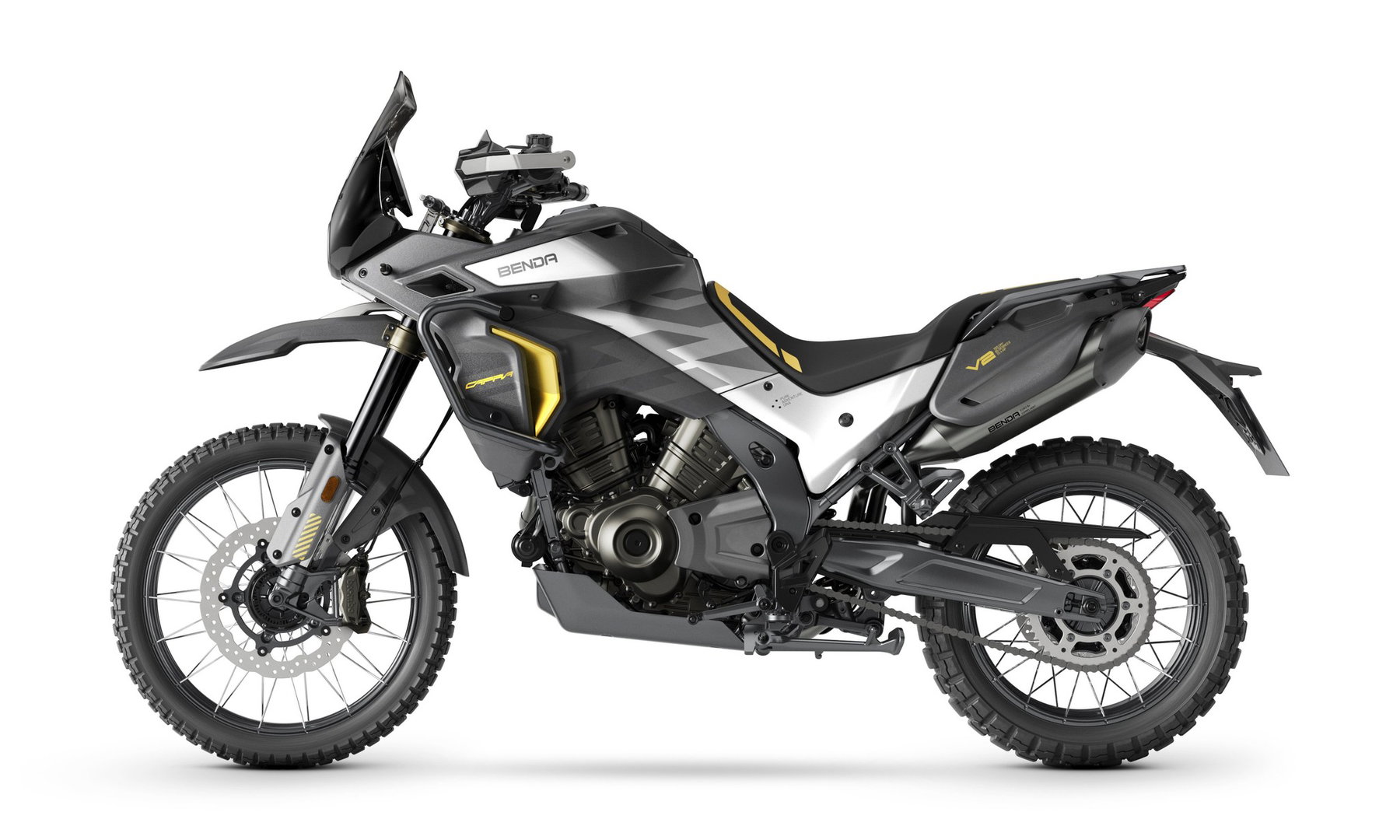
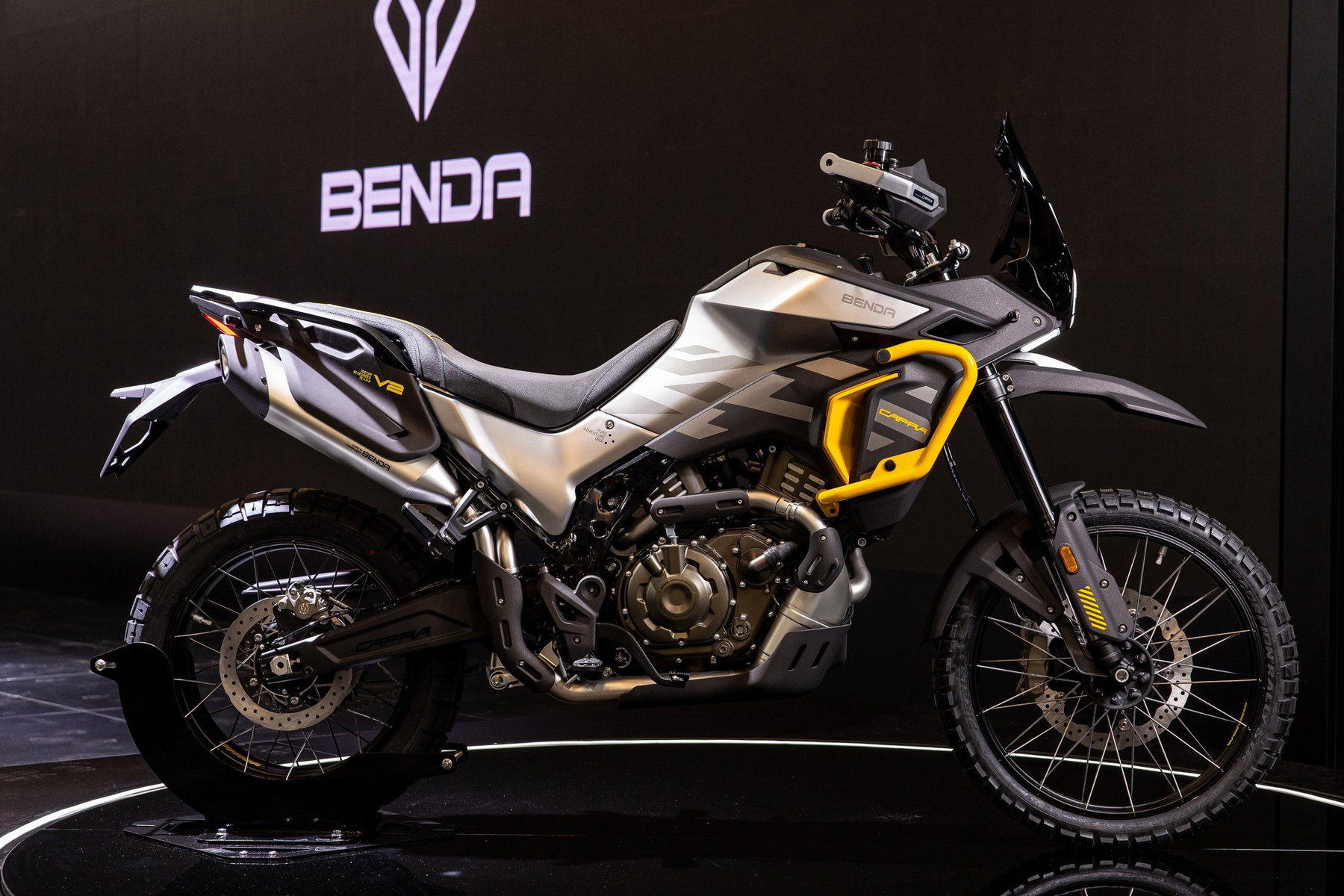
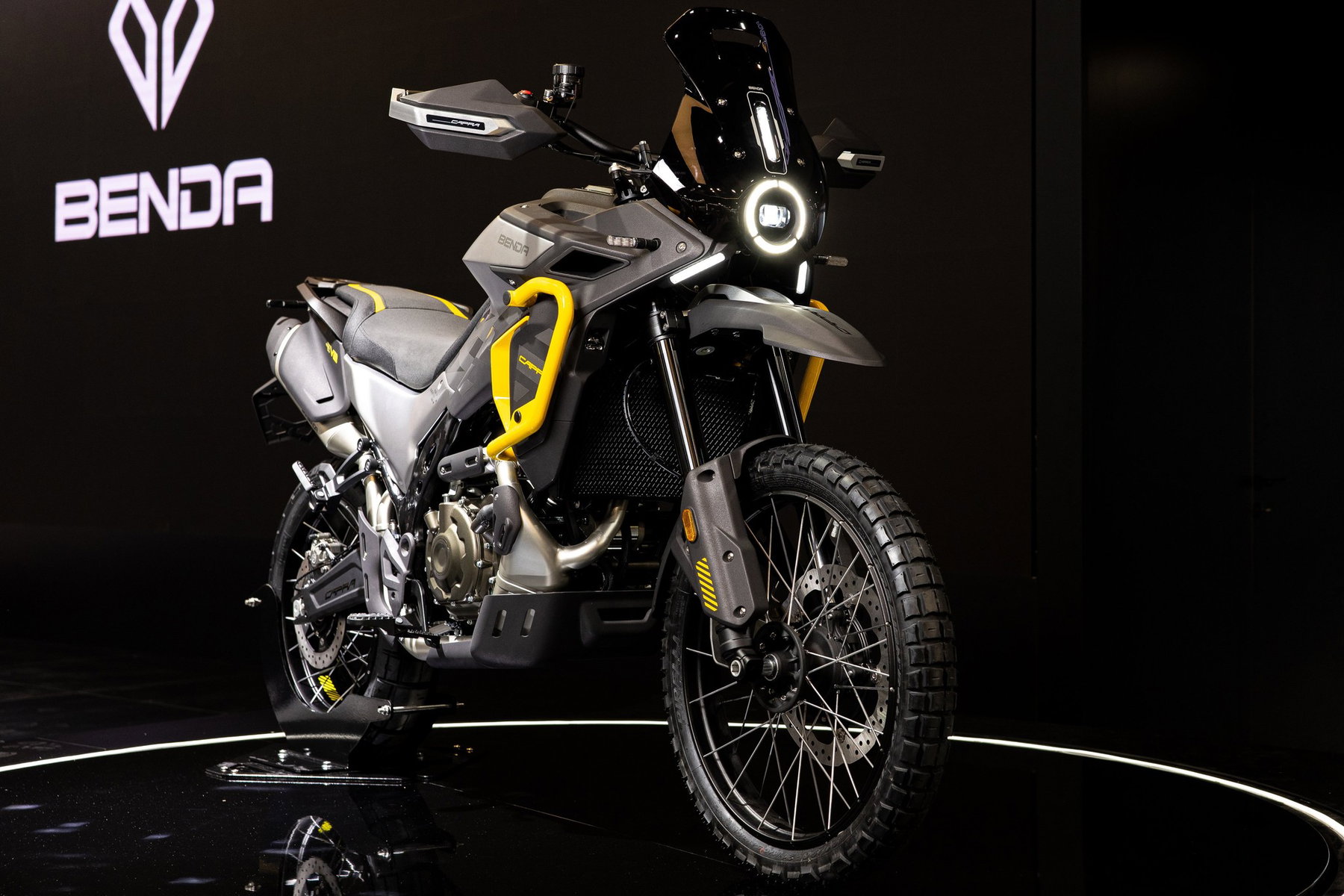
The Benda Capra 700 is a mid-size adventure tourer with a liquid-cooled V-twin, designed by Benda primarily for the road. With a 21-inch front wheel, an 18-inch rear wheel and long suspension travel, however, it is also prepared for gravel roads.
The name comes from the Latin genus Capra, which also includes the ibex. The mountain goat stands for sure-footedness on steep and loose terrain, and this image is meant to be reflected in the compact proportions of the machine. The Capra was styled by a European design team that worked closely with Benda’s engineers in Hangzhou, China. According to the manufacturer, the biggest challenge was packaging the V-twin into a compact adventure chassis. A V-engine is inherently longer than a parallel twin, and that had to be reconciled with the riding position and proportions.
Where does the Capra 700’s V-twin engine come from?
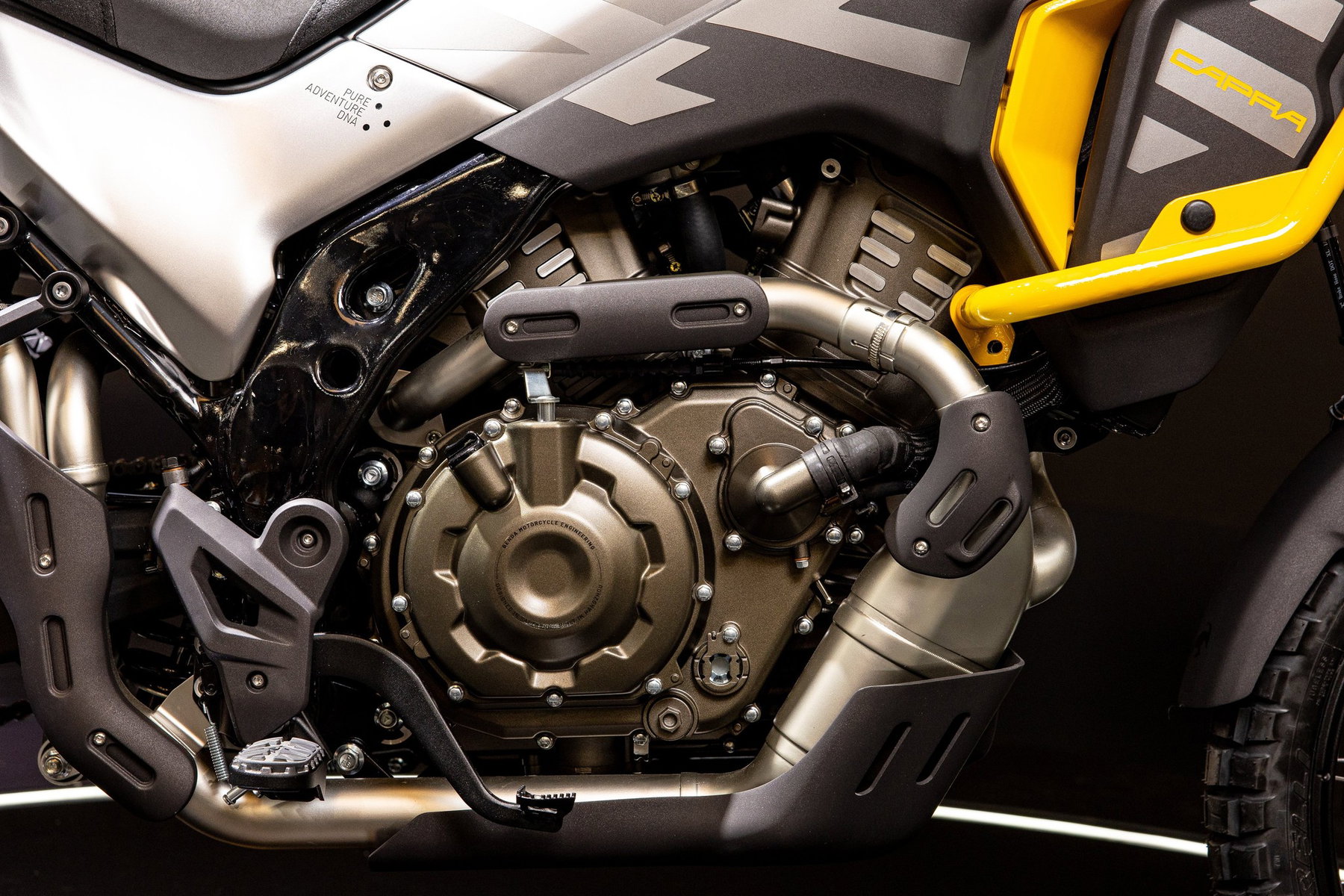
The engine is not new: it is the same 691.66 cc V-twin that already powers the Rock 707 cruiser. The Vinster 700 and Vinster X 700 roadsters, also shown at EICMA, use this unit as well.
The Capra carries over bore and stroke (80 x 68.8 mm), the 11.5:1 compression ratio and the performance figures unchanged from the Rock. The twin with a 65-degree cylinder angle produces 73.4 hp (54 kW) at 9,000 rpm and 68 Nm (50 lb-ft) at 6,500 rpm. Shifting is handled by a six-speed gearbox. Unlike the cruiser, which uses a belt, the Capra sends power to the rear wheel via a chain.
Ride-by-wire, an electronic throttle without a cable, ensures fine control. There is also an oil-bath slipper clutch, which prevents the rear wheel from hopping during hard downshifts.
By choosing a V-twin, Benda is taking a different path from most of its competitors. Yamaha, Honda, Aprilia and CFMOTO all rely on parallel twins in this class. Even Honda, whose Transalp had a V-twin for generations up to the XL700V, switched the 2023 revival to an inline engine.
How does the Benda Capra 700 differ from the Yamaha Ténéré 700?
In terms of power and torque, there is no difference at all: both deliver 73.4 hp at 9,000 rpm and 68 Nm at 6,500 rpm. The bigger differences lie in weight, suspension travel and the front brake.
The similarity extends into the engine itself. Both have an 80 mm bore and an 11.5:1 compression ratio. The Ténéré has a 68.6 mm stroke and 689 cc displacement, the Capra 68.8 mm and just under 692 cc. Even so, the engines are not technically related, because a V-twin and a parallel twin are fundamentally different in design. How the Benda’s V-twin feels in terms of throttle response, vibration and power delivery can only be shown by a test ride.
The tyre sizes are identical too, and at 1,599 mm the wheelbase is just 4 mm longer than the Yamaha’s. After that, the two go their separate ways:
- Suspension travel: the Capra offers 230 mm at the front and 220 mm at the rear, the Ténéré 210 and 200 mm.
- Seat height: at 850 mm, you sit 25 mm lower on the Benda.
- Tank: the Capra holds 18 instead of 16 litres.
- Weight: the Ténéré weighs 208 kg (459 lbs) ready to ride, while the Capra tips the scales at 220 kg (485 lbs).
The weight comparison is not entirely clear-cut. The German press release states 220 kg as the dry weight, while the English and Dutch versions refer to ready-to-ride weight. If the figure applies without fuel, the gap to the Yamaha would be even larger. Either way, the Capra is not lighter than the Ténéré.
Capra 700 chassis and brakes
The basis is a steel trellis frame with an aluminium swingarm. At the front, an upside-down fork provides 230 mm of travel. At the rear, a linkage-mounted shock with a separate reservoir (piggyback) delivers 220 mm of rear-wheel travel from 89 mm of shock stroke. Both fork and shock offer multi-step adjustment for compression and rebound. The spoked wheels carry tyres in sizes 90/90-21 and 150/70-18.
Benda economises on the brakes. At the front, a single disc with a radially mounted four-piston caliper does the stopping, with a single-piston caliper at the rear. The Ténéré uses two 282 mm discs at the front. Benda has not yet stated the diameter of the Capra’s disc. A well-tuned single-disc setup can certainly be sufficient and saves weight. On a 220 kg adventure tourer with luggage, however, first tests will show how much reserve remains under repeated hard braking.
The electronics include two-channel ABS and traction control. How far the systems can be adjusted is still open. For riding on gravel, for example, it would be important to know whether the rear ABS can be switched off.
Capra 700 design and equipment
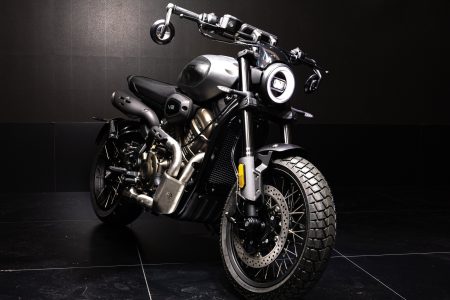
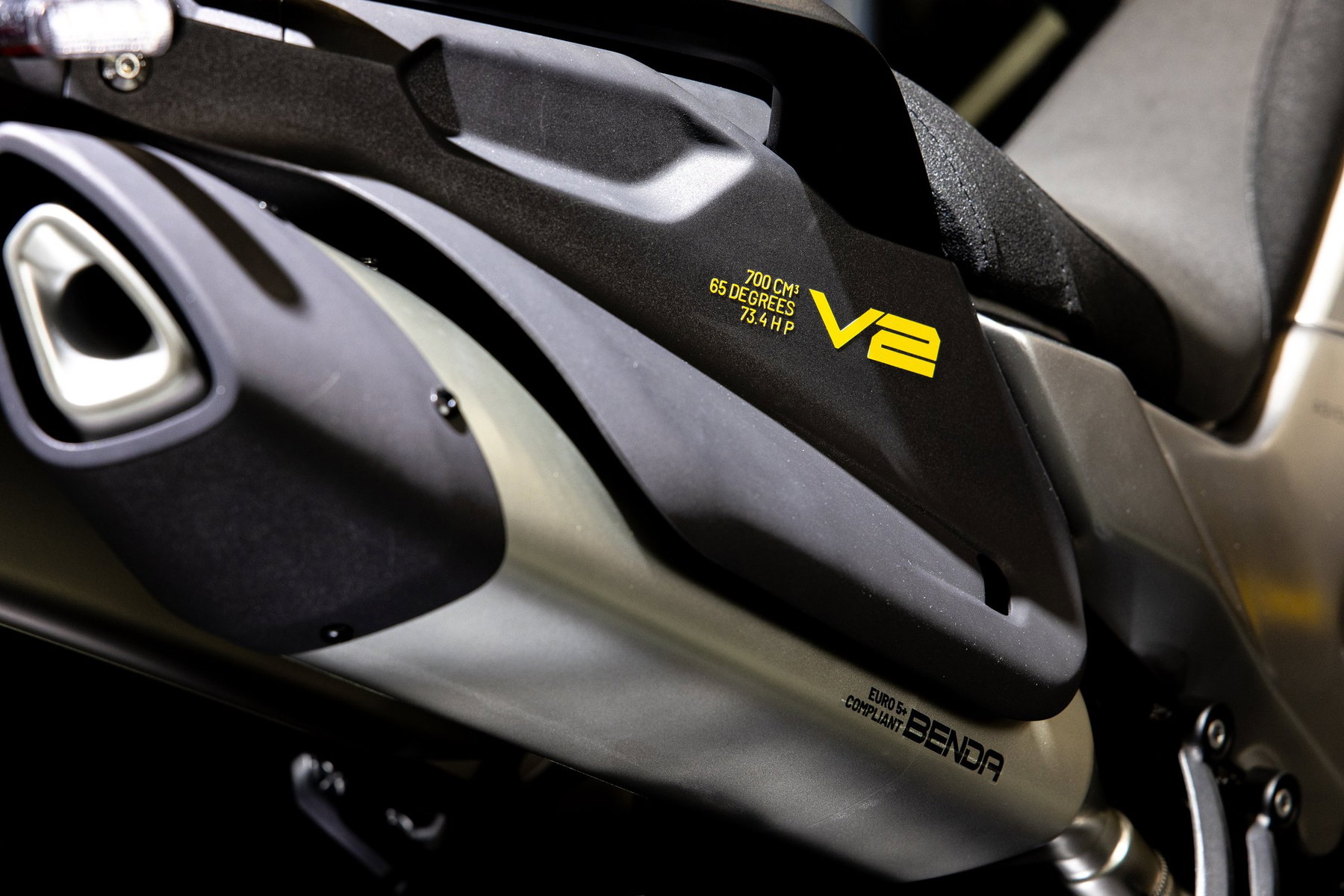
Visually, the Capra combines flowing bodywork lines with exposed technology. Its most striking feature is the high-mounted twin exhaust system, which is integrated into the bodywork under the tail. At the front, a distinctive daytime running light signature and built-in fog lights ensure recognition.
Practical touches include crash bars integrated into the side panels and a small luggage rack above the tank, whose slots accept straps or gear. The cockpit features a vertically mounted TFT display, plus a USB-A port. Benda quotes the dimensions as 2,306 mm long, 1,050 mm wide and 1,397 mm high.
When is the Benda Capra 700 coming and what will it cost?
Benda has not yet announced price or market launch. The manufacturer merely says it will publish further details soon.
George Schelfaut, Transportation Designer at Benda Motor Europe, sees the Capra as an important step for the brand’s ambitions in the European market. By entering the adventure segment, Benda aims to broaden its range and win new customers. The price in particular will show whether the special engine and equipment provide enough arguments against the established competition. What is certain is that the Capra has no weight advantage.
Can you ride the Benda Capra 700 with an A2 licence?
Not as standard, because at 54 kW the Capra 700 is well above the A2 limit of 35 kW. Benda has not yet said whether there will be a restricted version.
Frequently Asked Questions
-
How much horsepower does the Benda Capra 700 have?
The Benda Capra 700 produces 73.4 hp (54 kW) at 9,000 rpm. Peak torque of 68 Nm arrives at 6,500 rpm. Both figures are exactly the same as those of the Yamaha Ténéré 700.
-
How much does the Benda Capra 700 weigh?
Benda quotes a weight of 220 kg (485 lbs). Whether the figure applies with or without fuel is unclear, because the language versions of the press release differ. The tank holds 18 litres.
-
Which engine powers the Capra 700?
The Capra 700 is powered by a liquid-cooled 65-degree V-twin with 691.66 cc displacement. It is the same engine that Benda also uses in the Rock 707 and the new Vinster models.
-
What is the seat height of the Benda Capra 700?
The seat height is 850 mm. That puts you 25 mm lower than on the standard Ténéré 700 with 875 mm.
➜ Find all technical specifications for this model in our motorcycle database: Benda Capra 700 2027.
➜ This article is part of our comprehensive overview: New Motorcycles 2027: All Models, Releases and Highlights at a Glance. Find all key information on this topic in one place.
➜ More on this topic in our overview: EICMA 2026: All New Models and Premieres from Milan at a Glance.