- The ruling concerns private accident insurance, which pays out when the insured person is injured. Damage to your own motorcycle or to other vehicles is not covered by the decision.
- The exclusion for events where top speed matters only applies to competitions with rankings and a winner.
- A race track, slicks, speeds above 200 km/h and riders wanting to push to the limit are not enough to trigger the exclusion (ruling of 13 October 2026, case number IV ZR 251/25).
When you crash on a race track, three different types of insurance can come into play. Private accident insurance pays when the rider is injured, for example a daily hospital allowance, a recovery allowance or a benefit for permanent impairment. Comprehensive insurance covers damage to your own motorcycle. Liability insurance steps in when others suffer damage, for instance to other vehicles or to the crash barrier. The new ruling by Germany’s Federal Court of Justice (BGH) only concerns the first of these three, the protection of the rider as a person. After crashes at track days, race training sessions or open practice, accident insurers often refuse to pay because such events are supposedly about reaching top speeds. Whether that is enough had long been disputed among the courts. The IV Civil Senate in Karlsruhe, which is responsible for insurance law, has now settled the question. For anyone who regularly books track training during the season, the ruling is therefore more than a footnote in insurance law.

What did the BGH decide on accident insurance on the race track?
The Federal Court of Justice ruled that an accident on a race track is only excluded from accident cover if the event was a genuine competition for speed. Rankings and victory must therefore depend on the participants’ pace. In addition, this competition must have been agreed or announced in advance.
At the heart of the case was clause 5.1.5 of the 2012 General Accident Insurance Conditions, known as AUB 2012. This clause excludes accidents that happen to someone as the driver, passenger or occupant of a motor vehicle during driving events and the associated practice runs “in which the achievement of top speeds is important”. At the same time, the clause contains an exception to the exception: events where only or mainly average speeds matter remain insured. The clause names classic car, rally, reliability and orienteering drives as examples.
The clause appears in many accident insurance policies, and the Higher Regional Courts have interpreted it differently until now. Several courts required a race with rankings for the exclusion to apply. The Higher Regional Court of Dresden, by contrast, ruled in 2019 that even a fun event about power, adrenaline and controlling the vehicle at the limit was sufficient. Because of this dispute, the Higher Regional Court of Hamm had expressly allowed an appeal to the BGH. The question arises in a large number of cases, the court said.
Which event led to the dispute?
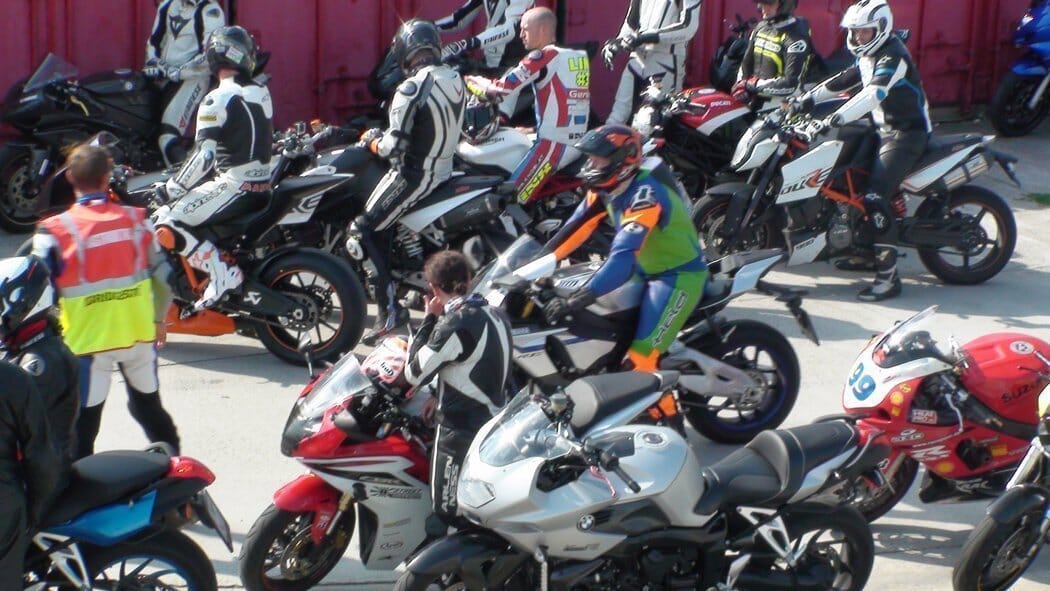
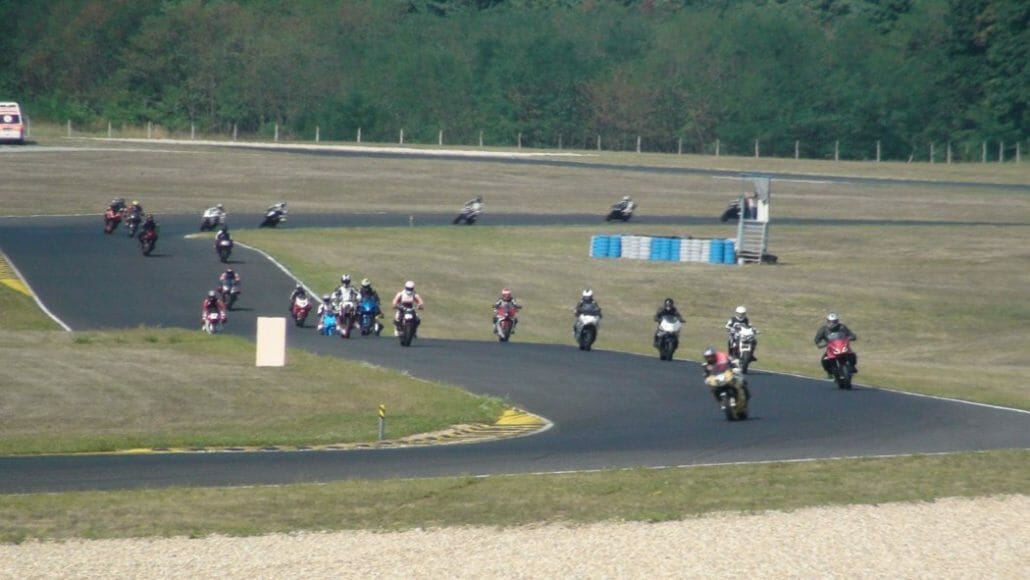
The case was triggered by a motorcycle accident at the “Track Days” of a motorcycle manufacturer on 12 and 13 June 2021. The manufacturer organised the event together with a race training provider at a motorcycle race track. On the one hand, a one-make cup with qualifying and races took place there; on the other, there were training and practice sessions for private riders. The injured rider only took part in the training sessions, not in the cup.
The training sessions were divided into six turns per day, each lasting 20 minutes. Participants were split into four performance groups of 40 to 50 riders each based on their lap times. Within a group, lap times were supposed to be no more than around six to seven seconds apart. Anyone who was too fast or too slow for their group could move up or down, which was usually checked every half day. Each rider had to carry a transponder for timing. Riders could print out their own lap times, but not those of others. There was therefore no ranking list. According to the organiser, around half of the participants did not use this option at all.
The event was advertised with the slogan “Take your bike to the limit”. The motorcycles were race-prepared. Number plates were removed, mirrors taken off or taped over, lights switched off or taped over, and many riders used pre-heated slicks. The injured rider was on a road-legal superbike and had been placed in the fastest group. Riders in this group reached around 230 km/h on the straights, according to their own statements.
On 13 June 2021, an accident involving several riders occurred, and one participant was killed. Another rider crashed into the later plaintiff from behind. A technical defect on that rider’s motorcycle may have played a role, as he is said to have been riding much more slowly on the far right of the track shortly before. He himself has no memory of the day of the accident. The rider was critically injured and spent several weeks in hospital.
How much money was at stake?
Specifically, the case concerned €8,900 (about $9,960) plus further payments for future treatment. The rider was covered by a group accident insurance policy that provided him with a daily hospital allowance of €50 (about $56) and a recovery allowance of €50 per day.
The claim was for €4,450 (about $4,980) each in hospital allowance and recovery allowance. In addition, the court was asked to declare that the insurer must also pay for future inpatient treatment, namely up to three years of hospital allowance and up to 100 days of recovery allowance. A possible disability benefit was not part of these proceedings. In December 2021, the insurer refused any payment, citing the top-speed clause.
The lawsuit was not filed by the injured rider himself, but by a company as the policyholder, that is, the insurer’s contractual partner. This is due to the type of contract. In a group accident insurance policy, an employer or a club, for example, takes out the contract for its employees or members. As a rule, only this contractual partner can enforce the rights under the contract in court. The insured person can only do so if they hold the insurance certificate or the contractual partner consents. The policy conditions may, however, provide otherwise.
Why did the Regional Court and the Higher Regional Court see the case differently?
The Regional Court of Bielefeld upheld the claim on 21 February 2024 because it required a race with rankings for the exclusion. The Higher Regional Court of Hamm overturned this ruling on 29 October 2025 and dismissed the claim.
After questioning several witnesses, the Higher Regional Court itself initially found that there was no competition during the training sessions. The group division was intended to separate slow and fast riders so that they would not endanger each other. The riders in each group were also released onto the track in small groups of about five participants. According to the organiser, anyone who dived aggressively into corners was taken off the track and warned. The head of track safety told the court that nothing was at stake in the training sessions, as there was “not even a booby prize to win”.
But that did not matter, the Higher Regional Court said. Top speed did not mean the motorcycle’s technical maximum speed, but the pace that each rider can still control. The purpose of the exclusion was to exclude events at which riders are encouraged to ride fast and therefore take particularly high risks. Whether a trophy awaits at the end does not change this risk.
For its assessment, the court considered the overall picture: the organiser’s advertising, slicks and taped-over mirrors, overtaking manoeuvres on the track, and safety precautions like those at a race, with two ambulances, a medical car and a race doctor. A track doctor testified that, apart from the missing race start, the training could not be distinguished from a real race. The injured rider himself stated that in a race he would be 10 to 20 seconds per lap faster than in training. His measured lap times in training were nevertheless close to race times. The court also saw a difference from a normal rider safety training course, which is expressly not covered by the exclusion. There, the focus is on dangers in road traffic such as slippery roads or oncoming traffic; here, it was mainly about riding fast.

How does the Federal Court of Justice justify its decision?
The Federal Court of Justice focuses on the wording of the clause and interprets exclusions narrowly. What matters is what the event is about, not what the individual rider is after.
Insurance conditions are pre-formulated contract clauses. Courts read them the way an average customer without specialist legal knowledge would understand them. What the insurer had in mind internally is irrelevant. According to the judges in Karlsruhe, such a customer understands the wording as follows: top speed only matters if the event has a result that depends on the participants’ pace. A result requires a classification, meaning winners and rankings.
Several points follow from this. A fast track or fast motorcycles are not enough. Nor is the expectation that most participants want to ride as fast as possible and take part precisely for that reason. And the insurer cannot argue that an event is so similar to a race that comparable dangers arise. According to the BGH, this is exactly what the requirement to interpret risk exclusions narrowly forbids. The BGH thus rejected precisely the reasoning on which the Higher Regional Court of Hamm had based its ruling.
The exception for classic car and orienteering drives also fits this picture. These events also have organised classifications. The clause therefore distinguishes between competitions where speed counts and competitions where consistency counts. A practice day without any classification belongs to neither group.
As a result, the BGH overturned the ruling of the Higher Regional Court of Hamm and reinstated the Regional Court’s ruling on the main claims. Only regarding the amount of default interest did the dismissal partly stand. The Higher Regional Court still has to clarify, to a minor extent, from when the insurer was in default. The full text of the BGH ruling has not yet been published; the reasoning is so far only known from the court’s press release.
Which track days and race training sessions are now insured?
Following the ruling, events without a ranking list, winners or trophies are generally insured, provided the accident insurance policy uses the AUB 2012 clause. What the event is called, whether track day, race training, open practice or advanced training, makes no difference.
Typical of such events is that riders are out on track freely or in groups, times are measured at most for group allocation or for the riders’ own information, and instructors teach riding technique. The decided case shows how far this goes. Neither transponders and lap times nor moving up and down groups, slicks, speeds above 200 km/h or advertising with “to the limit” removed the cover, because there was no classification.
Genuine competitions, on the other hand, remain excluded. These include races in which the finishing order counts, time trials, hill climbs and sprint competitions with a classification, as well as events at which the fastest riders receive a trophy or title. The addition in the clause regarding “associated practice runs” is important. Anyone who crashes in free practice or qualifying before a race in which they themselves are taking part may still be affected by the exclusion, even though nobody is being classified at that moment.
Mixed events, such as in the decided case where a cup was held alongside the training sessions, are tricky. It then depends on which part of the event the injured rider took part in. This has to be clarified on a case-by-case basis.
What applies to damage to your own motorcycle and to other vehicles?
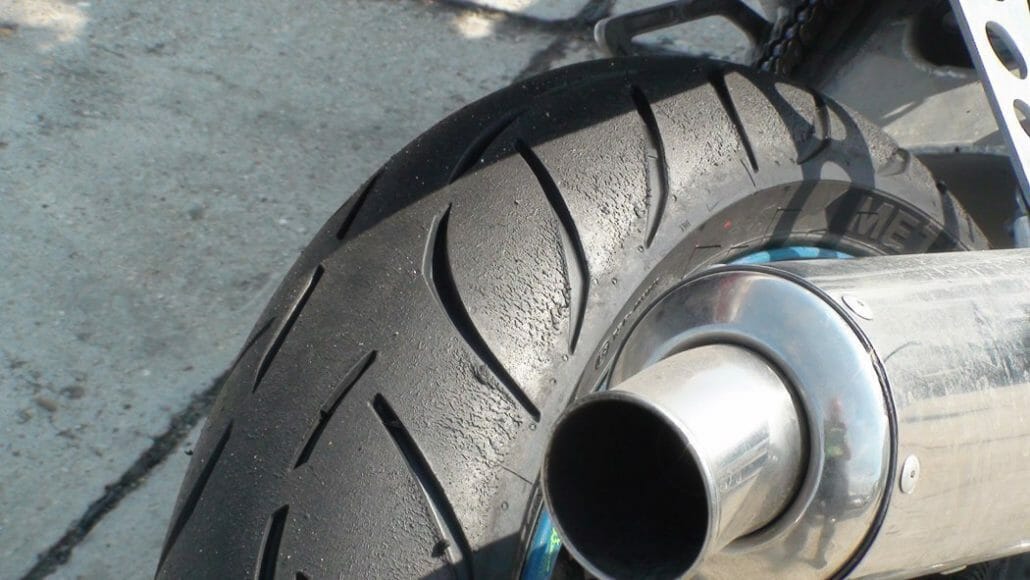
The BGH ruling does not apply to damage to your own motorcycle or to other vehicles. Here, only the conditions of the comprehensive and liability insurance policies are decisive, and some of them are worded much more strictly.
An older case from the Nürburgring shows how differently this can turn out. In April 2012, a driver crashed a Porsche 911 GT3 during an open driving event on the Nordschleife. He lost control at around 115 km/h and hit the crash barrier. The comprehensive insurance did not have to pay for the damage to the car of around €20,000 (about $22,400). Its conditions expressly excluded any driving on motorsport race tracks, even without chasing top speeds. Driver safety training was exempt, but there was no instructor guiding the drivers. The Higher Regional Court of Karlsruhe held this clause to be valid in 2014.
The liability insurance, by contrast, had to pay for the crash barrier damage of around €1,800 (about $2,000). Its clause only covered events where top speed matters. Since there was no classification, no ranking and no timing, the insurer could not prove the exclusion. Even then, it was not enough for the court that participants also wanted to reach high speeds.
Whether such a broadly worded clause as in the comprehensive policy would also be valid in accident insurance is not answered by the new BGH ruling. The exact wording in your own policy therefore always remains decisive. The AUB are non-binding model conditions of the German Insurance Association (GDV). Many insurers adopt the wording literally or in substance, but some use their own versions. Newer conditions sometimes refer explicitly to races or competitions. In the policy documents, the exclusion is usually found under headings such as “What is not insured?” or “Exclusions”.
What track day riders should keep in mind after a crash
The burden of proof is clearly divided. The insured person must prove the accident and its consequences. The insurer must prove that an exclusion applies. Following the BGH ruling, pointing to the race track, engine power, advertising or safety precautions is no longer enough. The insurer must prove that there was a classification.
It is therefore worth keeping all documents relating to the event. These include the event announcement, terms and conditions of participation, registration confirmation, schedule and information on group allocation, as well as the names of witnesses and instructors. Many organisers state explicitly in their conditions that the event is not a racing event.
It is also important to describe the accident factually and precisely. Anyone who talks about a “race” to the insurer or on social media, or brags about their ranking, can hand the insurer arguments, even if there was no classification at all. The decided case shows how delicate the choice of words can be. The accident report referred to a “test and presentation ride”, while the initial medical report first said “racing accident”, which was later crossed out and replaced with “training accident”. The insurer then accused the policyholder of providing false information. It did not succeed with this, but the issue had to be resolved in court.
Deadlines also play an important role. For disability benefits, meaning a permanent physical or mental impairment, the AUB 2012 generally stipulate that the disability must have occurred within one year of the accident. Within 15 months, it must be medically confirmed and claimed from the insurer. These deadlines continue to run even if the insurer has already refused. Anyone who misses them can lose the claim permanently, even if the refusal later turns out to have been wrong.
Claims under the insurance contract generally become time-barred after three years, counted from the end of the year in which they arose and the person concerned became aware of them. As long as the insurer has not decided on a reported claim in text form, the limitation period is suspended. After that, the period continues to run. In addition to the disability benefit, accident insurance may include further benefits depending on the policy, such as daily hospital allowance, recovery allowance, transitional benefits or accident pensions.
Anyone who has already received a refusal citing the clause can ask the insurer to review the case again with reference to the ruling of 13 October 2026, as long as the claim is not time-barred. Before the next track day, it makes sense to check your own accident, comprehensive and liability insurance and to ask the organiser whether there will be a classification.

Frequently Asked Questions
-
Does accident insurance pay for a crash on a race track?
In many cases yes, if there was no classification with rankings at the event. On 13 October 2026, Germany’s Federal Court of Justice ruled that the widely used top-speed clause only covers genuine competitions. However, the exact wording of your own policy remains decisive.
-
What does private accident insurance pay for after a crash?
Private accident insurance pays for the health consequences suffered by the insured person. Depending on the policy, this includes daily hospital allowance, recovery allowance, transitional benefits, accident pensions or disability benefits. Damage to the motorcycle or to other vehicles is a matter for comprehensive or liability insurance.
-
Is a track day a race in insurance terms?
According to the BGH ruling, a track day without a ranking list, winners or trophies is not a competition within the meaning of the AUB clause. Transponder timing and grouping riders by lap times do not change this. Things may be different for practice sessions directly linked to a race.
-
Does comprehensive insurance pay after a crash at race training?
That depends solely on the conditions of the comprehensive insurance; the BGH ruling does not apply to it. Some comprehensive policies exclude any driving on motorsport race tracks, even without competition. The Higher Regional Court of Karlsruhe held such a clause to be valid in 2014.
-
Which deadlines apply after an accident at a track day?
For disability benefits under the AUB 2012, the disability must generally occur within one year and be medically confirmed and reported to the insurer within 15 months. These deadlines keep running even after a refusal. Claims generally become time-barred three years after the end of the year in which they arose.