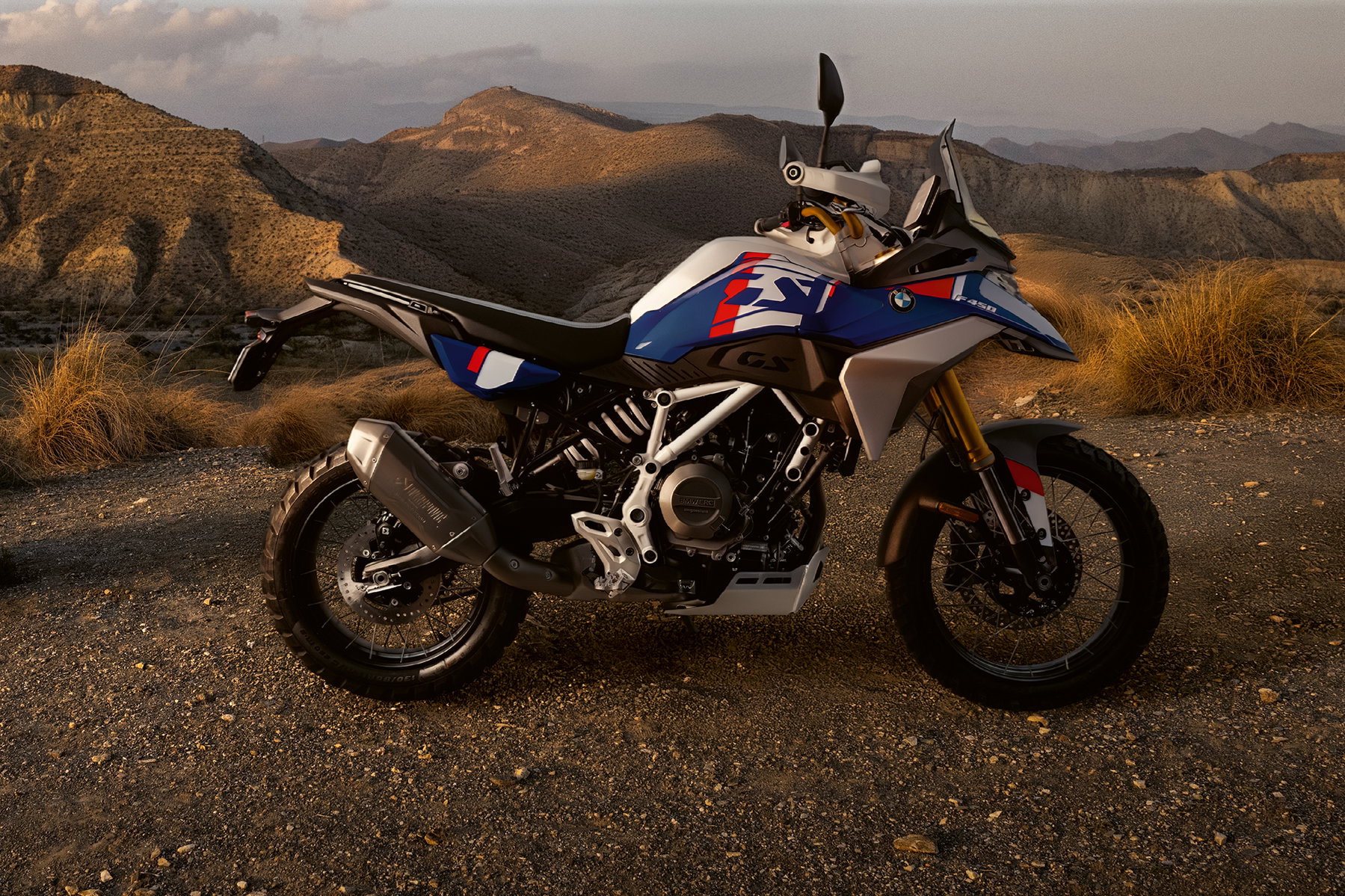
- Prototype spotted with a 21-inch front wheel and an 18-inch rear wheel
- Expected output of between 65 and 70 hp (48 to 52 kW)
- Production launch not likely before 2028
BMW has had a gap between its small and large adventure bikes for years. At the bottom sits the F 450 GS, which replaced the G 310 GS at EICMA 2025. Above it come the F 800 GS and the F 900 GS with 895 cubic centimetres. In between there has been nothing at all. That gap is exactly where a motorcycle now photographed as a prototype on public roads appears to be aimed. The individual components can already be identified fairly precisely in the pictures.
What does the prototype of the new middleweight GS show?
The prototype shows a slim adventure bike with a clear off-road focus. It runs a 21-inch wheel at the front and an 18-inch wheel at the rear, both cross-spoke wheels with tubeless tyres.
Those wheel sizes are a clear signal. The smaller F 450 GS follows a different recipe, which puts the new middleweight GS closer to classic adventure bikes. The bodywork still looks rough and provisional, while individual design elements are already neatly finished. The headlight visibly picks up elements of the R 1300 GS. The typical GS beak above the front wheel is missing so far, which may simply be down to development still being under way. Observers reckon the generous ground clearance points to around 230 millimetres (roughly 9 inches) of suspension travel.
One of the few figures on weight: the kerb weight is said to be around 204 kilograms (roughly 450 pounds), placing it between the F 450 GS and the F 900 GS.
Where does the engine of the new GS come from?
The engine is the most interesting and at the same time the least clear point. All that is certain is that it is a parallel twin showing visible technical kinship with the F 450 GS.
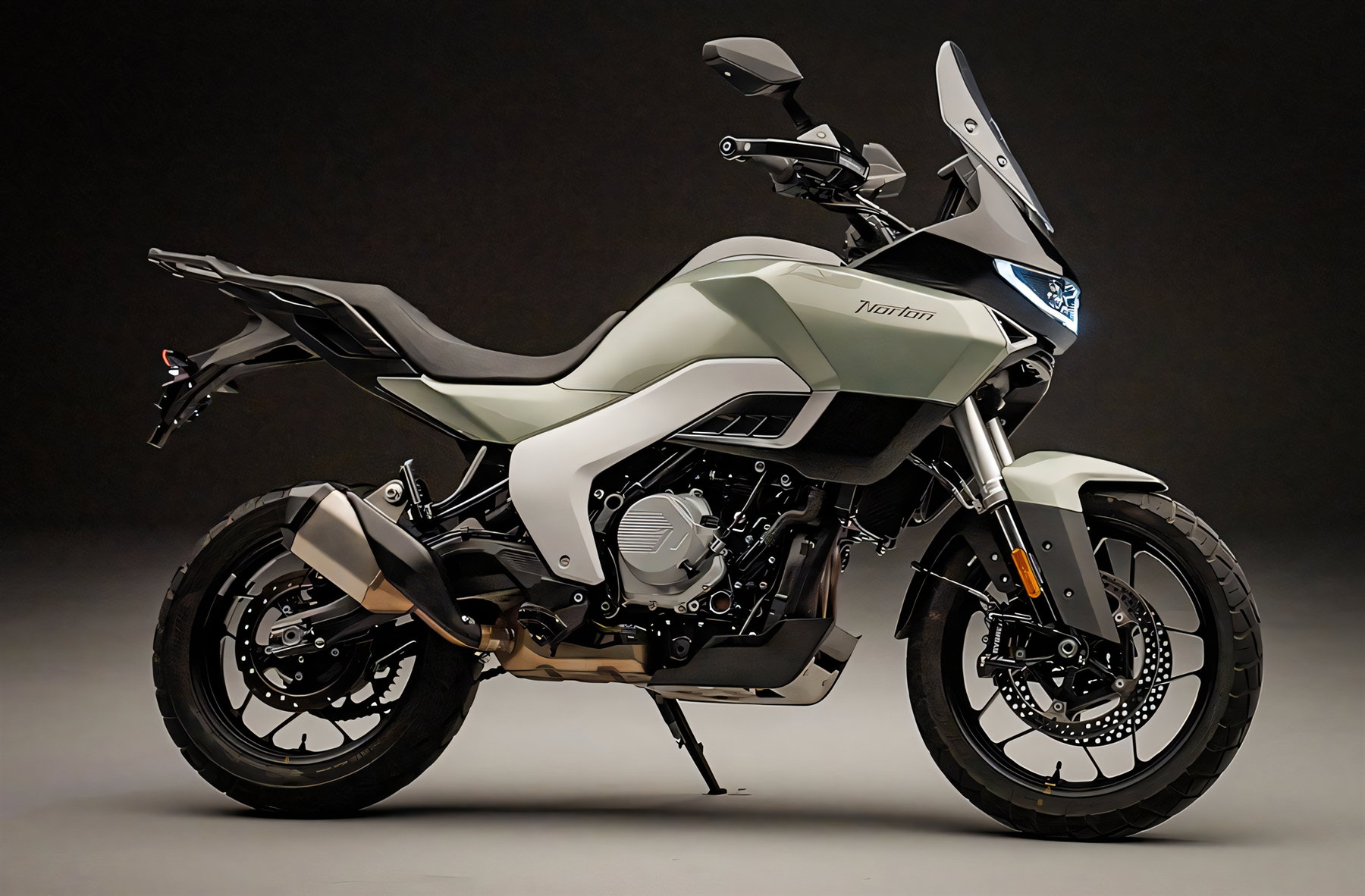
A look at the United Kingdom helps here. BMW partner TVS, which builds the F 450 GS in India, uses a further developed version of this twin for the Norton brand. In the Atlas and the Atlas GT the heavily reworked unit delivers 585 cubic centimetres and 70 hp (51 kW). That very engine is regarded as a possible starting point.
The picture is not entirely clear cut, though. In the photos the prototype’s engine differs from the British machine in several areas, while other areas look very similar. Some observers even assume that BMW is developing a completely separate unit that is based neither on the F 450 GS nor on the F 900 GS nor on the Norton twin. BMW has issued no official statement on either reading.
How is the crankshaft configured?
This question is open and technically particularly interesting. The Norton twin works with a 270-degree firing interval, as is common in this class. The F 450 GS, by contrast, uses an unusual 135-degree crankpin offset.
The firing interval describes the time gap between the two cylinders firing. It influences how the engine feels, how it sounds and how well the power can be metered off road. Whether BMW carries the idiosyncratic 135-degree solution over into the middleweight class or switches to the usual layout cannot be determined from the photos.
How much power is to be expected?
Between 65 and 70 hp (48 to 52 kW) is expected. That range follows from the existing model line-up, because space is tight both below and above.
The F 800 GS makes 87 hp (64 kW), the F 850 GS 95 hp (70 kW) and the F 900 GS 105 hp (77 kW). A new middleweight GS would have to sit clearly below those figures, otherwise it would take customers away from BMW’s own models. Some international estimates go a little further and consider up to 80 hp (59 kW) possible. None of these figures is confirmed; all of them are derived from the surrounding model range.
Chassis and brakes with parts from the bigger sisters
With the chassis, the look goes upwards rather than downwards. The prototype’s steel bridge frame is oriented more towards the F 900 GS than towards the small F 450 GS. The brake system also resembles the larger range.
In other places the kinship with the entry-level class remains visible. The mounting of the rear shock and the swingarm are reminiscent of the F 450 GS. The exhaust system and individual chassis parts also fall back on a similar recipe. The bottom line is a motorcycle that brings together components from several GS generations.
What is the motorcycle going to be called?
The name is open, with three variants under discussion. F 600 GS would fit the current system, and a return of the F 650 GS or F 700 GS badges is equally conceivable.
The name F 650 GS in particular would have a special ring to it for many riders. The F 650 GS Dakar from the early 2000s is still regarded as a benchmark for affordable adventure bikes with genuine off-road ambition. Reviving it would therefore also be a link to BMW’s own history.
The actual displacement is unlikely to be a criterion for the name. The F 800 GS, the F 850 GS and the F 900 GS carry different numbers but share the same cylinder volume of 895 cubic centimetres.
Who is the new GS up against?
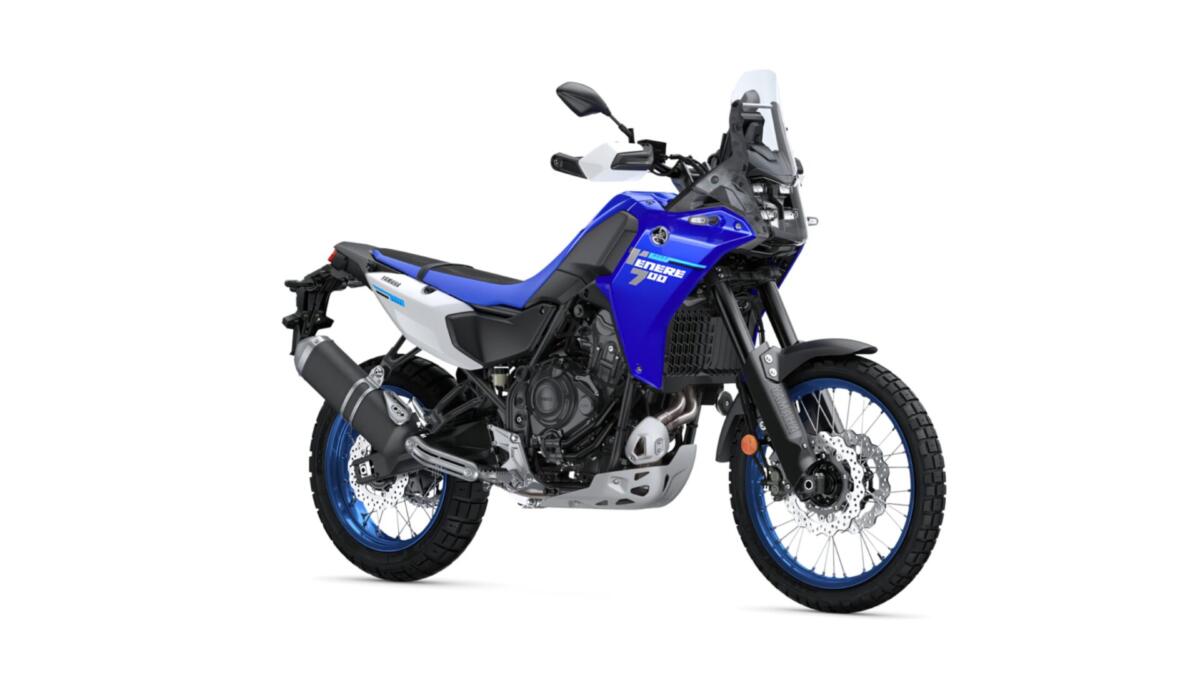
The Honda Transalp and the Yamaha Ténéré 700 apparently serve as benchmarks during testing. Both models define the middleweight adventure segment and are therefore the yardstick.
The Japanese rivals come in at 755 and 689 cubic centimetres respectively. Should BMW indeed stay at around 585 cubic centimetres, the new GS would be the smallest machine in this comparison. The motorcycle is expected in India as well, where a price of around 1.2 million rupees (approximately 10,800 euros / 12,550 US dollars) is anticipated, placing it between the F 450 GS and the F 900 GS. That figure, however, is purely an estimate with no manufacturer information behind it.
When will the new middleweight GS arrive?
A production launch is not to be expected before 2028. The development stage of the prototype shows that considerable work still lies ahead of BMW.
Plenty will happen in the model range before then. The F 450 GS is set to be joined by at least a naked bike at EICMA in autumn 2026, and presumably by a sports model as well. The middleweight GS would therefore only be the step after next on the new platform. It is also possible that the F 800 GS will drop out of the range once the new model arrives. That has not been confirmed.
Frequently asked questions
-
When will the BMW F 650 GS come to market?
A production launch is not expected before 2028. The prototype that has been spotted is at an early stage of development and many design details are still missing. There is no official announcement from BMW so far.
-
How much power does the new BMW middleweight GS have?
Between 65 and 70 hp (48 to 52 kW) is expected. That would place it clearly below the F 800 GS with 87 hp (64 kW) and the F 900 GS with 105 hp (77 kW). Some estimates also consider up to 80 hp (59 kW) possible.
-
Which engine will the new BMW middleweight GS get?
It is a parallel twin with visible kinship to the F 450 GS. The version reworked by TVS with 585 cubic centimetres and 70 hp (51 kW), used in the Norton models, is regarded as a possible starting point. Whether BMW adopts that unit or builds its own design remains open.
-
What is the new GS going to be called?
The name has not been settled. F 600 GS, F 650 GS and F 700 GS are all being mentioned. The actual displacement plays no part in this, since BMW also uses different numbers for the F 800 GS, F 850 GS and F 900 GS despite an identical cylinder volume.
-
Which motorcycles will the new BMW compete against?
The Honda Transalp and the Yamaha Ténéré 700 apparently serve as benchmarks during testing. Both are considered the standard in the middleweight adventure class and come in at 755 and 689 cubic centimetres respectively.