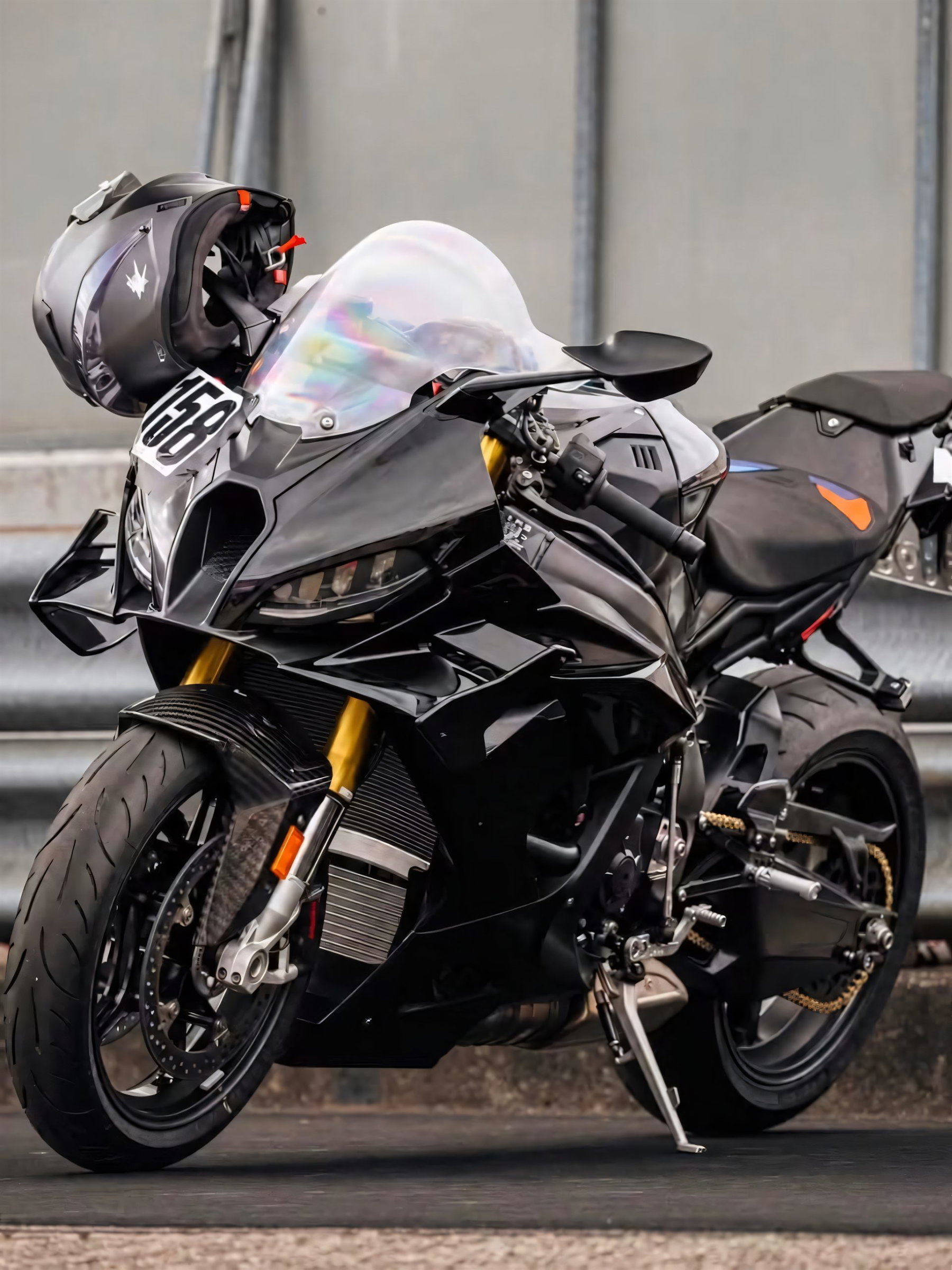
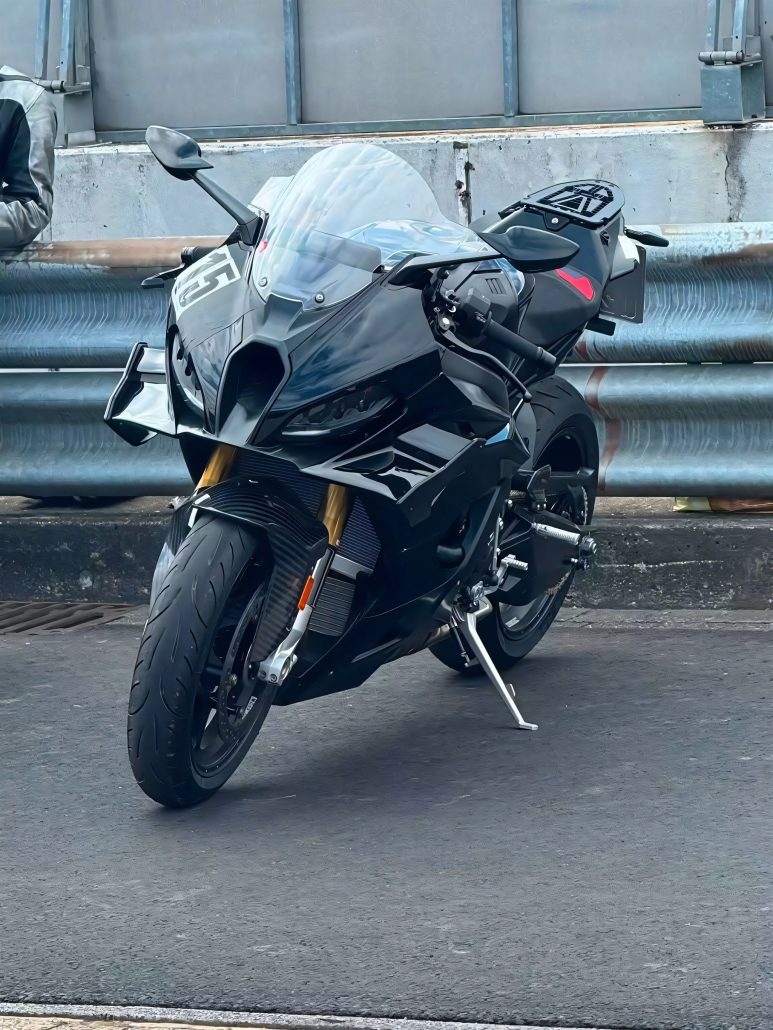
- Up front sits an electronically controlled Marzocchi fork with gold-anodized fork tubes, paired with new Brembo Hypure brake calipers
- The left handlebar clip-on carries a new switch unit with plus and minus buttons, along with a fluid reservoir
- Mirrors, turn signals, and a license plate point to a street-legal build, and it’s riding on treaded tires
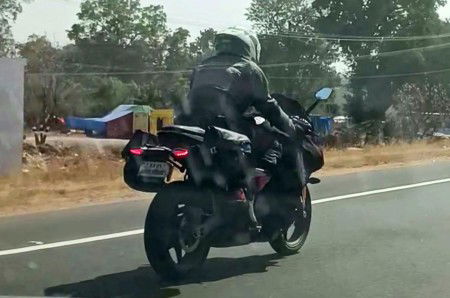
A few days ago, it was all about the looks. A drawing from a design registration showed what the next S 1000 RR is meant to look like. But drawings like that only capture the outer shape, since design filings protect appearance alone. What sits underneath the bodywork remains an open question. That’s exactly where these photos from the Nürburgring Nordschleife in Germany come in. They show the bike in motion, and with it, components that can actually be identified.
What do the photos from the Nordschleife show?
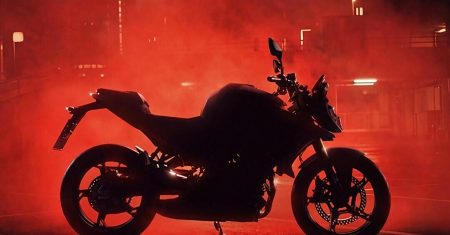
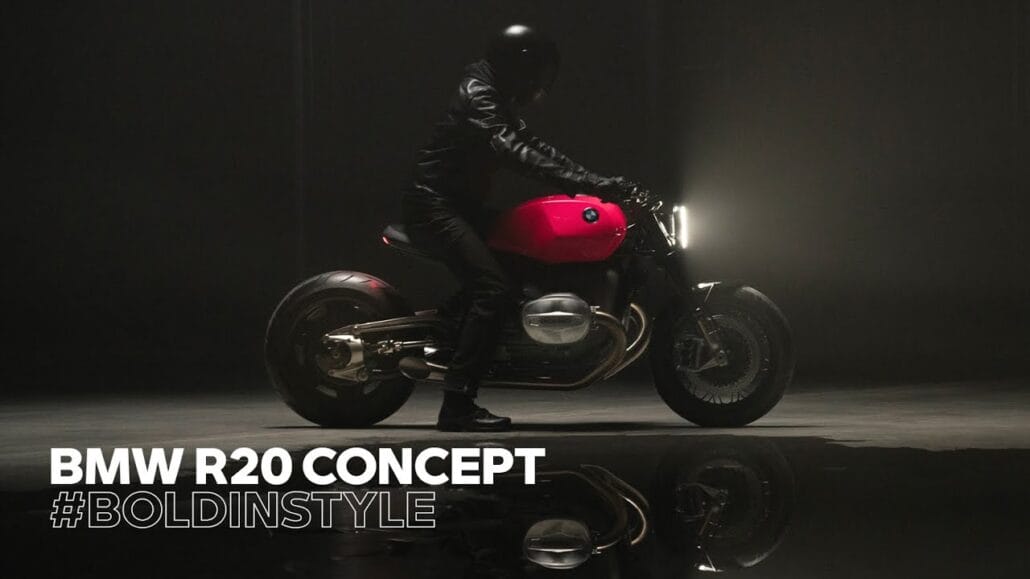
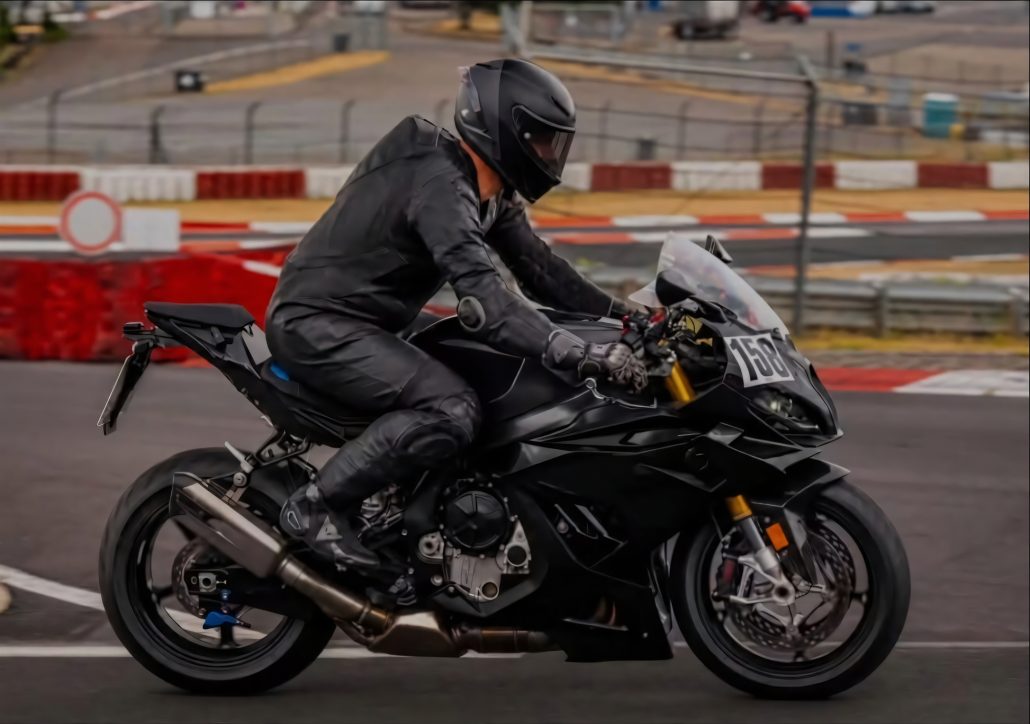
They show a prototype of the new S 1000 RR both on track and in the paddock. The bodywork clearly follows the Concept RR that BMW revealed in May 2025.
The photos include both static shots and scenes on track. The prototype carries number boards, and the rider is wearing full leathers. In the motorcycle industry, “spy shot” is the term for a prototype photographed during testing ahead of its official unveiling, and that’s exactly what happened here. BMW has not commented on the test sessions or on any technical details so far.
What does the front of the prototype look like?
The large winglets stand out the most. They extend far outward and wrap around slim, multi-part headlights, with a large central air intake positioned between them.
Winglets are the small wing elements attached to the fairing. At speed, they generate downforce and help keep the front wheel planted under acceleration. The front fender is made of carbon. The fork tubes are gold-anodized, and the front brake calipers are radially mounted, gripping two discs.
Which fork and brakes does the prototype use?
Up front is an electronically controlled telescopic fork from Marzocchi. The brake discs are clamped by Brembo’s new Hypure calipers.
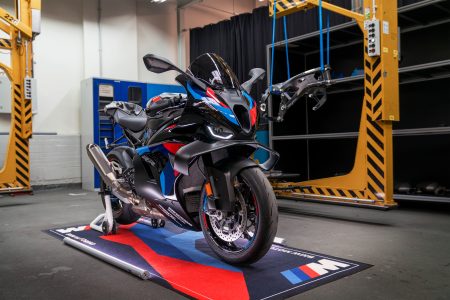
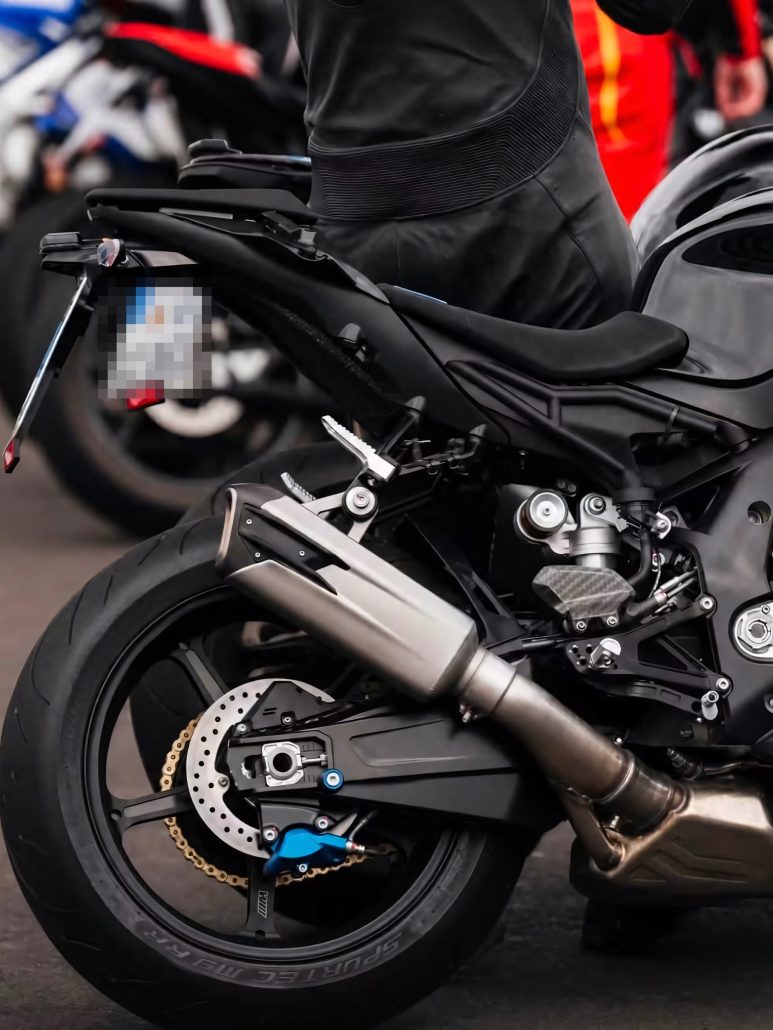
Electronically controlled means the damping is no longer adjusted by hand. Instead, a control unit continuously adapts it to the riding situation. Another detail stands out at the rear: the M brake caliper for the rear wheel is mounted low, sitting below the swingarm rather than above it. In the photos, it’s finished in blue anodizing.
A new frame, and a missing part at the shift lever
The side-view shots show the engine sitting in a new frame. The photos don’t reveal much more than that, neither about the material nor the exact design.
The left side is more revealing. The shift linkage is missing the external module for the quickshifter. A quickshifter allows clutchless up- and downshifts; BMW calls its system Shift Assist. Whether the prototype simply wasn’t fitted with one, or whether the technology has moved inside, can’t be determined from the photos alone. At KTM, the equivalent hardware already sits internally.
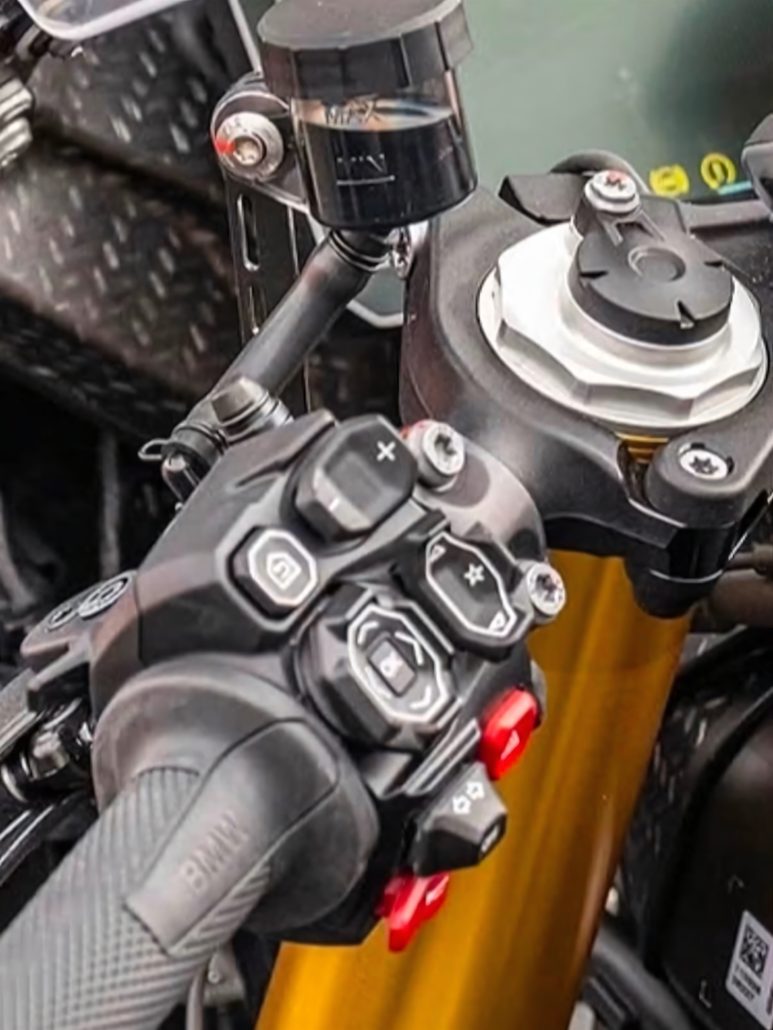
What does a closer look at the handlebar reveal?
The left handlebar clip-on carries a new switch unit with two additional buttons, labeled plus and minus. Next to it, a small window displays the currently selected value.
That allows settings to be changed on the move, without going through the main menu. This mainly concerns traction control and other rider-assistance systems. Riders on track can fine-tune things lap by lap without having to stop.
There’s also a fluid reservoir mounted on top of the same clip-on. A reservoir like that points to a hydraulic clutch, where fluid transmits force from the lever to the clutch instead of a cable. The cockpit itself consists of a large, tablet-format TFT display. A lap timer is also mounted on the triple clamp, as is common during test sessions.
Is the prototype road-legal?
It looks that way. The photos show mirrors, turn signals, a license plate holder, and a mounted plate.
The tires fit that picture too, since it’s riding on treaded road tires rather than slicks. One of the photographed bikes carries a Munich license plate. For testing purposes, a setup like this means the machine is being run under conditions close to its eventual production spec.
Where does the prototype differ from the Concept RR?
Mainly in the chassis and brakes. The Concept RR was fitted with an Öhlins fork and shock, plus Brembo monoblock calipers on discs estimated at 330 to 340 millimeters in diameter.
The prototype, by contrast, runs Marzocchi and the Hypure calipers up front. The concept also wasn’t built to production-spec in every respect elsewhere. All of its bodywork parts were apparently made from carbon, and both the bridge frame and the bolt-on subframe appeared to be aluminum. On the current S 1000 RR and M 1000 RR, that component is still made of steel.
Which of these solutions will ultimately make it to production remains open. BMW hasn’t commented on that either.
The prototype and the timeline for the new RR generation
Track testing fits the timeline that’s been circulating for the next generation. Production is said to start in May 2027, with the bike expected to reach dealers in the summer of 2027.
As for power, a figure of 215 hp (158 kW) has recently leaked out. The current model produces 210 hp (154 kW) at 13,750 rpm. BMW hasn’t confirmed these numbers either.
That places this test within a staggered generational changeover. The S 1000 RR leads the way, while the all-new M 1000 RR isn’t expected until late 2027, for the 2028 season. Until then, the current lineup stays in the program, and this Nordschleife prototype is unlikely to be the last one caught on camera.
Frequently Asked Questions
-
Where was the BMW S 1000 RR prototype spotted?
At the Nürburgring Nordschleife in Germany. A prototype of the upcoming generation was there for testing, both in the paddock and on track. BMW has not made this testing public.
-
What brakes does the new BMW S 1000 RR prototype have?
Up front, Brembo’s new Hypure calipers are used, radially mounted on two discs. At the rear brake, a low-mounted M caliper is visible. The 2025 Concept RR, by contrast, still wore Brembo monoblock calipers up front.
-
Is the prototype street-legal?
The photos suggest so. Visible are mirrors, turn signals, a license plate holder with a plate, and treaded road tires. That’s not confirmed proof, though, since BMW isn’t commenting on the bike.
-
Why is the quickshifter module missing on the prototype?
That can’t be answered from the photos alone. No external module is visible on the shift linkage on the left side. It’s possible that none was fitted, or that the technology has moved inside, as is the case at KTM.
➜ Find all technical specifications, photos and prices in the data sheet of our motorcycle database: BMW S 1000 RR (2028) – Specs.
➜ This article is part of our comprehensive overview: Motorcycle Patents and Future Technology: What Manufacturers Are Developing. Find all key information on this topic in one place.