- 997 cc, 90-degree cylinder angle, at least around 210 hp (154 kW) according to the manufacturer
- Variable intake funnels, finger followers and the engine as a stressed frame member
- Alongside the naturally aspirated engine, one patent also describes a version with a turbine on the cylinder head
CFMoto has been working for some time on its own superbike, designed to compete with the established models from Europe and Japan. Until now, however, only the rough key data of the engine were known. The Chinese manufacturer has now filed eleven patents in its home country covering the V4, which is internally called V.04. Most of the documents deal with smaller details. Taken together, though, they show which fundamental decisions the engineers have made. And one of them raises a new question.
What do the new patents reveal about the CFMoto V4 engine?
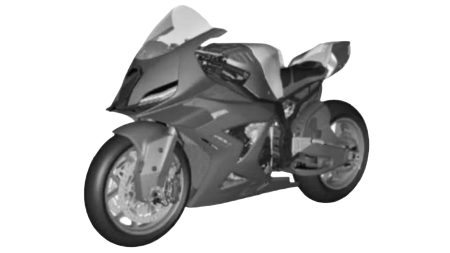
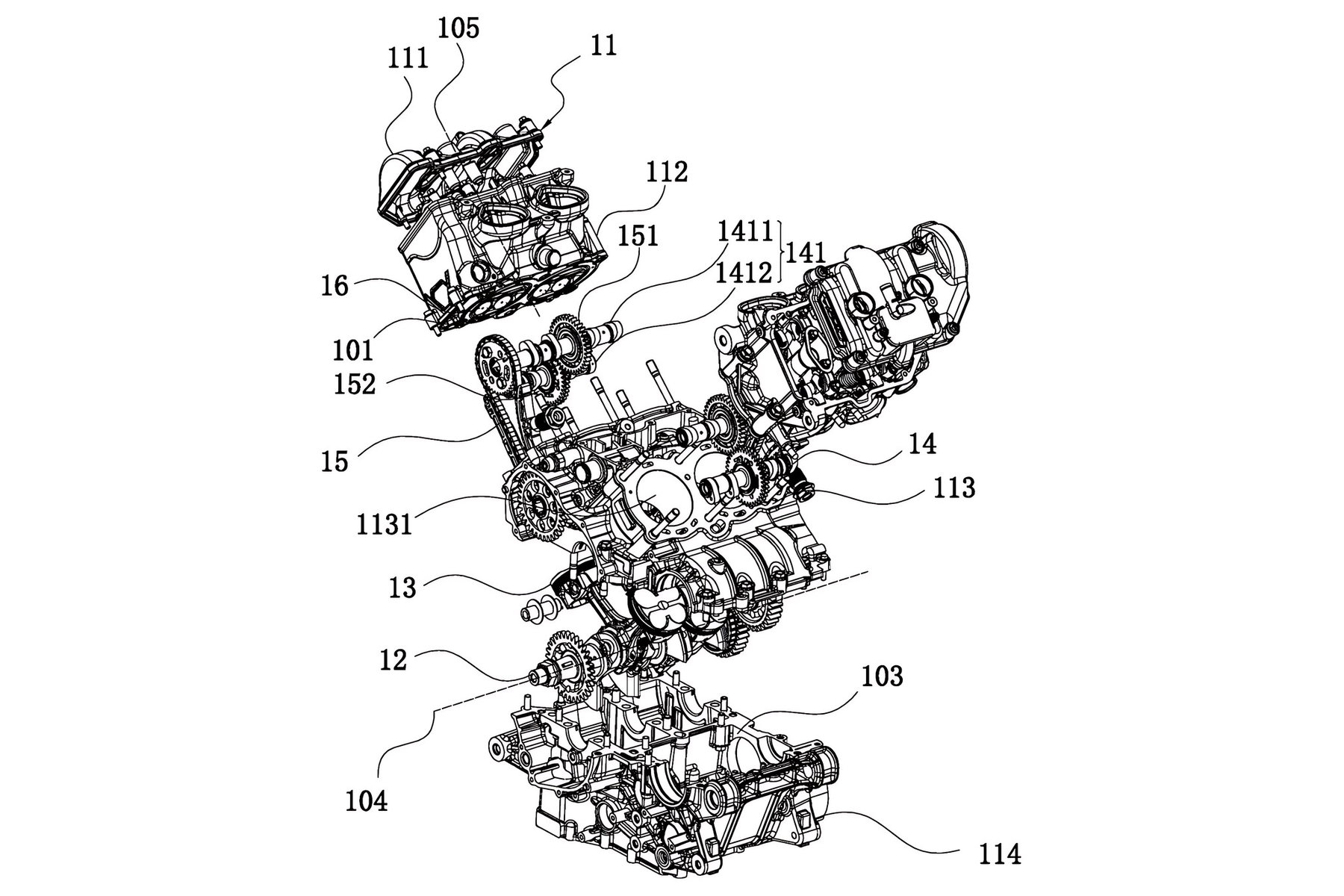
The patent drawings show the V4 in exploded views and confirm several key design features. These include a variable intake, a special camshaft drive and finger followers in the cylinder head. In addition, one filing mentions a forced-induction variant of the engine.
V4 patents are nothing new at CFMoto, by the way. Drawings of a 1,000 cc V-four already surfaced in summer 2023. At the time, there was talk of a target of 201 hp (148 kW). That filing was made by CFMoto alone and not jointly with its long-standing partner KTM. A link to the Austrians’ cancelled V4 road bike could not be established. It was also clear back then that not every patent leads to a production model.
What are the technical specifications of the CFMoto V4 SR-RR engine?
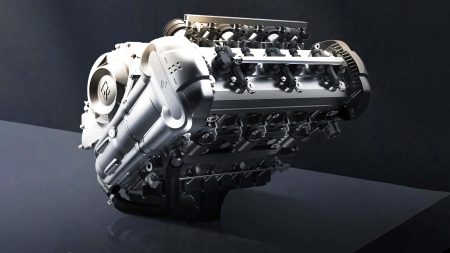
The engine has a displacement of 997 cc and a cylinder angle of 90 degrees. Bore and stroke measure 81 and 48.4 millimetres. The same dimensions are used by the Ducati Panigale V4 R and the litre-class MotoGP bikes, whose generation is currently coming to an end.
As at Ducati, the crankshaft rotates in the opposite direction to the wheels. This counteracts the gyroscopic forces of the spinning wheels, which make a motorcycle reluctant to turn in. The bike should therefore change direction more quickly.
The power figures have changed slightly over time. At its first presentation at EICMA 2024 in Milan, the engine was displayed as a cutaway show model in a transparent case. An information board quoted 212 hp (156 kW) at 14,500 rpm and 114 Nm (84.1 lb-ft) at 12,500 rpm. With the complete motorcycle at EICMA 2025, CFMoto then spoke of around 210 hp (154 kW). The manufacturer currently states at least this figure, along with a rev limit of 14,500 rpm. The engine alone is said to weigh 61.5 kg (135.6 lbs) dry. That is only 7.1 kg (15.7 lbs) more than the twin-cylinder Ducati developed for the 2025 model year Panigale V2 and Streetfighter V2.
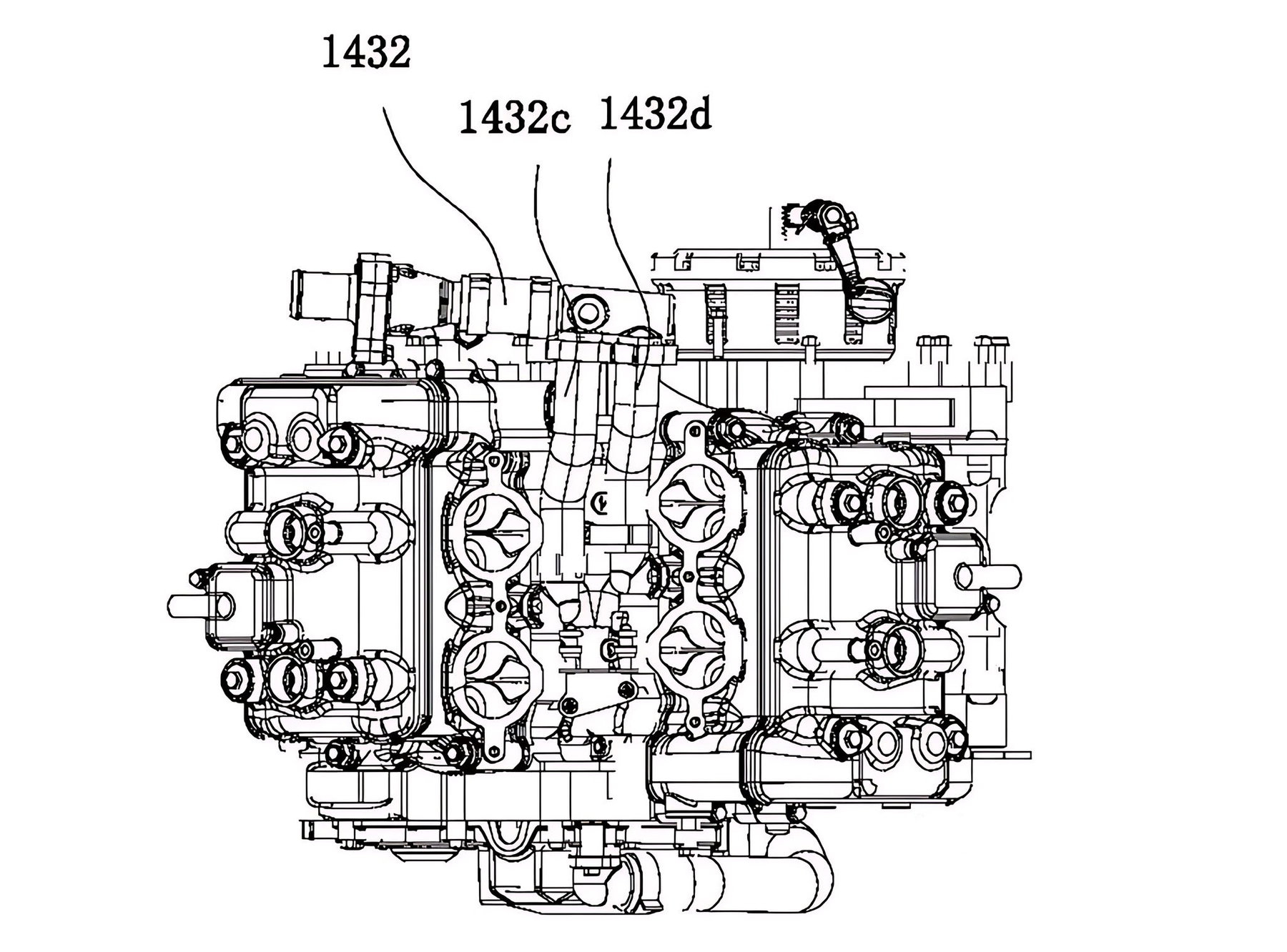
How does the variable intake of the CFMoto V4 work?
The intake funnels consist of two parts, and a small electric motor can raise or lower the upper section. This way, the length of the intake tract adapts to engine speed. Intake funnels are the short tubes through which air flows from the airbox to the throttle bodies.
The longer lower sections are firmly bolted into the airbox, exactly where the throttle bodies connect. The shorter upper sections sit on a common frame. An electric motor in the middle moves this frame up or down.
Below a set engine speed, the upper sections remain raised. Air then flows into the engine not only through the funnels but also past their edges from the side. According to the patent, this produces more torque. At high revs, the frame lowers and the upper sections sit on top of the fixed funnels. This creates a longer intake tract, which is intended to improve peak power.
Ducati also uses such a system on the Panigale’s V4. It was not yet visible on the prototype engine at EICMA 2024.
CFMoto V4 SR-RR: engine as a stressed member and air through the steering head
As on the Ducati Panigale V4, the engine of the CFMoto V4 SR-RR plays a load-bearing role in the chassis. There is no conventional frame wrapping around the engine. Instead, a short cast-aluminium front frame is bolted directly to the cylinder heads. Even on the EICMA 2025 prototype, it looked as though the frame section carrying the footpegs was also attached to the rear of the engine.
The drawings also show the path of the intake air. It flows in a straight line through the steering head into the airbox. This direct route is intended to make the best possible use of the so-called ram-air effect, in which the airflow at high speed forces additional air into the engine.
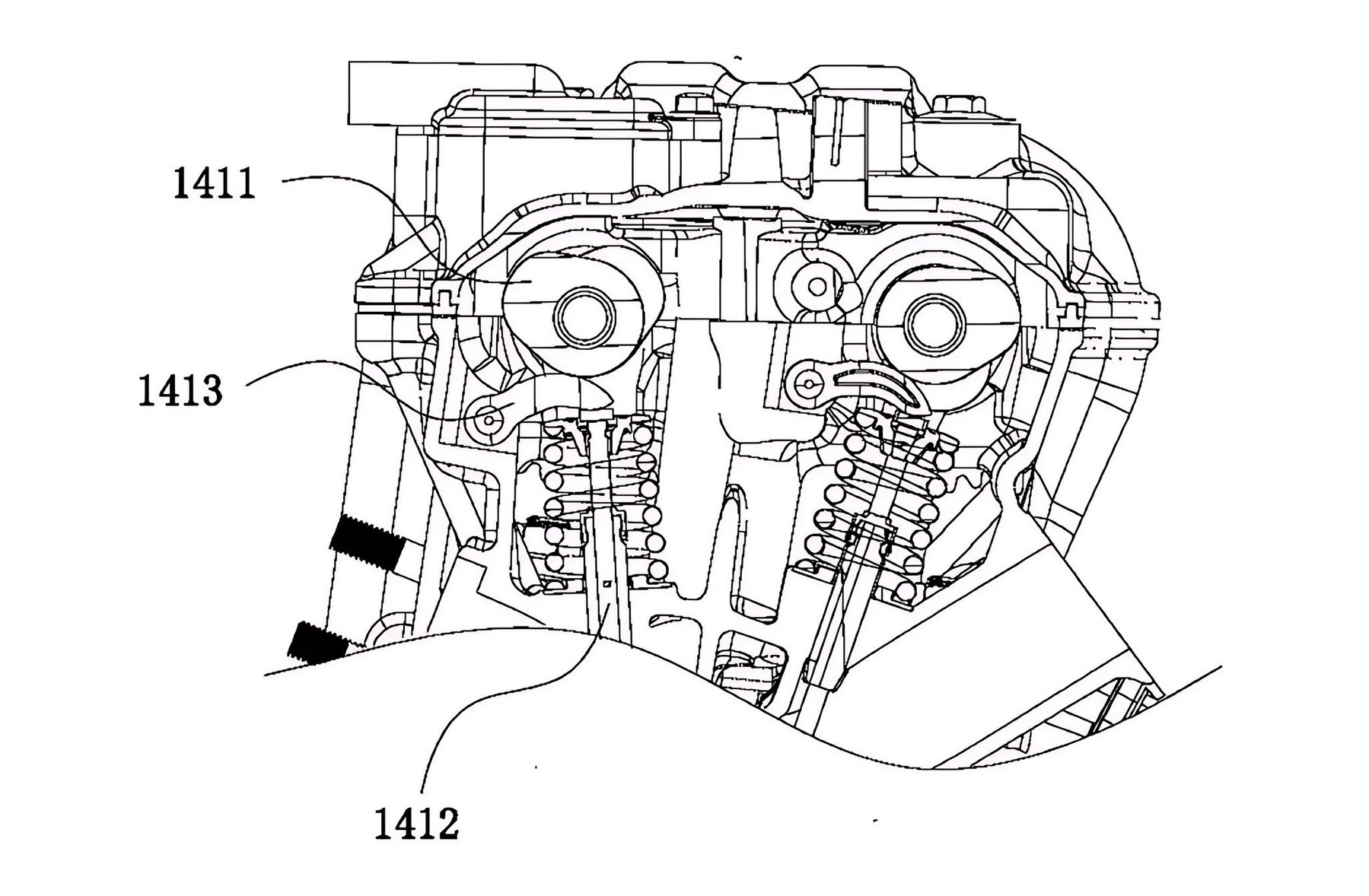
How does the valve train of the CFMoto V4 differ from Ducati and Aprilia?
The CFMoto V4 opens its valves via finger followers, taking a different approach from its two Italian V4 rivals. Finger followers are small levers that sit between the camshaft and the valve. This design follows the direction of many current superbikes.
Aprilia relies on classic bucket tappets on the RSV4, where small shims set the valve clearance. Ducati sticks with its signature desmodromic system, in which the valves are actively opened and also actively closed again.
When it comes to the camshaft drive, however, the CFMoto engine resembles other modern V4 units. The front cylinder bank is driven by a chain on the left-hand side, the rear bank by a chain on the right-hand side. Each chain only drives the intake camshaft. The exhaust camshaft is driven via gears. According to the patent, this allows shorter chains. They are easier to tension, keep the valve timing more precise and should last longer.
The gears between the camshafts are not located at the end but in the middle of the shafts. This is intended to make the engine more compact and is reminiscent of the solution in the Aprilia RSV4’s V4. The cylinder heads are compact too. The throttle bodies are bolted directly to them, eliminating a separate intake manifold.
Is CFMoto planning a turbocharged V4?
One of the patent documents explicitly describes a turbo variant of the V4. Whether this will lead to a motorcycle, however, remains open.
The passage refers to the exhaust ports in the cylinder head. In essence, it states that if the engine has a turbocharger, the exhaust leads directly to a turbine mounted on the cylinder head. On the naturally aspirated engine, by contrast, a conventional exhaust manifold carries the exhaust gases away.
This naturally raises the question of a forced-induction superbike, similar to the supercharged Kawasaki Ninja H2. That would no longer be entirely unusual. Honda, for example, has shown the V3R 900 E-Compressor prototype.
There is, however, a second possible explanation. CFMoto also builds side-by-side vehicles, i.e. four-wheeled off-road vehicles with seats next to each other. One of them is the ZForce Z10 with a 998 cc turbocharged three-cylinder. It competes with the Kawasaki Teryx H2, whose supercharged engine comes from the Ninja H2. A turbo V4 could therefore just as well be intended for such a vehicle.
How far along is the development of the CFMoto V4 SR-RR?
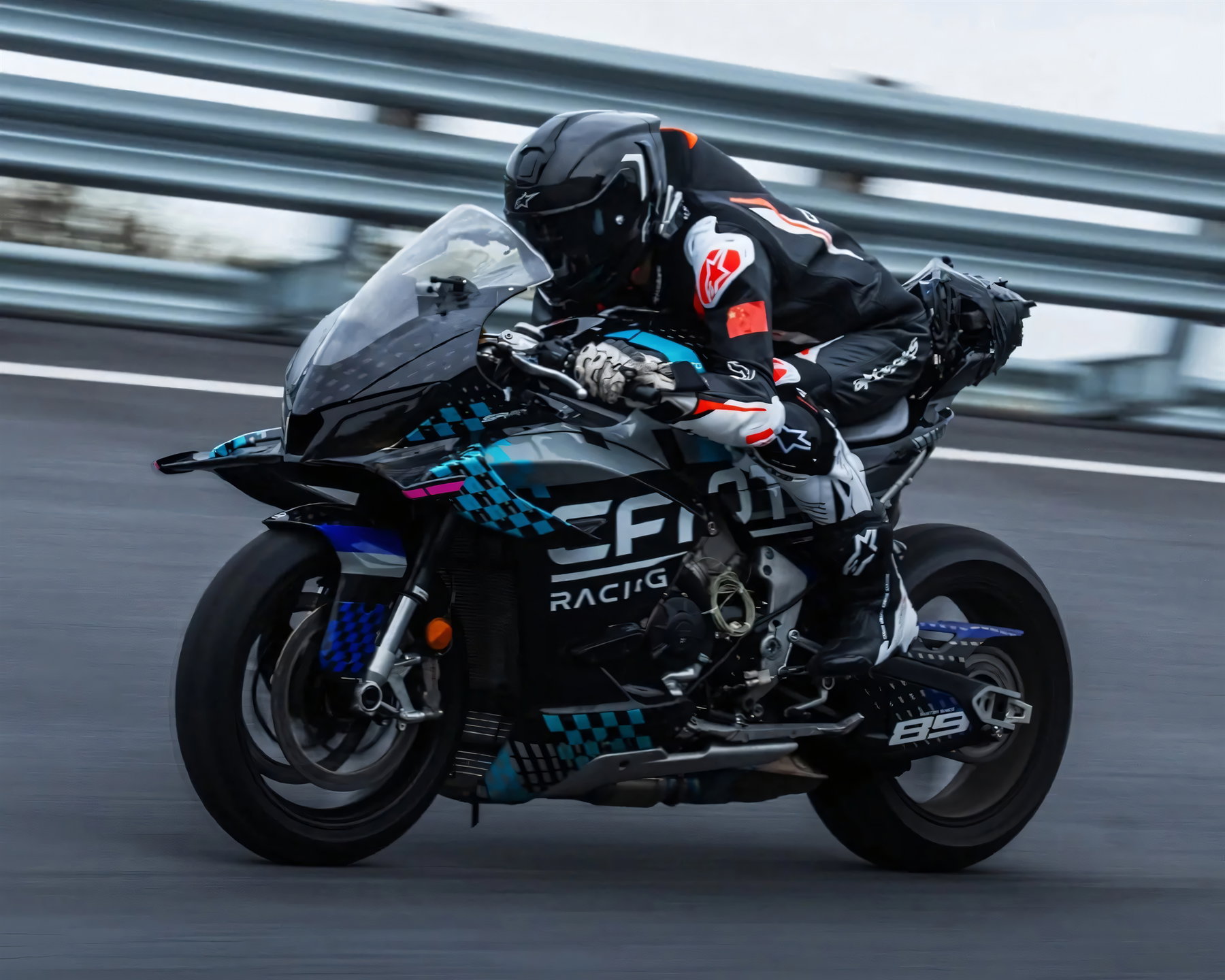
The CFMoto V4 SR-RR is still a development project, but it is already running. CFMoto recently released footage showing Moto2 rider David Alonso riding a development model in China. Alonso won the 2024 Moto3 world title with Team Aspar on a CFMoto.
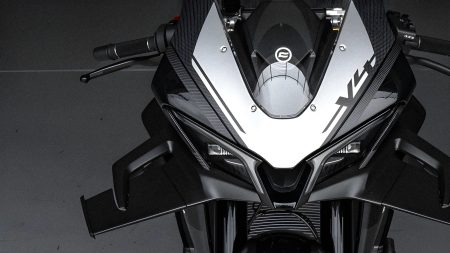
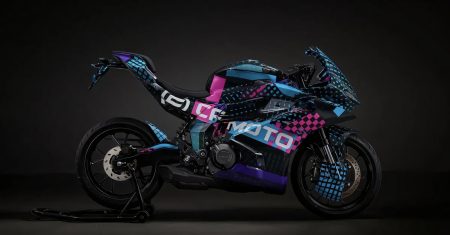
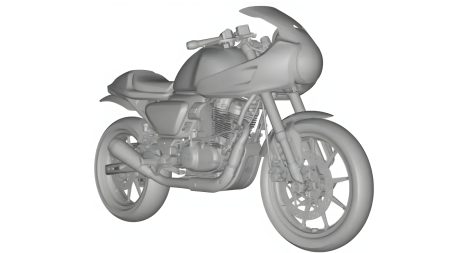
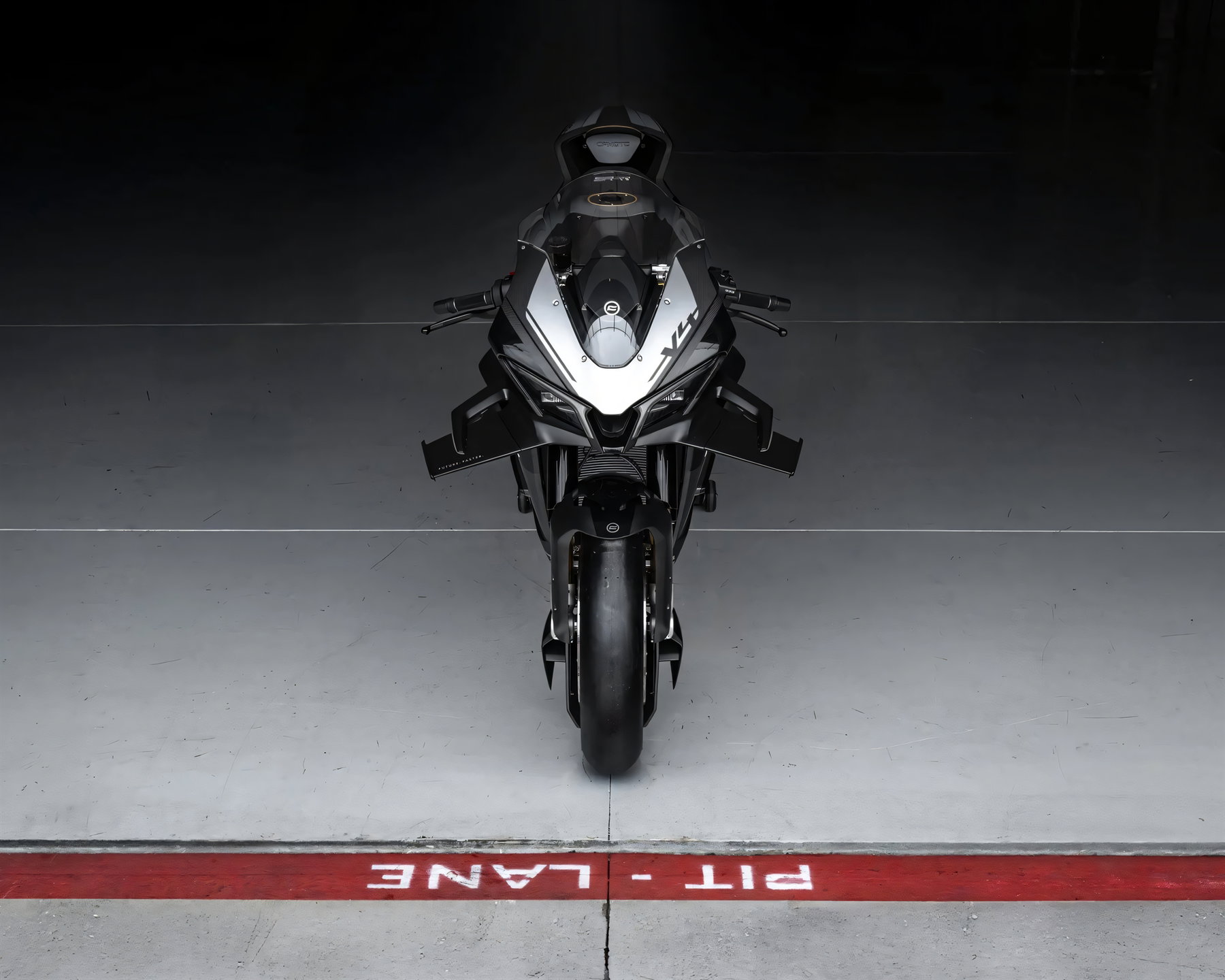
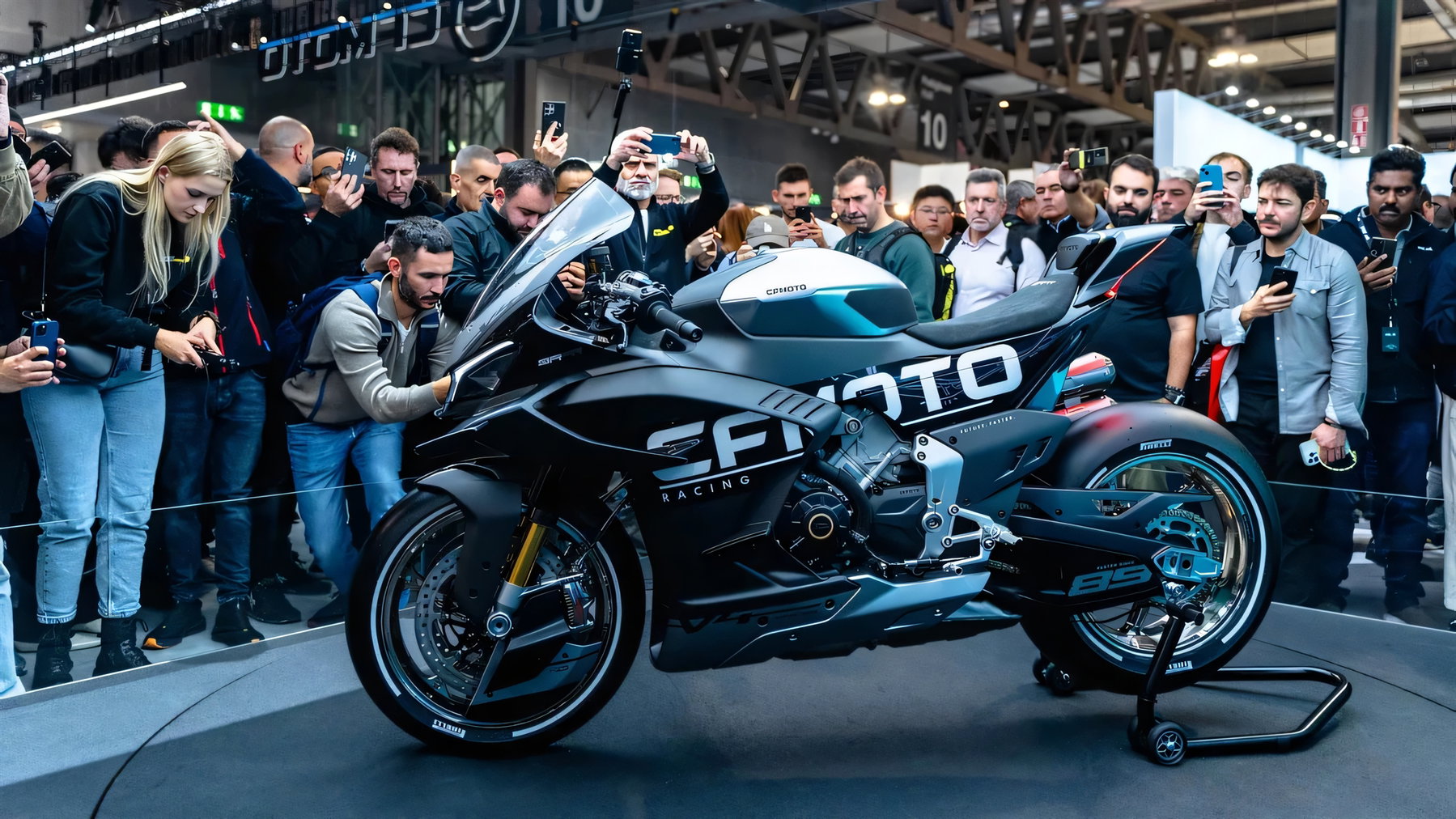
The road to this point has followed clear steps. At EICMA 2024, CFMoto initially showed only the engine, together with a design model of the future motorcycle. A year later, the complete superbike followed as a prototype at the same show. It featured electronically adjustable winglets that can move together or in opposite directions on both sides. These were joined by electronically controlled suspension and a titanium Akrapovič exhaust system designed to meet the Euro5+ emissions standard.
CFMoto quoted a top speed of over 300 km/h. For the power-to-weight ratio, the manufacturer states less than 1 kg per hp. Whether this figure also applies to a fully homologated production bike with catalytic converters and all required components is not known. With the V4 SR-RR, CFMoto aims to break into the large superbike segment, which until now has been dominated by manufacturers from Europe and Japan.
Frequently Asked Questions
-
How much horsepower does the CFMoto V4 engine have?
According to CFMoto, the V4 produces at least around 210 hp (154 kW). The rev limit is 14,500 rpm and peak torque is 114 Nm (84.1 lb-ft). At its first presentation in 2024, the manufacturer still quoted 212 hp (156 kW).
-
What is the displacement of the CFMoto V4 SR-RR?
The CFMoto V4 SR-RR has a displacement of 997 cc. The V4 has a 90-degree cylinder angle, with a bore and stroke of 81 and 48.4 millimetres.
-
Will the CFMoto V4 SR-RR get a turbo?
That remains open. One patent does describe a turbo variant of the V4 with a turbine mounted on the cylinder head. However, it could also be intended for CFMoto side-by-side vehicles, where the manufacturer already uses a turbocharged three-cylinder.
-
How much does the CFMoto V4 SR-RR engine weigh?
The V4 is said to weigh 61.5 kg (135.6 lbs) dry. That is only 7.1 kg (15.7 lbs) more than the current Ducati twin in the Panigale V2.