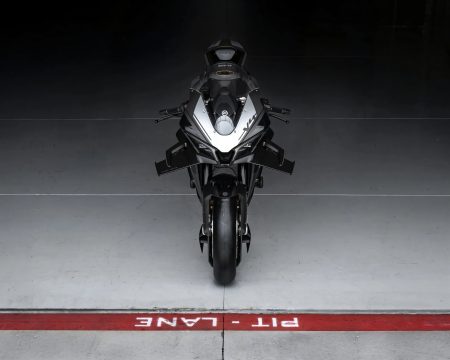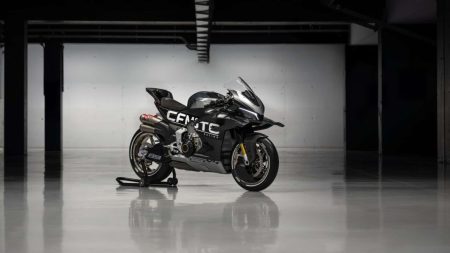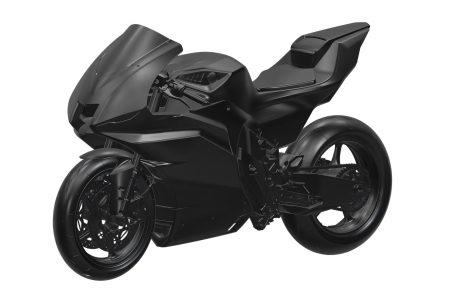
- 997cc V4 producing more than 210 hp (around 154 kW) at a weight of under 200 kg (441 lbs)
- Active aerodynamics with winglets that adjust between 0 and 90 degrees depending on the riding situation
- Measured GPS top speed of 196.2 mph (around 316 km/h), the fastest Chinese motorcycle to date
The CFMoto V4SR-RR has taken another development step in the wind tunnel of Pininfarina near Turin. The first completely newly developed V4 superbike from China relies on movable winglets and is aiming to join the ranks of established sport machines.
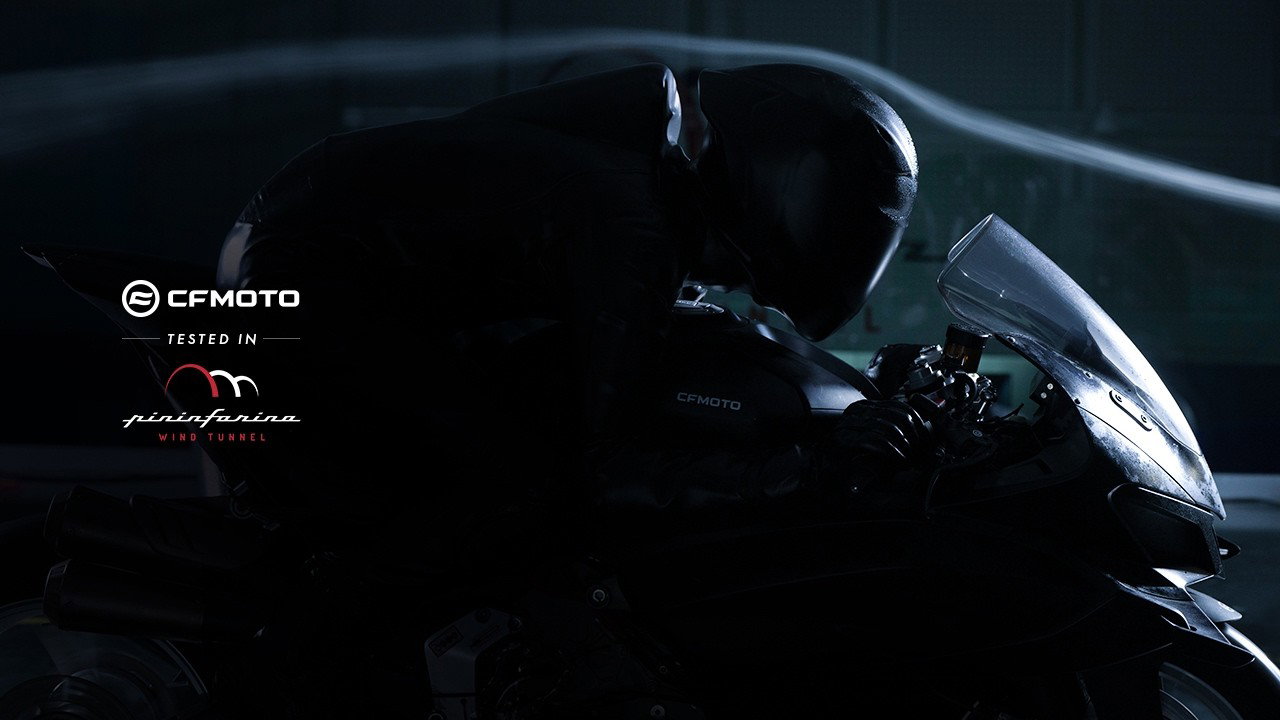
CFMoto continues to visibly work on its flagship in the sport segment. The manufacturer shows in a short video how a prototype of the V4SR-RR is tested in the wind tunnel at Pininfarina near Turin. The footage shows the motorcycle both riding straight and leaned over, each time with a mannequin in the saddle that replicates the rider’s influence on airflow. This puts a detail center stage that sets the V4SR-RR apart from many other sport motorcycles: active aerodynamics.
What is CFMoto doing in the Pininfarina wind tunnel?
CFMoto is fine-tuning the aerodynamics of the V4SR-RR there, in particular the behavior of the movable winglets. The test runs both in upright riding and while leaned over, so the interplay of downforce and drag can be captured across different riding attitudes. In the published video the wings are not seen moving, but the adjustable mechanism from the first prototype is retained.
The location holds special significance for motorcycle history. There, BMW developed in 1975 the prototype that led to the R100RS introduced in 1977. It is considered the first series-production street motorcycle with a full, fixed fairing designed to reduce drag and improve comfort. Roughly half a century later, at the same site, a technology is being refined that takes that very idea a step further.
How does the V4SR-RR’s active aerodynamics work?
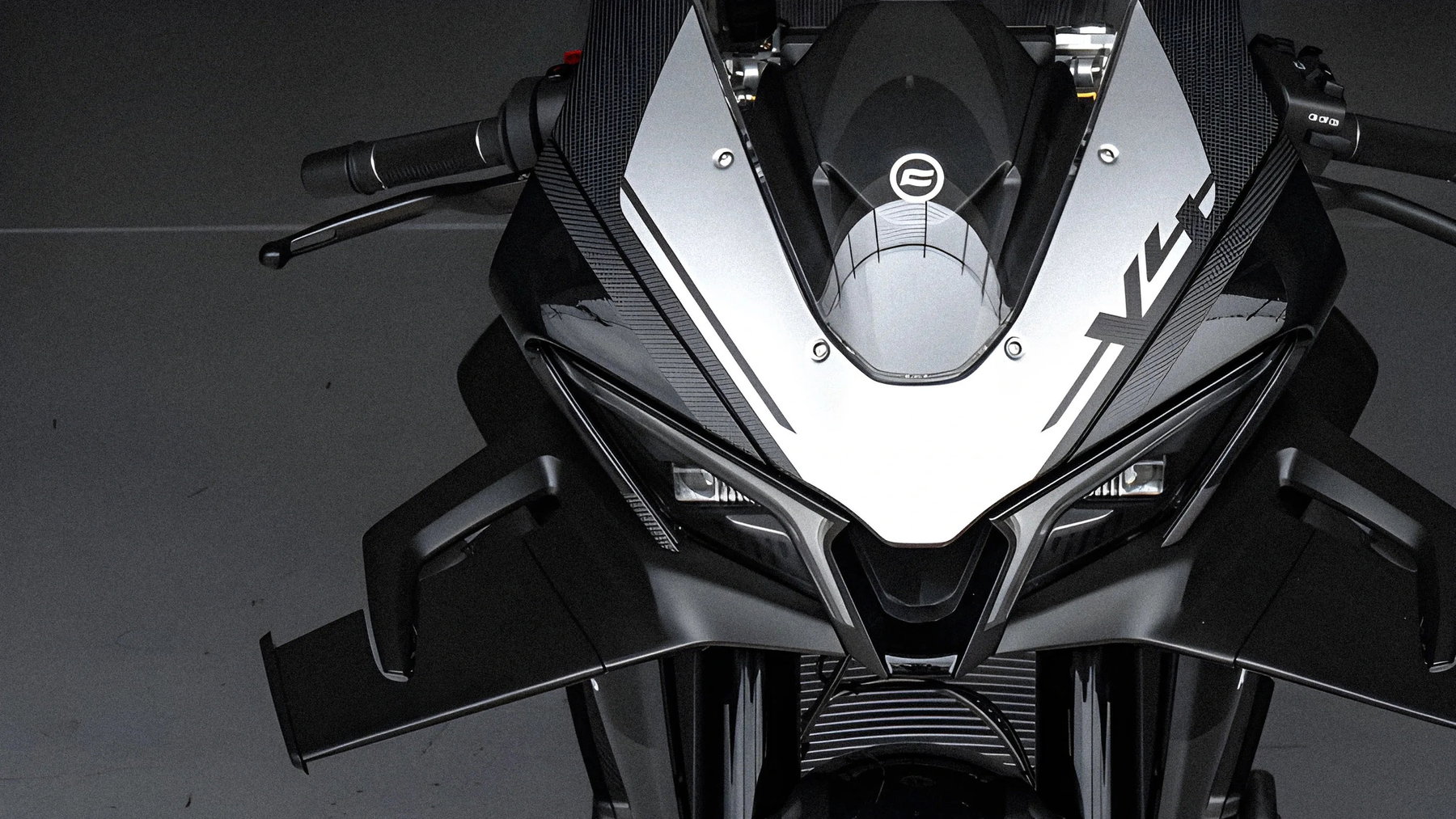
The winglets at the front automatically adjust their angle of attack and adapt in real time to speed and riding situation. The manufacturer describes the goal as having the wings generate downforce at high speed while keeping drag low when it is not needed. Both sides can move independently of each other.
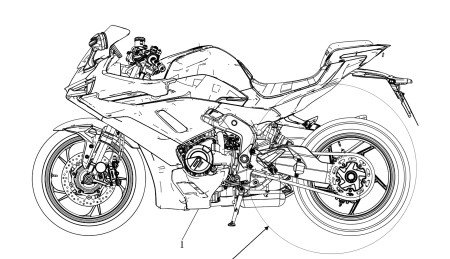
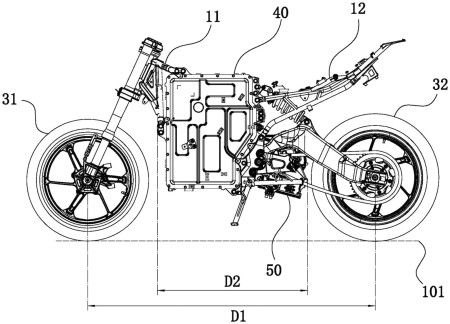
How this happens in detail is revealed in CFMoto’s patent filings. Each winglet sits on a pivot bearing that absorbs the forces. A push rod connects the wing to an electric actuator motor that rotates it. On the prototype shown, a second mount at the midpoint additionally supports the wing so it does not bend under load.
The patent specifies clear angle ranges. When accelerating, the winglet stays flat, at more than 0 and less than 10 degrees, to keep drag low. At high speed the angle rises to 10 to 20 degrees to curb front-wheel lift and secure stability. Under braking the wings fold out to 45 to 90 degrees, increasing pressure on the front wheel as well as drag, which adds extra deceleration before the motorcycle pitches forward.
Then there is the response to lean angle. Via the inertial measurement unit, the control system detects when the motorcycle leans into a corner and can angle both winglets differently. In theory this should help the bike turn in more easily, build more downforce, and direct airflow so that the front is pulled into the corner.
Series production is also being considered. Since the actuator motor is the most expensive component, CFMoto protects it in three ways according to the patent: wing travel is mechanically limited, a self-locking worm gear prevents the motor from being moved from outside, and the push rod is deliberately made weaker than the motor. Anyone who moves the wing by hand is thus more likely to damage the inexpensive rod than the costly drive unit.
What power and weight does the V4SR-RR have?
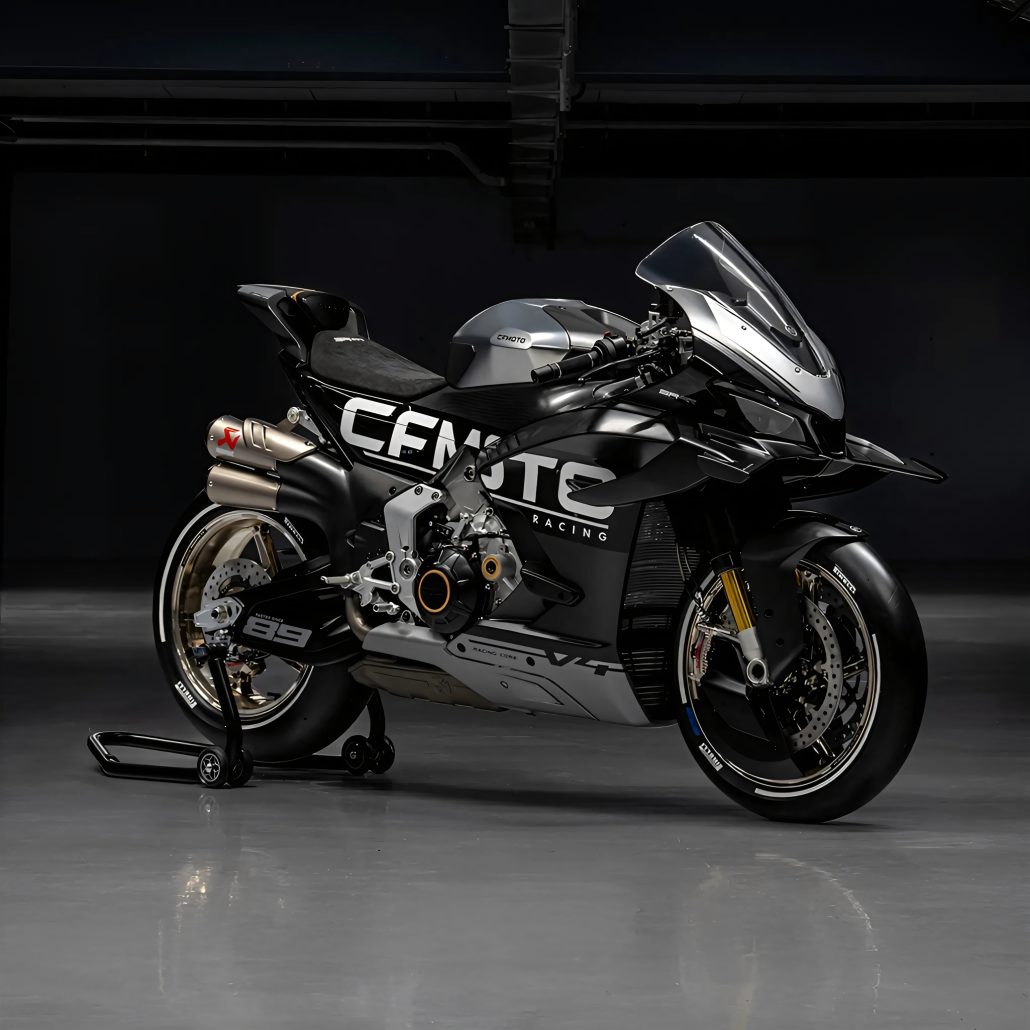
The 997cc V4 produces more than 210 hp (around 154 kW) according to the manufacturer, and weight sits under 200 kg (441 lbs). That works out to a power-to-weight ratio of more than one hp per kilogram, a figure only few sport motorcycles have reached so far. According to media reports, the prototype is said to produce around 212 hp (about 156 kW).
Further top-shelf components round things out. The titanium exhaust system from Akrapovič is said to already meet the Euro 5+ standard, pointing to an advanced stage of development. Road holding is handled by a semi-active, electronically controlled suspension, complemented by an extensive package of rider assistance systems.
How fast is the CFMoto V4SR-RR?
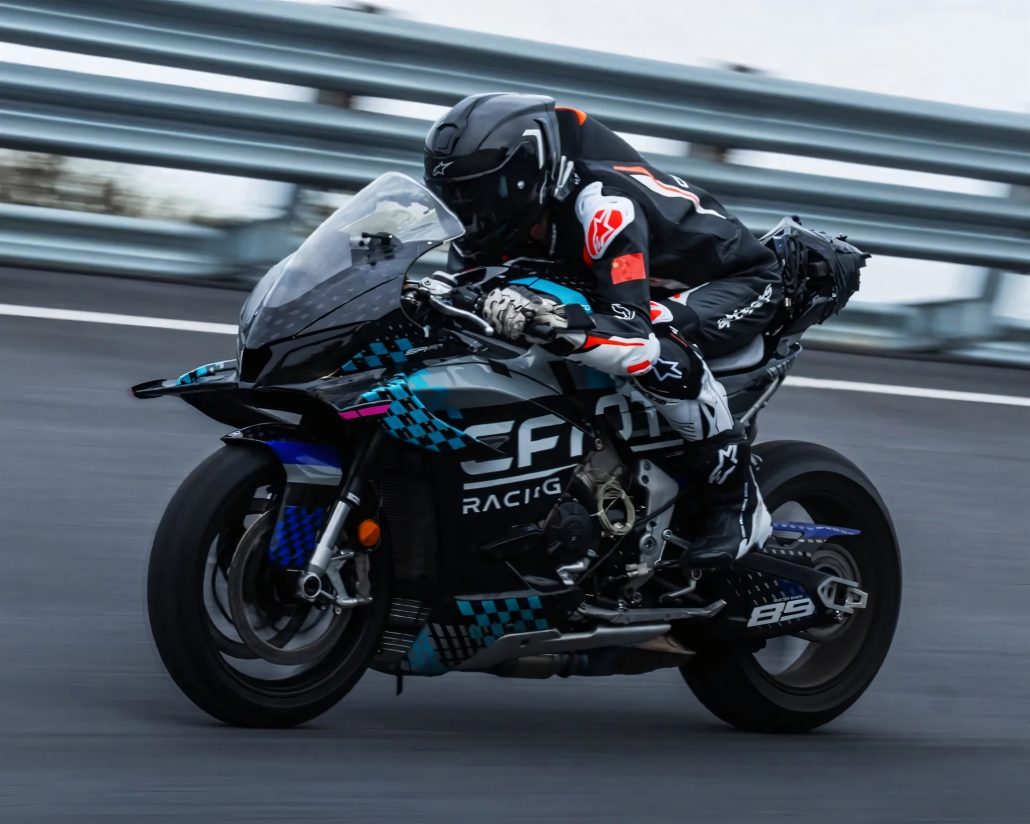
A prototype reached a GPS-measured top speed of 196.2 mph, or around 316 km/h. According to the manufacturer, that makes the V4SR-RR the fastest combustion-engined motorcycle built in China to date. The measurement was taken at the test facility in Shangrao.
For context: many manufacturers keep production machines to the voluntary 300 km/h (186 mph) limit that became common around the turn of the millennium. On paper, the V4SR-RR even has less displacement and power than some rivals. The Ducati Panigale V4 comes in at 1,103cc and 216 hp, the Aprilia RSV4 Factory at 1,099cc and 220 hp. In production form, both sit at around 186 and 189 mph respectively. That the V4SR-RR gets close to the 200 mph mark despite lower rated output suggests active aerodynamics plays a noticeable part. The absolute top speed still belongs to the supercharged Kawasaki Ninja H2R at around 249 mph.
Chassis, suspension and the two prototypes
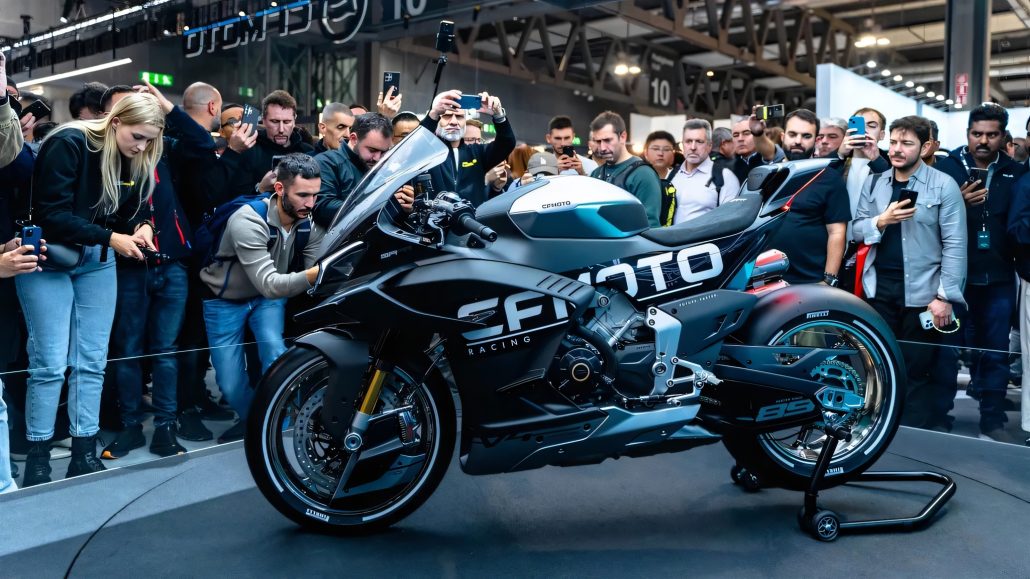
CFMoto takes a consistent approach with the chassis. A classic main frame appears to be absent; instead, the engine serves as a load-bearing element. The aluminum swingarm is bolted directly to the rear cylinder head and the gearbox. Ducati uses a similar approach on the Panigale V4, with an aluminum frame for the steering head.
Two variants have been shown so far. A black-and-silver show model carries Brembo brake calipers in MotoGP specification. A camouflaged riding prototype marked “Proto 5” looks closer to production, as it uses Brembo Hypure calipers, has a side stand, a slightly revised nose fairing, and adjustable footpegs that slide in elongated slots.
The project’s roots go back further. Initial patents for a V4 producing over 200 hp appeared as early as 2023, CFMoto showed the engine alongside a concept in 2024, and the complete V4SR-RR followed at the end of 2025. Movable winglets had already been announced before, for instance on the Bimota KB998 Rimini. However, the technology was first seen in action on the CFMoto.
When will the CFMoto V4SR-RR reach the market?
The production version is expected to be unveiled in the second half of 2026, with a production model expected for 2027. Possible stages include the CIMA show in September in China or EICMA in November in Milan. CFMoto has not yet announced pricing.
At the same time, the manufacturer is apparently pursuing an entry into the Superbike World Championship, possibly as early as 2027. The V4SR-RR thus represents a dual ambition: a sporty production motorcycle and, at the same time, the basis for a possible race machine. It fits into a broader trend in which Chinese brands are pushing into the top performance class, with active aerodynamics becoming the next technical battleground.
Frequently Asked Questions
-
How much horsepower does the CFMoto V4SR-RR have?
The CFMoto V4SR-RR produces more than 210 hp (around 154 kW) from a 997cc V4, according to the manufacturer. Media reports put the prototype at around 212 hp. Weight is under 200 kg (441 lbs).
-
How does the V4SR-RR’s active aerodynamics work?
The winglets adjust their angle automatically depending on speed and riding situation. When accelerating they stay flat for low drag; at high speed and under braking they fold out up to 90 degrees to increase downforce and deceleration. Via the inertial measurement unit, both sides can work differently while cornering.
-
How fast is the CFMoto V4SR-RR?
A prototype reached a GPS-measured top speed of 196.2 mph, or around 316 km/h. That makes it the fastest combustion-engined motorcycle built in China to date. The figure was recorded at the test facility in Shangrao.
-
When will the CFMoto V4SR-RR reach the market?
The production version is expected to be shown in the second half of 2026, with a production model expected for 2027. Possible dates include CIMA in September or EICMA in November. CFMoto has not yet announced a price.
-
Will CFMoto enter the Superbike World Championship with the V4SR-RR?
An entry into the Superbike World Championship is considered likely, possibly as early as 2027. The date has not been officially confirmed yet.
➜ This article is part of our comprehensive overview: Motorcycle Patents and Future Technology: What Manufacturers Are Developing. Find all key information on this topic in one place.