- 890 cc V-twin with 110.3 hp and 92 Nm, 70 percent of peak torque already at 3,000 rpm
- KYB suspension with 20 mm more travel at each end (250 and 240 mm), 256 mm ground clearance
- From 19,290 euros, European market launch in April 2027
Ducati gave the DesertX a fundamental overhaul at the start of 2026. Since then, an 890 cc V-twin has replaced the 937 cc Testastretta engine, and the trellis frame has given way to a monocoque. The Rally version initially stuck with the old technology. At EICMA 2026, Ducati is now following suit and moving the most off-road-focused DesertX onto the new platform as well. According to Ducati, experience from events such as the Erzbergrodeo, the Albania Rally, the Transanatolia and the NORRA Mexican 1000 Rally with its 1,500 desert kilometres went into its development. This makes the DesertX Rally one of the new motorcycles for 2027.
What does the DesertX Rally offer over the standard DesertX?
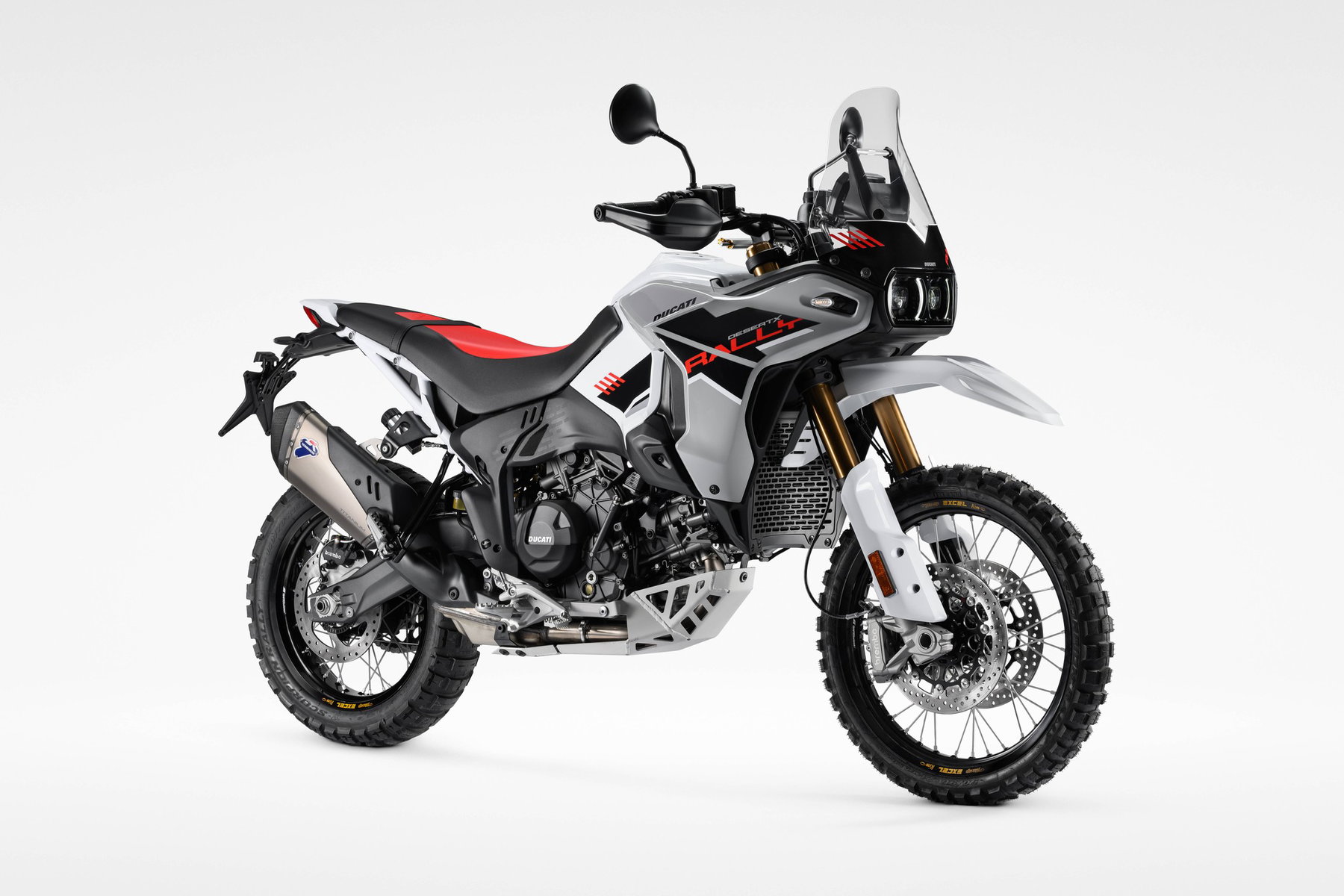
The DesertX Rally stands apart mainly through its longer-travel suspension, its own wheels, a standard titanium exhaust and stronger protection for off-road use. In return, Ducati charges 2,500 euros more in Germany than for the standard DesertX.
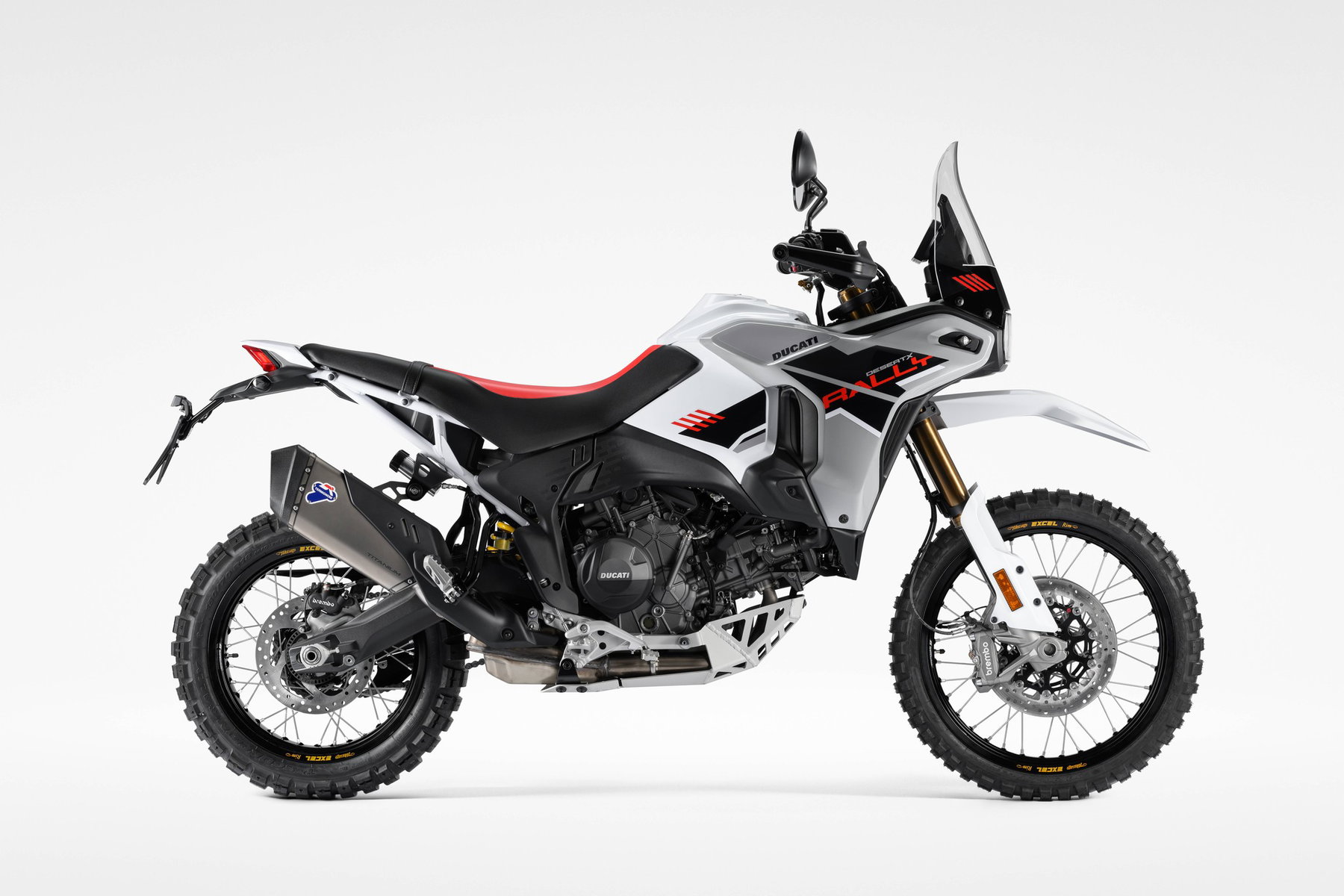
The aluminium bash plate on the Rally is 4 mm thick instead of 2.5 mm on the base model. An additional bracket is meant to spread the force of hard impacts more effectively. Up front sits a high-mounted mudguard. This leaves more space between wheel and mudguard so that mud cannot clog the front wheel on heavy ground. Thanks to the new braking system, the high mudguard now fits without modifications. The seat is a one-piece design intended to make switching between sitting and standing easier.
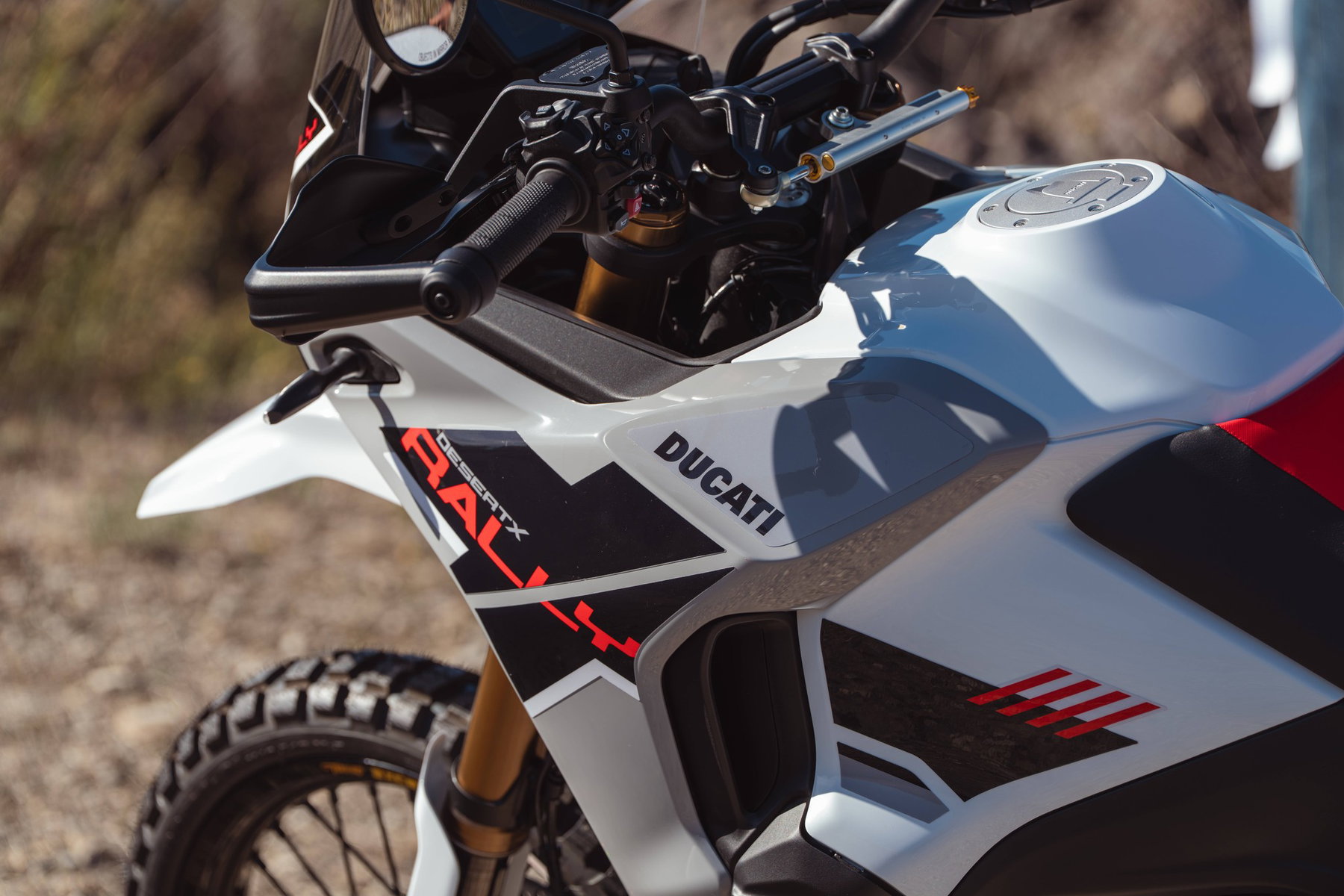
As standard, Ducati fits a road-legal Termignoni exhaust with titanium internals and a carbon end cap. At 4 inches, the rear rim is narrower than the 4.5-inch rim of the standard DesertX, which should make the Rally more agile off-road. An adjustable Öhlins steering damper sits directly on the handlebar. A crossbar on the cockpit is standard and can carry a sat nav, for example.
How is the suspension of the DesertX Rally set up?
Up front is a 48 mm KYB upside-down fork with closed cartridges, a design otherwise common on motocross and enduro competition bikes. The oil in the cartridges is pressurised so that no air bubbles form even under hard impacts and damping stays consistent. The 48 mm inner tubes are DLC-coated, while the outer tubes have a Kashima coating. Both reduce friction and wear. Preload, compression and rebound can be adjusted separately on each fork leg, and there are quick adjusters for compression on the fork caps. Travel increases by 20 mm to 250 mm.
At the rear is a fully adjustable KYB shock with a larger 46 mm piston, through which the oil is meant to flow more freely. Compression can be adjusted separately for slow and fast wheel movements, for example for long undulations and for sharp hits. Preload is set via a remote adjuster. The shock is connected via the progressive “Full Floater” linkage. It responds softly at the start of the stroke and provides more support towards the end so that the suspension does not bottom out as easily. Rear travel also grows by 20 mm, here to 240 mm. Ground clearance is 256 mm.
The aluminium double-sided swingarm was newly developed for this DesertX generation. It does without lightening holes and pivots directly on the engine. Its pivot point sits 6 mm lower than on the Multistrada. The rear axle nut is now hexagonal so that a wheel change can be done on the road with normal tools.
What has changed compared to the previous DesertX Rally?
Compared to its predecessor, the DesertX Rally gets a new engine, frame and wheels, and suspension travel grows by 20 mm at each end. Power and torque remain the same despite the smaller displacement.
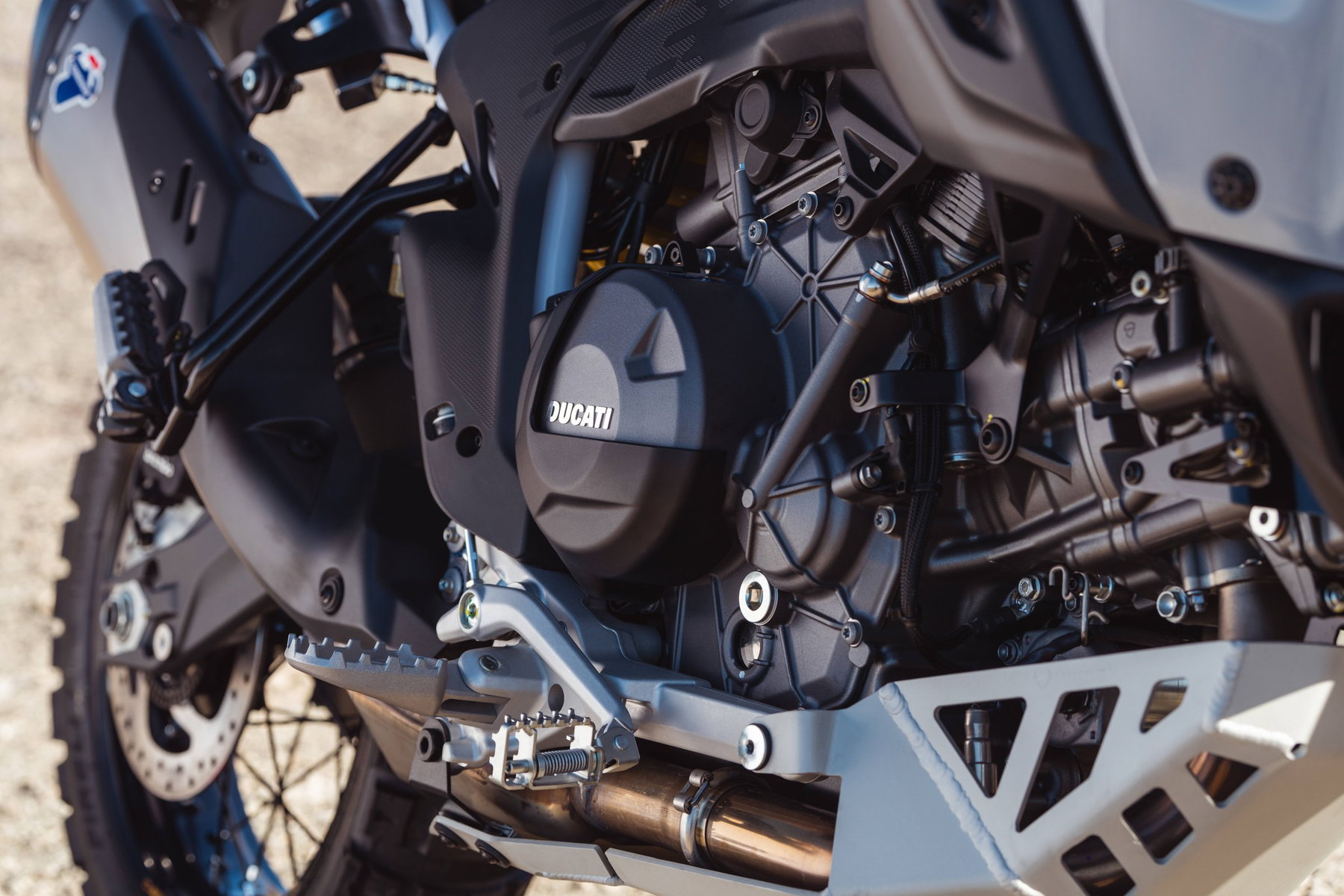
Instead of the 937 cc Testastretta with desmodromic valve actuation, the 890 cc V-twin with conventional valve springs now does the work. In DesertX trim it weighs 54.9 kg, making it 5.4 kg lighter than the old engine. The tubular steel trellis frame gives way to a cast aluminium monocoque. The Takasago Excel spoked rims are now designed for tubeless tyres, and the rear wheel has 36 instead of 32 spokes, which should make it stronger.
The complete motorcycle weighs 209 kg (461 lbs) with all fluids but without fuel, making it one kilogram lighter. Despite the longer suspension travel, seat height drops by 10 mm to 900 mm. The tank holds 18 instead of 21 litres. There is also a new landscape 5-inch display and the Quickshifter 2.0.
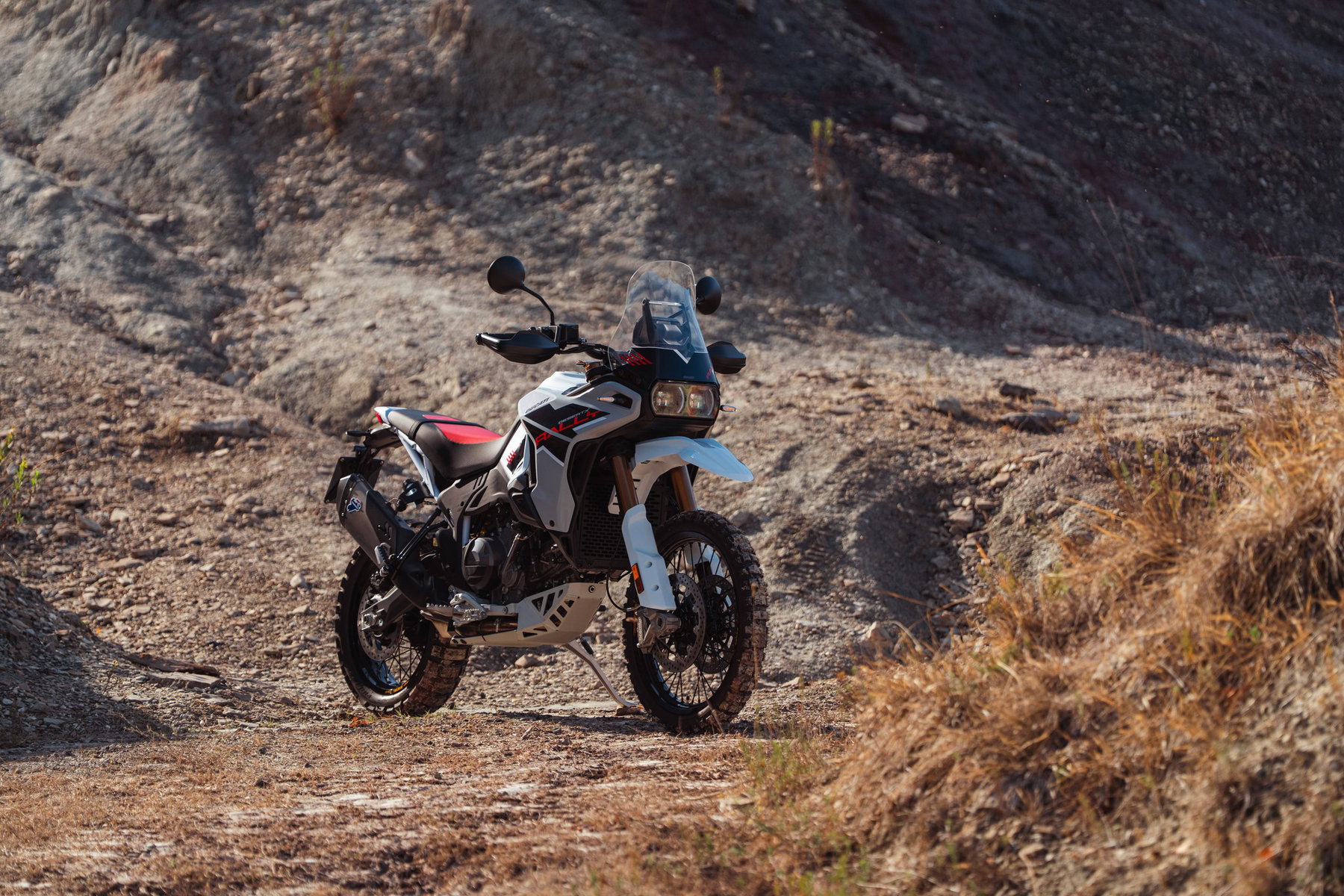
Visually, the new Rally also moves away a little from the old Dakar role models. The whole front end sits lower so that the rider sits more on the bike than in it. It remains recognisable by its high mudguard and the light signature front and rear, with the daytime running light now positioned horizontally. The tank fairing panels can be replaced individually after a crash, as can the side protection parts with aluminium reinforcement.
How powerful is the engine of the Ducati DesertX Rally 2027?
The V-twin of the Ducati DesertX Rally produces 110.3 hp (81.1 kW) at 9,000 rpm and 92 Nm (68 lb-ft) at 7,000 rpm. As early as 3,000 rpm, 70 percent of peak torque is available, and at 3,500 rpm it is more than 80 percent.
Between 4,000 and 9,000 rpm, torque never drops below 90 percent of its peak. This is made possible by variable intake valve timing, which Ducati calls IVT. The engine displaces 890 cc, has a 90-degree cylinder angle and four valves per cylinder, and complies with the Euro 5+ standard. In the DesertX it gets a more powerful alternator. It can handle higher electrical loads and adds 0.51 kg to the engine, but increases rotational inertia by 12 percent. As a result, the V-twin runs more smoothly at low revs and responds more gently to the throttle, which helps especially in rough terrain.
Ducati has tuned the gear ratios specifically for the DesertX family. The first four gears are short and help when riding slowly over obstacles. Fifth and sixth gears are longer and reduce revs on country roads and motorways, benefiting comfort and fuel consumption. The Quickshifter 2.0 does without an external switch on the gear lever and relies solely on the gear sensor on the shift drum. This should make it less sensitive to impacts, mud and dust. A slipper clutch prevents rear wheel hop when downshifting.
For holders of an A2 licence, there is a version restricted to 35 kW. Ducati quotes 43.5 hp at 6,250 rpm and 49 Nm (36 lb-ft) at 5,750 rpm for it. Maintenance calls for an oil change every 15,000 km or every two years, while valve clearance is checked every 45,000 km.
Frame, ergonomics and wheels of the DesertX Rally 2027
The monocoque frame is bolted to the head of the vertical cylinder and uses the engine as a stressed member. At the same time, it serves as an airbox with a volume of 12.5 litres, sealed at the top by the tank. To clean the air filter, the handlebar is turned to full lock; after undoing three screws, the intake snorkel and filter can be removed.
For the DesertX, Ducati has stiffened the monocoque with a front crossbar and closed an opening on the left side that is open on the other V2 models. This gives the frame its own lateral and torsional stiffness. At the rear, a tubular steel subframe is attached. It can be partially removed so that the workshop can reach the rear cylinder to check valve clearance.
The ergonomics are designed for riding while standing. The handlebar is wide, the seat and handlebar move further forward and the footpegs further back. The narrow 18-litre plastic tank carries the weight of the fuel low down. Its side surfaces have a grippy finish to give the knees better hold. With the optional low seat, seat height drops to 880 mm. The height of the rear brake pedal can quickly be switched between a road and an off-road position.
The wheels measure 21 inches at the front and 18 inches at the rear. As standard, Ducati fits the Pirelli Scorpion Rally STR in sizes 90/90-21 and 150/70 R18. Also approved are the more off-road-oriented Scorpion Rally and the road-focused Scorpion Trail. At the front, two 305 mm discs with Brembo M4.32 monobloc calipers do the braking, at the rear a 265 mm disc with a two-piston caliper. The rear brake has a new lever ratio for better modulation, and cornering ABS is tuned to the longer suspension travel.
What electronics does the DesertX Rally have?
The DesertX Rally uses an inertial platform that measures movements on six axes. Cornering ABS, traction control, wheelie control and engine brake control are all based on it.
The ABS offers four levels. Level 1 is preset in Rally mode and intended for experienced off-road riders. It only works on the front wheel, with cornering function and rear lift-up detection switched off. Level 2 is aimed at riders with less off-road experience, works on both wheels and allows brief lock-ups at the rear. Levels 3 and 4 are intended for the road, with level 4 specifically for low grip. In Enduro and Rally modes, ABS can be switched off completely.
Traction control has eight levels, four each for off-road and road. It evaluates not only the current slip at the rear wheel but also how quickly it changes, and should therefore intervene earlier. Controlled drifts off-road remain possible. Wheelie control has four levels and is switched off ex works in Enduro and Rally. Engine brake control intervenes less strongly in the off-road levels so that the rear wheel does not lock when downshifting.
Six riding modes are available. Sport and Rally deliver the full 110 hp with direct throttle response, Touring also delivers full power but more smoothly. Urban and Wet limit output to 95 hp, Enduro to 75 hp while still offering responsive throttle. In Enduro mode, ABS level 2 is preset.
The 5-inch widescreen colour display with 800 x 480 pixels offers three views, which the rider switches between using a joystick on the handlebar. Road shows the basic information, Road Pro additionally shows power and torque as percentages. The Rally view includes a tripmaster with a manually correctable odometer, as needed for roadbook navigation. Apart from a red shift light, the warning lights are integrated into the display. Two USB ports, full LED lighting with dynamic indicators, automatic indicator cancelling, a coming-home function and a brake light that flashes during emergency braking from over 55 km/h are standard. Smartphone connectivity and turn-by-turn navigation are available at extra cost.
What accessories are available for the DesertX Rally?
For longer trips, Ducati offers an 8-litre auxiliary tank at the rear. It has its own side sliders and is designed to protect the most important parts as the first point of impact in a crash.
There are also LED auxiliary lights, a centre stand, heated grips, a radiator guard, a front crash bar, a larger windscreen and reinforced hand guards. For luggage, there are aluminium side cases with their own mounts and a rackless soft luggage system developed together with Mosko Moto. A Termignoni racing exhaust with its own mapping is said to add 6 hp, but is not road-legal.
How much does the Ducati DesertX Rally 2027 cost and when will it arrive?
In Germany, the Ducati DesertX Rally costs from 19,290 euros (around 21,700 US dollars). The standard DesertX starts at 16,790 euros (around 18,900 US dollars).
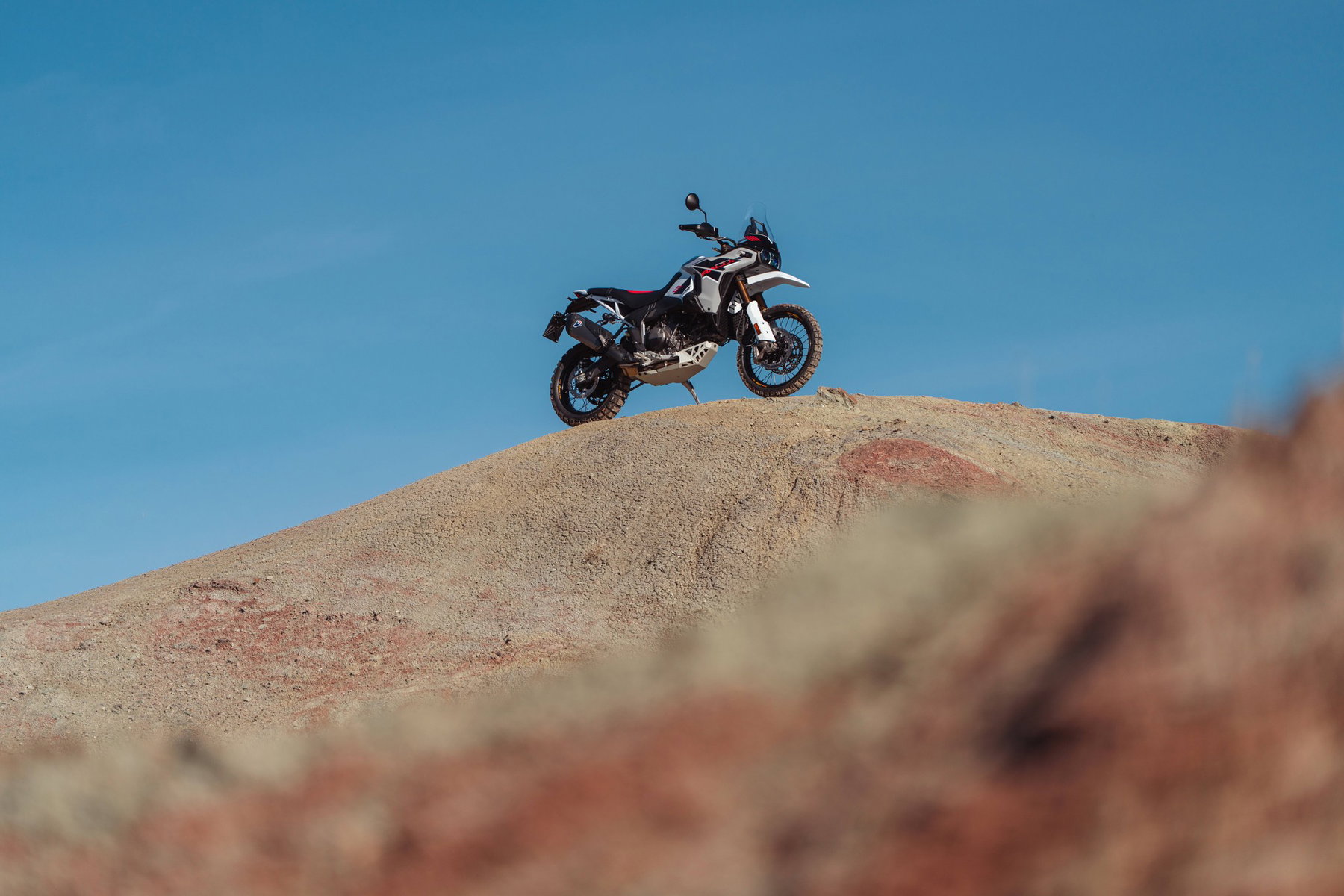
The DesertX Rally is due at European dealers in April 2027, with other markets to follow. The A2 version with 35 kW is also available. The Rally is offered in Matt Star White Silk.
Frequently Asked Questions
-
How much does the Ducati DesertX Rally 2027 cost?
In Germany, the Ducati DesertX Rally costs from 19,290 euros. That makes it 2,500 euros more expensive than the standard DesertX at 16,790 euros.
-
How much horsepower does the Ducati DesertX Rally have?
The DesertX Rally produces 110.3 hp at 9,000 rpm and 92 Nm at 7,000 rpm. That is the same output as its predecessor with the 937 cc engine. For the A2 licence, there is a 35 kW version.
-
What is the seat height of the DesertX Rally 2027?
The seat height of the DesertX Rally is 900 mm, 10 mm lower than its predecessor. With the optional low seat, it is 880 mm.
-
Does the new DesertX Rally have tubeless tyres?
Yes, the Takasago Excel spoked rims of the DesertX Rally 2027 are designed for tubeless tyres. The predecessor still ran on tubed tyres.
➜ Find all technical specifications for this model in our motorcycle database: Ducati DesertX Rally 2027.
➜ This article is part of our comprehensive overview: New Motorcycles 2027: All Models, Releases and Highlights at a Glance. Find all key information on this topic in one place.
➜ More on this topic in our overview: EICMA 2026: All New Models and Premieres from Milan at a Glance.