- 218 hp (160.4 kW), rev limiter in second to fifth gear now only at 15,000 rpm
- Front Frame with 12 percent less lateral stiffness, new braking functions Dynamic Engine Brake and Race Brake Control
- At dealers from March 2027, in Germany from 28,690 euros (approx. 33,000 US dollars)
The current Panigale V4 has only been on the market since the 2025 model year. Ducati had presented the seventh superbike generation at World Ducati Week 2024. Two years later, a comprehensive update now follows. What is new is not one single big change, but many small steps across almost all components. Power increases by only 2 hp (1.5 kW). Other points are more interesting: the frame has deliberately become softer, the gearing longer, and the electronics make greater use of the rear wheel when braking. In addition, Ducati is including the Panigale V4 S in its Factory Made customisation programme for the first time. This makes the Panigale one of Ducati’s new models for the 2027 model year.
What is changing on the 2027 Ducati Panigale V4?
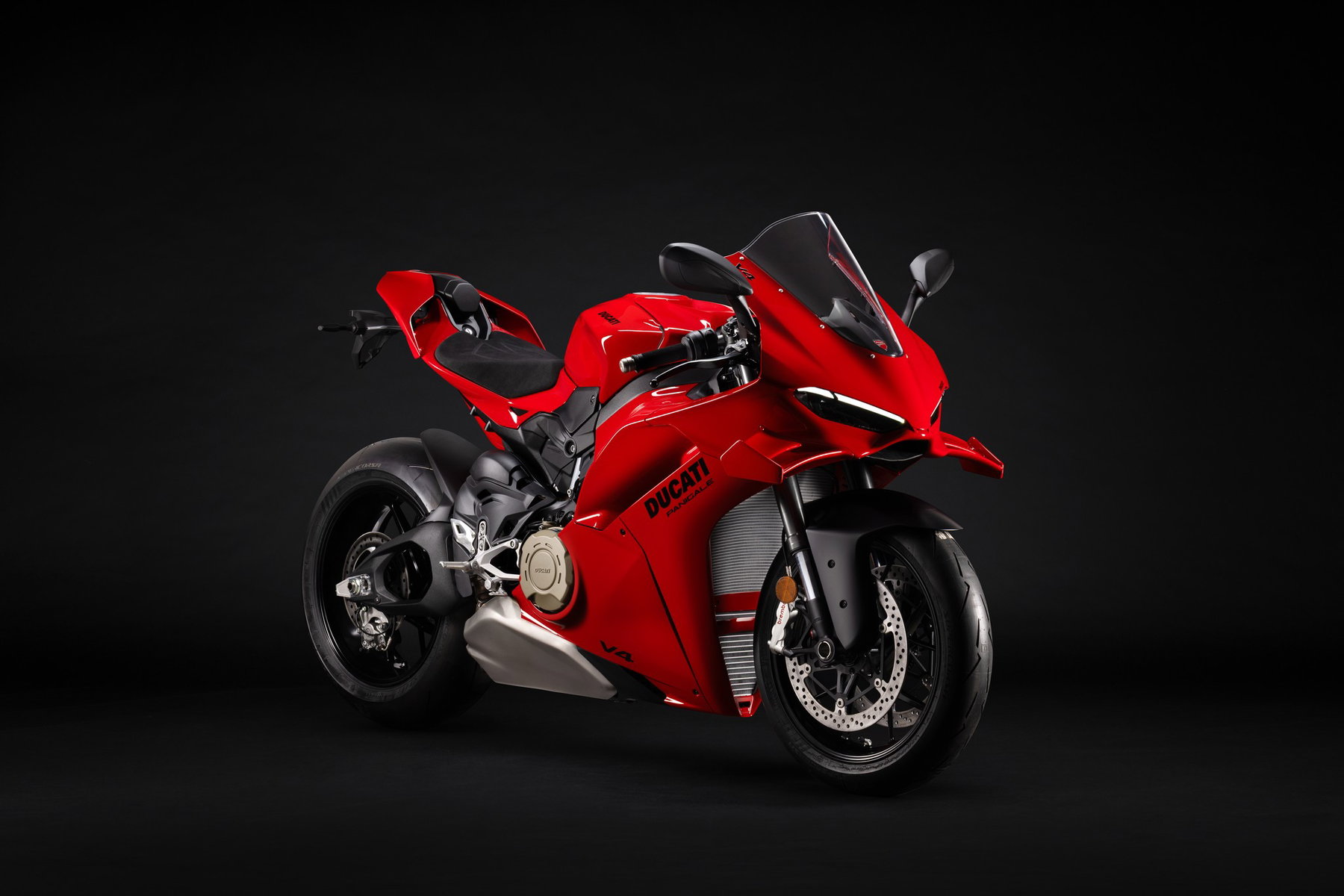
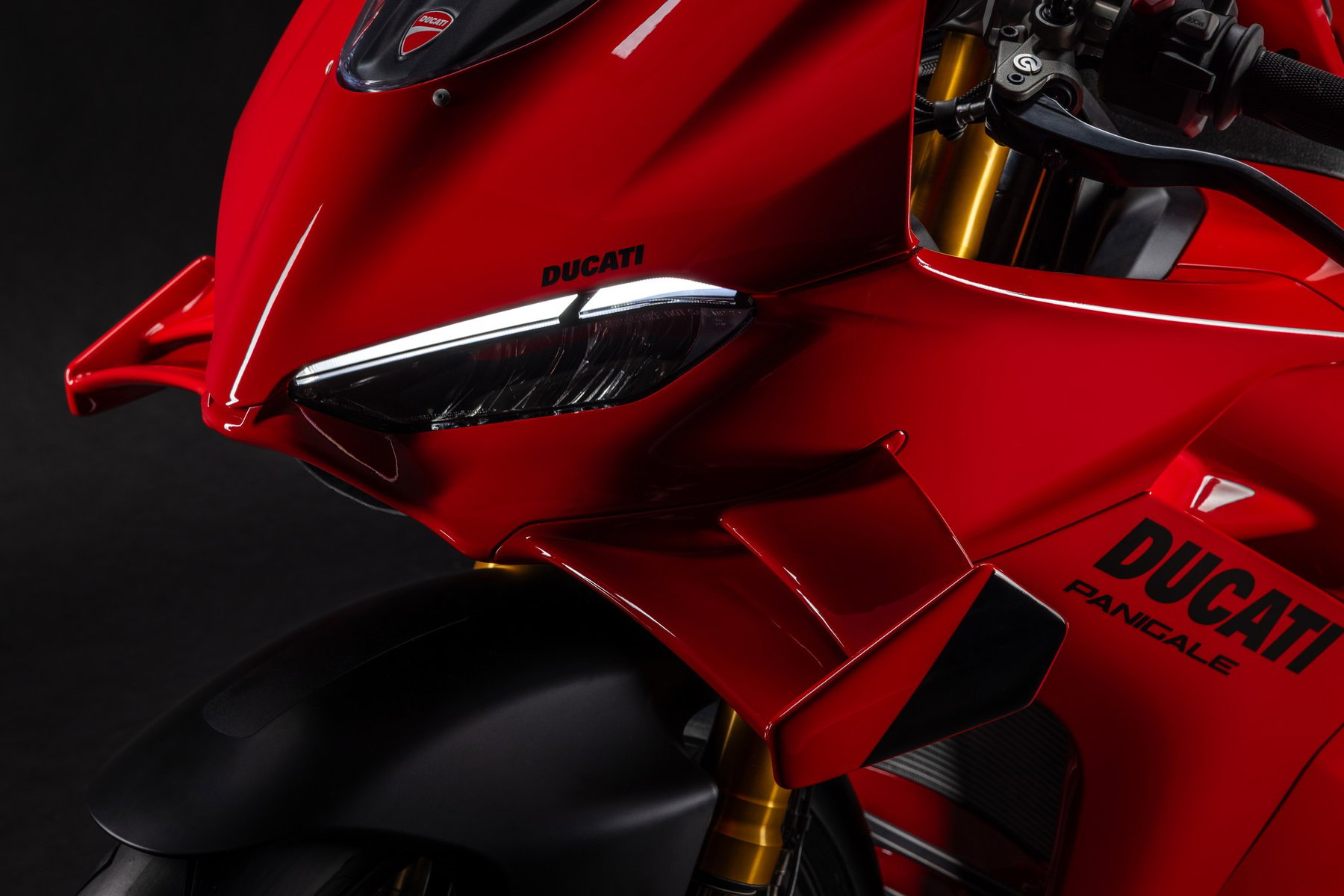
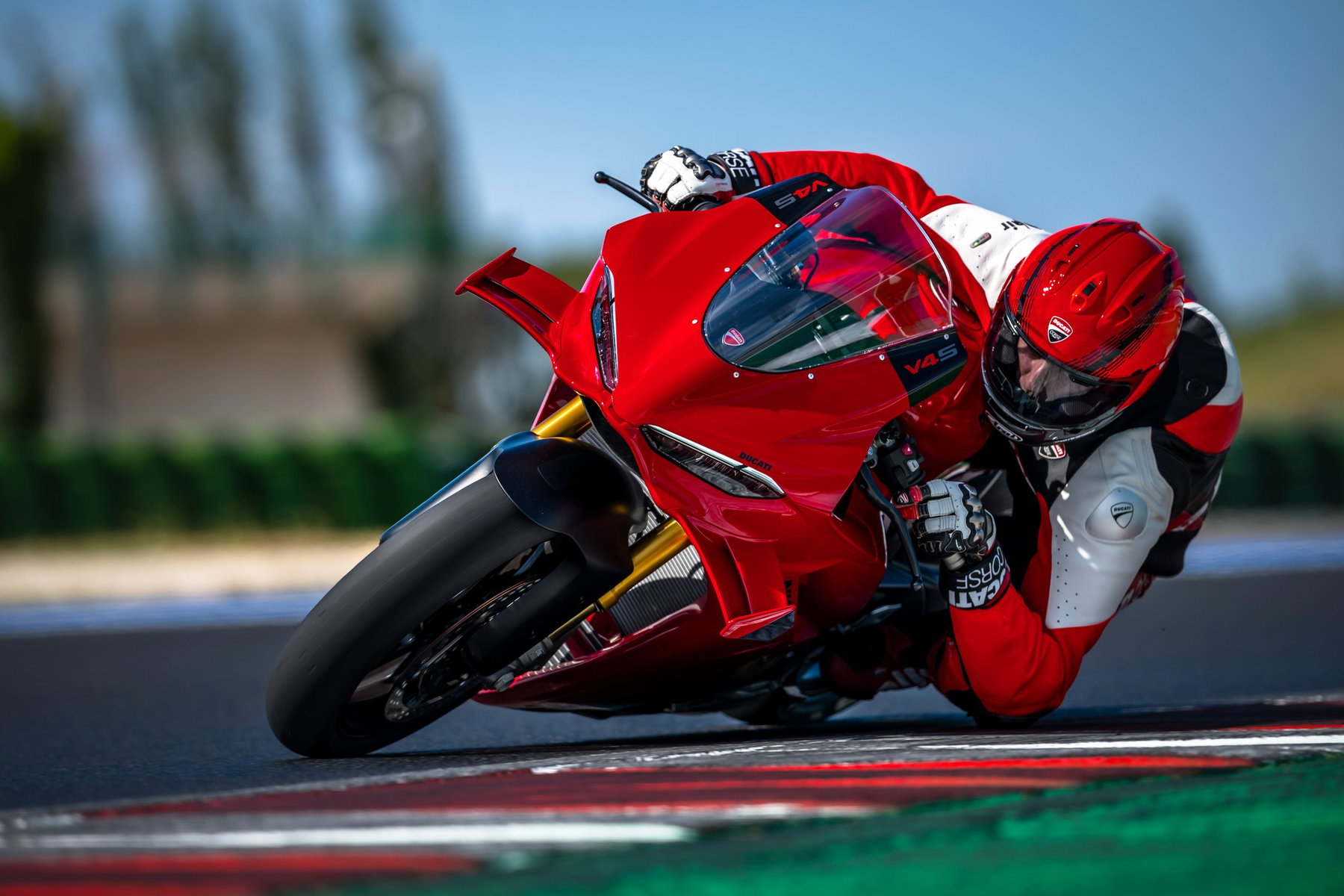
The 2027 Panigale V4 gets more power in the upper rev range, longer gearing, a softer Front Frame and new braking functions. Visually, the revised aerodynamics stand out above all.
The changes apply to both versions, i.e. the Panigale V4 and the Panigale V4 S. Ducati has aligned everything with a common goal: performance should increase while at the same time becoming easier for the rider to use. This refers above all to use on the race track. There, the Panigale is meant to behave more predictably at the limit than before. Apart from the wings, the fairing remains virtually unchanged. The biplane winglets now have larger side endplates. The Front Frame features a new black finish.
How much horsepower does the new Panigale V4 have?
In the Euro 5+ version, the Desmosedici Stradale now produces 218 hp (160.4 kW) at 13,500 rpm. That is 2 hp (1.5 kW) more than before.
The displacement of the V4 engine remains 1,103 cc. On paper, the gain in peak power looks small. However, Ducati has worked above all on the power curve at the top end. Between 12,000 and 14,000 rpm, the engine is said to be noticeably stronger. At 13,000 rpm, the gain is 3.5 hp (2.6 kW) according to the manufacturer.
This is achieved through several measures, each of which brings only a little on its own:
- Intake: The front air intake comes from the Panigale V4 R. At 300 km/h, it increases the air pressure at the filter inlet by 0.6 percent. There is also a new sport air filter with higher flow.
- Exhaust: The silencer now has a diameter of 38 instead of 36 millimetres. This reduces back pressure in the exhaust system.
- Lubrication: Ducati has retuned the oil circuit. The maximum amount of oil flowing through the engine is 10 percent lower. As a result, less power is lost to internal friction.
At high speed, there is also a ram-air effect. At 300 km/h, this is said to provide a further 1.3 hp (1.0 kW). However, the larger air intake also creates more drag. The new winglets are intended to compensate for this disadvantage.
Torque, on the other hand, drops slightly. The engine now delivers 120.6 Nm (89 lb-ft) at 11,000 rpm. The predecessor produced 120.9 Nm (89.2 lb-ft) at 11,250 rpm.
Why has Ducati lengthened the gearing?
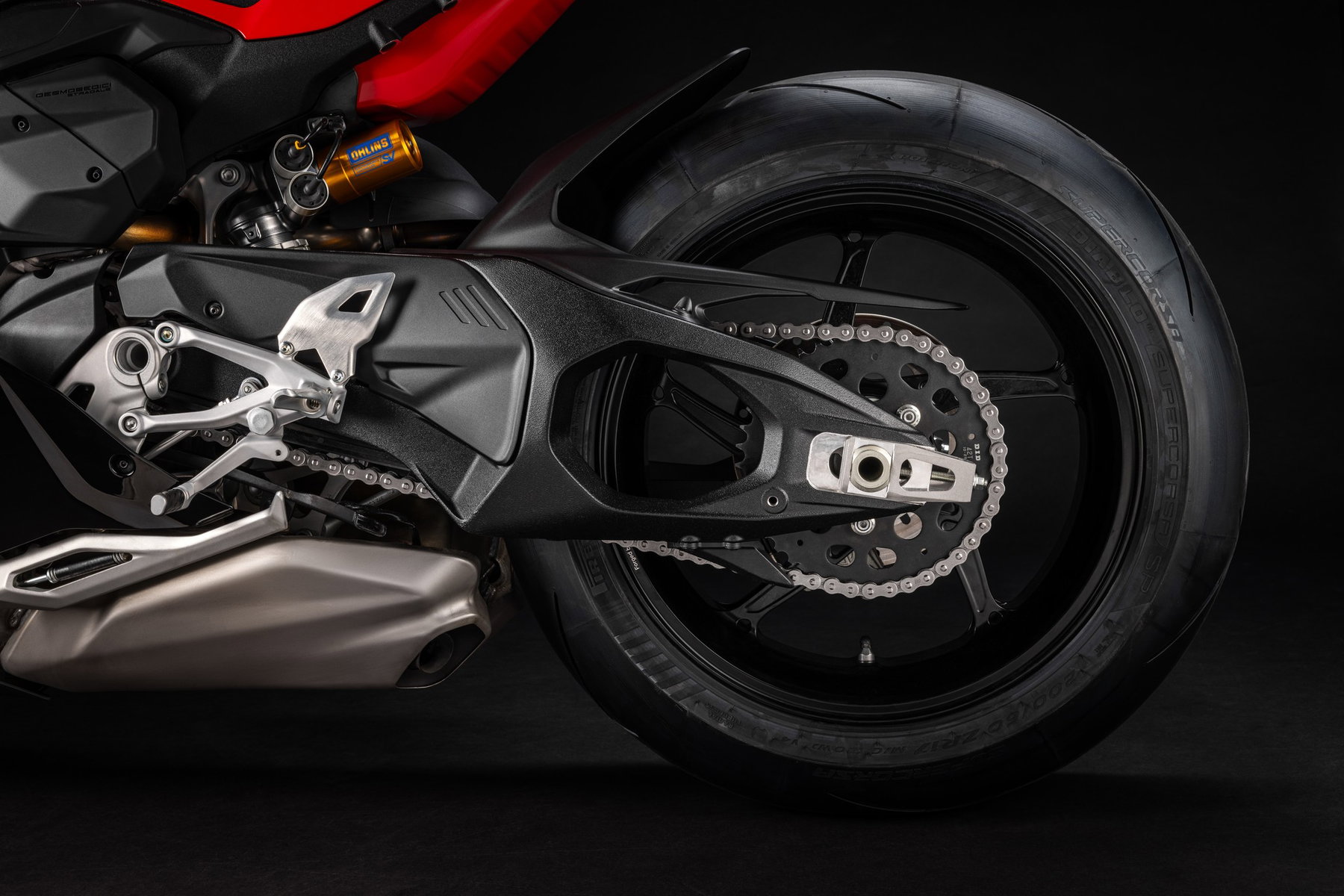
The longer gearing is meant to let the rider use the additional power in the upper rev range for longer and shift less often. At the same time, it makes the motorcycle shorter and more agile.
Instead of 16/41, Ducati now uses a 17-tooth front sprocket and a 42-tooth rear sprocket. To make this work, the engine now revs 500 rpm higher in second to fifth gear. The rev limiter there only cuts in at 15,000 instead of 14,500 rpm. Each gear therefore reaches further. Top speed increases by 12 km/h. According to Ducati, the rider needs two fewer gear changes per lap at Vallelunga. This allows them to concentrate more on their line and riding technique.
The new gearing has a side effect on the chassis. The wheelbase shrinks by 8 millimetres to 1,477 millimetres. This is meant to make the motorcycle change direction faster and demand less effort from the rider. This is particularly noticeable on twisty circuits.
Why has the Panigale V4 frame become softer?
The Front Frame is designed to flex more at high lean angles so that the front tyre stays in better contact with the asphalt. To achieve this, Ducati has reduced lateral stiffness by 12 percent.
The Front Frame is the aluminium frame at the front that connects the engine to the steering head. When the motorcycle is leaned over very far, the suspension can hardly absorb bumps any more. A frame that then flexes a little more sideways takes over part of this work. The result is meant to be more grip at the front wheel and more precise feedback when turning in. This makes it easier for the rider to tighten the line towards the apex. Higher corner speeds are meant to be possible, and the rider can get on the throttle earlier on corner exit.
On the Panigale V4 S, there is also a change to the riding position. The new clip-on handlebars can be mounted 10 millimetres higher for track use. This setting is expressly intended for the race track only. Ducati is following a development from MotoGP in recent years. A higher handlebar gives the rider more leverage. This is meant to make changes of direction and long, hard braking manoeuvres less tiring.
What do Dynamic Engine Brake and Race Brake Control do?
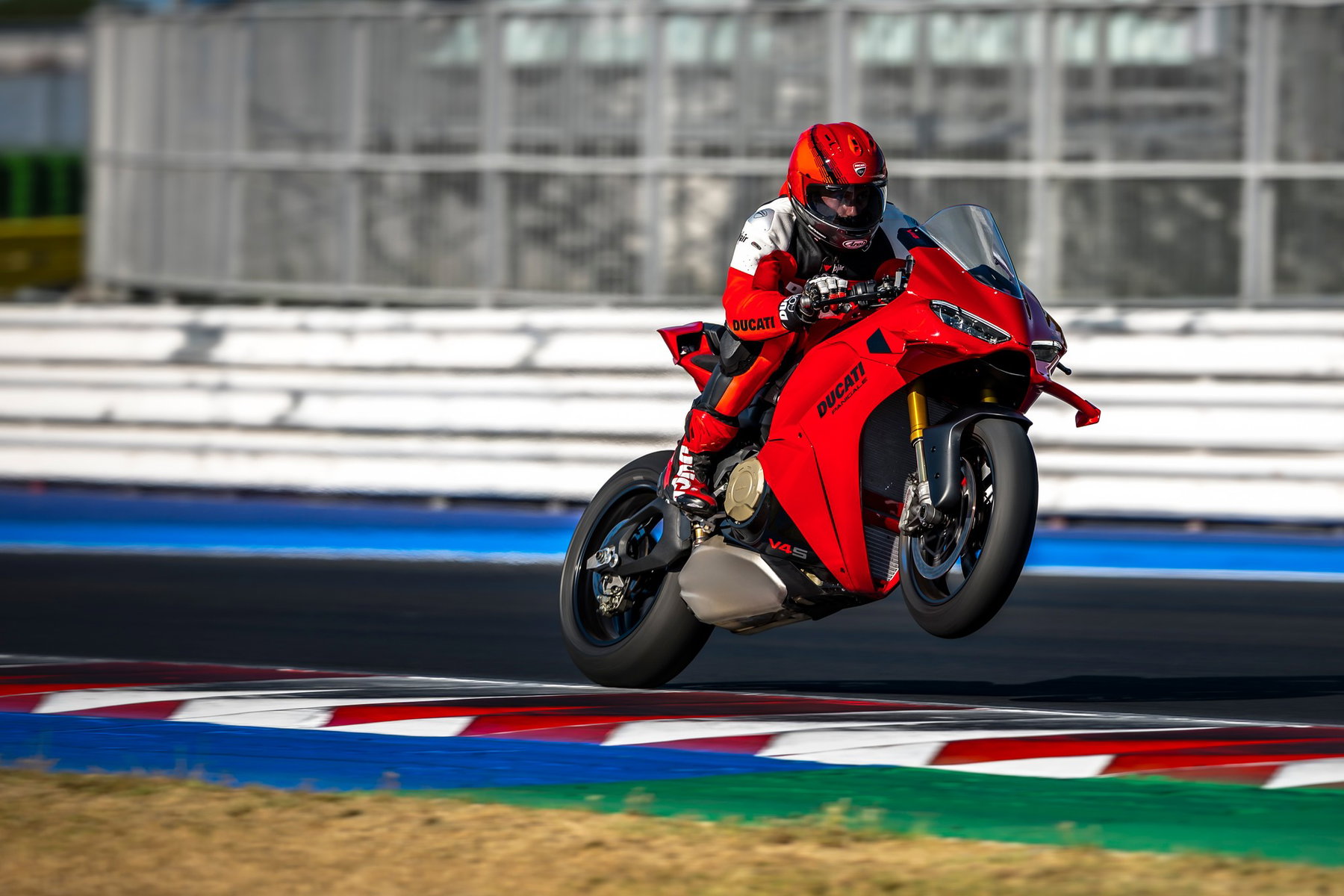
Both systems are designed to make the rear wheel contribute more to deceleration when braking. This is meant to allow later braking points and higher speeds on corner entry.
The Dynamic Engine Brake (DEB) replaces the previous Engine Brake Control. It regulates engine braking, i.e. the braking effect of the engine when closing the throttle. What is new is that it is based on the actual load on the rear tyre. This load is calculated by the Ducati Vehicle Observer (DVO). This is an algorithm developed by the racing department Ducati Corse. It estimates the state of the motorcycle from sensor data and allows the control systems to intervene more precisely. The DEB also combines engine control with automatic intervention of the rear brake. On corner entry, the Panigale is therefore meant to behave more predictably and remain more stable when braking while leaned over.
Race Brake Control (RBC) is also new. During hard braking, it shifts more work to the rear wheel and thus makes better use of the available grip. Until now, it has mainly been professionals who brake using this technique. With DEB and RBC, Ducati wants to make it accessible to a wider group of riders. According to Ducati, the electronics package comes from the Superleggera V4 Centenario. The Ducati Quick Shift gearshift assistant now also uses the calibration of the Panigale V4 R.
The rest of the electronics are based on a six-axis inertial measurement unit. These include:
- Bosch cornering ABS and Race eCBS (combined braking system with cornering function)
- Traction control, wheelie control and launch control, each with DVO
- Ducati Slide Control for controlled drifting on corner exit
- Riding modes Race A, Race B, Sport, Road and Wet
Also new is the 6.9-inch TFT display in 8:3 format with 1,280 x 480 pixels.
How much faster is the new Panigale V4 on the race track?
In tests at the Vallelunga circuit, the 2027 Panigale V4 was on average 0.4 seconds per lap faster than its predecessor, according to Ducati. This figure applies to the EU-homologated configuration.
Ducati riders already tried out many of the new features under race conditions at the Lenovo Race of Champions at World Ducati Week. Nicolò Bulega, freshly crowned Superbike world champion, beat the previous pole record there by 0.7 seconds. When the current generation debuted, Ducati had already fielded a Panigale V4 at the Race of Champions that was a full second faster than its predecessor. With the Panigale V4 R, the brand also won the titles in the British Superbike Championship and the EuroMoto SBK in 2026. In 2025, a Panigale V4 S won the Italian Production SBK Championship.
Anyone who wants even more power can opt for the new Akrapovič Full Racing Exhaust PRO. The complete system is not approved for road use. It is said to add 11 hp (8.1 kW) and 7 Nm (5.2 lb-ft). This brings the Panigale to 229 hp (168.4 kW) and 127.6 Nm (94.1 lb-ft). At the same time, the system saves 6.6 kg (14.6 lbs) of weight.
How do the Panigale V4 and Panigale V4 S differ?
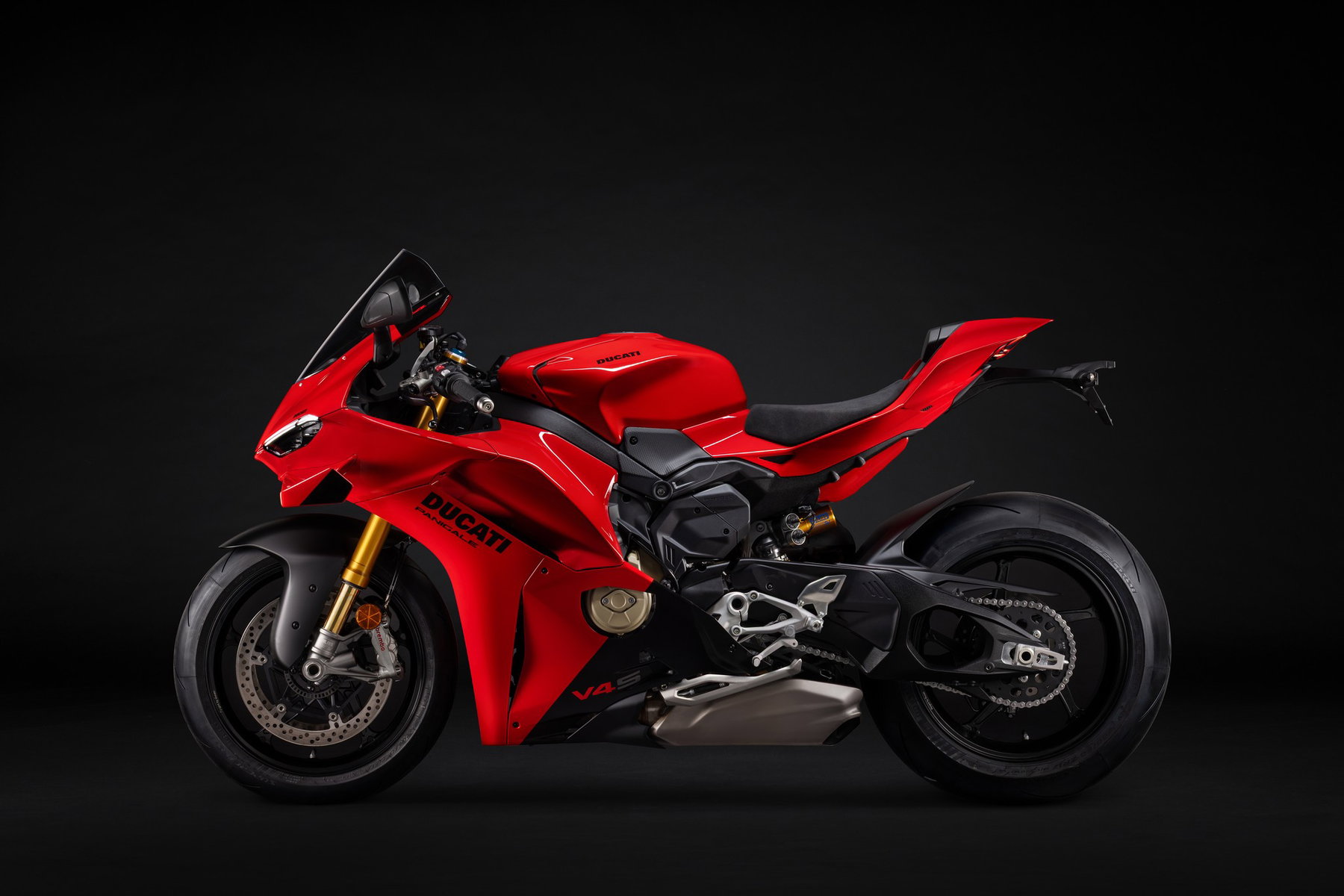
The Panigale V4 S has electronically controlled Öhlins suspension, forged wheels and a lithium battery. As a result, it weighs 187 kg (412 lbs) ready to ride without fuel, while the base version tips the scales at 191 kg (421 lbs).
Engine, gearing, frame, aerodynamics and the new braking functions are the same on both versions. The differences lie in the suspension and some equipment details:
| Panigale V4 | Panigale V4 S | |
|---|---|---|
| Fork | Showa BPF, 43 mm, fully adjustable | Öhlins NPX 25/30, 43 mm, electronically controlled |
| Shock absorber | Sachs, fully adjustable | Öhlins TTX36, electronically controlled |
| Steering damper | Sachs | Öhlins, electronically controlled |
| Wheels | Light alloy, five spokes | Forged aluminium, five spokes |
| Battery | Lead-acid | Lithium-ion |
| Weight without fuel | 191 kg (421 lbs) | 187 kg (412 lbs) |
| Seats | one | one or two, depending on country |
The V4 S uses Ducati Electronic Suspension (DES) 3.0 with the Öhlins Smart EC 3.0 control system. The system automatically adjusts the damping of the fork and shock absorber while riding. The passenger kit is available as an accessory for the V4 S.
Both versions brake at the front with two 330-millimetre discs and Brembo Hypure monobloc calipers. At the rear is a 245-millimetre disc. Pirelli Diablo Supercorsa SP-V4 tyres in sizes 120/70 ZR17 and 200/60 ZR17 are fitted as standard. The seat height is 850 millimetres, and the aluminium tank holds 17 litres. Suspension travel is 125 millimetres at the front and 130 millimetres at the rear. Cruise control, pit limiter and lap timer are standard on both models.
Ducati quotes fuel consumption of 6.5 litres per 100 kilometres and CO2 emissions of 151 g/km. The warranty runs for 24 months with unlimited mileage. An oil change is due every 12,000 kilometres or 24 months, and a valve clearance check every 24,000 kilometres.
What does the Factory Made programme offer for the Panigale V4 S?
With Factory Made, the Panigale V4 S can be individually configured at the time of ordering. Colour, livery and selected parts are fitted directly during production in Borgo Panigale.
Eleven colours are available. Six of them come from Ducati: Ducati Red, Ducati Yellow, Thrilling Black, GP19 Red, Aviator Grey and Arctic White Silk. Five more come from the Ad Personam catalogue of Automobili Lamborghini: Arancio Xanto, Giallo Belenus, Verde Scandal, Viola Pasifae and Blu Uranus. In addition, there are the two liveries Corse and Performance.
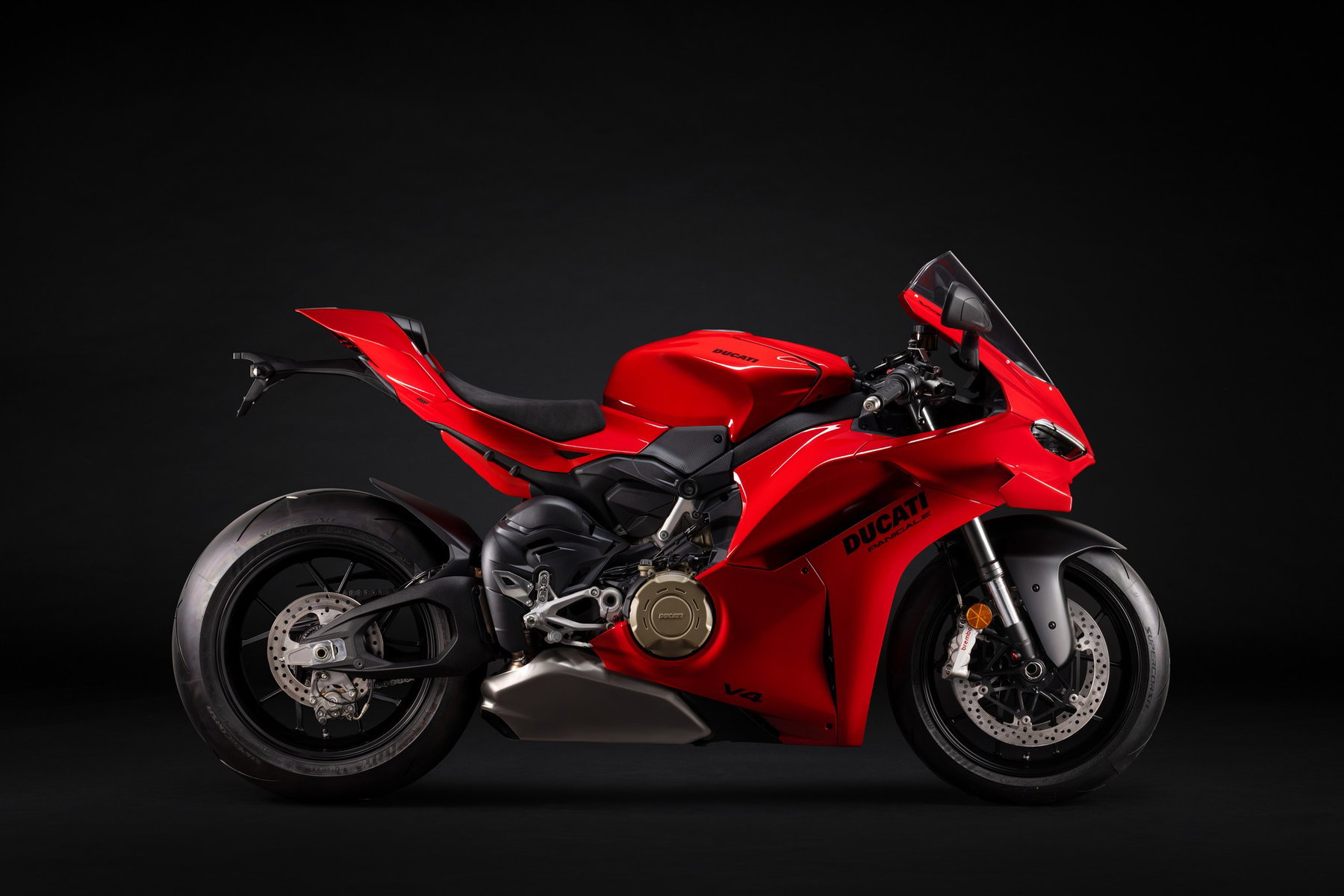
Ducati lists a total of 45 equipment options that can be fitted at the factory. These include, for example, the PRO and PRO+ front brakes, the STM dry clutch and adjustable rearsets. The oil-bath clutch remains standard. No conversion by the dealer is required for these parts. The components are homologated and tested by Ducati. The Panigale V4 is the first model line of the Panigale family in this programme. The base version, by contrast, is only available in Ducati Red with an Urban Grey frame and black wheels.
When will the 2027 Panigale V4 arrive and how much will it cost?
The new Panigale V4 will be at European Ducati dealers from March 2027. In North America, deliveries begin in April, with other markets following in the months after.
In Germany, the Panigale V4 is expected to cost 28,690 euros (approx. 33,000 US dollars). The Panigale V4 S will cost 35,990 euros (approx. 41,400 US dollars). Ducati is thus raising prices slightly. On top of that come delivery charges of 305 euros (approx. 350 US dollars) in each case. The cost of the options from the Factory Made programme is not yet known.
Frequently Asked Questions
-
How much does the 2027 Ducati Panigale V4 cost?
In Germany, the 2027 Panigale V4 is expected to cost 28,690 euros (approx. 33,000 US dollars), and the V4 S 35,990 euros (approx. 41,400 US dollars). Delivery charges of 305 euros (approx. 350 US dollars) are added in each case. Prices are rising slightly compared to the predecessor.
-
How much horsepower does the 2027 Panigale V4 have?
The 2027 Panigale V4 produces 218 hp (160.4 kW) at 13,500 rpm, 2 hp more than before. Maximum torque is 120.6 Nm (89 lb-ft) at 11,000 rpm. With the Akrapovič racing exhaust, 229 hp (168.4 kW) is possible.
-
When will the new Ducati Panigale V4 be launched?
The new Panigale V4 arrives at European dealers in March 2027. In North America, deliveries start in April 2027.
-
What is the difference between the Panigale V4 and V4 S?
The V4 S has electronically controlled Öhlins suspension, forged wheels and a lithium battery, and at 187 kg (412 lbs) it is 4 kg (9 lbs) lighter. The base version uses a Showa fork and a Sachs shock absorber. Only the V4 S can be individually configured via the Factory Made programme.
-
What does the Dynamic Engine Brake do on the Panigale V4?
The Dynamic Engine Brake regulates engine braking based on the actual load on the rear tyre. It replaces the previous Engine Brake Control and additionally applies the rear brake automatically. On corner entry, this is meant to make the motorcycle more stable and predictable.