- 63.5 hp (46.7 kW) at 9,400 rpm and 53.5 Nm (39 lb-ft) at 7,500 rpm, rev limiter at 11,900 rpm
- Frame weighing 8.96 kilograms and engine with a dry weight of 26.8 kilograms, total weight 109 kilograms
- Price in Germany from 13,290 euros (around 15,260 US dollars), European deliveries from December 2026
In July the bike was still standing on the World Ducati Week stage in Misano as a pre-production model, without a single official figure. Now the complete spec sheet is available, along with the technical documentation. The Desmo450 SM is derived from the Desmo450 MX motocross machine but is a pure competition motorcycle for supermoto racing. That makes it the newest member of a model family that Ducati has expanded within a few years from a single motocross bike into a complete single-cylinder range.
What makes the Desmo450 SM a race machine?
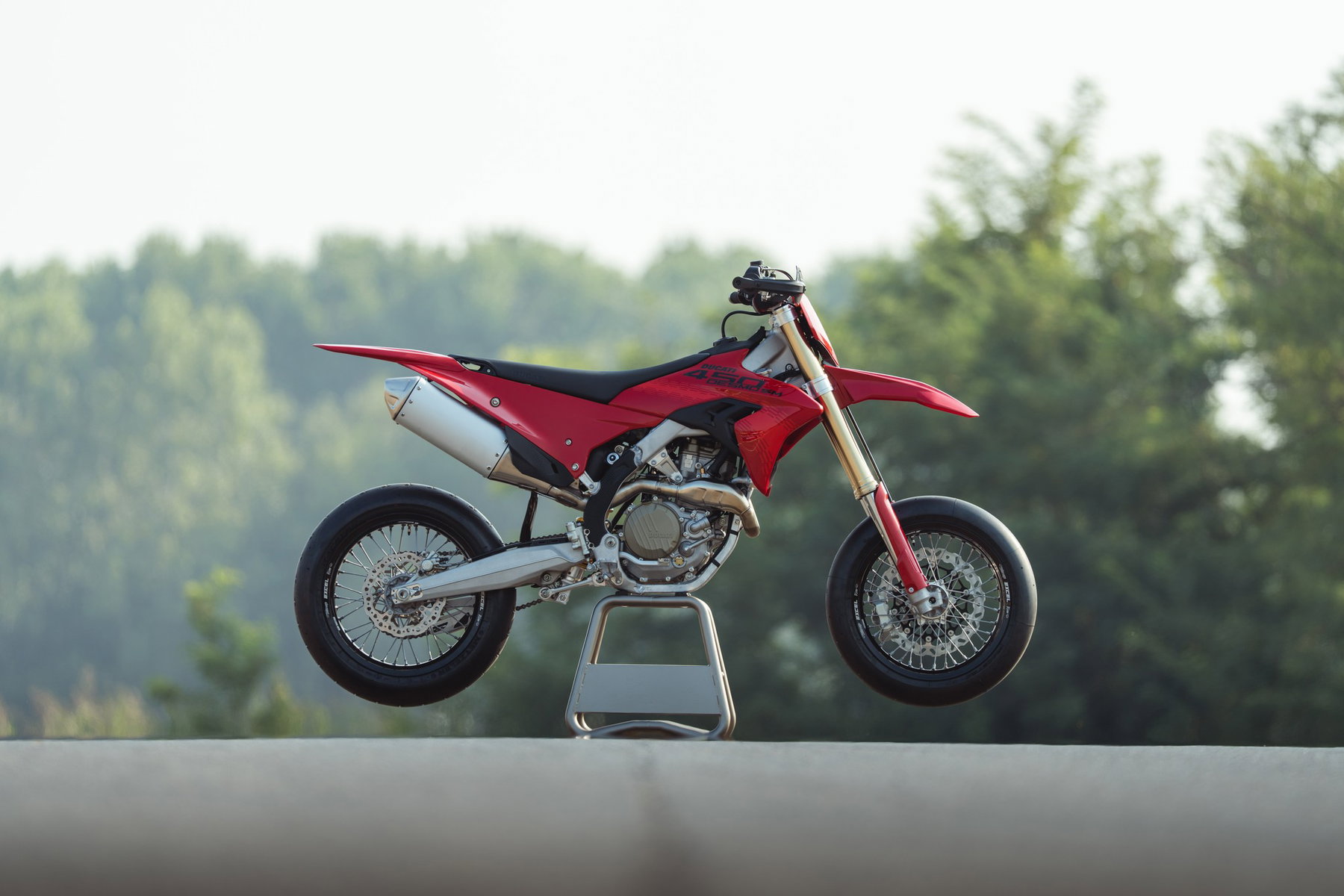
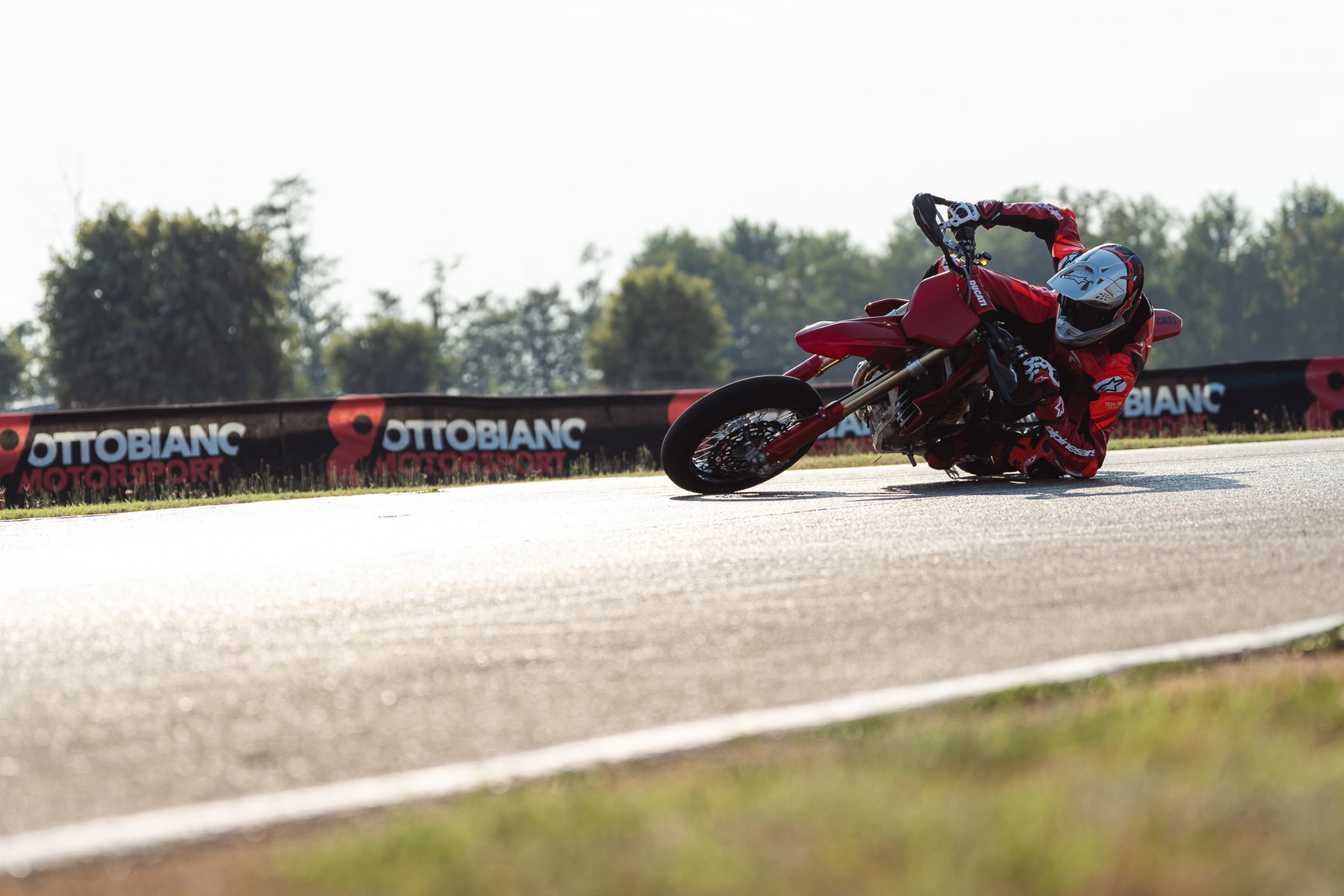
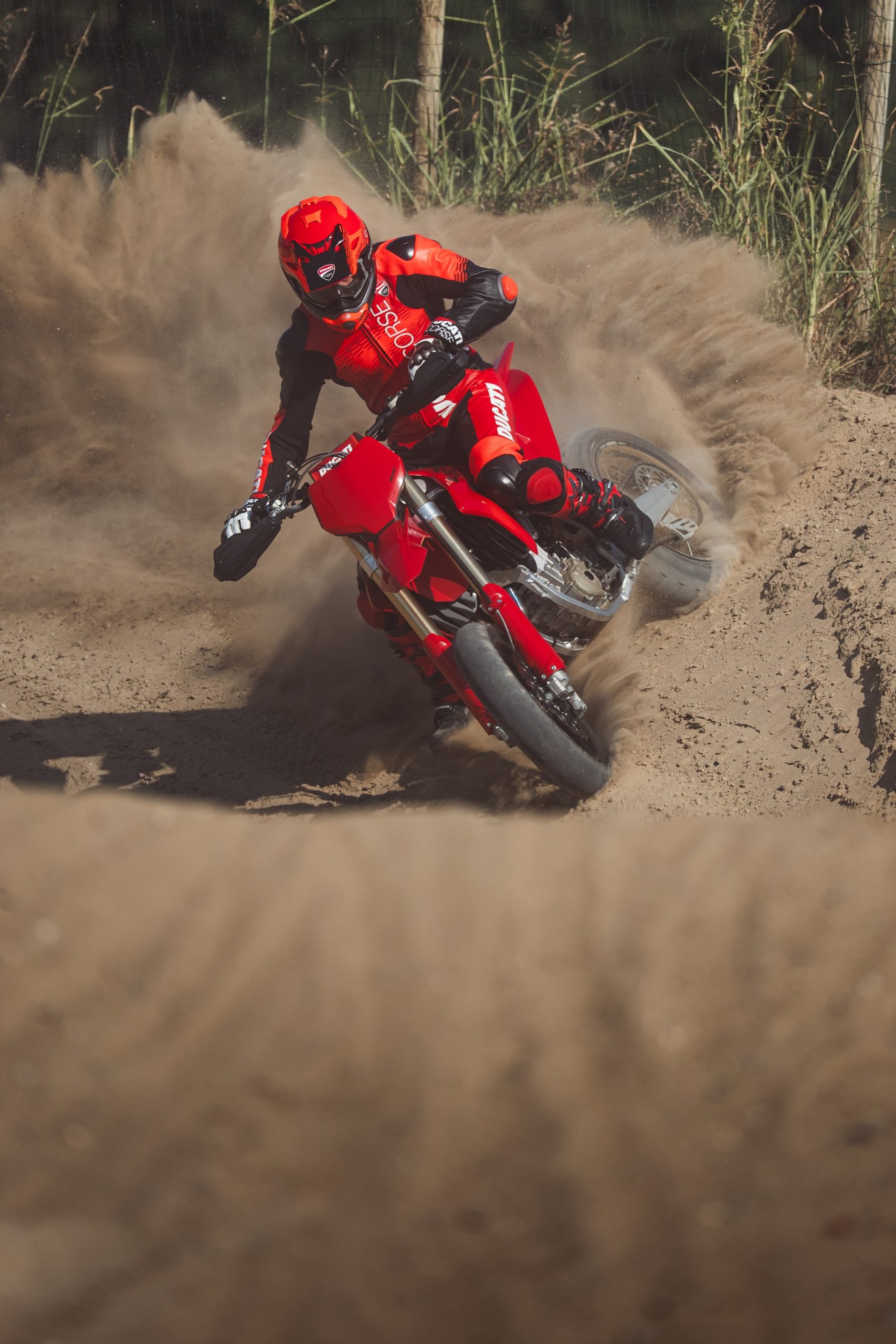
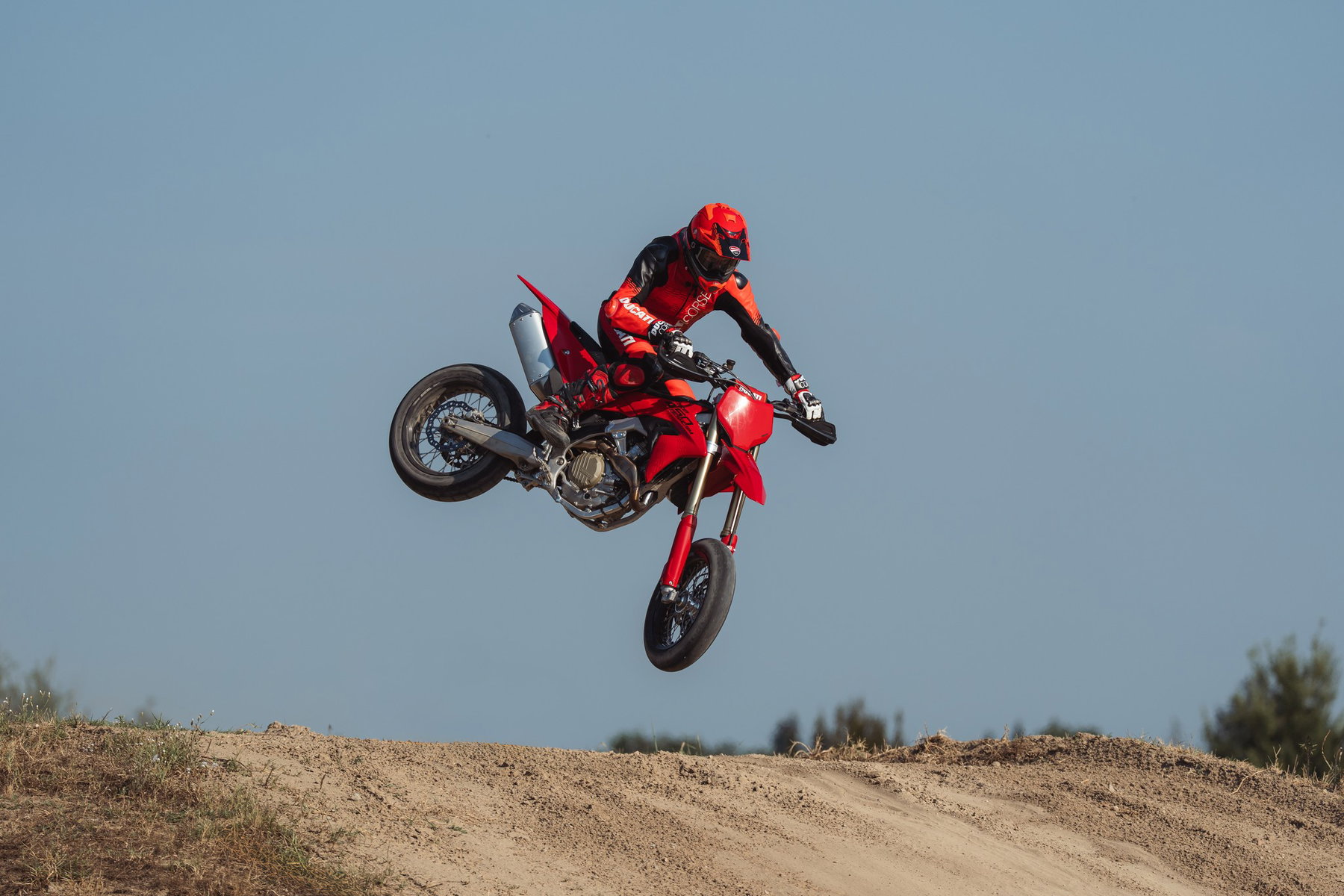
The Desmo450 SM uses the platform of the Desmo450 MX, but for asphalt use Ducati has retuned the suspension, triple clamps, wheels, brakes, final drive ratio, slipper clutch and electronics. According to the manufacturer, the result is not a converted motocross bike but a machine that is race-ready from the factory.
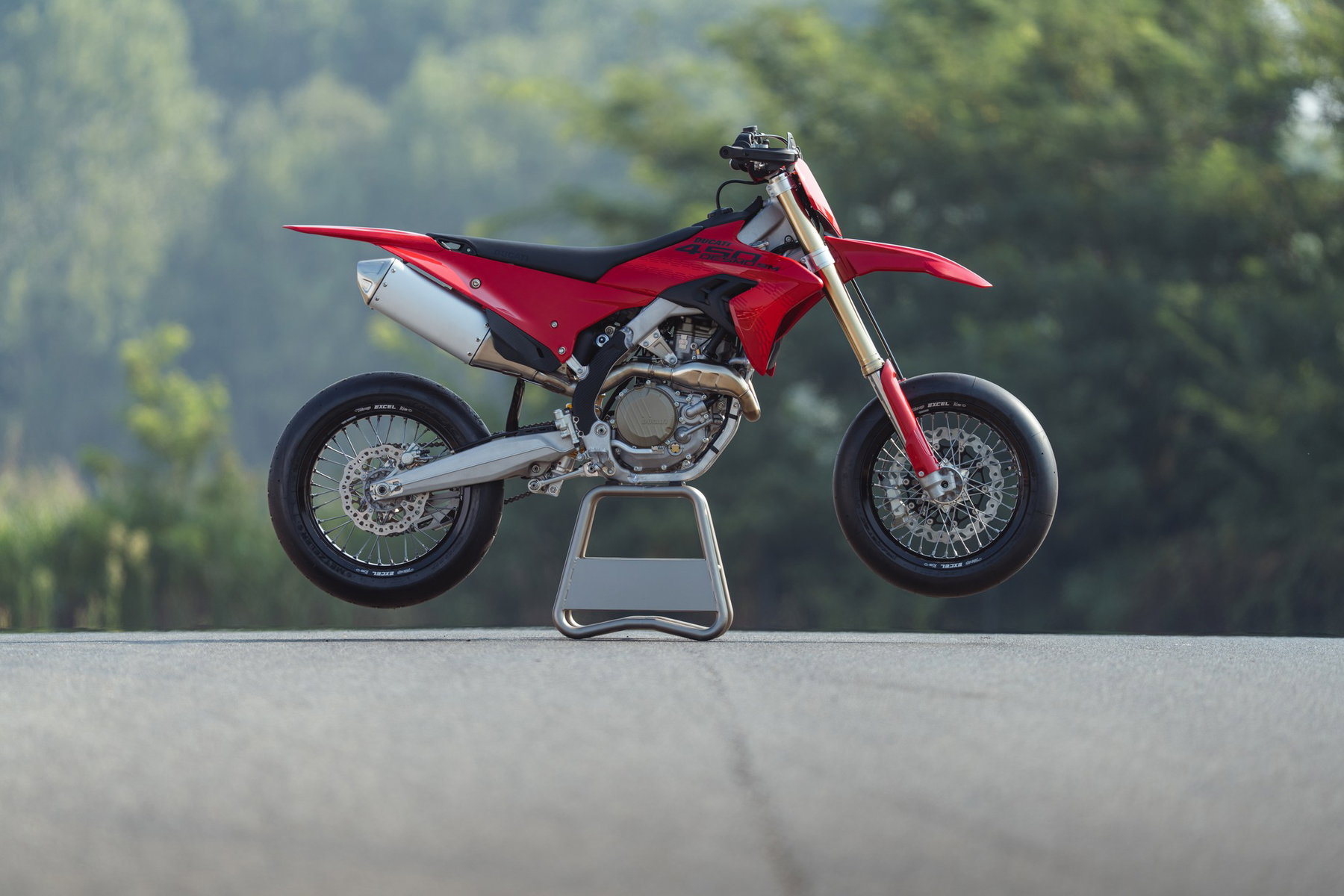
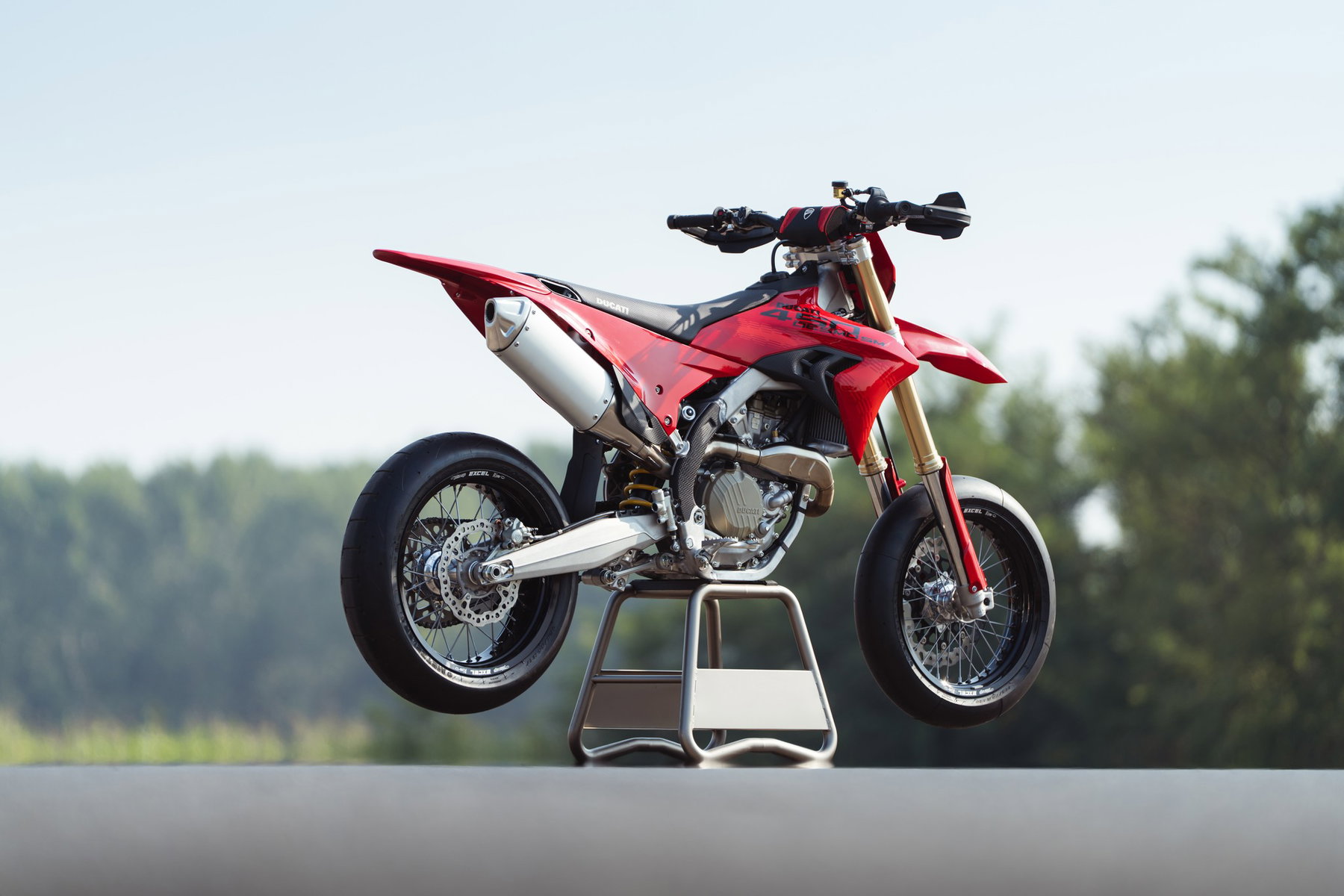
Giulio Fabbri, responsible for product communication at Ducati, had already made that clear at the premiere: “This is not the Desmo450 MX with new wheels.” Work had been done on wheels, brakes, suspension, frame, engine and in part on the plastic parts as well. At the time Ducati also announced its intention to build the lightest motorcycle in this category. At 109 kilograms ready to ride without fuel (240 lbs), the SM sits between the Desmo450 MX at 104.8 kilograms (231 lbs) and the Desmo450 EDS enduro at 110.5 kilograms (243.6 lbs). Seat height is 930 millimetres, the wheelbase 1,483 millimetres, the rake 25.4 degrees and the trail 85 millimetres. The tank holds 7.2 litres.
The machine was developed together with Marc Reiner Schmidt. The multiple supermoto world champion, listed by Ducati and several specialist media as a four-time title holder, is riding a converted Desmo450 MX with Team Undici this season and, according to Ducati, took a win at the bike’s global race debut. At the beginning of July, Schmidt was second in the championship after three rounds with 207 points, seven points behind KTM rider Julen Avila Cortés.
How much power does the Desmo450 engine make?
The single cylinder with 449.6 cubic centimetres produces 63.5 hp (46.7 kW) at 9,400 rpm and delivers 53.5 Nm (39 lb-ft) at 7,500 rpm. The rev limiter only cuts in at 11,900 rpm, which Ducati describes as a new benchmark for the category.
This is made possible by desmodromic valve actuation, a positively controlled system that works without valve springs. Because no spring forces have to be overcome, steeper cam profiles and greater valve lift become possible. That also pays off low down: according to Ducati, 70 percent of maximum torque is already available at 4,200 rpm.
The engineering effort inside is considerable. The intake valves are made of titanium and measure 40 millimetres, the steel exhaust valves measure 33 millimetres and have hollow, sodium-filled stems, which dissipates heat more effectively. The rocker arms and the piston pin carry a DLC coating, a particularly hard, low-friction layer. The piston runs a compression ratio of 13.5 to 1 and uses a so-called box-in-box architecture with a double-ribbed underside. The alternator, cylinder head and clutch covers are made of magnesium, while a balancer shaft damps the vibrations and drives the water pump at the same time. Bore and stroke are 96 by 62.1 millimetres.
Mixture preparation is handled by a mechanically operated 44-millimetre Mikuni throttle body and a Keihin injector, with intake air drawn through a Twin Air filter. The steel and aluminium exhaust system has a resonator and complies with the 2025 FIM regulations, which allow a maximum of 109 decibels with two decibels of tolerance. The radiators are diamond-shaped rather than rectangular, which increases the radiating surface by 6.5 percent while allowing slim side panels.
The five-speed gearbox has a quickshifter that works on upshifts only, plus an aluminium shift drum. The Suter slipper clutch has been specially calibrated and helps the rider let the rear wheel slide in a controlled way on corner entry. Power reaches an aluminium RK sprocket via a DID 520 chain. The complete engine weighs 26.8 kilograms dry (59.1 lbs).
Frame and suspension: what did Showa change?
According to Ducati, this was the first time Showa had been directly involved in suspension development for a supermoto. The aim was support under hard braking, precision on turn-in and traction on corner exit.
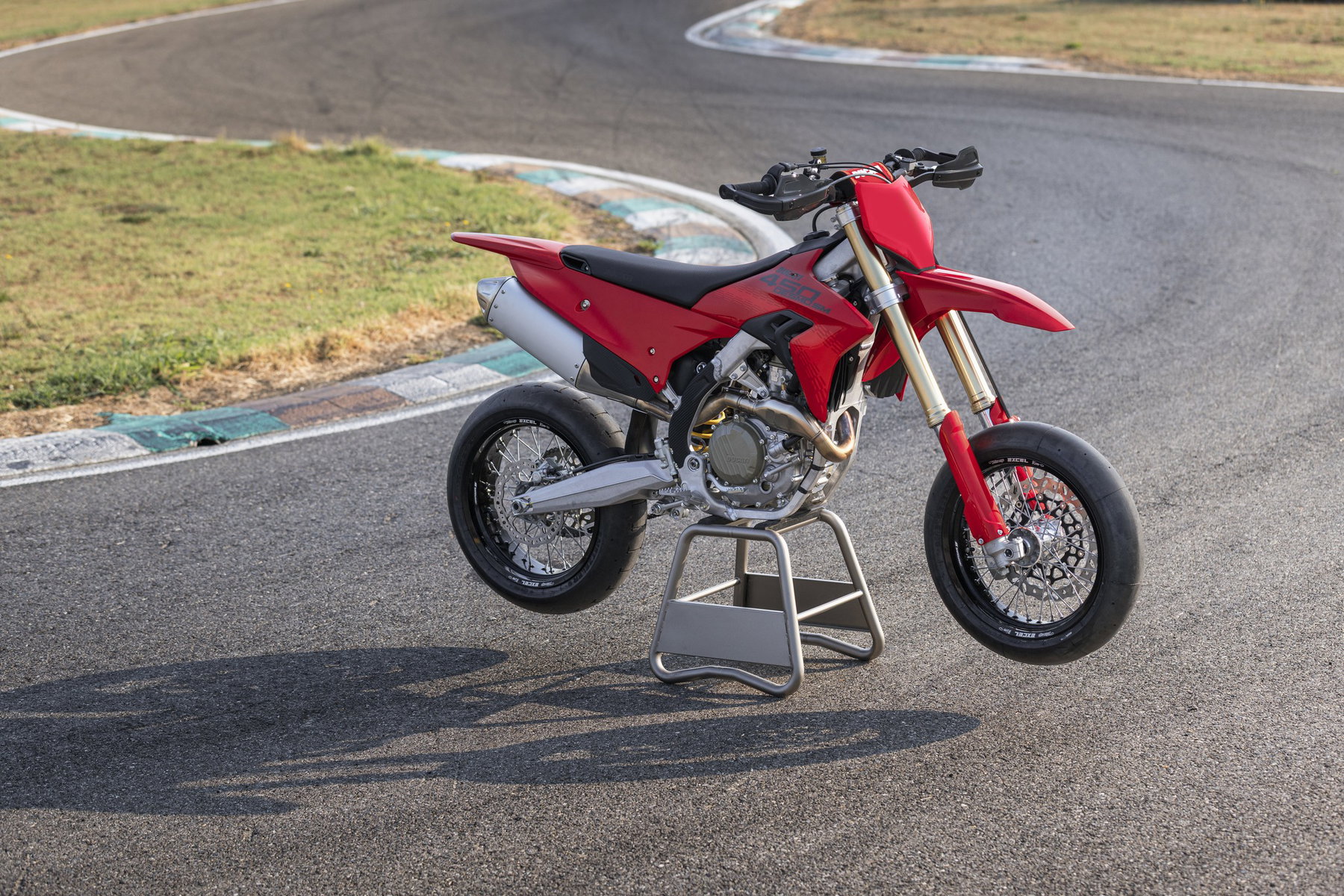
At the front there is an upside-down fork with 49-millimetre stanchions and closed-cartridge technology, in which the damping unit sits in a sealed cartridge and therefore works more consistently. Compression and rebound damping are externally adjustable, and there are dedicated springs, 280 millimetres of travel, a Kashima coating on the outer tubes and aluminium fork bottoms with radial caliper mounts and 33 millimetres of offset. The CNC-machined triple clamps sit further apart than on the Desmo450 MX to make room for the bulky front wheel.
At the rear sits a black anodised aluminium shock with a 16-millimetre piston rod and 129 millimetres of stroke, which gives 295 millimetres of rear wheel travel. Spring preload, rebound and high- and low-speed compression damping are adjustable. It is actuated centrally via a forged progressive linkage on the cast swingarm.
The frame is an aluminium double-cradle design that follows the front-frame concept of Ducati’s sports bikes. It consists of cast, forged and extruded parts, with self-hardening alloys used in highly stressed zones. The number of welds is low, which keeps the intake tract as straight as possible. All told, the frame weighs 8.96 kilograms (19.8 lbs).
Wheels, tires and brakes
The Takasago Excel rims measure 16.5 x 3.5 inches at the front and 17 x 5 inches at the rear, combined with Alpina spokes and the Bartubeless system. This system does away with inner tubes and, according to the manufacturer, cuts rotating and unsprung masses by 1.2 kilograms (2.6 lbs). From the factory the bike runs Metzeler Racetec Slick SM slicks, which are also used in the world championship. A K2 goes on the front, a K1 on the rear. In the spec sheet Ducati lists the front tire as 125/75 R420, in the equipment list as 125/75 R16.5, with 165/55 R17 at the rear in both cases.
Calipers and master cylinders come from Brembo. At the front there is a radially mounted Stylema caliper with a radial PR15x19 master cylinder, plus a floating Galfer disc with a diameter of 310 millimetres and an aluminium carrier. At the rear a 240-millimetre Galfer disc is gripped by a single-piston Brembo floating caliper. According to Ducati, the discs were also developed with the aim of reducing unsprung mass and the gyroscopic effect.
How does traction control work on a supermoto?
The patented Ducati Traction Control is specifically calibrated for supermoto use and estimates the actual slip of the rear wheel. It modulates ignition timing and ignition angle, taking into account engine speed, the gear engaged, throttle position and further sensor data.
Four levels are available, and the system can also be switched off. The levels are based on intervention logic rather than on the surface: lower levels allow more freedom, higher levels aim at stability. The system comes from the Desmo450 MX but has been developed further and additionally shuts the engine down if the bike crashes or tips over.
There are also two throttle response mappings, “Smooth” with a gentler and “Dynamic” with a more direct response. Power Launch works in three stages against the rev limiter and switches off automatically as soon as fourth gear is engaged or the throttle is closed. Engine braking control can be adjusted in two stages. Everything is preconfigured in two riding modes that are fitted as standard. Control is via a switch on the left handlebar, with five LEDs indicating the status. Anyone wanting to customise the modes needs the optional connectivity system: only this Wi-Fi module connects the X-Link app to the ECU. Standard equipment also includes a lithium-ion battery, an hour meter, a mapping switch and Ducati Fall Detection.
Design and ergonomics
Centro Stile Ducati concentrated above all on the surfaces outside the leg area so that the rider can move freely. The positive and negative shapes pick up the air outlets of the Panigale V4, the front number board echoes the look of the new Panigale, and the front fender is inspired by the Hypermotard.
Another detail is more practical: the side number boards have a modified contour in the area of the exhaust, which has been mirrored on the left-hand side. It serves the rider as a reference point when moving back on the bike. Side panels, frame protectors and the lower areas of the boards have a textured surface that gives thighs and boots better grip under acceleration and over jumps.
When does the Desmo450 SM need a service?
The valve clearance check is due after 45 operating hours, the oil change every 15 hours. For the piston and the full engine overhaul, by contrast, the interval depends on the load.
Behind this is what Ducati calls predictive maintenance. Drawing on its experience in the Superbike World Championship and MotoGP, Ducati Corse has developed an algorithm that calculates an engine load index in real time from the operating parameters and adjusts the intervals accordingly. The maintenance schedule can be viewed in the X-Link app. Ducati distinguishes between two types of service: the MID Service covers the valve clearance check after 45 hours and the piston replacement, whose interval lies between 45 and 60 hours depending on the calculated load. The FULL Service with a complete engine overhaul is due after 90 to 120 hours depending on riding style. Anyone riding professionally and intensively therefore has to visit the workshop more often, while for amateurs the intervals stretch out.
Ducati has also simplified the work itself. The alternator, clutch and cylinder head covers are no longer sealed with three-component sealant but with gaskets, metal at the cylinder head and rubber on the other two covers. The warranty is tailored to racing use and runs for three months or 20 operating hours.
Ducati Desmo450 SM price: what does the race supermoto cost?
In Germany the Desmo450 SM starts at 13,290 euros (around 15,260 US dollars). That is the list price including 19 percent VAT, plus 305 euros in delivery charges (around 350 US dollars).
In the UK Ducati quotes 12,095 pounds (around 14,090 euros / 16,180 US dollars), in the US 12,995 US dollars (around 11,320 euros) and in Australia 18,625 Australian dollars (around 11,540 euros / 13,250 US dollars). The fact that the US figure is well below the German price is mainly down to taxation, because European list prices include VAT.
A look at Ducati’s own range is more revealing. The Desmo450 MX costs from 12,490 euros (around 14,340 US dollars) in Germany, so the race supermoto commands an 800-euro premium. And the street-legal Hypermotard 698 Mono is listed from 12,990 euros (around 14,910 US dollars). For around 300 euros more, then, you get a motorcycle that is not allowed on public roads. The closest rivals in the competition segment are considered to be the KTM 450 SMR and the Husqvarna FS450, which cost 11,449 pounds (around 13,340 euros / 15,320 US dollars) and 11,499 pounds (around 13,400 euros / 15,380 US dollars) respectively in the UK. These figures are not directly comparable, however, because taxes and pricing structures differ from market to market.
When does the Ducati Desmo450 SM reach dealers?
The Desmo450 SM arrives at selected European dealers from December 2026, with the remaining markets to follow. For the US Ducati quotes spring 2027, and a date for Australia is still to come. It is available in Ducati Red.
In July an October launch was still being mentioned, so the date has slipped back. With the SM, Ducati is represented in all the major off-road disciplines. The range began with the Desmo450 MX in motocross, grew with the Factory version, the smaller Desmo250 MX and the enduro models, and now extends to supermoto. On Ducati’s German site the Desmo450 SM is not filed under off-road but among the motard models alongside the Hypermotard ranges.
Frequently Asked Questions
-
What does the Ducati Desmo450 SM cost?
The Ducati Desmo450 SM price in Germany is 13,290 euros (around 15,260 US dollars), plus 305 euros in delivery charges. In the UK Ducati asks 12,095 pounds (around 14,090 euros / 16,180 US dollars), in the US 12,995 US dollars (around 11,320 euros).
-
How much power does the Ducati Desmo450 SM have?
The single cylinder produces 63.5 hp (46.7 kW) at 9,400 rpm. Maximum torque is 53.5 Nm (39 lb-ft) at 7,500 rpm, and the rev limiter cuts in at 11,900 rpm.
-
Is the Ducati Desmo450 SM street legal?
No, the Desmo450 SM is a pure competition motorcycle. It leaves the factory on Metzeler Racetec Slick SM slicks, which according to information from around the premiere makes it the only production Ducati with this type of tire.
-
How heavy is the Ducati Desmo450 SM?
Ducati quotes 109 kilograms (240 lbs) ready to ride without fuel. Contributing to that are a frame weighing 8.96 kilograms and an engine with a dry weight of 26.8 kilograms.
-
When is the Ducati Desmo450 SM available?
Deliveries to selected European dealers begin in December 2026, with further markets to follow. For the US Ducati quotes spring 2027; in Europe an October launch had originally been expected.
➜ This article is part of our comprehensive overview: New Motorcycles 2027: All Models, Releases and Highlights at a Glance. Find all key information on this topic in one place.