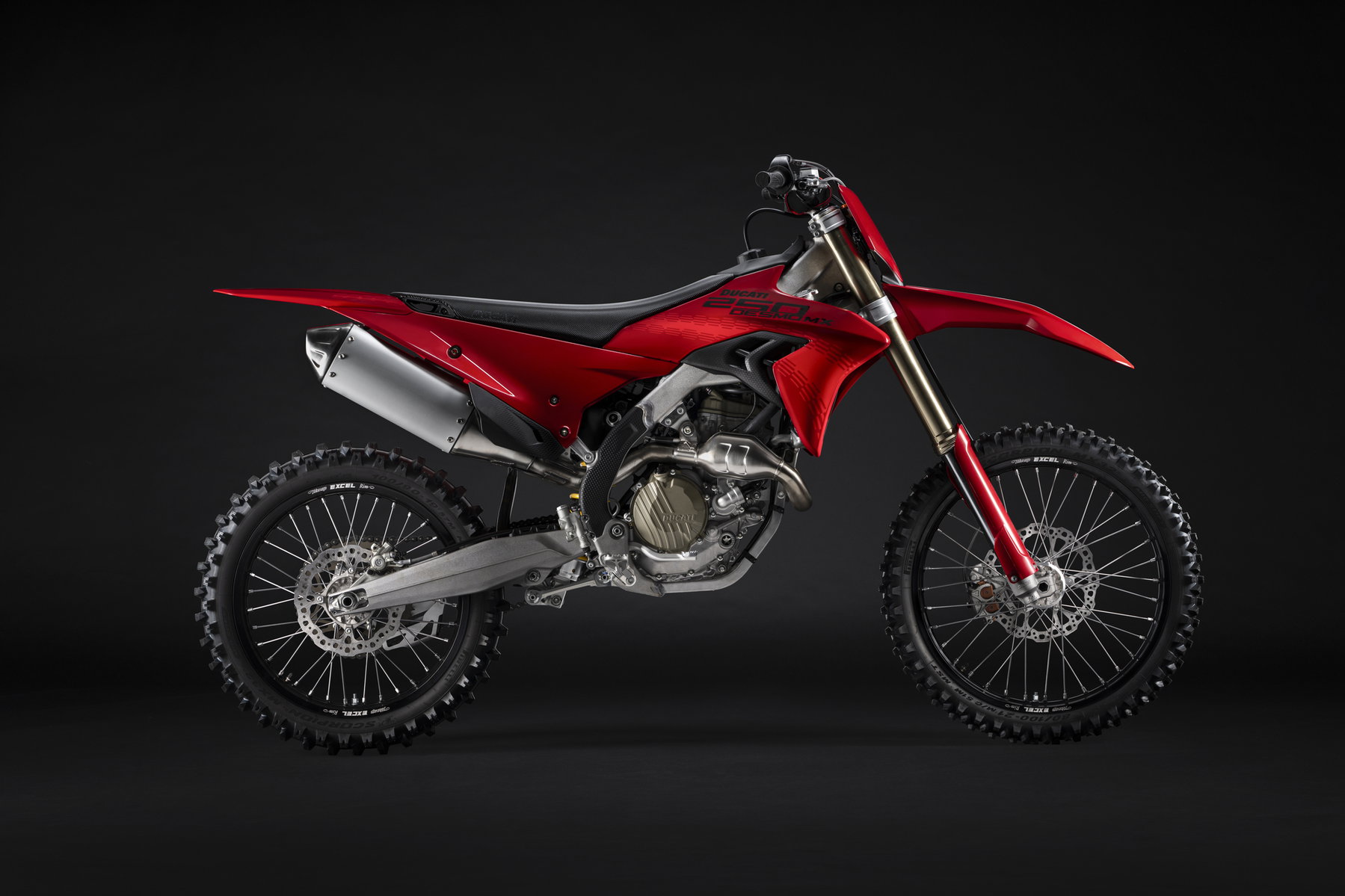
- 44.5 hp (32.7 kW) at 12,500 rpm from a new desmodromic single-cylinder with 249.7 cm³ displacement
- 103 kg wet weight without fuel, five-speed gearbox with quickshifter, and three-level traction control
- Market launch from July 2026 in Europe, prices from 8,995 pounds (UK) or 10,595 US dollars (USA) depending on market
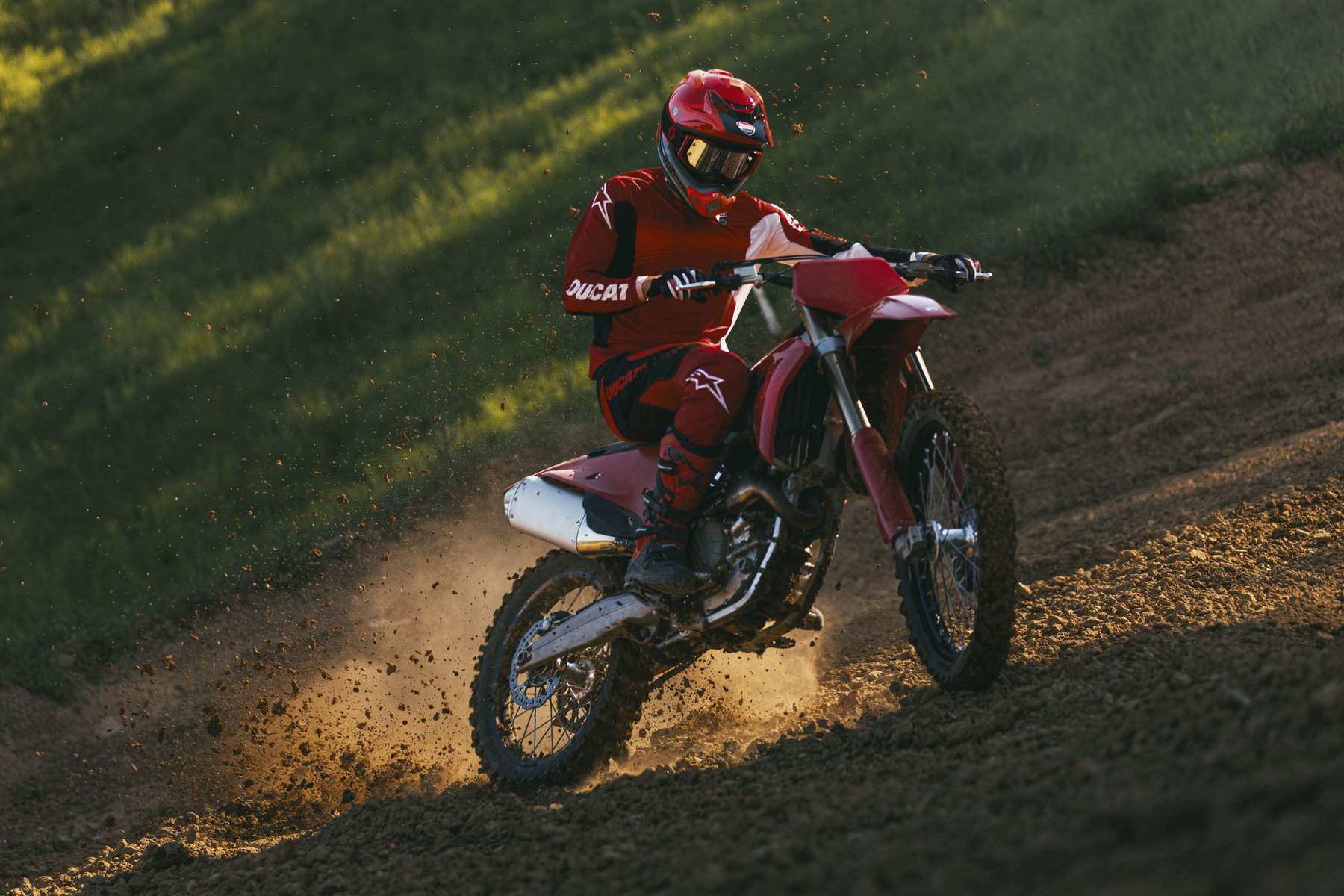
One year after the market launch of the Desmo450 MX, Ducati sends the Desmo250 MX into competition as its second production model for motocross. The new machine targets the fiercely contested MX2 class and was developed under racing conditions in the Italian Prestige MX2 Championship. Responsible for the project was Alessandro Lupino, eight-time Italian champion, who had already brought the larger Desmo450 MX to production readiness. At the center stands a completely new engine that carries Ducati’s trademark technology into a displacement class that has until now been firmly in the hands of Japanese and Austrian manufacturers. With the Desmo250 MX, Ducati completes the third pillar of its off-road program in the year of its centenary, following the Desmo450 MX and the recently unveiled Desmo450 EDS as its first modern enduro model.
What Powers the New 249.7 cm³ Engine of the Desmo250 MX?
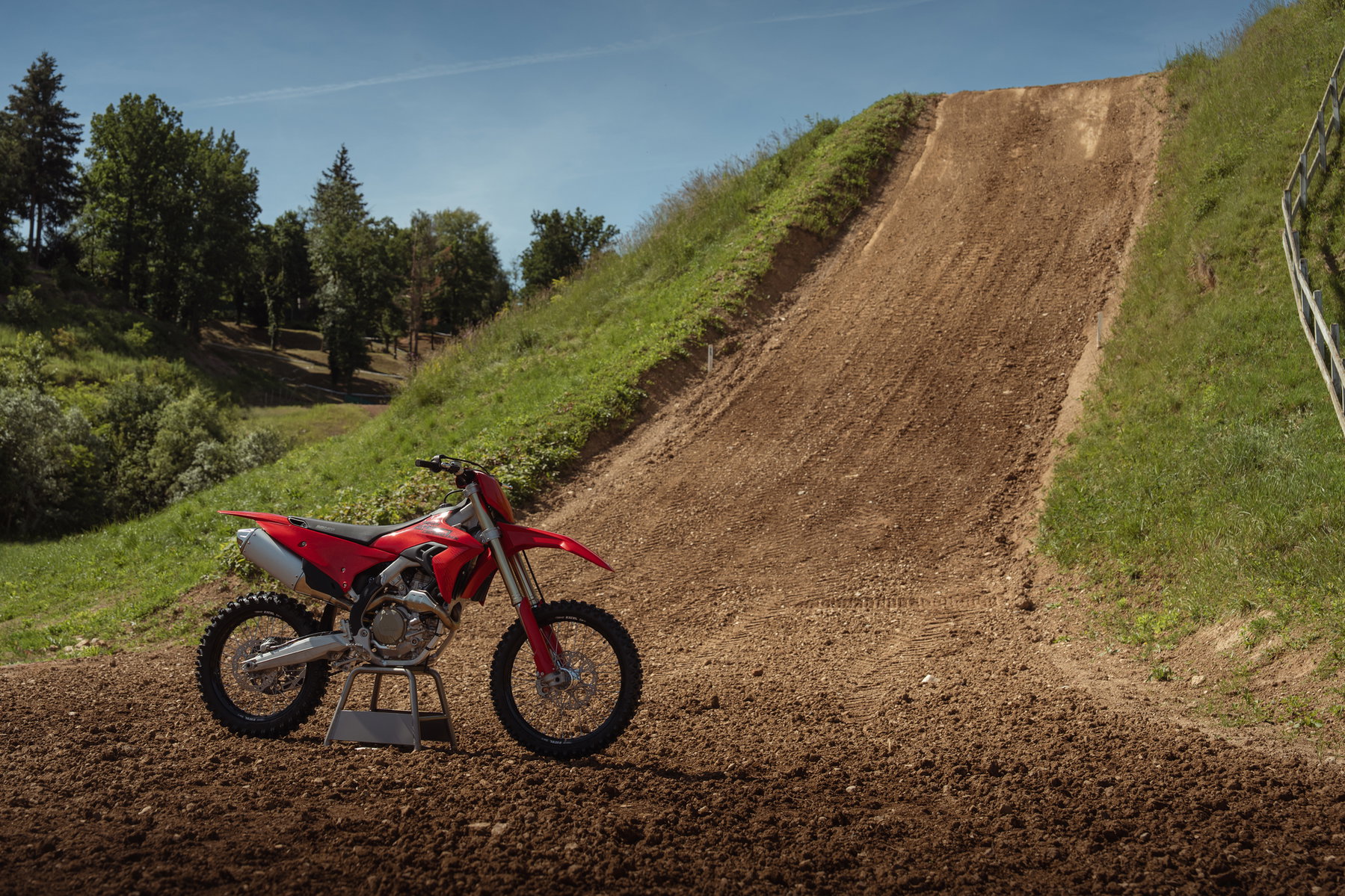
The engine of the Desmo250 MX is a complete new development. The single-cylinder four-stroke with double overhead camshaft and four desmodromically actuated valves produces 44.5 hp (32.7 kW) at 12,500 rpm and delivers a maximum torque of 28.3 Nm (20.9 lb-ft) at 8,800 rpm. The maximum rev limit is 15,000 rpm.
The bore and stroke of 81 x 48.4 mm exactly match the dimensions of the Panigale V4 R. Ducati emphasizes, however, that port flow, channel geometry, valve timing, and flywheel mass have been entirely optimized for motocross use. The intake valves are made of titanium with a diameter of 34 mm, the exhaust valves of steel with a 27.5 mm diameter. Both valves and rocker arms come from the Panigale V4 R engine. The rocker arms and wrist pin feature a DLC coating for friction reduction.
The desmodromic valve train enables more aggressive cam profiles at identical valve diameters compared to conventional valve springs. The mechanical closure of the valves allows higher valve accelerations and greater lift values, which should produce a broader and more consistent torque curve. At the same time, the frictional resistance from the spring preload of conventional valve trains is eliminated, which should release additional torque particularly at low and medium engine speeds.
The compression ratio is 14.5:1. Magnesium covers for the alternator, cylinder head, and clutch save weight. The entire powertrain is said to weigh less than 25 kg. A balancer shaft with integrated water pump drive reduces both vibrations and the number of components. The crankshaft is a composite construction, the connecting rod a one-piece unit. The chain tensioner operates hydraulically and is said to offer more precise function than a conventional mechanical solution.
How Is the Desmo250 MX Connected to the Panigale V4 R?
The connection to the Panigale V4 R extends beyond the identical bore-and-stroke dimensions. Ducati describes the Desmo250 engine as a development that builds on the know-how of the Superbike program. Key engine parameters are shared, while geometries, masses, and flow dynamics have been completely reworked for off-road use. The system of mechanically closed valves, which Ducati has used for decades in its street and racing machines, is employed here for the first time in a pure competition single-cylinder for off-road use.
Mixture preparation is handled by a mechanically operated Mikuni throttle body with a 44 mm diameter. A TwinAir element serves as the air filter. The exhaust system is a new construction from a steel-aluminum mix with resonator and meets the 2025 FIM noise regulation with a maximum sound level of 109 dB plus 2 dB tolerance.
Five-Speed Gearbox with Quickshifter and Hydraulic Clutch
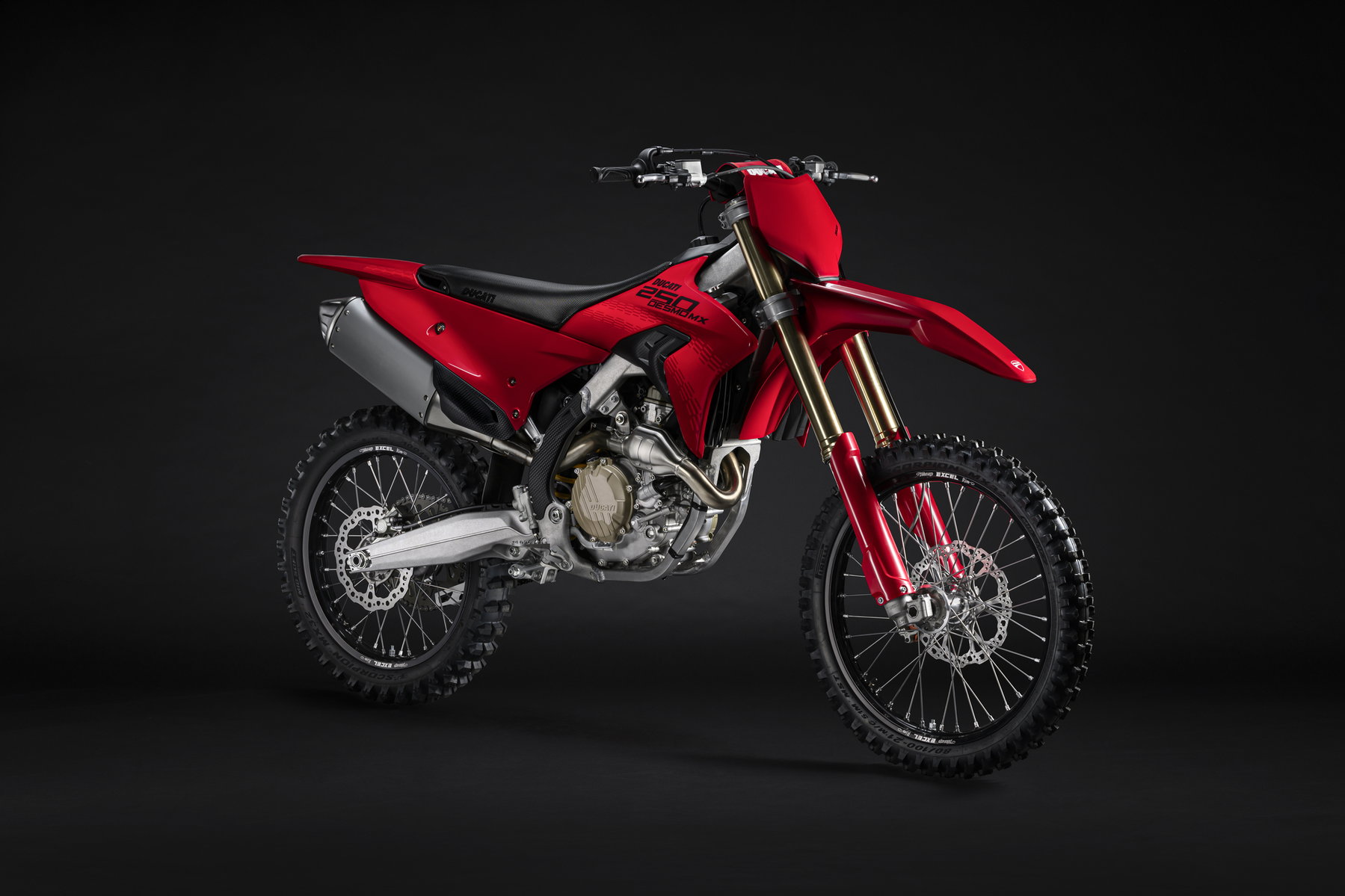
The five-speed gearbox developed specifically for the Desmo250 MX works with a quickshifter that engages exclusively during upshifts. The gear ratios have been specifically tailored to the 250cc class. The shift drum is made of aluminum, reducing weight and rotational inertia.
The hydraulically actuated Brembo clutch uses a 7-plate pack with diaphragm spring. Compared to the Desmo450 MX, which operates with eight clutch plates, the clutch is more compact and lighter. The rear sprocket is integrated into the clutch basket and is made of aluminum. The chain is a DID DMS 520.
How Is the Chassis of the Desmo250 MX Constructed?
The Desmo250 MX adopts the aluminum twin-spar frame from the Desmo450 MX with adapted engine mounts. The frame consists of a combination of cast, forged, and extruded parts. The stiffness balance has been specifically tuned for the lighter 250cc machine, with particular emphasis on braking stability and precision during corner entry.
At the front, a fully adjustable 49 mm Showa upside-down fork works in a closed-cartridge design with Kashima coating on the inner tubes. Wheel travel is 310 mm, and the fork offset is 33 mm. External adjusters for compression and rebound damping allow individual tuning. At the rear, a fully adjustable Showa shock absorber with 301 mm wheel travel is mounted centrally on the cast aluminum swingarm with forged progressive linkages. The shock offers adjustment for spring preload, high- and low-speed compression damping, and rebound.
The forged aluminum triple clamps undergo additional machining after forging to optimize the stiffness-to-weight ratio.
What Brakes and Tires Are Used?
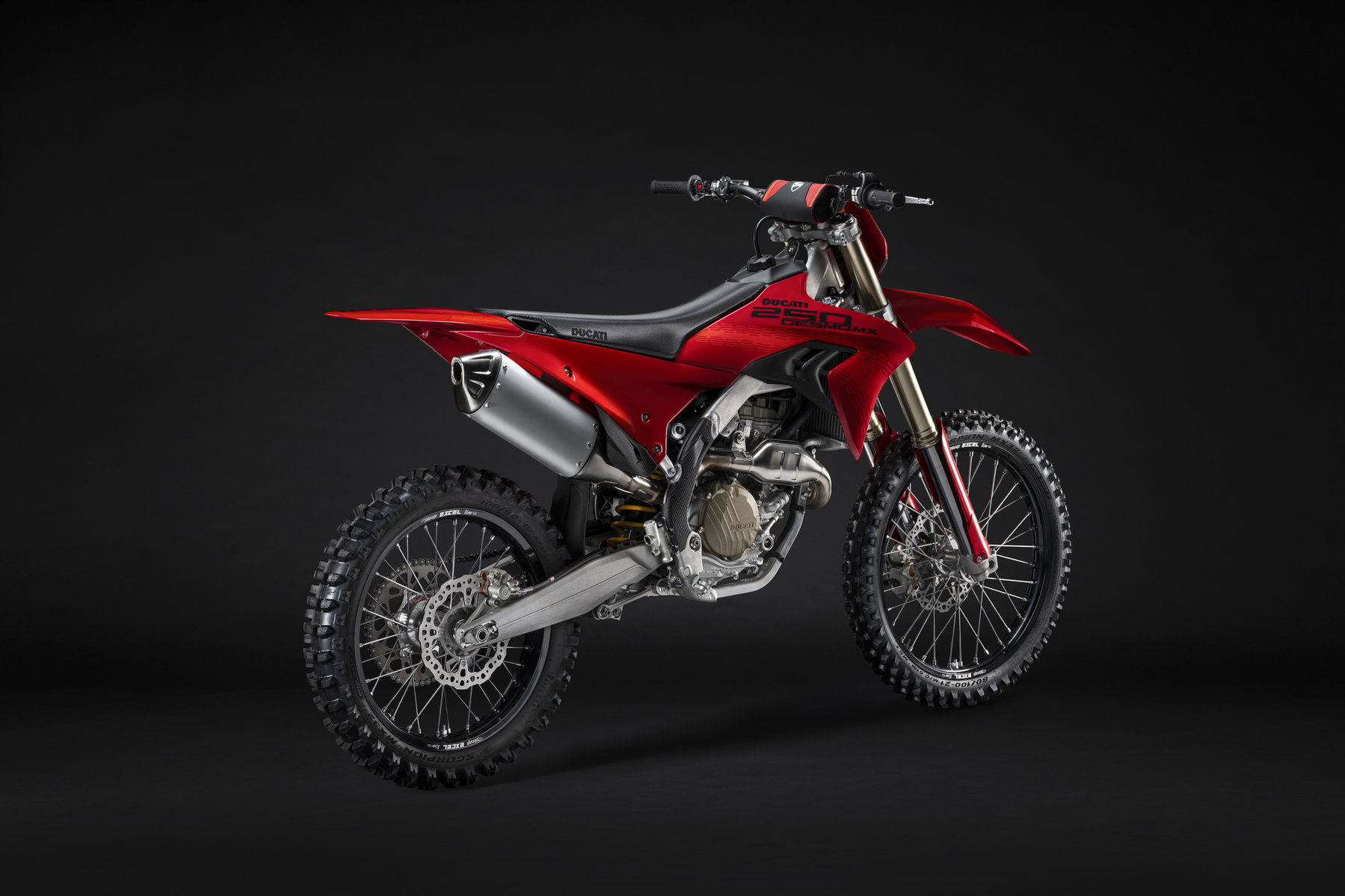
The braking system matches that of the Desmo450 MX. At the front, a Brembo two-piston floating caliper bites a 260 mm Galfer disc, while a single-piston floating caliper works a 240 mm Galfer disc at the rear. The discs were designed for low unsprung weight and reduced gyroscopic effect.
The Takasago Excel aluminum rims with Alpina spokes measure 21 x 1.60 inches at the front and 19 x 2.15 inches at the rear. Pirelli Scorpion MX32 mid-soft tires in 80/100-21 front and 100/90-19 rear come fitted as standard.
The radiators feature a diamond shape rather than a rectangular design, which according to Ducati increases the cooling surface by 6.5 percent without restricting rider movement through wider side panels.
The wet weight without fuel is 103 kg (227 lbs). The fuel capacity is 7.2 liters, the seat height 970 mm, and the wheelbase 1,499 mm. The steering head angle is 26.9 degrees, and the trail measures 117 mm.
What Can the Electronics of the Desmo250 MX Do?
The electronics package is derived from the Desmo450 MX system but has been recalibrated and optimized for the 250cc machine. Two power modes and two riding modes are available. The Ducati Traction Control (DTC) offers three intervention levels, Engine Brake Control two levels, and Launch Control three levels. The quickshifter comes as standard, as does Ducati Fall Detection.
The traction control system calculates intervention based on actual rear wheel slip rather than just rpm or throttle ratios. This should make the power reduction more accurate and linear than conventional systems. This technology is based on experience from Ducati’s MotoGP and WorldSBK program.
All settings can be configured via the optional Ducati X-Link app on a smartphone. The same app also controls the predictive maintenance logic developed by Ducati Corse.
How Often Does the Desmo250 MX Need Servicing?
The service intervals of the Desmo250 MX adapt to actual usage intensity. An algorithm developed by Ducati Corse calculates engine load in real time based on operating parameters and riding conditions. The results can be viewed via the X-Link app.
The mid-service includes valve clearance checks after 45 hours and piston replacement, which depending on calculated wear becomes due between 45 and 60 operating hours. The full service comprises a complete engine overhaul and is scheduled between 90 and 120 hours depending on conditions. Oil and filter changes are required every 15 hours. The warranty covers three months or 20 operating hours.
A professional rider under racing conditions will therefore trigger shorter service intervals than a hobby rider with a less aggressive riding style.
Already Racing: The Desmo250 MX in World Championship Competition
The Desmo250 MX is already in active competition use. In the current season, Ferruccio Zanchi races the machine in the MX2 World Championship and the EMX250, where he achieved multiple top-10 finishes after an initial injury-related break. Simone Mancini campaigns a race version in the European MXGP. Through the Ducati Performance catalog, a machine can be built that closely matches the competition motorcycle. The range includes CNC-machined triple clamps, a complete exhaust system or an Akrapovic titanium slip-on, Brembo racing brake calipers, and Showa suspension components. Only the factory Showa suspension remains exclusive to the racing team.
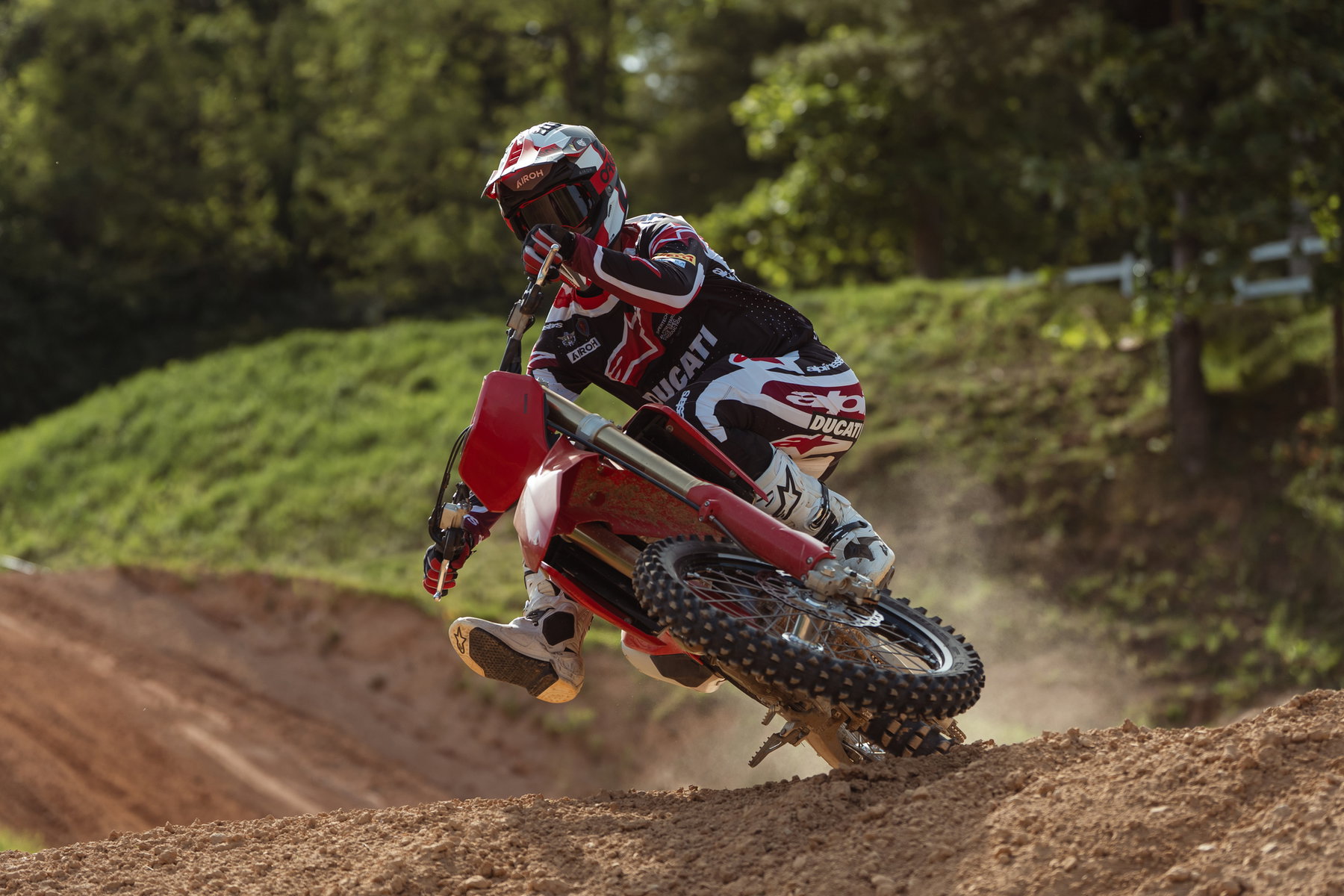
Additionally, Ducati offers a clothing collection in collaboration with Drudi Performance, consisting of an Alpinestars set with jersey, pants, gloves, and boots, an Arai helmet, a wind vest, a softshell, and a Spidi rain jacket.
When and Where Is the Ducati Desmo250 MX Available?
The Desmo250 MX is expected to be available from July 2026 at selected Ducati dealers in Europe. North America follows in August, then additional markets worldwide. The machine is offered exclusively in Ducati Red.
The prices known so far: In the UK the list price is 8,995 pounds, in the USA 10,595 US dollars, in Australia 14,925 AUD, and in New Zealand 17,763 NZD. Ducati has not yet published a price for the German market. For comparison: the larger Desmo450 MX costs 12,490 euros plus 345 euros delivery charges in Germany.
➜ This article is part of our comprehensive overview: New Motorcycles 2026: All Models, Releases, and Highlights at a Glance. Find all key information on this topic in one place.
➜ Find all technical specifications, photos, and comparison data for this model in the datasheet: Ducati Desmo250 MX 2027 – Specs.
Frequently Asked Questions
-
How much power does the Ducati Desmo250 MX produce?
The Desmo250 MX produces 44.5 hp (32.7 kW) at 12,500 rpm and delivers a maximum torque of 28.3 Nm (20.9 lb-ft) at 8,800 rpm. Thanks to the desmodromic valve train, the maximum rev limit reaches 15,000 rpm.
-
How much does the Ducati Desmo250 MX weigh?
The wet weight without fuel is 103 kg (227 lbs). The engine alone weighs less than 25 kg, achieved in part through magnesium covers for the alternator, cylinder head, and clutch.
-
When will the Ducati Desmo250 MX be available?
The European market launch is scheduled from July 2026 at selected Ducati dealers. North America follows in August 2026, with additional markets worldwide thereafter.
-
How much does the Ducati Desmo250 MX cost?
In the UK the price is 8,995 pounds, in the USA 10,595 US dollars, in Australia 14,925 AUD, and in New Zealand 17,763 NZD. A German price has not yet been announced.
-
What are the service intervals of the Ducati Desmo250 MX?
Valve clearance checks are due after 45 hours, piston replacement between 45 and 60 hours. A complete engine overhaul is scheduled between 90 and 120 operating hours. Oil and filter changes are required every 15 hours.
➜ More on this topic in our overview: New Motorcycles 2027: All Models, Releases and Highlights at a Glance.