- 218 hp (160.3 kW) and 120.6 Nm (89 lb-ft) from the familiar 1,103 cc V4
- Exclusive: Ducati Racing Gearbox with Neutral Lock, STM dry clutch, Corner Sidepods and larger biplane wings
- Available from March 2027 as a single-seater in the Winter Test livery at European dealers
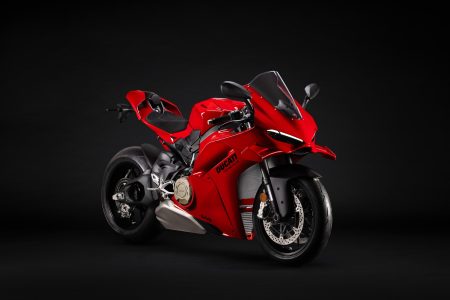
Since the Panigale V4 switched to its new generation for the 2025 model year, there has been no SP in the line-up. The first Panigale V4 SP arrived in 2021, followed a year later by the SP2. The new version is based on the updated Panigale V4 for the 2027 model year and adopts its engine, frame and electronics. On top of that, Ducati adds a layer of parts that come straight from the Superbike World Championship or are designed for track use. The target group is riders who regularly go to the track but are not professionals. Every SP carries its own serial number, although Ducati does not specify a fixed production run. This makes the SP one of Ducati’s new models for the 2027 model year.
What is the difference between the Panigale V4 SP and the Panigale V4 S?
The SP has a racing gearbox, a dry clutch, carbon wheels and its own aero package. It also gets a Brembo master cylinder with remote adjustment and additional adjustment options on the shock absorber.
Both models share the same basic structure. There are no differences in the engine, Front Frame or electronics. The V4 S already has the electronically controlled Öhlins suspension with NPX 25/30 fork and TTX36 shock. The SP, however, goes further in several areas. Instead of forged aluminium rims, it rolls on carbon wheels. The oil-bath clutch gives way to a dry clutch, and the gearbox uses a race-style shift pattern. On top of that come a lighter chain, footpegs machined from aluminium and a range of track parts that Ducati supplies with the bike.
How does neutral below first gear work?
On the Ducati Racing Gearbox, neutral is no longer between first and second gear but below first. The Neutral Lock system also blocks neutral while the motorcycle is moving.
With a normal road gearbox, neutral can accidentally engage instead of first gear when downshifting hard before a corner. On the track this is a risk, because engine braking and drive suddenly disappear. With the new layout, this can no longer happen. Anyone who wants to select neutral has to use the same procedure as Ducati’s factory riders in WorldSBK and MotoGP. Gear changes are also said to be more precise as a result.
To match, the footpegs can quickly be converted from a standard to a reverse shift pattern. With the reverse pattern, first gear is engaged by pushing down instead of pulling up, as many racers prefer. The pegs themselves are machined from solid aluminium, adjustable and have a carbon heel guard.
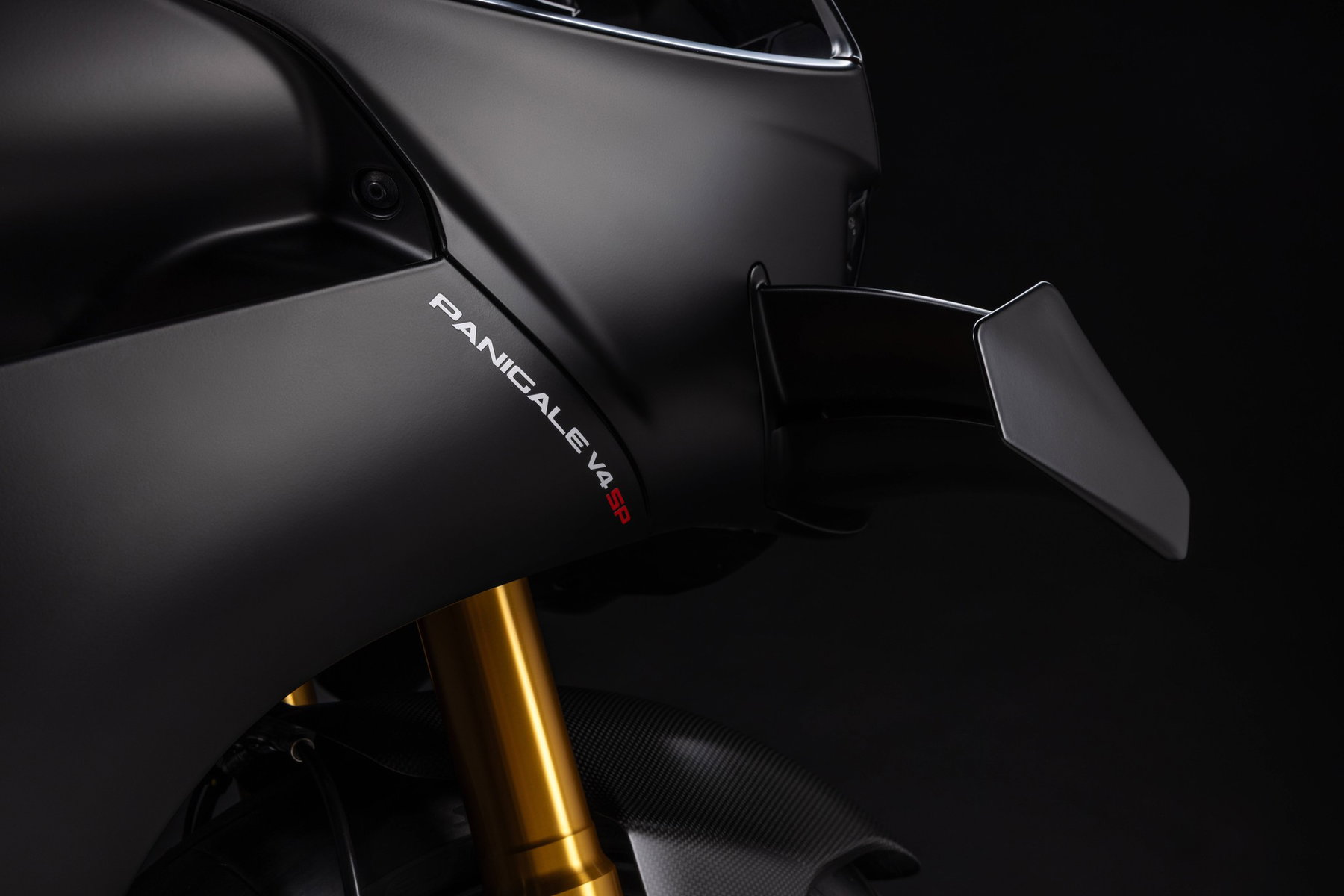
What do the Corner Sidepods and the larger wings do?
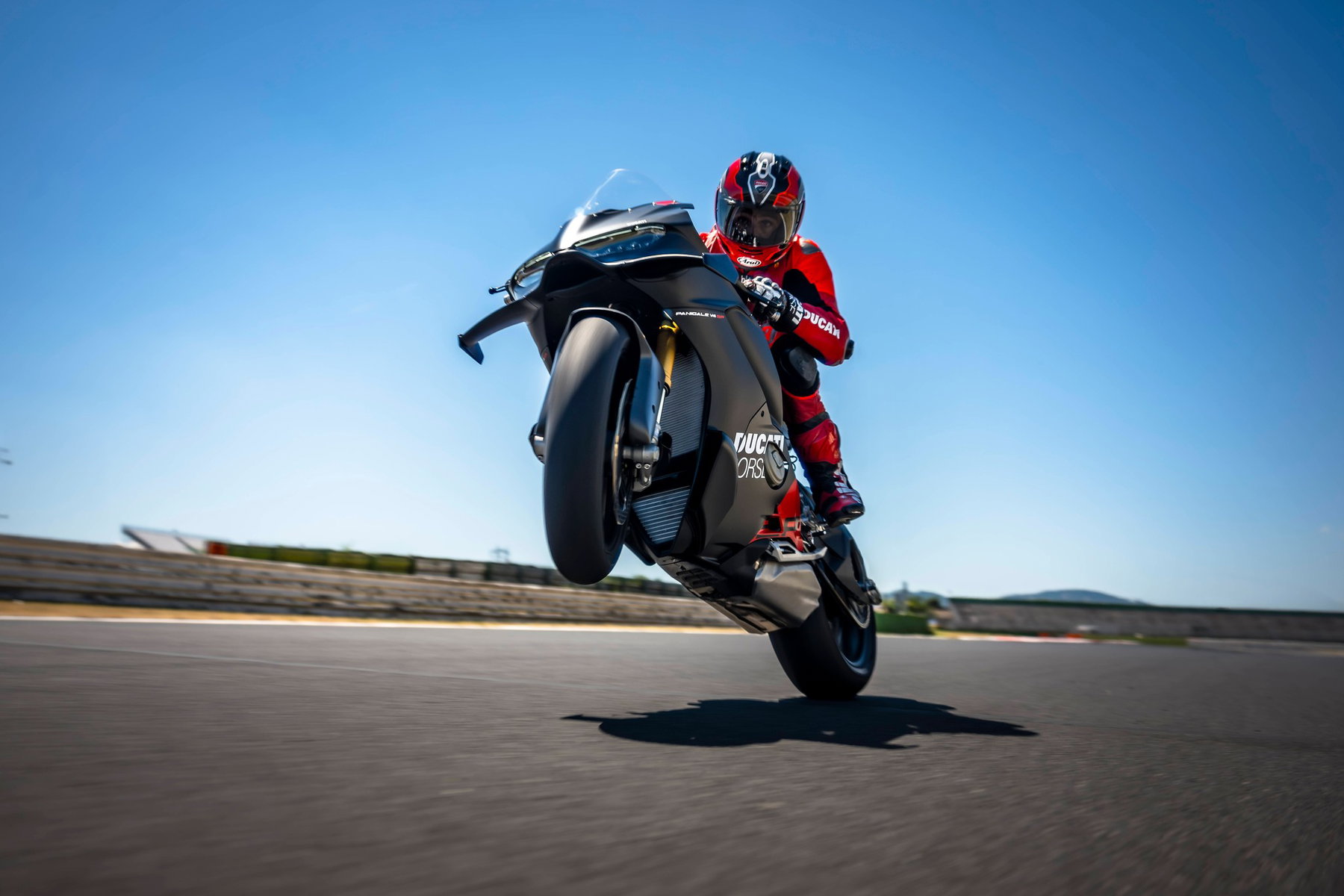
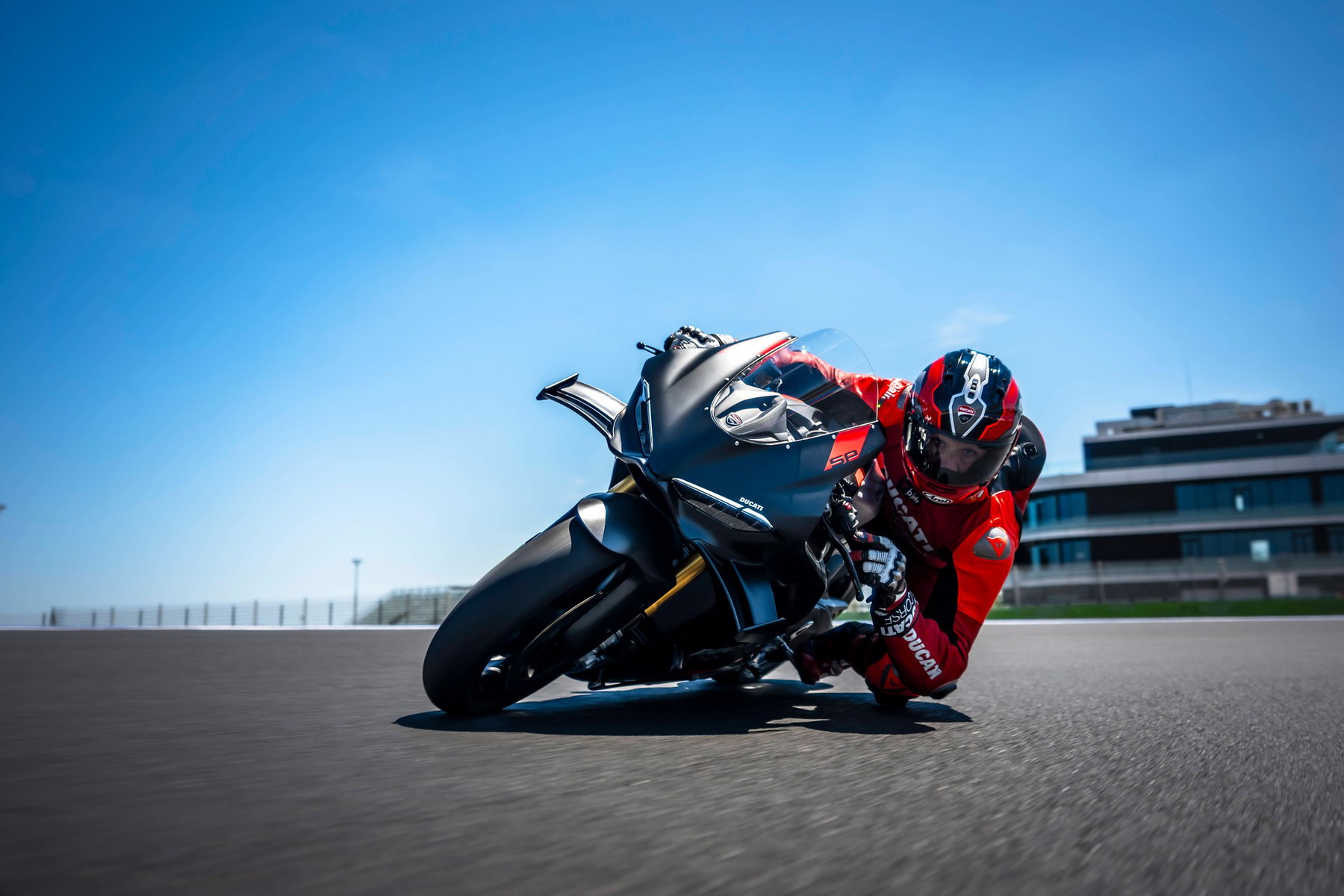
The larger biplane wings are said to generate 25 percent more downforce at 270 km/h than on the Panigale V4. The Corner Sidepods use ground effect at high lean angles and help the motorcycle close the line towards the inside of the corner.
The aero package is homologated for the Superbike World Championship. As on the base model, the wings consist of two stacked elements, but they are larger. More downforce presses the front wheel harder onto the tarmac at high speed. This should make the Panigale calmer and more precise in fast sections.
The Corner Sidepods sit low on the sides of the fairing. Ducati introduced this solution in MotoGP in 2021 and later transferred it to a production motorcycle for the first time with the Panigale V4 R. When the motorcycle is leaned over deep in a corner, suction is created between the fairing and the road surface. As a result, the SP should turn in tighter on its own. The aim is higher cornering speeds and therefore shorter lap times.
How much horsepower does the Panigale V4 SP have?
In the SP, the Desmosedici Stradale produces 218 hp (160.3 kW) at 13,500 rpm and 120.6 Nm (89 lb-ft) at 11,000 rpm. This matches the Panigale V4 2027; there is no extra power in standard trim.
The 1,103 cc V4 with counter-rotating crankshaft is derived from MotoGP development. For 2027, Ducati gave it 2 hp (1.5 kW) more, mainly through better breathing and lower internal friction. The front air intake is larger and increases air pressure by 0.6 percent at 300 km/h. According to the equipment list, the rev limiter in second to sixth gear only cuts in at 15,000 rpm. Together with the longer final drive ratio of 17 to 42 teeth, each gear reaches further. This is intended to increase top speed and save gear changes per lap.
A little more power is possible via the dry clutch. It allows the use of Ducati Corse Performance Oil. With this oil, the engine is said to deliver up to 3.5 hp (2.6 kW) more peak power.
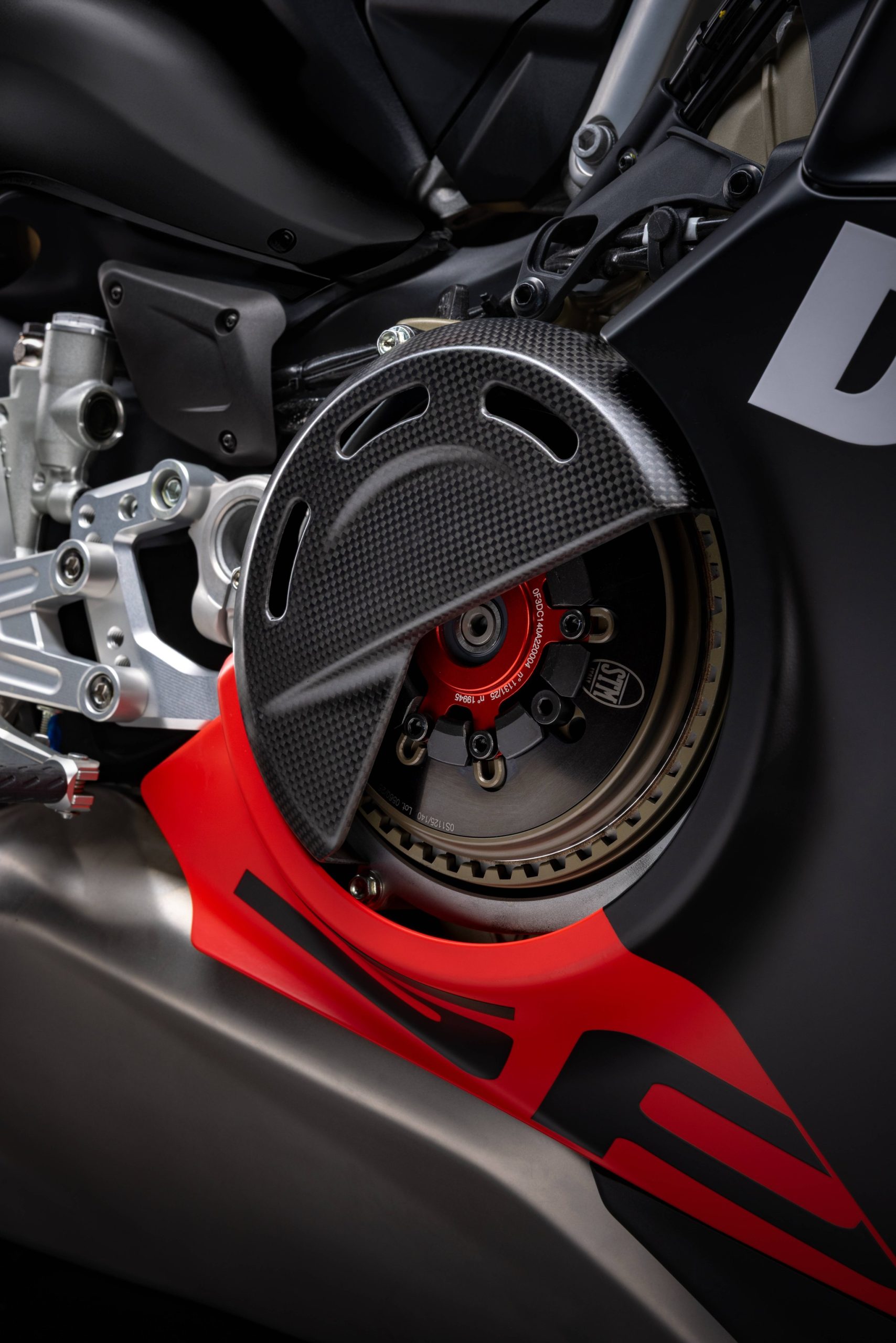
What does the dry clutch do better?
The STM EVO-SBK dry clutch is said to work more effectively against a hopping rear wheel under hard downshifting and to engage more smoothly. It also allows the mechanical engine braking to be adjusted.
A dry clutch runs without an oil bath and produces the rattle typical of Ducati. The anti-hopping function, which prevents the rear wheel from bouncing when downshifting, is said to work better than the standard clutch, especially under very high loads. Power reaches the rear wheel via a DID ERV7 520 chain. This chain is used by several factory teams and is significantly lighter than the solution on the V4 S.
Why does the SP weigh more than the V4 S despite its carbon wheels?
Ducati quotes 188 kg (414 lbs) for the Panigale V4 SP ready to ride without fuel. According to the factory, the V4 S weighs 187 kg (412 lbs). Why the SP should weigh 1 kg more despite lighter wheels is not entirely clear.
Compared to the forged aluminium wheels of the V4 S, the carbon wheels with five split spokes save a combined 0.95 kg (2.1 lbs) of unsprung mass. More important is the lower inertia: it drops by 12 percent at the front and 19 percent at the rear. This makes the wheels easier to set in motion and to slow down again. Changes of direction should therefore be quicker and more precise. The front rim measures 3.50 x 17 inches, the rear 6.00 x 17 inches. Pirelli Diablo Supercorsa SP-V4 tyres in 120/70 ZR17 and 200/60 ZR17 are fitted as standard. The carbon wheels are also approved for riding with a passenger.
Ducati’s documents do not reveal which parts add weight to the SP elsewhere. New additions include, for example, the Corner Sidepods and the larger wings.
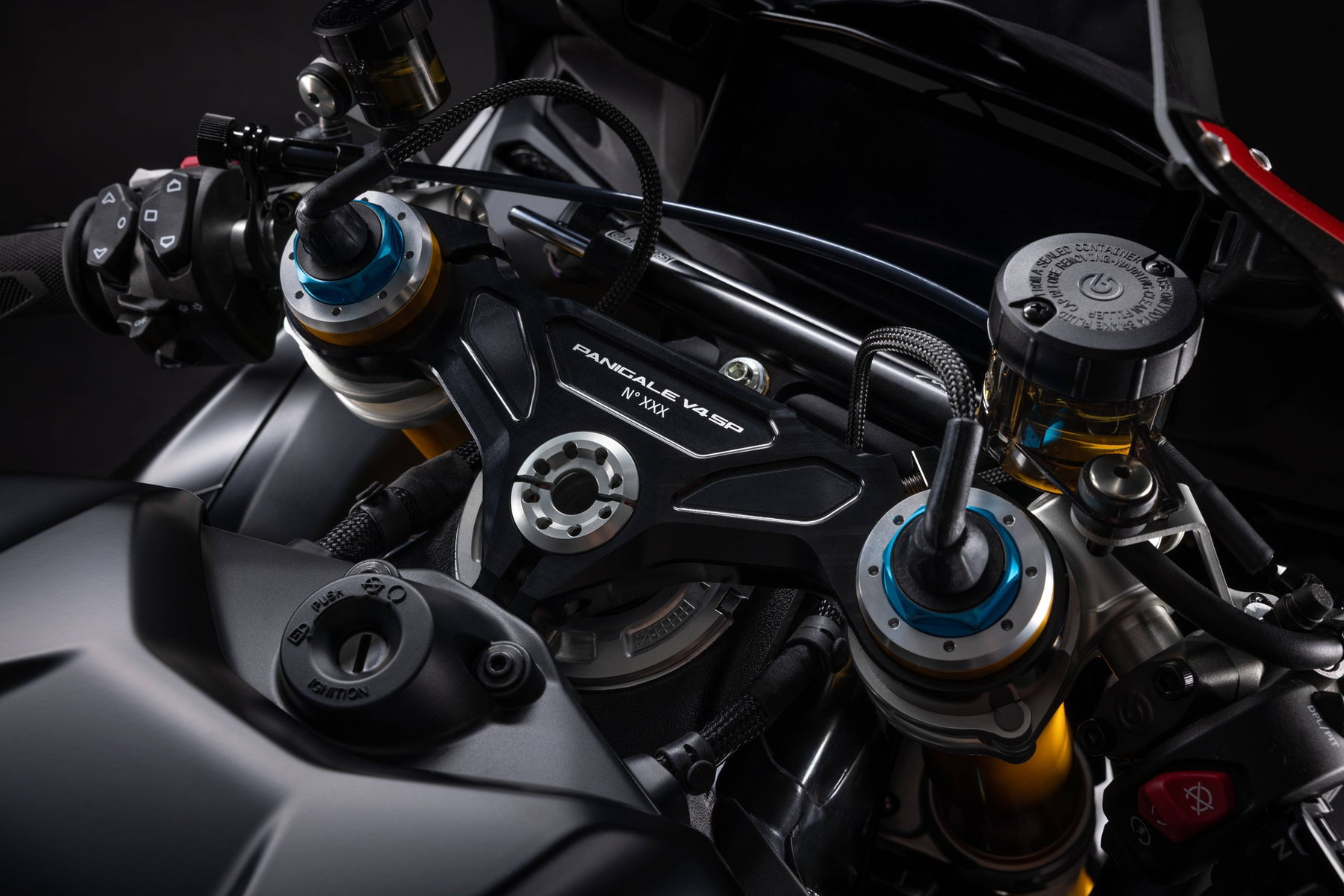
Suspension and brakes of the Panigale V4 SP
The SP’s shock absorber gets two adjustment options that the V4 S lacks. The spring preload can be adjusted hydraulically, which speeds up setup changes. There is also a length-adjustable linkage rod, which comes from the Panigale V4 R and is derived from WorldSBK. It allows the rear to be raised or lowered by up to 5 millimetres without changing the spring preload. This lets the chassis geometry be adapted to each track.
Fork, shock and steering damper come from Öhlins and are electronically damped via the Smart EC 3.0 system. The 43 mm fork has TiN-coated stanchions designed to reduce friction. Suspension travel is 125 millimetres at the front and 130 millimetres at the rear.
At the front, two 330 mm discs with Brembo Hypure four-piston monobloc calipers do the braking, with a 245 mm disc at the rear. New is the Brembo MCS 19.21 master cylinder. It allows the bite point at the lever to be changed in three steps. The distance of the lever from the handlebar can be adjusted while riding via a control on the left clip-on, a solution taken from racing. The brake and clutch levers have machined ends.
What electronics does the Panigale V4 SP have?
The SP adopts the complete electronics package of the Panigale V4 2027. It is based on a six-axis inertial measurement unit that supplies all control systems with data on the motorcycle’s attitude.
This includes cornering ABS with Race eCBS, traction control, Wheelie Control, Launch Control and Slide Control. The new Dynamic Engine Brake adjusts engine braking according to the load on the rear tyre, while Race Brake Control involves the rear wheel more in braking. The Ducati Vehicle Observer refines the interventions of several systems. The riding modes Race A, Race B, Sport, Road and Wet are available. Information is shown on a 6.9-inch TFT display in 8:3 format. Quickshifter, cruise control, pit limiter and lap timer are standard, as is a lithium battery. The SP is prepared for the Ducati Data Logger and the Ducati Multimedia System.
What is included in the track kit and what does the Akrapovič system offer?
Ducati supplies the SP with several parts that are intended for track use only and are not road legal. These include machined aluminium covers for the mirror holes, a kit for removing the number plate holder and an open carbon clutch cover.
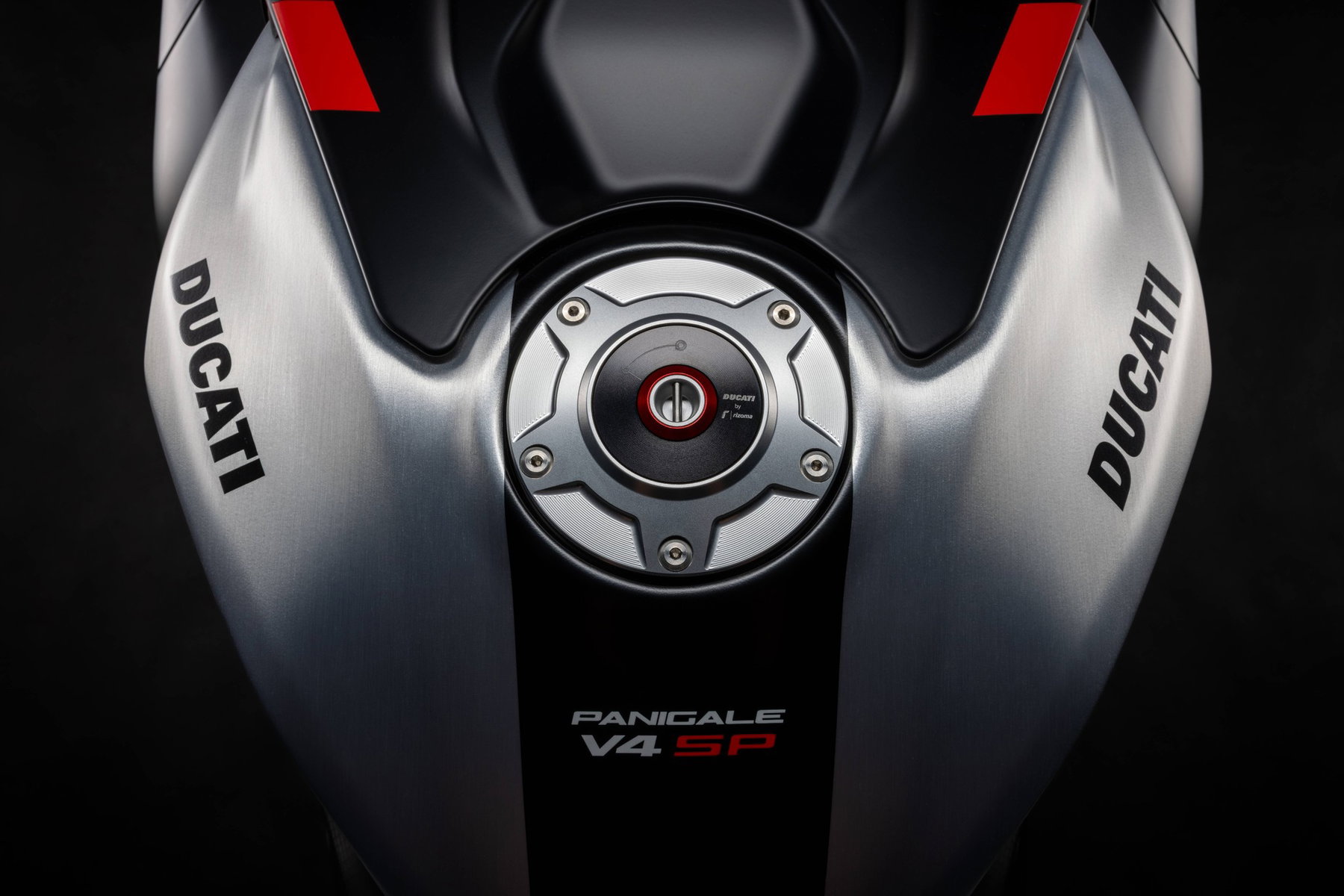
Also included are a racing fuel cap, carbon cooling ducts for the front brakes and a GPS module. The clip-ons can be mounted 10 millimetres higher for track use.
As an accessory, Ducati Performance offers a complete titanium racing exhaust system developed with Akrapovič. The two silencers sit high next to the tail. Ducati has revised the system so that it delivers more power while remaining quieter. This should make it usable even at tracks with strict noise limits. The system saves 6.6 kg (14.6 lbs) and is said to add 11 hp (8.1 kW) and 7 Nm (5.2 lb-ft).
How can you recognise the Panigale V4 SP at first glance?
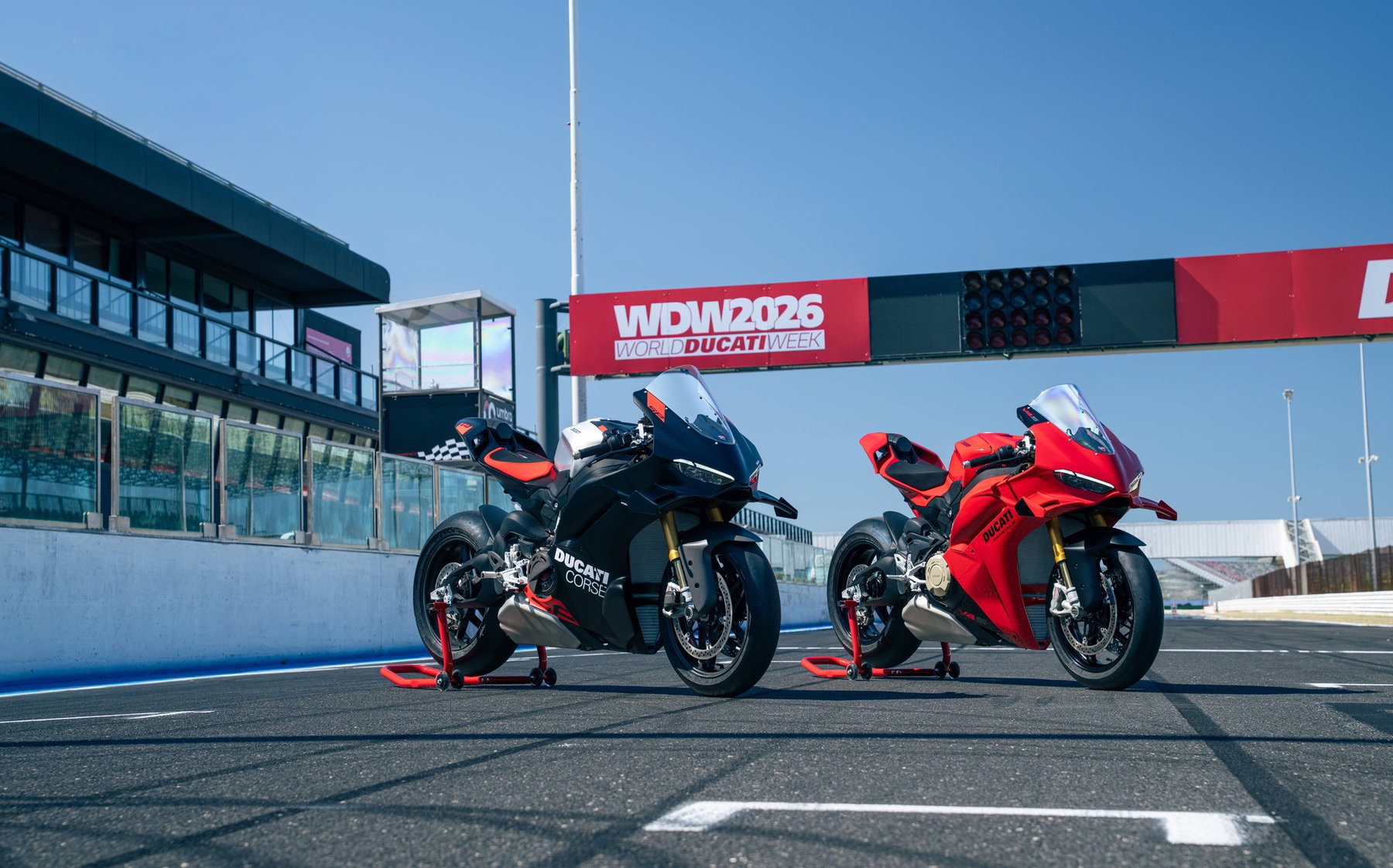
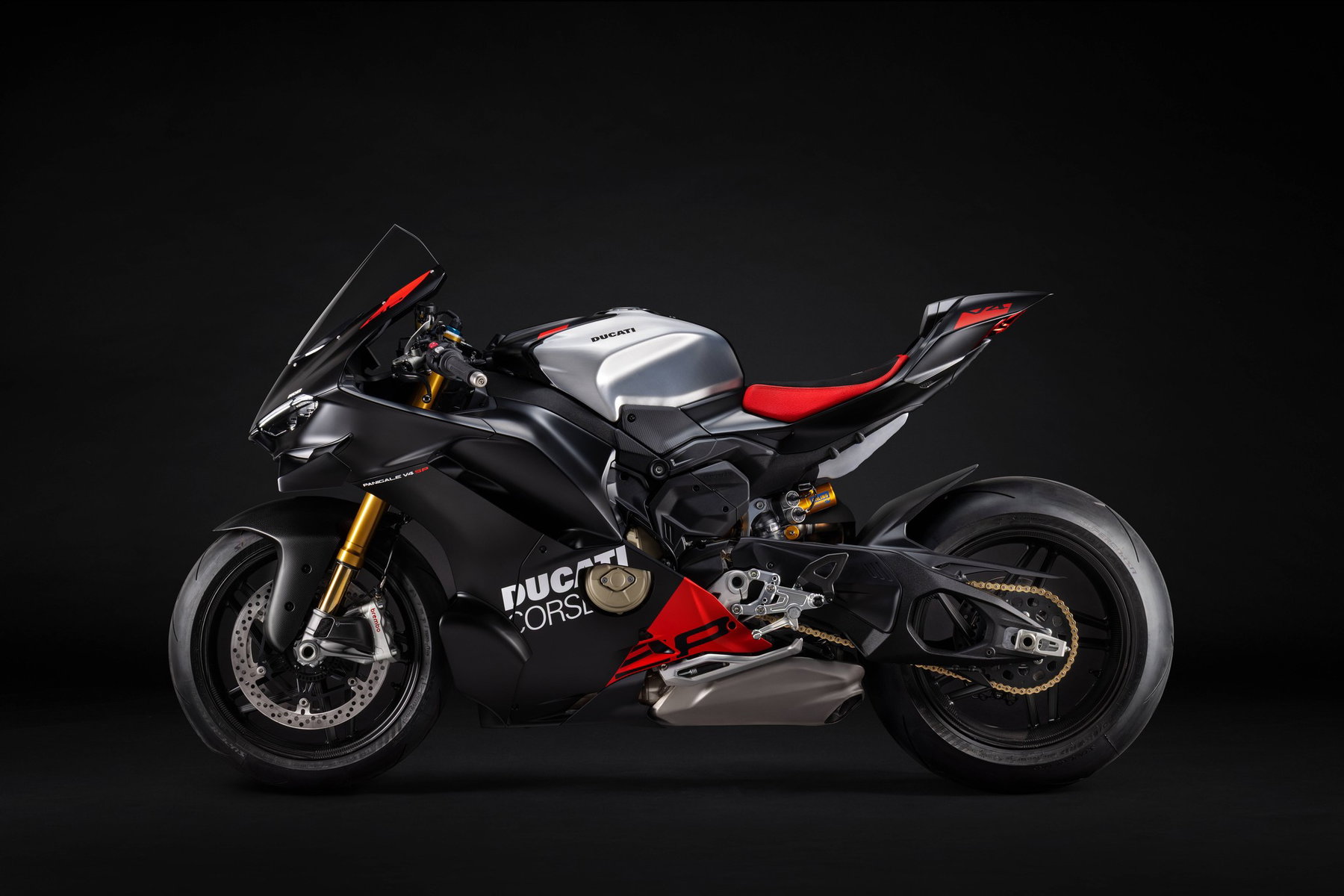
The SP comes exclusively in the Winter Test livery. It is inspired by the Ducati race bikes used during pre-season testing in MotoGP and WorldSBK.
The fairing and carbon wheels are matt black. In contrast stands the unpainted brushed aluminium tank with a capacity of 17 litres. Accents in Ducati red and a dedicated seat with the V4 SP lettering complete the look. The front mudguard is made of carbon. The upper triple clamp is machined from solid aluminium and carries the serial number of each motorcycle. The earlier SP models also wore the Winter Test livery.
When will the Panigale V4 SP 2027 arrive at dealers?
The Panigale V4 SP 2027 will be available at European Ducati dealers from March 2027. It is delivered as a single-seater, with a passenger kit available as an accessory.
The SP meets the Euro 5+ emissions standard. Ducati quotes fuel consumption of 6.5 litres per 100 kilometres and CO2 emissions of 151 g/km. The warranty runs for 24 months with unlimited mileage. Oil changes are due every 12,000 kilometres or 24 months, valve clearance checks every 24,000 kilometres. Seat height is 850 millimetres and the wheelbase is 1,477 millimetres.
Frequently Asked Questions
-
How much horsepower does the Panigale V4 SP 2027 have?
The Panigale V4 SP 2027 produces 218 hp (160.3 kW) at 13,500 rpm and 120.6 Nm (89 lb-ft) at 11,000 rpm. With Ducati Corse Performance Oil, up to 3.5 hp (2.6 kW) more is said to be possible. The Akrapovič racing system is said to add a further 11 hp (8.1 kW).
-
What is different on the Panigale V4 SP compared to the V4 S?
The SP has a racing gearbox with neutral below first gear, a dry clutch, carbon wheels and larger wings with Corner Sidepods. It also gets a Brembo MCS master cylinder, hydraulic spring preload and an adjustable linkage rod on the shock. Engine, frame and electronics are the same on both models.
-
How heavy is the Ducati Panigale V4 SP?
Ducati quotes 188 kg (414 lbs) ready to ride without fuel. That is 1 kg more than the V4 S, even though the carbon wheels are 0.95 kg (2.1 lbs) lighter than its aluminium wheels. Ducati gives no explanation for this.
-
Is the Panigale V4 SP limited?
Every SP carries its own number on the machined triple clamp. However, Ducati has not announced a limited production run.
-
When will the Panigale V4 SP go on sale?
The Panigale V4 SP will arrive at European Ducati dealers from March 2027. It is available as a single-seater in the Winter Test livery.