- 4.13 kilometres, 15 corners, construction starting in December 2026, first race in November 2027
- Investment of 96 million Australian dollars (approximately 59 million euros / 69 million US dollars)
- 377 trees have to go, 3,770 new ones are to be planted
From 2027, Adelaide takes over the Australian Grand Prix from the Phillip Island Grand Prix Circuit. The calendar therefore loses a fast natural circuit by the sea and gains something that has never existed in the history of the World Championship: a race in the middle of a city centre. The contract initially runs for six editions up to and including 2032. Following the first presentation in February 2026, the revised track plan is now available, and it differs clearly from the first draft.
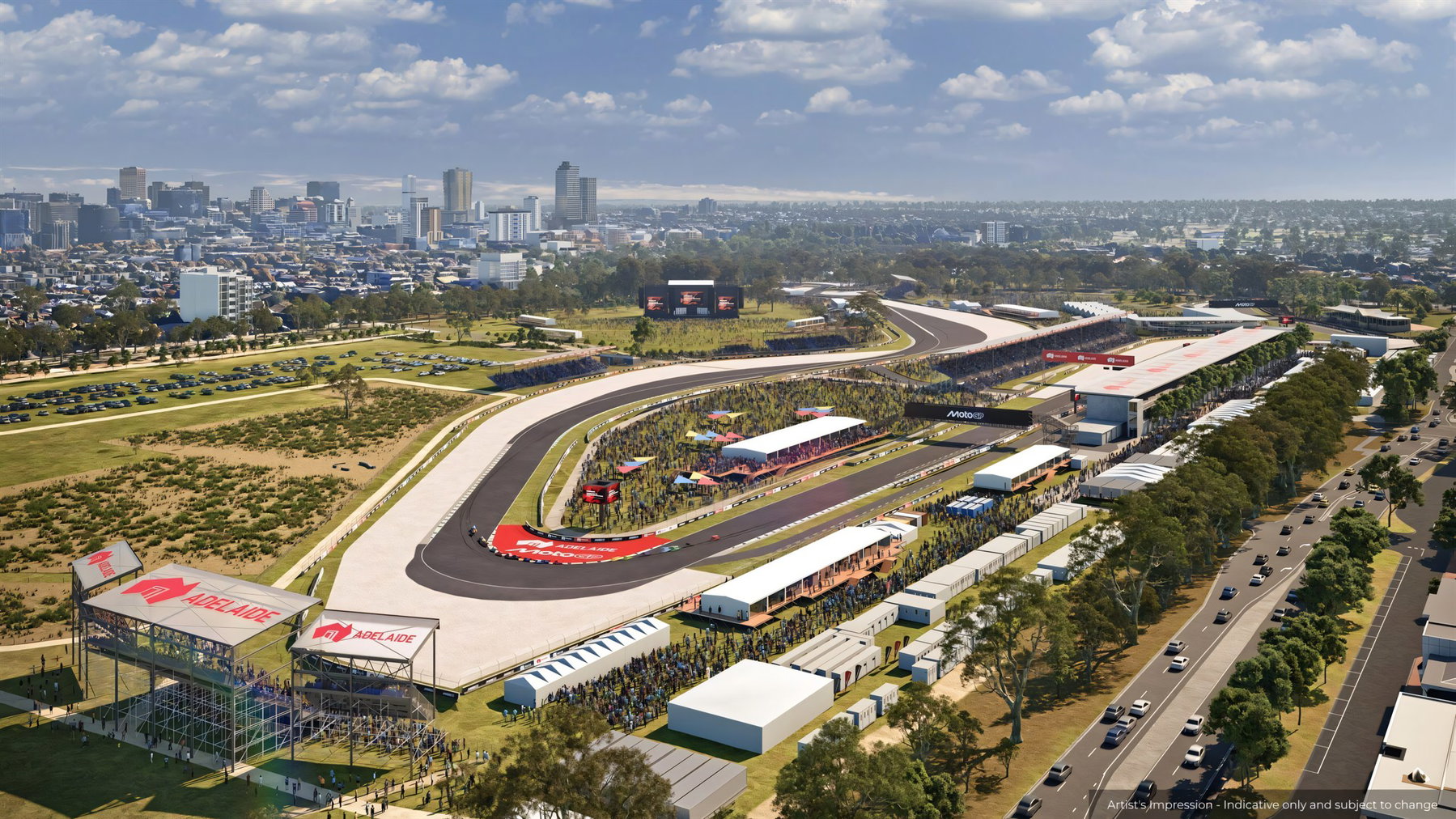
What does the new Adelaide layout look like?
The circuit is 4.13 kilometres long and has 15 corners. It is being built on the site south-east of the city centre that hosted the Formula 1 Australian Grand Prix from 1985 to 1995.
Several well-known sections return, among them Stag Corner, Rundle Road, Brewery Bend and Dequetteville Terrace. Other passages have been redrawn to meet today’s FIM safety requirements. The right-angled corners between Wakefield Street and Flinders Street, which worked for cars, have been dropped for motorcycle racing. According to the organisers, the design involved the South Australian Motor Sport Board, the FIM, Motorcycling Australia, MotoGP and Supercars Australia. Technical advice came from Loris Capirossi, former 125 cc and 250 cc world champion and today MotoGP safety adviser, as well as from Mark Skaife, five-time Supercars champion.
The Supercars will also race on the circuit in future. The track will be adapted between the events because the two series have different requirements.
What has changed compared with the first plan?
The circuit is shorter and has fewer corners. In February the figures were still 4.195 kilometres and 18 corners; now it is 4.13 kilometres and 15 corners.
Mark Warren, head of the South Australian Motor Sport Board, says more than 20 design variants were needed before the current layout was settled. The wishes of two very different racing series, public use of the site and environmental protection all had to be taken into account.
This is most clearly visible at the Senna chicane. Originally the track was to lead onto Wakefield Road there. Now the chicane is pulled further into the Park Lands, the track crosses Wakefield Road and runs across the site of the current tennis courts. Warren says this solution saved around 20 significant native trees while at the same time making the section between the chicane and the new complex of turns 8, 9 and 10 faster and more interesting. At this point, environmental protection and racing did not contradict each other but led to the same solution.
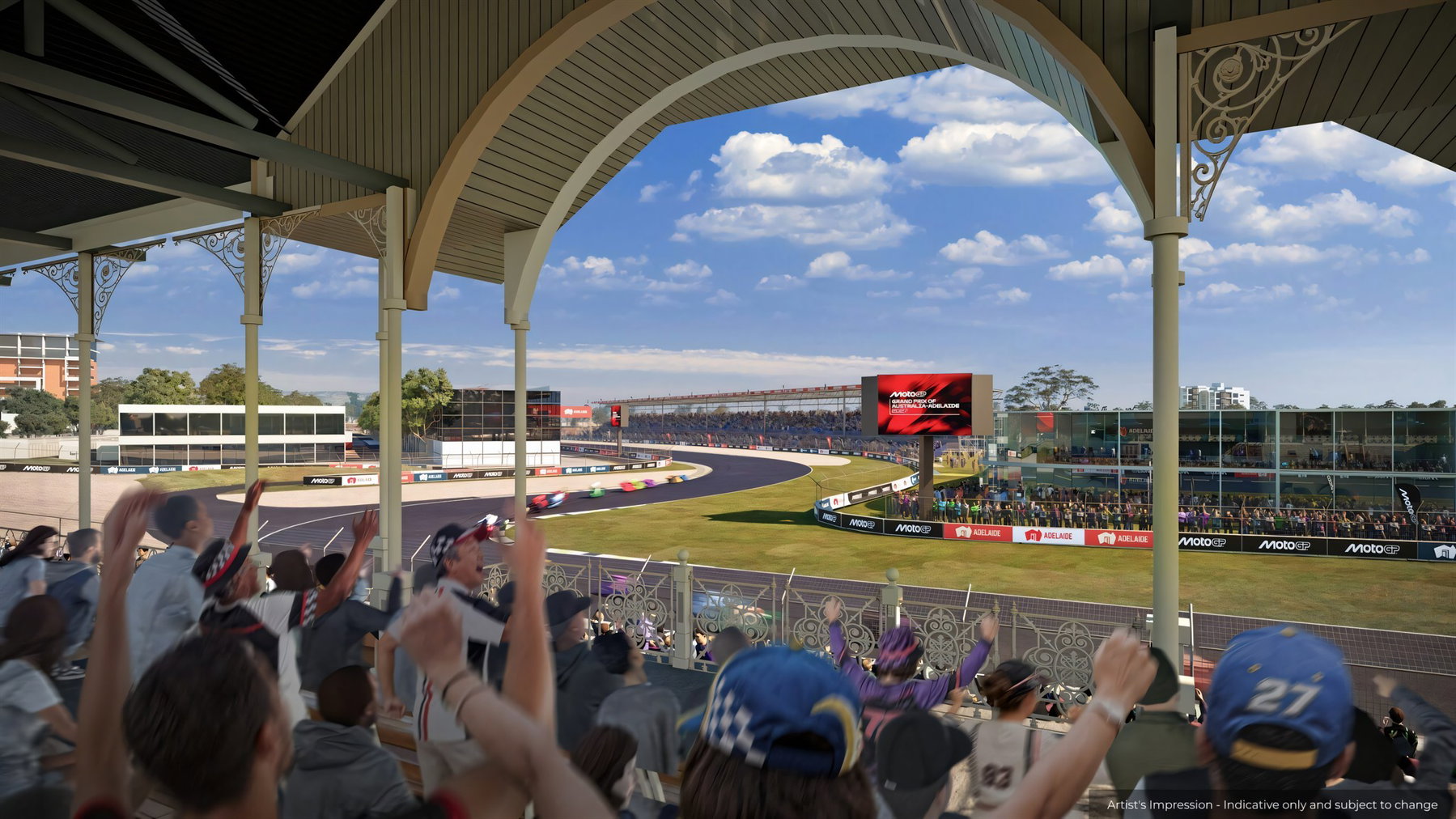
There is also a new demountable pit building. According to the organisers, the previous temporary facility has reached the end of its service life. The Government of South Australia is tendering for a replacement that is intended to cut set-up and dismantling times by up to a third. The heritage-listed grandstand will be retained and integrated into the new layout.
How fast will the MotoGP machines be in Adelaide?
The simulations arrive at a top speed of around 343 km/h and a lap time of about one minute and 26 seconds.
The peak figures are reached on the long straights. The Brabham straight is regarded as the defining feature of the circuit, while the model calculations for more than 340 km/h refer to the Dequetteville Terrace section. For the Supercars, the organisers quote more than 275 km/h and lap times of around one minute and 33 seconds. The circuit is laid out as a mixture of fast, flowing passages and hard braking zones, with large run-off areas at the critical points. The gravel traps for the races are to be installed only temporarily and removed afterwards so that the site remains usable for the rest of the year.
Why is there a dispute about the trees in the Park Lands?
The conversion requires 377 trees to be felled, among them 42 that are classified as significant. This is exactly where opposition to the project has flared up.
The Government of South Australia describes the remaining 335 trees as unregulated, invasive, dead or in poor condition. A further 88 trees are to be transplanted to other places in the park, and root-zone investigations are still under way on 22 of them to clarify whether they can stay. In total there are 8,895 trees in the circuit area, 95 per cent of which will remain untouched according to government figures.
As compensation, ten new trees are to be planted for every tree felled. That amounts to around 3,770 new plantings, all of them as already grown specimens. Subtracting the felled trees leaves a net gain of at least 3,393 trees in the Adelaide Park Lands. Both figures appear in the official statements and mean different things, one the plantings, the other the net gain on paper.
In addition, 15 million Australian dollars (approximately 9 million euros / 11 million US dollars) will go into a package for restoring habitats and green spaces, among other places along the Torrens River. Environmental groups have protested against the plan in recent months, and a petition to stop the project was signed by 43,000 people.
Malinauskas points to the cooperation with the Conservation Council: “We have worked in close collaboration with the Conservation Council to ensure this project delivers the best possible outcome for all South Australians who do, or who want to use our magnificent Park Lands.” According to his account, the Conservation Council itself concludes that the project will have a nature-positive effect with benefits for habitats and biodiversity.
A public consultation runs until 20 September 2026, in which the people of South Australia can comment on the design, the planned community areas and the intended planting zones. The feedback is to feed into the final detailed planning.
When will construction take place and when is the race?
Construction is due to start in December 2026, with the bulk of the work to be finished by around April. The first race is scheduled for November 2027, although an exact date is still to come.
The gap in time is no accident. It gives the new surface several months to settle and cure before the first machines run over it. Construction is supported by the Department for Infrastructure and Transport. The Grand Prix is to take place before the bp Adelaide Grand Final. Further steps are still due before construction starts, among them the final homologation of the circuit.
Costs, expectations and what comes next
According to Malinauskas, the project costs around 96 million Australian dollars. The government expects MotoGP and Supercars together to generate more than 200 million Australian dollars (approximately 124 million euros / 144 million US dollars) in economic impact each year. In February, Malinauskas had quoted an annual effect of around 130 million euros (approximately 151 million US dollars) for MotoGP alone.
On spectator numbers, the organisers are aiming high. Warren cites the MotoGP round in Thailand with 228,000 visitors across three days as the order of magnitude that would be a very good result. A night race is not currently planned, but he did not rule one out either.
Beyond the race weekends, the site is to remain in use. Cycling circuits, improved sports facilities and upgraded public areas are planned. From 2028, the Santos Tour Down Under Classic is also due to return to the Adelaide Circuit.
Carlos Ezpeleta, Deputy CEO of MotoGP Group, sums up the design like this: “We have spent many months working closely with the FIM and our colleagues in Adelaide to design a MotoGP circuit that is both exciting and, most importantly, safe.” He also says that local stakeholders were involved from the outset and that a project of this size inevitably brings restrictions with it. The aim, he says, is for the people of Adelaide to be proud of the event.
For the World Championship calendar, the switch means a noticeable change. Phillip Island stood for fast, flowing corners and a setting by the sea, while Adelaide is going for tight city streets and a festival atmosphere. How that affects the racing will only become clear in November 2027.
Frequently Asked Questions
-
When will the first MotoGP race in Adelaide take place?
The first Grand Prix on the new Adelaide Street Circuit is planned for November 2027. An exact date has not yet been announced. The race is to be held before the bp Adelaide Grand Final.
-
How long is the MotoGP circuit in Adelaide in 2027?
The circuit is 4.13 kilometres long and has 15 corners. The first draft from February 2026 still listed 4.195 kilometres and 18 corners. The changes emerged from more than 20 design variants.
-
Why is MotoGP leaving Phillip Island?
Adelaide takes over the Australian Grand Prix from 2027, with the contract initially running up to and including 2032. There had previously been talks about a move to Melbourne, but the Government of Victoria did not pursue that option seriously. That cleared the way for the bid from South Australia.
-
How fast will the motorcycles be on the Adelaide Street Circuit?
The simulations quote a top speed of around 343 km/h. The lap time for MotoGP machines is about one minute and 26 seconds. Supercars are expected to reach more than 275 km/h.
-
How many trees have to be felled for the circuit?
The conversion requires 377 trees to be removed, 42 of which are classified as significant. A further 88 trees will be transplanted, and investigations are still under way on 22 of them. As compensation, around 3,770 new plantings are planned.
➜ More on this topic in our overview: 2027 MotoGP Season: The Complete Overview.
➜ This article is part of our comprehensive overview: 2026 MotoGP Season: The Complete Overview – Teams, Riders, Calendar & Championship Standings. Find all key information on this topic in one place.