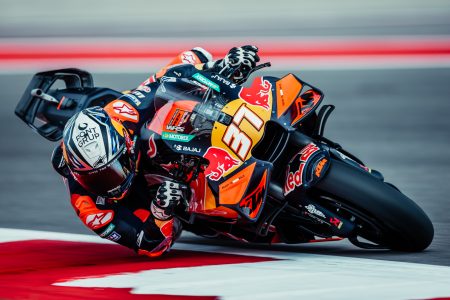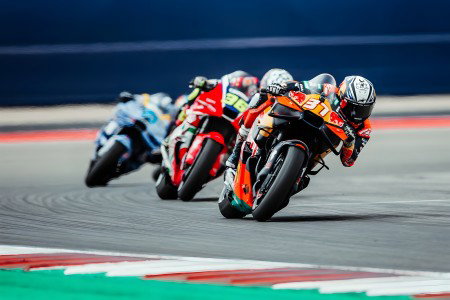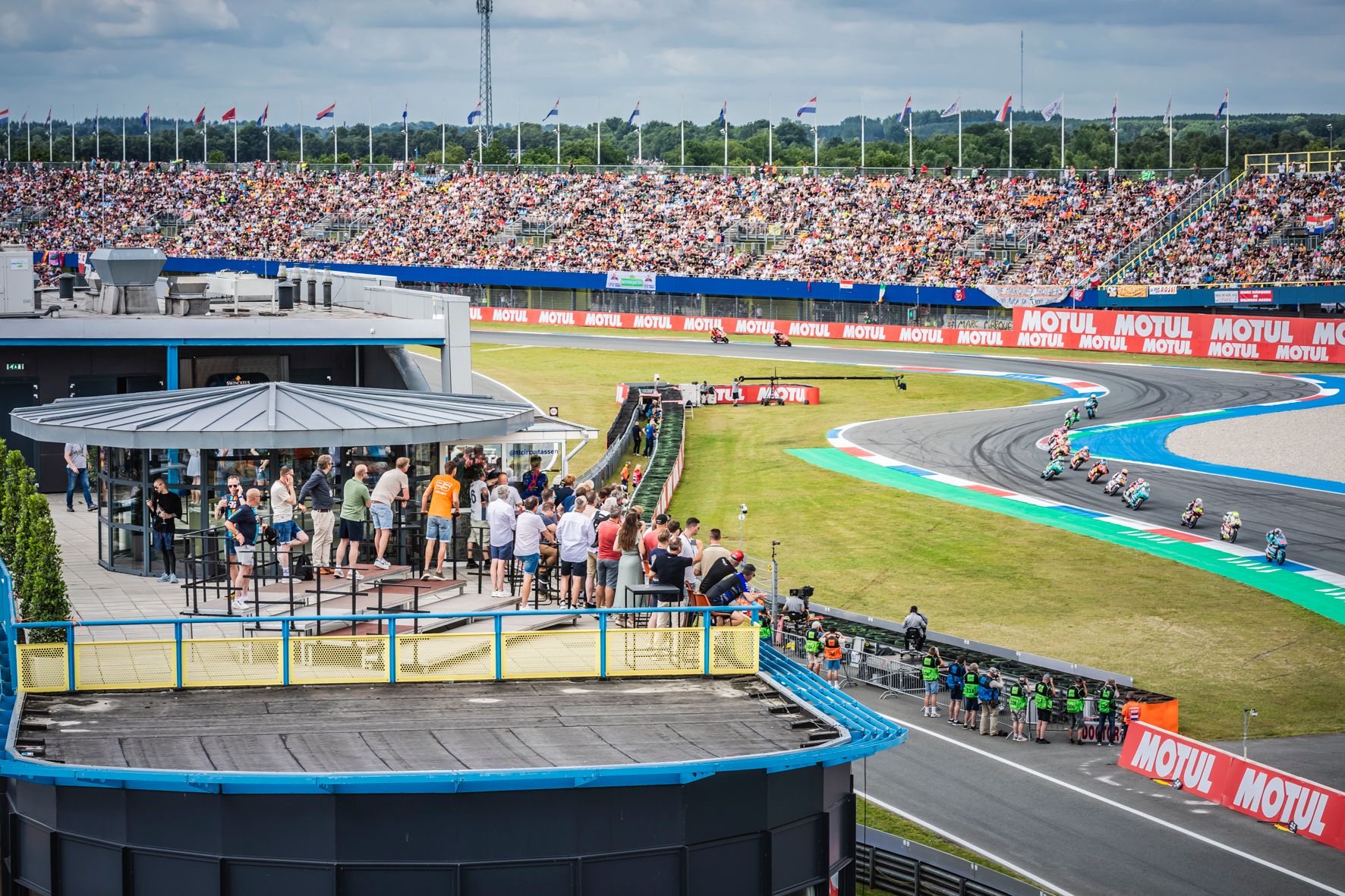
- Front holeshot devices are banned from all MotoGP machines starting with the Dutch Grand Prix, June 26 to 28.
- From the German GP at the Sachsenring, July 10 to 12, the row spacing on the starting grid in all classes increases from nine to twelve meters.
- From the 2028 season, a manufacturer may field a maximum of six motorcycles in MotoGP, provided at least five manufacturers compete.
On June 22, the Grand Prix Commission, MotoGP’s regulatory body, announced three decisions. The focus is on safety at race starts and the long-term structure of the grid. Two of the measures take effect this season, while the third reorganizes the field from 2028 onward. The Commission comprises representatives of the FIM, the teams’ association IRTA, the manufacturers’ association MSMA, and the MotoGP rights holders.
What Changes With the MotoGP Holeshot Ban Starting at Assen?
Starting with the Dutch Grand Prix, front holeshot devices may no longer be installed in MotoGP machines. The ban applies exclusively to the front systems; the rear ride-height devices remain permitted for racing for the time being. According to the FIM, the decision was made after consultation with all teams and after riders were able to practice their starts without the front device in additional practice sessions.
These tests took place during the race weekend at Brno. Rider opinions were divided, but the prevailing impression was that the change either represented an improvement or made no difference. The early front ban had originally been planned for a later round according to media reports, but following the successful test at Brno, it was brought forward to Assen.
The move should be understood within the broader context of the technical reset, which already mandates a complete ban on all ride-height devices for the coming season. The Commission is thus pulling the end of the front start systems forward by a full season.
How Does a Holeshot Device Work?
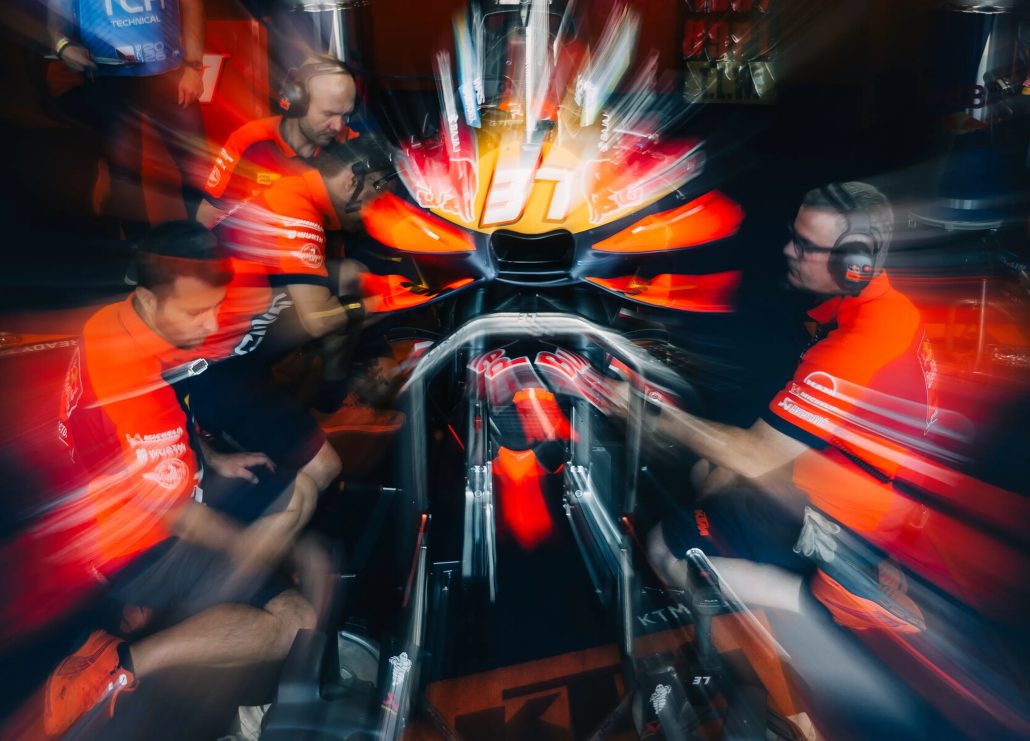
A holeshot device is a mechanical system that lowers the machine immediately before the start, reducing the tendency for the front wheel to lift under hard acceleration. The rider compresses the front fork with their body weight and then locks the suspension in the lowered position using a lever on the upper triple clamp. With a lower center of gravity, the motorcycle can accelerate harder without the front lifting and the electronics cutting power.
The system releases automatically during the first braking maneuver into turn one and, under rules introduced in 2023, may not be reactivated during the remainder of the race. Ducati brought the technology to the field in late 2018; by 2021, every manufacturer had its own variant, with Suzuki being the last. True in-ride front ride-height devices that operate while riding had already been banned since 2023; the pure start devices remained permissible until this decision.
Because electronically controlled suspension elements are not allowed in Grand Prix racing, these systems are deliberately simple, manually actuated mechanical-hydraulic solutions. They are complex in detail but considerably simpler in principle than the semi-active suspensions found on many high-end production motorcycles.
Why Is the FIM Intervening Now?
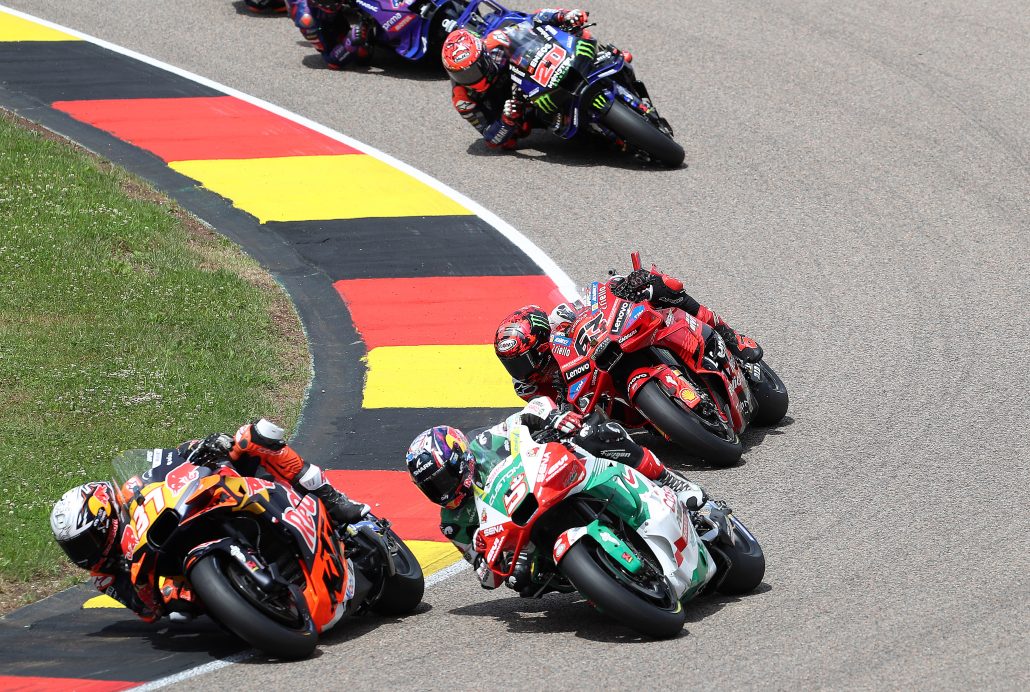
The trigger is the growing number of safety concerns at race starts. The device itself is not considered an immediate safety risk; the problem lies in the hard braking required to release the system in the first corner, which can put following riders in jeopardy. Added to this is the assessment that developing these systems is expensive without enriching the racing.
Reports specifically point to incidents in Catalunya and at Balaton Park. During the start crash in Hungary, multiple riders were caught up in a collision in turn one — a typical example of how a tightly packed field under full acceleration crowds into a tight corner entry. Taken together, these measures follow a string of start-line accidents in which riders were injured and missed races.
New Starting Grid From the Sachsenring
From the German GP at the Sachsenring, the starting grid in all classes will be spread out. The vertical gap between rows increases from three to four meters, expanding the distance between the three-rider rows from nine to twelve meters. The three-across formation is retained; a switch to a two-rider-per-row format will not happen.
This step had been preceded by a debate in which riders rejected an original proposal for two riders per row in favor of greater row spacing. The change takes effect at the Sachsenring rather than Assen because it had to be confirmed that the new layout could be implemented at all remaining circuits on the calendar. For Assen, the announcement came too late.
The larger grid also carries a risk, as approach speeds into the first corner may increase due to the greater gaps. At the same time, qualifying gains importance because grid position decides over even greater distances. The regulation applies to MotoGP, Moto2, and Moto3 equally.
What Does the Six-Motorcycle Limit Mean for Manufacturers?
From 2028, a manufacturer may equip a maximum of six riders with its machines, which effectively amounts to a factory team plus up to two additional teams. The rule applies on the condition that at least five manufacturers are represented on the grid at that point. Currently, only Ducati reaches this ceiling with its factory team plus Gresini and VR46, while Aprilia, KTM, Yamaha, and Honda each field four machines.
Criticism had centered on the fact that a single manufacturer can numerically dominate the field and thereby gain an advantage in data for setup and development. Ducati had at times fielded up to eight motorcycles; since Pramac’s switch to Yamaha for the 2025 season, the number stands at six. For 2027, six Ducatis are again expected, while the remaining manufacturers are likely to supply their factory team and one satellite team with four machines each.
The cap is intended to preserve brand diversity on the grid and prevent a single marque from determining the composition of the field through sheer numbers alone. The measure is embedded in the recently signed Concorde Agreement for the years 2027 to 2031, which covers all five manufacturers and the MotoGP rights holders and secures the composition of the field until at least 2031. The limit provides this framework with a clear enforcement mechanism.
What Impact Does the Holeshot Ban Have on the Championship Fight?
The timing coincides with a tight title battle, making the removal of the front device particularly relevant. Just eight points separate the Aprilia teammates Bezzecchi and Martin, while Marc Marquez is closing in with three wins from four races, most recently at Brno. Without the front system, the focus at the start shifts more toward clutch feel, throttle response, body positioning, and the machine’s anti-wheelie strategy.
Poor starts become harder to disguise, while riders who already have a strong launch phase could regain part of their advantage. Which machine accelerates most cleanly without the refined start aids will only become clear in race conditions. The teams with the most highly developed systems face the task of adjusting their setups in a short time.
Frequently Asked Questions
-
When does the MotoGP holeshot ban take effect?
The MotoGP front holeshot device ban takes effect at the Dutch Grand Prix in Assen from June 26 to 28, 2026. It applies to all MotoGP machines. The rear ride-height devices remain permitted for racing for the time being.
-
What is a holeshot device in MotoGP?
A holeshot device is a mechanical system that lowers the machine before the start and reduces the tendency for the front wheel to lift. The rider locks the compressed suspension using a lever on the triple clamp. The system releases automatically when braking into the first corner.
-
How does the starting grid change from the Sachsenring?
From the German GP on July 10 to 12, the vertical gap between rows increases from three to four meters. The spacing between the three-rider rows thus grows from nine to twelve meters. Three riders per row are retained across all classes.
-
Why are manufacturers limited to six motorcycles from 2028?
From 2028, a manufacturer may equip a maximum of six riders — effectively a factory team plus up to two additional teams. The rule is designed to safeguard brand diversity on the grid. It only applies if at least five manufacturers compete.
-
Are the rear holeshot devices also banned?
No, the decision applies exclusively to the front devices. The rear ride-height devices remain permissible for racing for the time being. The complete ban on all ride-height devices is part of the technical reset for the coming season.
➜ This article is part of our comprehensive overview: 2026 MotoGP Season: The Complete Overview – Teams, Riders, Calendar & Championship Standings. Find all key information on this topic in one place.