- According to a study from three countries, ABS reduces the number of injury crashes by 24 to 34 percent
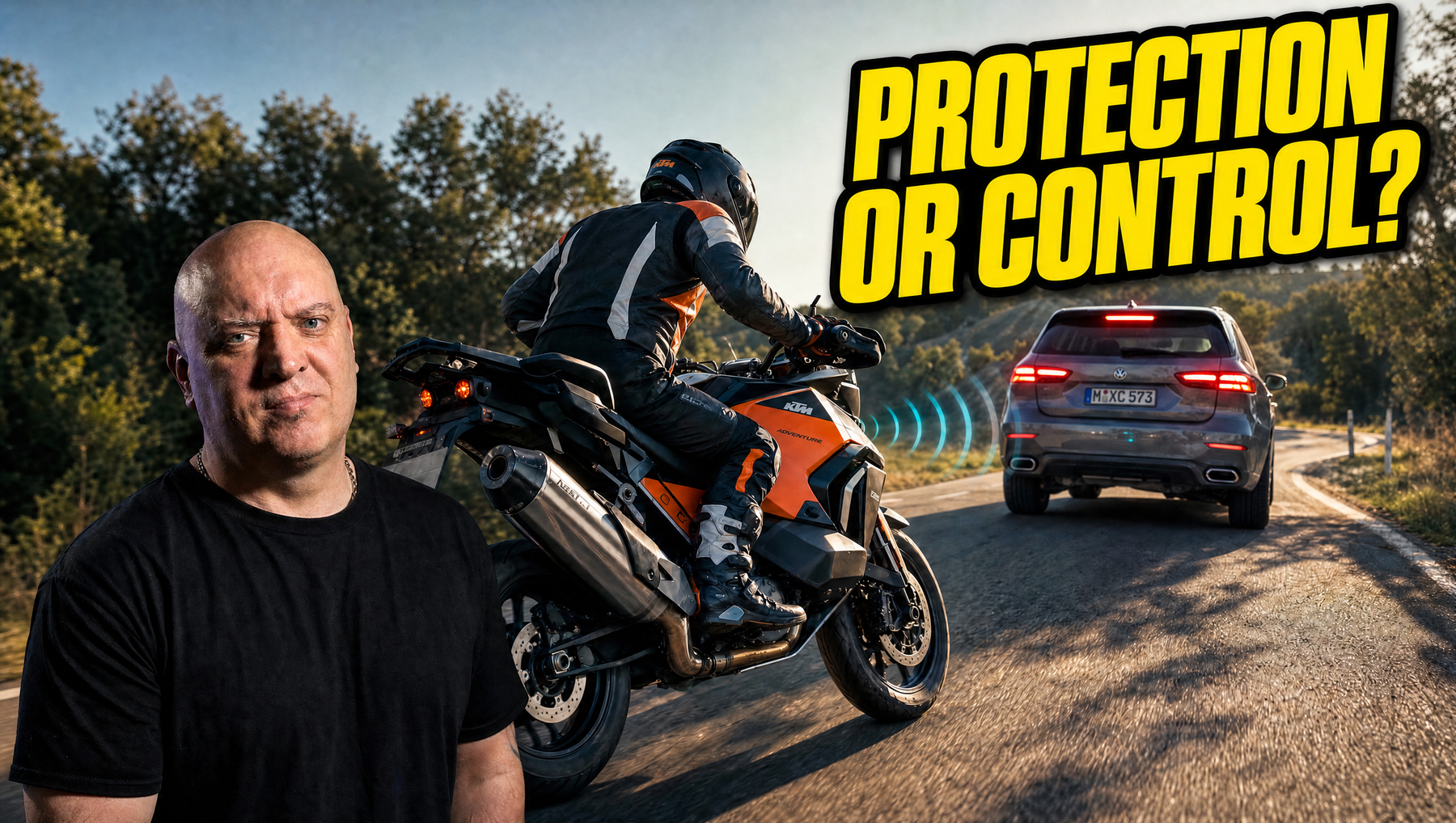
- Since 2026, the KTM 1390 Super Adventure S Evo has been the first production motorcycle that adds brake pressure on its own
- A Polaris patent describes a helmet that measures rider fatigue and can slow the vehicle down if necessary
In 1988, BMW became the first manufacturer to launch an electronic-hydraulic ABS for motorcycles, back then as an optional extra. Today, ABS is mandatory on most new motorcycles. On top of that come cornering ABS, traction control, radar and automated transmissions. In 2026, a production motorcycle even arrived that brakes harder on its own if the rider does not apply enough pressure to the lever. That raises the question of whether electronics mainly make motorcycling safer or gradually take tasks away from the rider. The answer depends heavily on which system you look at.
Video language available in English and German
How much safety do ABS and cornering ABS provide?
Of all rider assistance systems, the benefit of ABS is the best documented. A 2015 study from Sweden, Italy and Spain found 24 to 34 percent fewer injury crashes for motorcycles with ABS than for comparable models without it. The figures vary by country: 24 percent in Italy, 29 percent in Spain and 34 percent in Sweden.
In the EU, ABS has been mandatory for new vehicle types since 2016 and for all newly registered motorcycles over 125 cc since January 1, 2017. Enduros and trial bikes are exempt. Smaller motorcycles need either ABS or a combined braking system.
What is the difference between ABS and cornering ABS?
Standard ABS only intervenes when a wheel is about to lock. Cornering ABS also takes the lean angle into account. A sensor constantly measures the motorcycle’s position, so brake pressure in a corner is dosed accordingly. The bike stands up less when braking, and the tires are not overloaded. The same sensor also helps the traction control work properly at lean. The German automobile club ADAC calls cornering ABS a “quantum leap in motorcycle riding safety”. In its overview of assistance systems, it rates both ABS and cornering ABS as “very high”, the highest safety potential.
Why is the technology missing in many crashes?
In 2022, Allianz accident research analyzed around 500 randomly selected motorcycle crashes. Only about a third of the motorcycles involved had ABS, and just under six percent had cornering ABS. On average, the bikes were more than twelve years old, and those without ABS were even over 20 years old. The technology can only help where it is actually fitted. How well an assistance system works, however, also depends on how the rider uses it.
Do riders with assistance systems take more risks?
A small share at least considers it possible. In a 2020 survey of almost 4,000 riders by the German Institute for Motorcycle Safety (ifz), 13 percent said they felt “tempted” to ride more riskily because of the assistance systems. About 70 percent said they felt more comfortable with the support. Almost 80 percent said they know how the systems on their own motorcycle work and how to operate them. By their own assessment, however, one in five still has some catching up to do.
The ADAC considers this knowledge gap a real risk. An active intervention in braking or steering can “aggravate rather than resolve” a critical situation if it comes unexpectedly for the rider. The club therefore calls the owner’s manual essential reading. It also advises having the dealer explain the systems and taking a safety training course regularly.
What are the downsides of motorcycle electronics?
Besides the risk of using the systems incorrectly, the technology brings three problems that purely mechanical parts do not have: software bugs, security vulnerabilities and the question of how long spare parts will be available.
Software bugs
A recall in the US shows what this can look like in practice. In February 2023, BMW had to recall 754 motorcycles of the S 1000 R and S 1000 XR model lines there. After a software update at the dealership, the “Dynamic Pro” riding mode could be reset to factory settings. As a result, the wheelie control was switched off. This was not shown in the cockpit. The US National Highway Traffic Safety Administration (NHTSA) assumed that this could increase the risk of a crash.
Keyless systems
In 2017, the ADAC tested motorcycles from BMW, Ducati and KTM with keyless access. Using a radio range extender built from off-the-shelf electronic parts, the key’s signal could be relayed from inside a café to the street outside. The motorcycles could then be started and ridden away within seconds. At the time, the ADAC recommended an additional mechanical lock such as a disc lock. It called on manufacturers to offer keyless systems that can be switched off.
Spare parts
Outside of statutory warranty and manufacturer guarantee, vehicle manufacturers are not legally required to keep spare parts in stock. For cars, the ADAC is calling for a legal entitlement of 12 to 15 years, which should explicitly include electronics. There is no such obligation for motorcycles either. For bikes with many control units, it is therefore unclear whether they can still be repaired in two decades.
Do radar assistants bring more safety or more comfort?
According to the ADAC, adaptive cruise control mainly adds comfort. The club rates its safety potential as only “medium”. The first motorcycle with front and rear radar was the Ducati Multistrada V4, unveiled at the end of 2020. Bosch co-developed the sensors. The front radar controls the adaptive cruise control, which works between 30 and 160 km/h (19 and 99 mph) on the Multistrada. The rider sets a speed, and the motorcycle keeps its distance to the vehicle ahead on its own. If that vehicle slows down, the motorcycle brakes along with it up to a certain limit. The rear radar warns of vehicles in the blind spot. BMW, KTM and Kawasaki now offer similar systems.
Where are the limits of adaptive cruise control?
BMW describes the limits for the R 1300 GS very clearly. The radar functions only detect moving vehicles, not stationary vehicles, animals or pedestrians. Cyclists are not reliably detected. When entering a corner, the system can lose track of the vehicle ahead and accelerate back to the set speed. At high speed, it also cannot brake hard enough in corners. The rider therefore still has to spot the end of a traffic jam behind a bend.
Bosch, the supplier of many of these systems, sees great potential. In 2018, its accident research estimated that radar-based assistance systems could prevent one in seven motorcycle crashes. For the newer functions, the company even claims up to one in six crashes on German roads. Both figures are the manufacturer’s own projections; there are no independent studies on this so far.
Which motorcycles shift and operate the clutch automatically?
Since 2024, more and more motorcycles have come onto the market on which electronics take over the clutch and gear shifting. The focus here is clearly on comfort. Honda’s E-Clutch first appeared on the CB650R and CBR650R. The clutch lever stays on, but is no longer needed. According to Honda, the system weighs 2 kg (4.4 lbs). Yamaha offers Y-AMT on the MT-09. Both the clutch and shift levers are gone, and gears are changed via paddles on the handlebar or automatically. According to the manufacturer, the system weighs 2.8 kg (6.2 lbs). The BMW R 1300 GS is available with the Automated Shift Assistant (ASA). Here the clutch lever is dropped, but the foot shift lever remains. In city traffic and in traffic jams, these systems noticeably relieve the rider. When and how hard to brake, however, is still the rider’s decision.
How does the emergency brake assist on the KTM 1390 Super Adventure S Evo work?
If the radar detects a risk of collision and the rider brakes too gently, the system increases the brake pressure on its own. The function comes from Bosch, and KTM is the first manufacturer to use it. The 2027 model year KTM 1390 Super Adventure S Evo has been at dealers since March 2026. In the US, the base version costs US$22,699 (approx. €20,260).
A test in the US showed how unfamiliar such an intervention can feel. While riding briskly in a group, the front brake lever suddenly went soft twice because the system was building pressure, which shortened the lever travel. The tester initially thought the brakes were fading. Afterwards, the function was switched off in the menu. This illustrates what the ADAC criticizes in general: an intervention the rider does not expect can unsettle more than it helps in the first moment.
Airbag and head-up display
Things are also moving in passive safety. Honda already offered the first airbag on a production motorcycle on the Gold Wing in 2006. For a long time, little followed. In March 2026, Yamaha and supplier Autoliv presented an airbag built into the fairing of the Tricity 300 three-wheel scooter. It is designed to absorb the rider’s kinetic energy in a frontal impact. An airbag, however, only helps once an impact has already happened.
Shoei’s GT-Air 3 Smart, which the helmet maker developed together with EyeLights, steps in earlier. A display in the visor projects navigation and riding data so that they appear to float about three meters (ten feet) in front of the rider. The rider no longer has to look down at the cockpit. Deliveries were announced for summer 2026, and in the US the helmet costs US$1,199 (approx. €1,070).
Why do some electronic features cost extra?
Because manufacturers sell some functions as software, even though the hardware is already built into the motorcycle. Bosch offers manufacturers so-called Functions on Demand. With these, riders can, for example, buy additional riding modes via the manufacturer’s app and install them on the motorcycle by smartphone without visiting a workshop. KTM sells a Tech Pack for many models with features such as Quickshifter+, cruise control and engine drag torque control. BMW offers activation codes, for example for the Riding Modes Pro. Ordering requires the vehicle identification number, and installation must be done by an authorized workshop.
A promotion in France showed how much software is now part of the sale. There, KTM included the Tech Pack free of charge until the end of March 2026 when buying certain models such as the 790 Duke, the 790 Adventure and the 890 Adventure.
What are manufacturers developing beyond production technology?
In the manufacturers’ development departments, there are prototypes that go much further. They are not built for sale but are meant to test new technology. At CES 2017, Honda showed the Riding Assist. The motorcycle balances on its own when stationary, without gyroscopes and using technology from Honda’s UNI-CUB mobility device. Yamaha had its humanoid robot Motobot race Valentino Rossi at Thunderhill Raceway in California. The robot needed 117.5 seconds for a lap, Rossi 85.7 seconds. In 2018, a BMW R 1200 GS set off without a rider at the Miramas test track, lapped the circuit and stopped on its own. BMW stressed that a fully autonomous motorcycle was “by no means” the goal. The aim was safety research.
What is heading toward production
From Motobot and the self-balancing Motoroid concept, Yamaha derived the AMSAS system. A drive on the front wheel and a steering motor keep the motorcycle balanced up to around 5 km/h (3 mph). The prototype is based on a YZF-R25 and is still in development. At the Japan Mobility Show 2025, Yamaha also showed the Motoroid Lambda. Its artificial intelligence first practices skills such as standing up and riding straight in thousands of simulations and then transfers them to the real world. The Motoroid Lambda cannot be ridden. Honda is working on motorcycles and cars communicating with each other and warning each other of hazards. The first devices for this are expected to be ready for practical use around 2028. In 2016, Honda founded the Connected Motorcycle Consortium together with BMW Motorrad and Yamaha.
Which patents show where development could be heading?
Two patents show that electronics could not only correct in the future, but also intervene on their own. At the end of 2020, a Honda patent became public in which an actuator behind the steering head moves the fork via a chain. Using cameras and radar, the motorcycle is supposed to change lanes or avoid an obstacle by itself. Additional cameras are meant to monitor whether the rider stays attentive. After braking, steering would be the next step in which the motorcycle chooses a direction on its own.
How does the Polaris helmet patent work?
On February 17, 2026, Polaris was granted a US patent for a helmet with sensors. The manufacturer mainly builds side-by-side vehicles, ATVs and snowmobiles, but the patent explicitly mentions motorcycles as well. The helmet measures head acceleration as well as heart rate, body temperature, oxygen saturation and respiratory rate. It combines these values with chassis data, such as suspension travel and damping. From this, it calculates over time how much strain the rider is already under.
If a threshold is exceeded, the system warns the rider with a sound, a vibration or a message on the display. If the rider does not respond, a stronger warning follows that has to be confirmed at the push of a button. If that does not happen either, the vehicle can limit its speed, reduce power or brake to a standstill. No product or market launch has been announced. The patent does, however, show an approach in which the vehicle no longer reacts only to the road, but to the rider’s condition.
Motorcycle electronics: curse or blessing?
The data paints a clear picture. ABS and cornering ABS have a well-documented safety benefit. With radar and automated transmissions, on the other hand, comfort tends to be the main focus. Active interventions such as the emergency brake assist can help, but can unsettle riders who are not familiar with them. On top of that come software bugs, security gaps in keyless systems, the open question of spare parts and features that are only unlocked for an extra charge. How much electronics makes sense therefore depends on which system is meant and how well the rider knows it.
Frequently Asked Questions
-
Since when has ABS been mandatory on motorcycles?
In the EU, ABS has been mandatory for all newly registered motorcycles over 125 cc since January 1, 2017. For new vehicle types, the requirement already applied from 2016. Enduros and trial bikes are exempt, smaller motorcycles need either ABS or a combined braking system.
-
How many crashes does motorcycle ABS prevent?
A study from Sweden, Italy and Spain found 24 to 34 percent fewer injury crashes for motorcycles with ABS. The figure was lowest in Italy and highest in Sweden.
-
Does motorcycle adaptive cruise control detect stationary vehicles?
No, at least not on BMW models. The radar functions of the R 1300 GS only detect moving vehicles, not stationary vehicles, animals or pedestrians. In corners, the system can also lose track of the vehicle ahead and accelerate again.
-
Which motorcycle has an emergency brake assist?
The KTM 1390 Super Adventure S Evo is the first production motorcycle with Bosch’s emergency brake assist. If the radar detects a collision risk and the rider brakes too gently, the system increases the brake pressure. The function can be switched off in the menu.
-
Can motorcycle electronics be dangerous?
Yes, in some cases. Unexpected interventions can make critical situations worse if the rider does not know the system. Software bugs can also disable functions without warning, as a BMW recall in the US has shown.