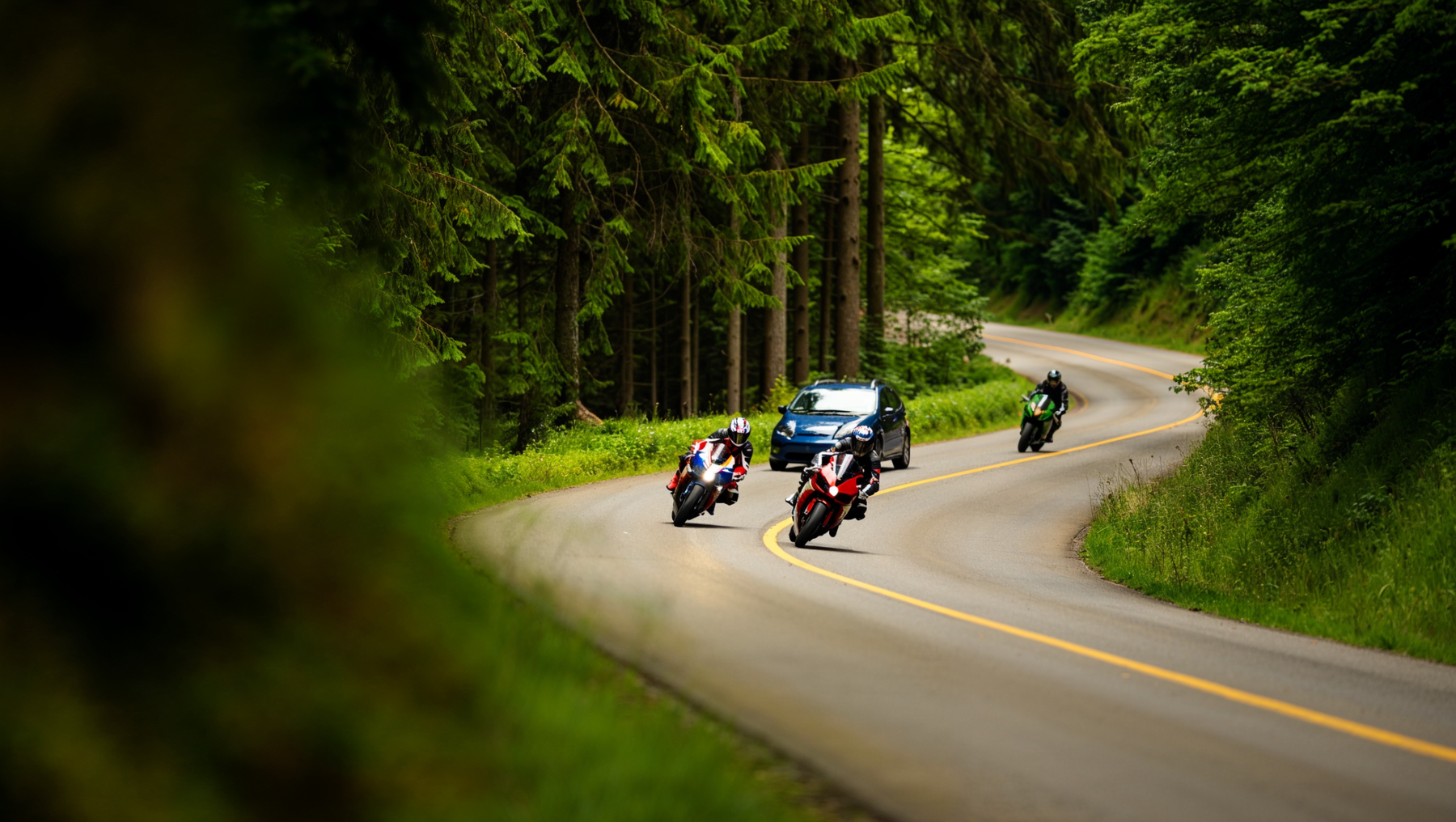
- In 2024, official statistics recorded improper overtaking as a factor in nearly 11,700 injury accidents in Germany, 212 of which were fatal.
- Overtaking is only permitted when the road ahead is fully visible and there is absolutely no risk to oncoming traffic.
- Even small speed differences compared to the vehicle ahead significantly increase the required overtaking distance.
Anyone riding on a rural road behind a slower vehicle will sooner or later face the question of whether an overtaking maneuver is worth it. The accident researchers at DEKRA advise restraint in many of these situations, as overtaking is one of the most demanding maneuvers in road traffic. Even a small misjudgment of speed, distance, or oncoming traffic can have severe consequences when you are in the opposing lane. Especially on winding roads, there is often little room to safely abort a maneuver once it has begun.
Why is overtaking one of the most critical driving situations?
Overtaking maneuvers are considered particularly risky because they take place in the opposing lane and leave almost no margin for error. Luis Ancona from DEKRA accident research puts it bluntly: “Overtaking maneuvers are one of the most critical driving situations of all. At the slightest doubt, overtaking is simply not an option.”
Drivers frequently initiate overtaking without sufficiently assessing the traffic situation. If the situation is then misjudged, the consequences are especially severe when oncoming traffic is involved. Ancona notes that many maneuvers begin without adequate safety margins. Anyone who misjudges speed, distance, or approaching oncoming traffic runs a high risk of being seriously injured or killed in an accident.
How many overtaking accidents occur in Germany?
In 2024, official statistics recorded improper overtaking as a factor in nearly 11,700 injury accidents. In 212 of those cases, the accidents were fatal.
From the perspective of DEKRA accident research, such overtaking accidents are often the result of misjudgments. The necessary safety margin is frequently lacking because the road, one’s own speed, or oncoming traffic is not properly assessed. It is precisely these errors that turn a maneuver that seems feasible at first glance into a trap in the middle of the opposing lane.
What do the German Road Traffic Regulations (StVO) say about overtaking?
Overtaking is only permitted when the overtaking path is fully visible and any obstruction or endangerment of oncoming traffic can be ruled out. In unclear traffic situations, overtaking is strictly prohibited.
This means that an overtaking maneuver must be aborted immediately as soon as oncoming traffic appears. So-called queue jumping is also not permitted if there is no sufficiently large gap ahead for merging back in. Additionally, both the speed limit and the prescribed safety distances must be observed. Since oncoming traffic can approach just as quickly, the visible stretch of road must be sufficient for that as well. Particularly when the speed difference compared to the vehicle ahead is small, the required overtaking distance increases considerably. If it becomes apparent while pulling out that the available distance or speed is insufficient, the maneuver must be aborted decisively and early.
Where are the greatest dangers when overtaking?
Particularly critical are stretches with many curves, crests, dips, and junctions. At these blind spots, oncoming vehicles may be hidden and are often closer than expected.
Farm tracks from which a tractor or cyclist might turn onto or cross the road are also easily overlooked. On top of that, there is a common cognitive error: many drivers underestimate the actual overtaking distance required. Anyone who then pulls out with too little distance and too small a speed advantage has no reserve left at the critical moment to abort the maneuver.
What should you consider about traffic behind you?
Before pulling out, you must check whether a following vehicle has already begun its own overtaking maneuver. Only then should you signal clearly and in good time before pulling out and merging back in.
Under no circumstances should the overtaken vehicle be cut off. According to DEKRA accident research, checking behind is one of the most frequently neglected points. Anyone who skips this check may fail to notice a faster road user who is already in the opposing lane.
A documented motorcycle accident illustrates the risks
Just how consequential errors in such a situation can be is demonstrated by an accident case documented by DEKRA accident research. A 21-year-old motorcyclist was riding on a rural road while a car far ahead intended to make a U-turn at a farm track joining from the right. After the car driver had braked to a standstill on the farm track to let oncoming traffic pass, he began the U-turn without watching for the motorcyclist approaching from behind.
The motorcyclist swerved into the opposing lane but still clipped the front of the car. The motorcycle was deflected to the left off the road, and the rider fell and struck his helmet against a concrete drainage channel beside the carriageway. The motorcyclist died at the scene from severe head injuries; the car driver suffered shock.
Accident research identifies the cause as the car driver’s attempt to make a U-turn in one movement at an unsuitable location without paying sufficient attention to flowing traffic. At the same time, the motorcyclist had significantly exceeded the local speed limit. With attentive observation and an effective shoulder check, the car driver could have prevented the accident. For the motorcyclist, the collision would not have been avoidable even at the legal speed limit, but the impact speed would have been significantly reduced, thereby lessening the severity of injuries. At a slower speed, a theoretical evasion option to the right would also have been possible, as the motorcycle would have reached the collision point later. In this context, accident research points to regular rider safety training courses where critical situations are deliberately recreated, as well as forgiving road infrastructure without sharp-edged or solid structural elements at the roadside. The example shows that overtaking and comparable maneuvers on rural roads remain a recurring road safety issue.
The key points before every overtaking maneuver
Ancona also puts the risk into sober perspective: frequent overtaking maneuvers make the driving situation more demanding but generally offer no significant time savings. Especially in heavy traffic, it usually comes down to just a few minutes that are not worth the risk. Often, the next obstacle is waiting just around a few bends anyway.
From the perspective of DEKRA accident research, six questions should be answered before every overtaking maneuver:
- Is the road fully visible and free of oncoming traffic?
- Is the available distance sufficient for overtaking?
- Can your vehicle accelerate quickly enough?
- Has a following vehicle already begun overtaking?
- Was the turn signal activated in time?
- Can the maneuver be safely aborted at any point if the traffic situation changes?
Ancona frames the crucial thought as an appeal: “Before every overtaking maneuver, ask yourself: Is overtaking really necessary? Is it really worth it? Am I stressed, irritated, or fatigued? Often it defuses the situation if you hold back for a moment and reconsider your intention.”
Frequently Asked Questions
-
How many overtaking accidents occur annually in Germany?
In 2024, official statistics recorded improper overtaking as a factor in nearly 11,700 injury accidents in Germany, 212 of which were fatal.
-
When is overtaking permitted on rural roads?
Overtaking is only permitted when the overtaking path is fully visible and any obstruction or endangerment of oncoming traffic can be ruled out. In unclear traffic situations, overtaking is strictly prohibited.
-
Where is overtaking particularly dangerous?
Particularly critical are stretches with many curves, crests, dips, and junctions. At these blind spots, oncoming vehicles may be hidden and are often closer than expected. Farm tracks from which tractors or cyclists might enter the road are also easily overlooked.
-
What should you check before every overtaking maneuver?
Six points: a fully visible and clear road, sufficient overtaking distance, enough acceleration reserve, no following vehicle already overtaking, timely signaling, and the ability to safely abort the maneuver at any point if the traffic situation changes.