- Karlsruhe leads with 128 euros in fines per registered car, while the average across the 30 cities is around 39 euros
- The revenue figures cover speeding and red-light offences, and in Karlsruhe and Münster they also include illegal parking and mobile phone offences
- In crashes involving excessive speed, 177 people died in 2025 in cases where the speed limit was exceeded and 665 in cases where it was not, according to the Federal Statistical Office
From 3 to 9 August 2026, police across Germany will step up speed enforcement. Shortly before this campaign week, the comparison portal LeasingMarkt.de published an analysis comparing fine revenues and enforcement density in 30 German cities. The analysis dates from July 2026 and is based on data from 2025. It has made plenty of headlines in recent days, mostly with the same core message: Karlsruhe earns the most money from speeders. Anyone who looks at the underlying data finds a considerably more complicated picture.
Which city tops the German speed camera ranking?
Karlsruhe takes first place. For every car registered in the city, 128 euros in fines are collected on paper, more than three times the average of around 39 euros across the 30 cities surveyed.
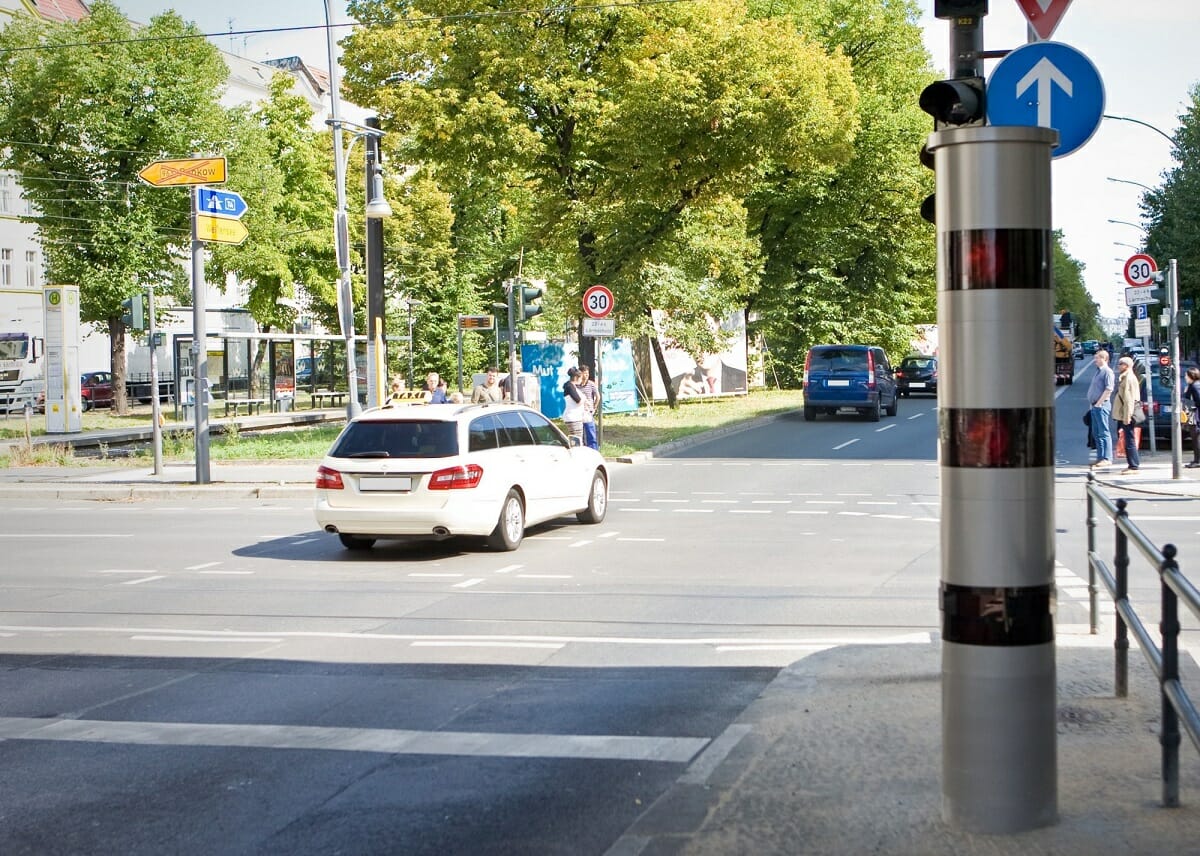
The ranking puts total revenue for Karlsruhe at around 18 million euros. In the survey this figure comes from, the exact amount is 17.8 million euros. Karlsruhe also leads on fixed installations, with 2.6 stationary cameras per 10,000 cars against an average of one device. The city itself has reported 35 stationary units across the urban area, seven measuring vehicles and four enforcement trailers. Enforcement trailers are measuring trailers that are repeatedly moved to different locations.
At the bottom of the table sits Munich with 1.90 euros per car. The highest absolute sums are recorded by Hamburg with 41.8 million euros and Berlin with 37.9 million euros. Because both cities have very large numbers of registered vehicles, they slip down the table when measured against the vehicle fleet.
The top 10 of the ranking
The overall score is made up of four components: the level of fines per registered car, plus stationary cameras, mobile cameras and measuring points, each per 10,000 cars. Measuring points are locations where measurements can be taken, in some cases also for distance checks or traffic counts.
| Rank | City | Federal state | Fines per car | Stationary cameras per 10,000 cars | Mobile cameras per 10,000 cars | Measuring points per 10,000 cars |
|---|---|---|---|---|---|---|
| 1 | Karlsruhe | Baden-Württemberg | 128.00 euros | 2.6 | 0.5 | 5.3 |
| 2 | Potsdam | Brandenburg | 27.00 euros | 0.9 | 0.9 | 7.7 |
| 3 | Leipzig | Saxony | 53.00 euros | 1.2 | 0.5 | 7.3 |
| 4 | Mainz | Rhineland-Palatinate | 39.80 euros | 1.0 | 0.6 | 6.8 |
| 5 | Wuppertal | North Rhine-Westphalia | 36.80 euros | 2.5 | 0.6 | 3.4 |
| 6 | Flensburg | Schleswig-Holstein | 34.80 euros | 2.0 | 0.4 | 3.5 |
| 7 | Hamburg | Hamburg | 51.80 euros | 0.5 | 0.4 | 6.1 |
| 8 | Halle an der Saale | Saxony-Anhalt | 56.80 euros | 0.5 | 0.4 | 5.6 |
| 9 | Münster | North Rhine-Westphalia | 38.50 euros | 0.3 | 0.6 | 5.7 |
| 10 | Erfurt | Thuringia | 36.50 euros | 1.1 | 0.4 | 4.9 |
Potsdam comes second even though its revenue per car, at 27 euros, is below average. The decisive factor is enforcement density: the Brandenburg state capital leads the field on both mobile cameras and measuring points. Seven mobile devices there correspond to 0.9 units per 10,000 cars, more than double the average of 0.4. On measuring points, Potsdam is ahead with 7.7, followed by Leipzig with 7.3 and Mainz with 6.8, against an average of 4.4. Bochum brings up the rear here with 2.1. On stationary units, Karlsruhe is followed by Wuppertal with 2.5 and Flensburg with 2.0, while Duisburg sits at the bottom with 0.2.
Where do the revenue figures come from?
The revenue figures are not an original survey by the ranking itself. They come from a survey by the traffic law working group of the German Bar Association, published on 15 July 2026, which records revenues for 2025.
For this survey, 126 municipal press offices were contacted and 63 replied. Together, these 63 cities account for more than 271 million euros. Thirty-five of them passed the one-million mark. The precise subject of the question matters: what was recorded were revenues from speeding and red-light offences combined. So these are not purely speed camera revenues.
Why are the cities’ figures not directly comparable?
Because the cities drew different boundaries around what they reported. Several municipalities explicitly pointed out in their responses that their total includes more or less than that of the others.
The most striking case is the front runner. Karlsruhe reported its total fine revenue, meaning it includes illegal parking and mobile phone offences, and explained that revenues from speeding and red-light offences cannot be reported separately. The same applies to Münster with 9.7 million euros, which sits at ninth place in the ranking. The top figure of 128 euros per car therefore rests on a broader basis than the figures of cities that reported only speed and red-light offences.
The boundaries are inconsistent elsewhere too. Bielefeld reported 11.2 million euros, expressly including motorways. Tübingen gave 2.6 million euros, expressly excluding the state police. Oberhausen reported 10 million euros including mobile phone offences. The list also contains the district of Mettmann with ten towns, so not a single city at all.
It therefore depends city by city whether only municipal enforcement is included, or the state police as well, or motorways too. That explains part of the wide gaps in the table.
Why is Munich in last place?
Because in Bavaria speed enforcement largely sits with the state police, and the revenue then does not end up in the city coffers. The low figure of 1.90 euros per car therefore mainly describes how responsibilities are divided.
Enforcement in Munich certainly happens. Munich police headquarters reported 178,272 speeding offences and 11,162 red-light offences for 2025. At the Luise Kiesselbach tunnel alone, 35,262 offences were recorded. Similarly high figures come from other cities: in Berlin, 825,819 speeding offences were registered during 8,271 mobile enforcement operations, with a further 351,338 at stationary units plus 21,530 red-light offences. Düsseldorf counted 330,892 speeders, 53,932 of them in the Kö-Bogen tunnel. In Münster, 95,000 proceedings were opened for speeding offences.
How many speed cameras are the cities operating?
Across the 63 cities in the survey, 482 stationary and 267 mobile measuring units were in operation in 2025.
Berlin has the most fixed units with 48, followed by Hamburg with 40, Karlsruhe with 35, Stuttgart with 33, Wuppertal with 25, Bielefeld with 24, and Tübingen and Dresden with 22 each. On mobile technology, Berlin is the most extensively equipped, with 20 measuring vehicles, six measuring trailers and 56 handheld laser devices. Hamburg deploys 26 mobile measuring devices, 23 handheld laser devices and nine unmarked video measuring vehicles. Duisburg has seven measuring vehicles and five enforcement trailers, Stuttgart six mobile cameras and three trailers. A semi-stationary unit costs around 150,000 euros including installation and commissioning.
Is Germany carrying out more and more speed checks?
The 2025 figures do not point to a clear upward trend. Twenty-five cities took in more than in 2024, 19 cities took in less, and for the rest the amount stayed roughly the same.
The largest decline was recorded by Hamburg, down 5.2 million euros. The largest increase went to Berlin, up 4.4 million euros, followed by Rostock, where revenues rose from 3.4 to 6.4 million euros. The number of mobile units has increased only marginally compared with 2024. The level of the fines themselves is not a factor in any case, since the catalogue of fines applies uniformly nationwide.
What do the 2025 accident figures say about speeding?
Excessive or inappropriate speed was the most common cause of fatal road accidents in 2025. According to the Federal Statistical Office, 29 percent of road deaths and 13 percent of all injuries occurred in such crashes, corresponding to 812 people killed and 48,700 injured.
In total, 2,832 people died on German roads in 2025, 62 more than in 2024 and roughly the same number as in 2023. Around 371,000 people were injured. The number of seriously injured fell to the lowest level since separate records began in 1991.
Broken down by road type, a clear pattern emerges. On motorways, 42 percent of deaths were attributable to speed-related crashes, on rural roads 34 percent with 532 people killed, and in built-up areas only 16 percent with 156 killed. Overall, 56 percent of all road deaths occurred on rural roads, 34 percent in built-up areas and 10 percent on motorways.
Why speed cameras miss the larger share of speed-related crashes
The Federal Statistical Office distinguishes between two groups when recording the cause, and this distinction is decisive. The first group covers cases in which someone was driving too fast for the conditions and was also exceeding the speed limit. Here, 2,358 crashes involving personal injury, 177 fatalities and 1,037 serious injuries were recorded in 2025. Of those killed, 60 died in built-up areas, 112 on rural roads and five on motorways.
The second and considerably larger group covers cases in which someone was driving too fast for a bend, wet conditions or visibility, without exceeding the permitted speed. Here, 37,605 crashes involving personal injury, 665 fatalities and 9,478 serious injuries were counted.
A speed camera can only detect the first group, because it measures nothing but whether the speed limit has been exceeded. The second group lies outside its technical reach. Because several causes can be recorded for a single crash, these individual figures cannot simply be added up to the overall total. The order of magnitude, however, is unambiguous.
What do the figures mean for motorcyclists?
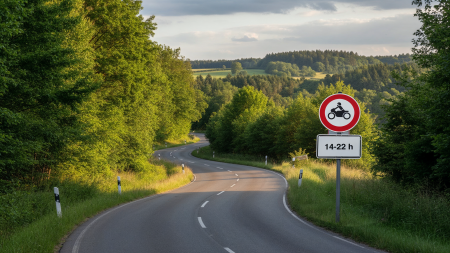
Motorcyclists are killed above all where municipal enforcement barely takes place. In 2025, 517 riders and pillion passengers of registered motorcycles died. Of those, 393 lost their lives on rural roads, 90 in built-up areas and 34 on motorways.
A total of 27,405 crashes involving personal injury were recorded in which a registered motorcycle was involved, with 31,151 casualties and 7,744 seriously injured. Among the riders’ own mistakes, inappropriate speed is the most common single cause: 6,618 of 19,121 recorded cases. For car drivers, the figure is 20,948 of 208,372 cases. The share is therefore around three times as high for motorcycles.
A legal particularity plays a role in enforcement itself. Germany has no keeper liability, only driver responsibility. If the driver cannot be identified in the enforcement photo, then according to the traffic law working group neither the rider nor the registered keeper faces consequences. Because motorcycles carry no number plate at the front and the rider wears a helmet, units that measure only from the front often result in no proceedings at all against motorcyclists. This circumstance is becoming less important, however, since according to the cities surveyed, units at junctions can now generally measure in all four directions of travel and record red-light offences at the same time. Hamburg also deploys nine unmarked video measuring vehicles fitted with front and rear cameras that record offences continuously on video.
Where the cities position their measuring devices
The municipalities provided information on their choice of locations in the survey themselves. According to their statements, stationary and semi-stationary units are placed at accident blackspots and at dangerous or poorly visible junctions. Mobile devices are used above all in areas requiring protection, for example near kindergartens, schools and care homes as well as in 30 km/h zones. The cities also cited noise and emissions protection as further reasons.
Hamburg illustrates how differently the two formats work. Stationary enforcement there brought in 7.2 million euros in 2025, after 11.3 million euros the year before. Mobile enforcement generated 34.6 million euros. The city attributes the decline at fixed units with a high degree of probability to the numerous roadworks, since traffic flows more slowly there anyway.
According to all the cities surveyed, the revenue stays entirely with the municipality and is not earmarked. It flows into the general budget, which funds among other things traffic calming measures and provision for cycling and walking. If a local court rules on a case, the money goes to the state treasury instead.
The ranking thus slots into a debate that has accompanied road safety in Germany for years. The analysis shows how much money the cities take in and how many devices they operate. It says nothing about how often measurements are actually taken, how many commuters and through-travellers are recorded, or whether the units stand at the most dangerous locations. These data are therefore not sufficient to draw conclusions about an individual’s risk of being caught or about the effectiveness of enforcement.
Frequently asked questions
-
Which city tops the German speed camera ranking?
Karlsruhe takes first place in the July 2026 analysis. For every registered car, 128 euros in fines are collected on paper, with total revenue of 17.8 million euros. The average across the 30 cities surveyed is around 39 euros.
-
Which year do the figures come from?
The analysis was produced in July 2026 and is based on data from 2025. The revenue figures come from a survey dated 15 July 2026 that records the year 2025. The accident figures from the Federal Statistical Office also refer to 2025.
-
Why does Munich collect so little in fines?
In Bavaria, speed enforcement largely sits with the state police, whose revenue does not flow into the city coffers. Enforcement is nevertheless intensive: Munich police headquarters recorded 178,272 speeding offences in 2025. Last place with 1.90 euros per car therefore mainly describes who is responsible.
-
Are motorcycles caught by stationary speed cameras?
Only to a limited extent, because many units measure exclusively from the front and motorcycles carry no number plate there. Without an identifiable rider there are no proceedings in Germany, as there is no keeper liability. Newer junction units can, however, measure in all four directions of travel.
-
How many people died from speeding in 2025?
According to the Federal Statistical Office, 29 percent of the 2,832 road deaths occurred in crashes involving excessive or inappropriate speed, which is 812 people killed. In 177 of those deaths the speed limit was also exceeded, while in 665 deaths the speed was too high without the limit being exceeded.
➜ This article is part of our comprehensive overview: Motorcycle Law & Policy: Legislation, Court Rulings and Developments for Riders. Find all key information on this topic in one place.