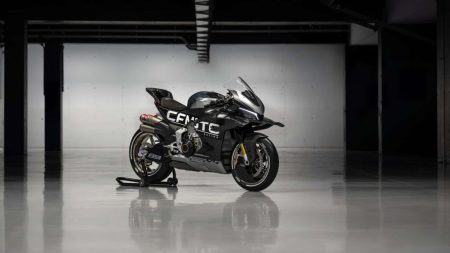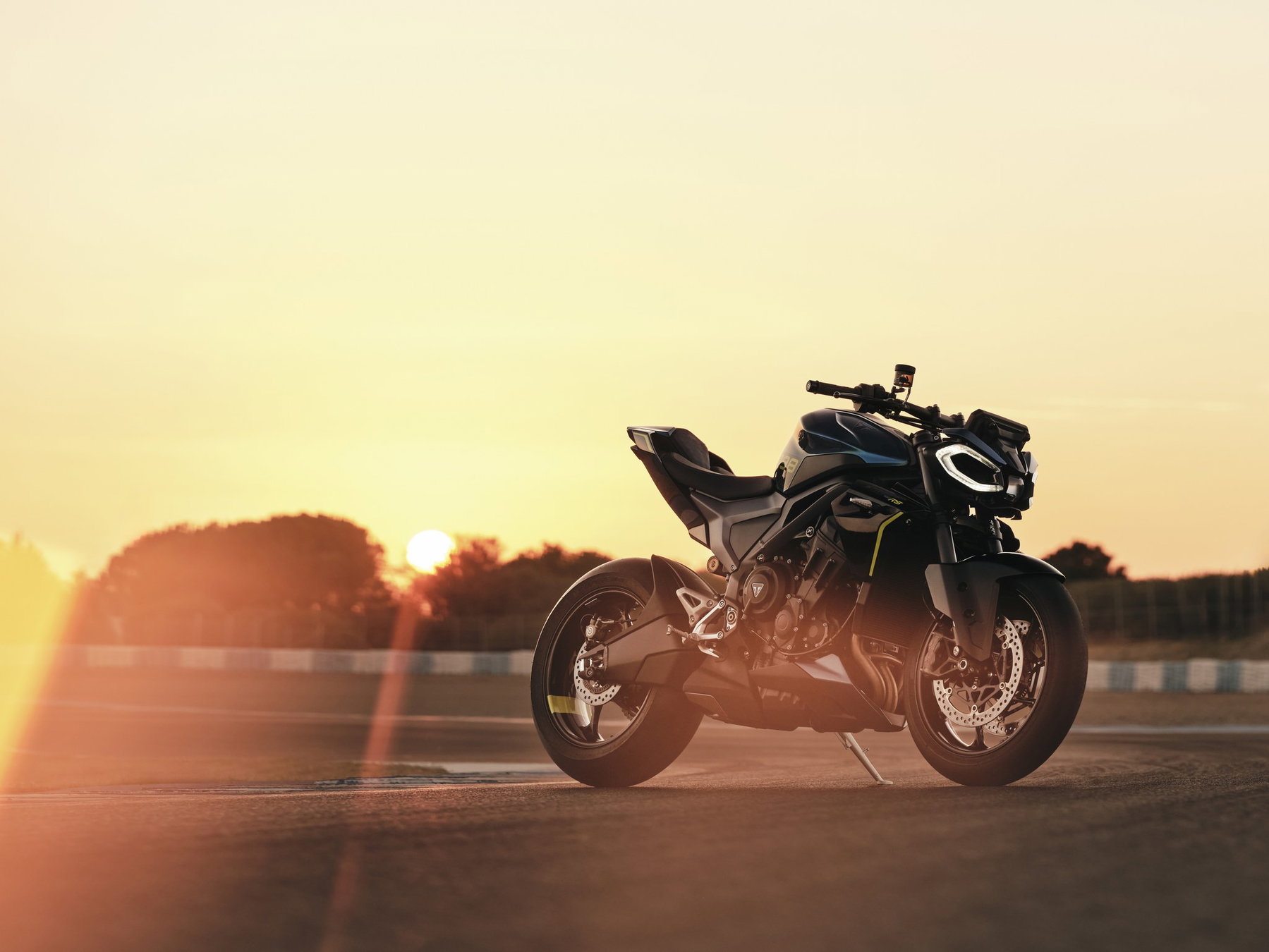
- 798 cc, 135 hp (99.3 kW) at 11,500 rpm and 86 Nm at 9,250 rpm
- 183 kg ready to ride, 5 kg less than its predecessor
- €13,995 in Germany, at dealers from the end of January 2027
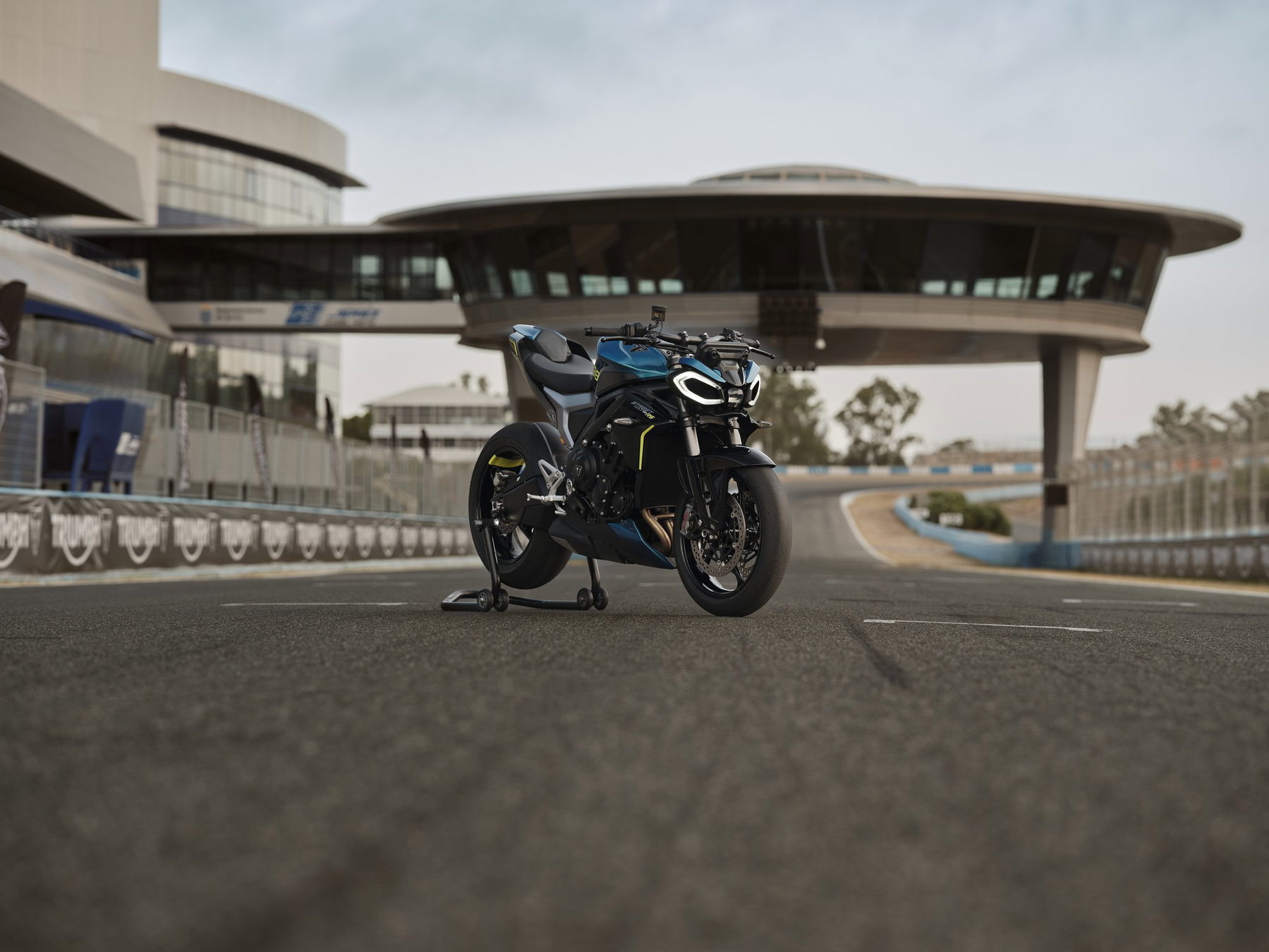
Triumph has been building the Street Triple since 2007, and with the 798 RS the era of the 765 now comes to an end. For the 2027 model year, the British manufacturer has not only increased displacement but also developed a new engine, frame, electronics and design. The impetus came from Moto2: from the 2027 season onwards, every team in the class will race with a new 798 cc triple from Triumph, and the production bike’s engine stems directly from that development. Triumph announced the Street Triple on 6 October, and it was then shown at EICMA 2026 in Milan, but the technical specifications were kept under wraps until now. After the Bonneville T40 and the new Tiger 1200, it is the third major Triumph newcomer among the new motorcycles for 2027. During an online presentation for journalists, the engineers also explained many details that do not appear in the official documents.
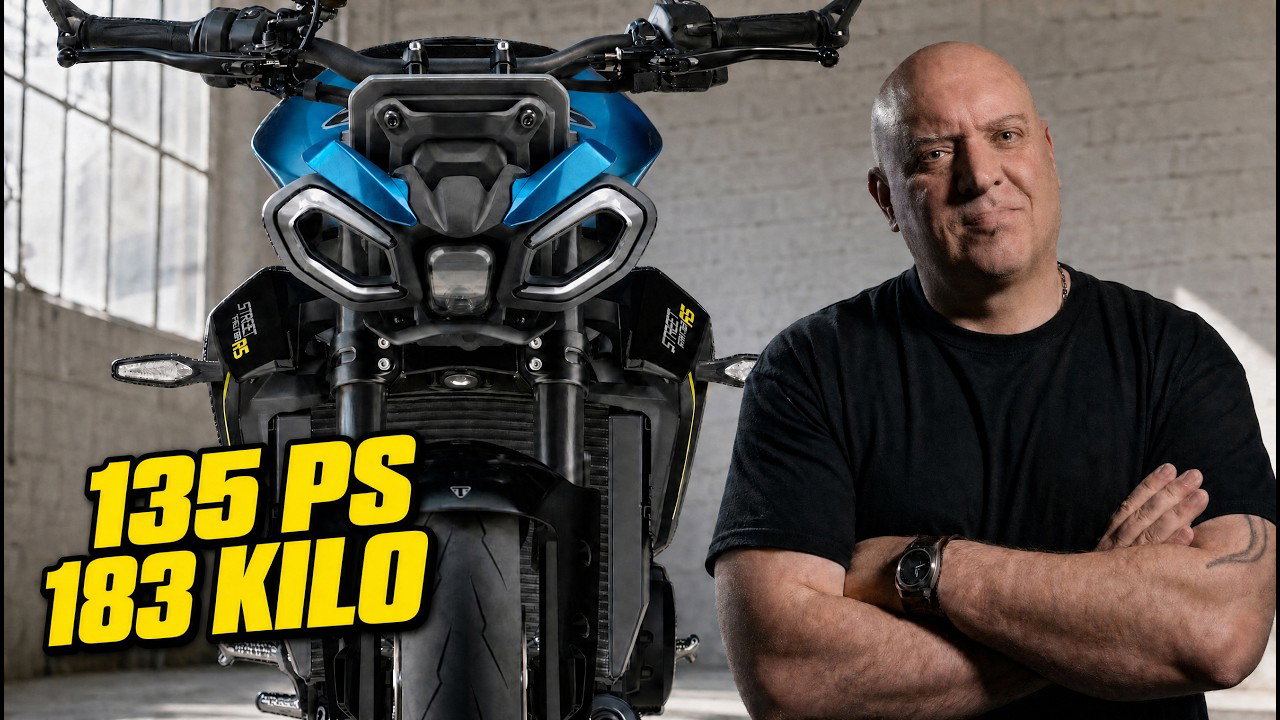
Video language available in English and German
How much Moto2 is in the Street Triple 798 RS engine?
According to Triumph, more than 90 percent of the parts in the road engine and the Moto2 race engine are identical. The differences mainly concern the high-rev range and components a race bike does not need.
The Moto2 engine uses camshafts with profiles even more focused on top-end power. These are paired with stiffer valve springs and titanium intake valves. The race engine revs slightly higher, has a more closely spaced gearbox and does without a starter motor and starter drive, because the bikes are push-started on the grid. The price for this: it has to be rebuilt every three race weekends. The Street Triple, by contrast, makes do with a service interval of 10,000 km or 12 months, the same schedule as the 765.
Triumph has supplied the spec engines for Moto2 since 2019 and has accumulated more than two million racing kilometres in that time. The current contract with the series organiser runs until 2029. The lessons learned from racing and from endurance testing have flowed directly into the new engine. Triumph sees the main benefit in durability: an engine that has to withstand the stresses of a world championship should also last a long time on the road. Product chief Steve Sargent describes the Street Triple as a link between road and track, because it not only supplies the Moto2 engine but is also the bike to beat in the World Supersport Championship and in the British BSB series.
Does the Street Triple 798 RS use the Trident 800 engine?
No. Bore (78.0 mm) and stroke (55.7 mm) are identical, but beyond that the two triples share hardly any parts. The cylinder head and cylinders are completely different, and there is little in common in the lower part of the engine either. Triumph designed the engines of the Trident 800 and the Tiger Sport 800 for low- and mid-range pull and relaxed riding. With the Street Triple’s engine, peak power was the priority.
What is new about the 798 cc triple?
Practically everything. The crankcase, cylinder head, valve train, combustion chamber, intake, exhaust and gearbox are new, while the clutch, primary drive, cooling and lubrication have been revised for the higher output.
The most important change is in the cylinder head. The valves are no longer actuated by heavy bucket tappets but by lightweight finger followers with a DLC coating. DLC is a diamond-like carbon layer that reduces friction and wear. Because less mass is moved, the valves can open and close faster. This allows more aggressive cam profiles that keep the valves open longer, as well as stiffer valve springs. Larger valves and a higher compression ratio of 13.5:1 are added. The new head is also around half a kilogram lighter. This is achieved, among other things, by individual bearing caps for the camshafts instead of one large continuous bearing frame, and by slimmer bearing journals.
All told, the triple produces 135 hp (99.3 kW) at 11,500 rpm and 86 Nm (63 lb-ft) at 9,250 rpm. According to Triumph, torque is around 10 percent higher than the 765’s across the entire rev range, and even a little more in some areas. As before, the rev limiter kicks in at 12,650 rpm, working in a soft and a hard stage. Triumph itself calls the 798 the most powerful engine in the middleweight class.
Air enters a larger airbox through two openings to the left and right of the steering head, combined with new intake ports and new injectors. The air path runs directly through the two daytime running lights, which therefore serve more than just a styling purpose. The sound benefits too: the intake noise is said to be even more present for the rider than on the 765, while the triple howl typical of the Street Triple remains.
On the exhaust side, a stainless-steel 3-into-1 header feeds a silencer under the engine with two downward-facing outlets. The system is significantly smaller than before. Gear changes are handled by a six-speed gearbox with a slipper clutch and adjustable clutch lever, and power is sent to the rear wheel via an X-ring chain.
Why is the Street Triple now only available as an RS?
Because the Trident 800 has now taken over the role of the versatile all-rounder that used to be covered by the Street Triple R and S. This allowed Triumph to give the Street Triple a much sportier focus.
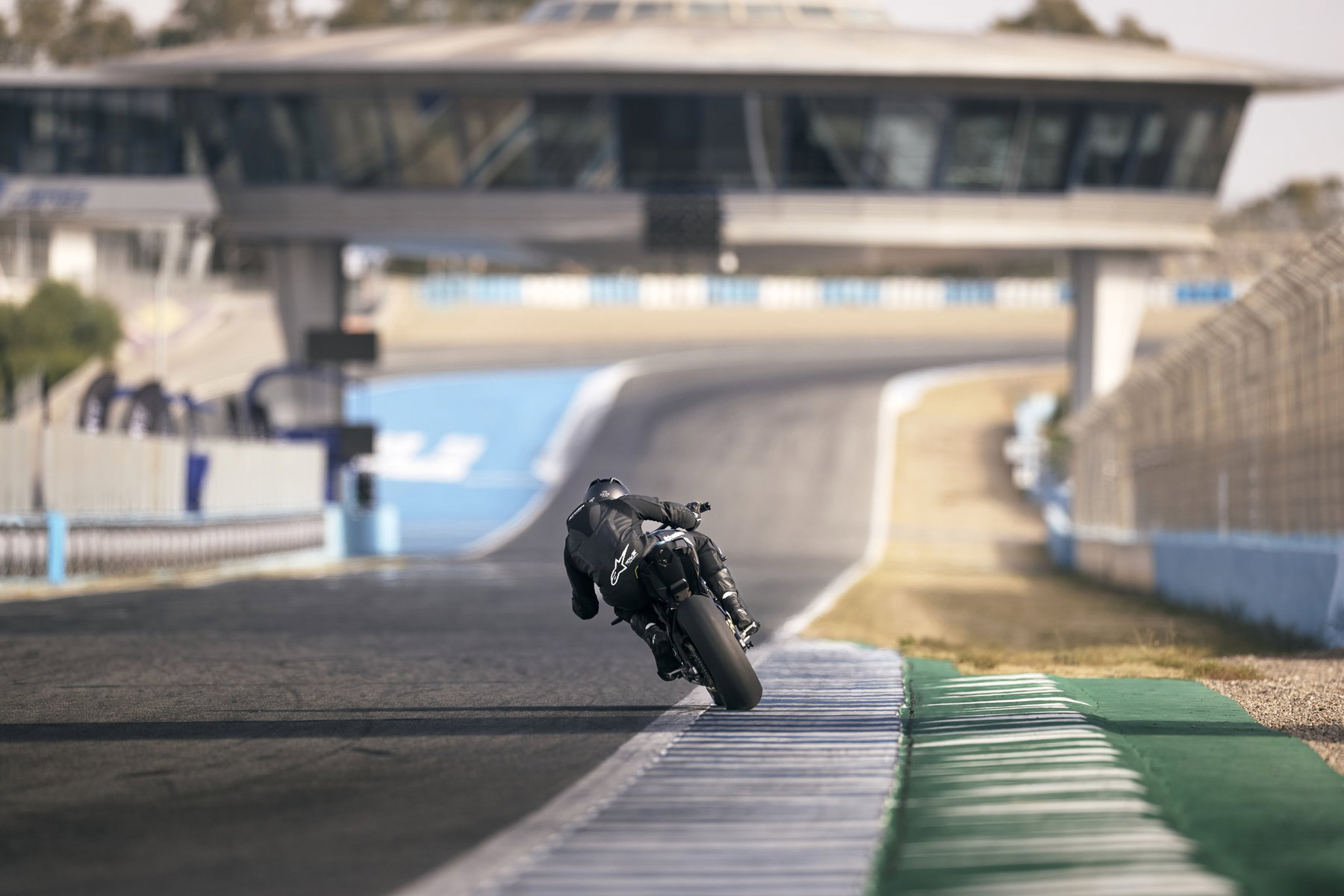
The clear separation is intended to give both models their own profile. According to the engineers, however, the 798 RS is not a pure track bike and should still work well on country roads.
Triumph does not offer an A2 version with 35 kW for novice riders. Anyone wanting to start out on a graduated licence is referred to the restricted versions of the Trident and Tiger Sport, which can be de-restricted after passing the test for a full licence. Triumph has not commented on possible spin-offs such as the previous special editions 765 RX and 765 Moto2 Edition.
Where did Triumph save 5 kg on the Street Triple 798 RS?
In many places at once. With its 15-litre tank full, it weighs 183 kg (403 lbs), 5 kg (11 lbs) less than its predecessor, despite carrying considerably more technology.
The foundation is a new twin-spar frame made of cast and formed aluminium parts, with a subframe also made of aluminium. The tank is now aluminium and, as on the 765, still holds 15 litres. Add to that the lighter cylinder head and the more compact exhaust system. Because the engineers could start from scratch and were not tied to any parts of the old model, they say they trimmed small amounts of weight everywhere.
The exhaust under the engine brings a second advantage: the mass sits more centrally and lower, lowering the centre of gravity. On paper, this results in a power-to-weight ratio of around 1.36 kg per hp. Triumph speaks of the best power-to-weight ratio in its class and states that, according to its own comparative measurements, the Street Triple accelerates faster than any other motorcycle in this class.
What has changed in the chassis?
The frame, swingarm, linkage and geometry are new. The goal was quicker turn-in without losing the neutrality and stability the Street Triple is known for.
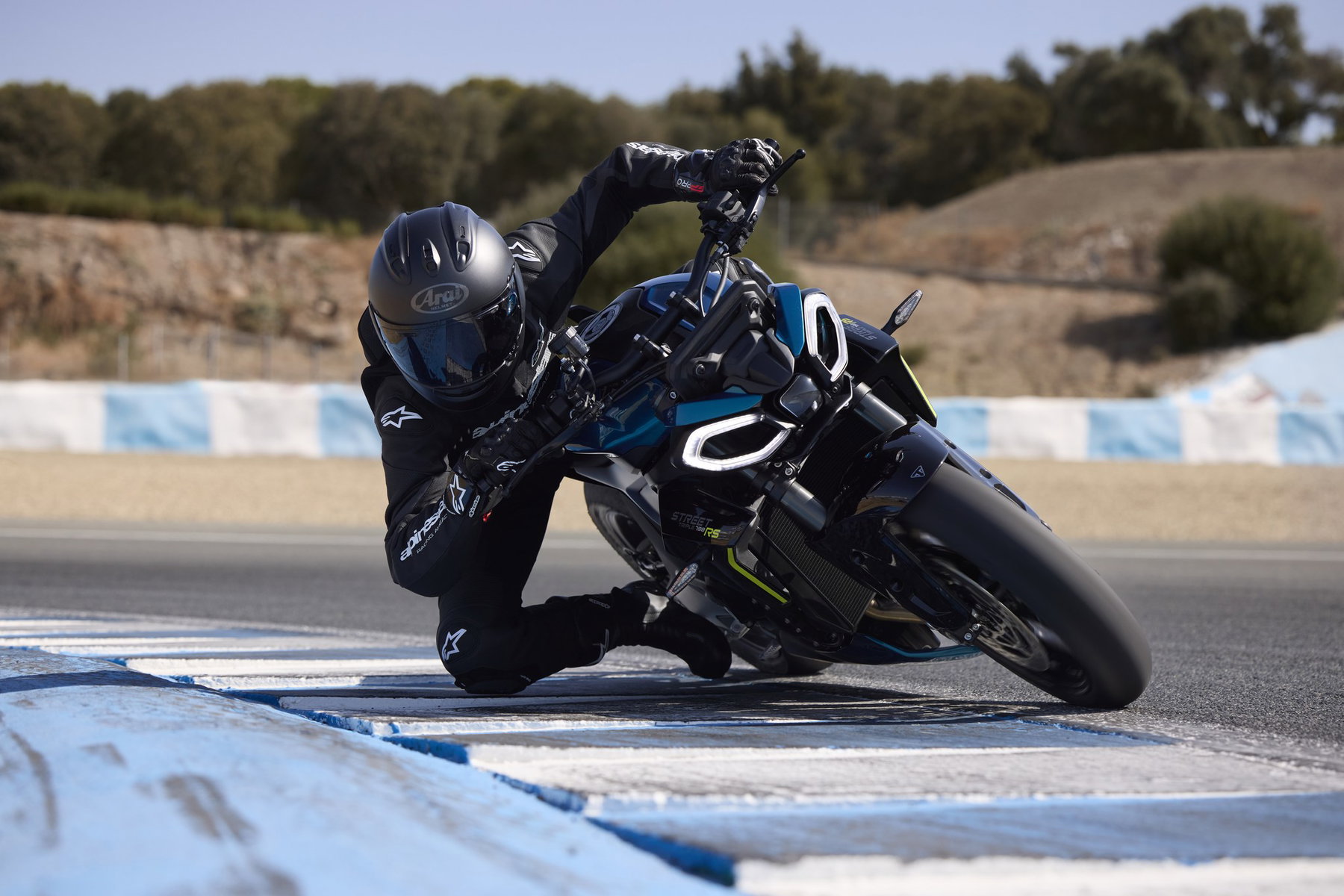
The steering head is steeper at 23.1 degrees, trail is shorter at 92.5 mm, and the wheelbase measures 1,409 mm. The lower weight helps here, because the suspension has less mass to control and can be tuned accordingly. In corners, the bike is said to feel planted despite the easier turn-in. There is also more lean-angle clearance for the track.
The Moto2-style swingarm is made of pressed aluminium parts and castings. It has a much taller profile and is stiffer than on the predecessor. The main frame, on the other hand, is about as stiff as before; Triumph saw no need for change there. Frame, engine, swingarm and suspension were tuned as one system.
One important change is hardly visible from the outside: the shock linkage no longer sits below the swingarm but above it, hidden behind the exhaust. As a result, the shock stands much more upright. This solution also comes from racing. On the Supersport race bike, the rear tyre rubbed against the old linkage as soon as the rear wheel was moved far forward. As a result, the team could not shorten the wheelbase as much as it wanted.
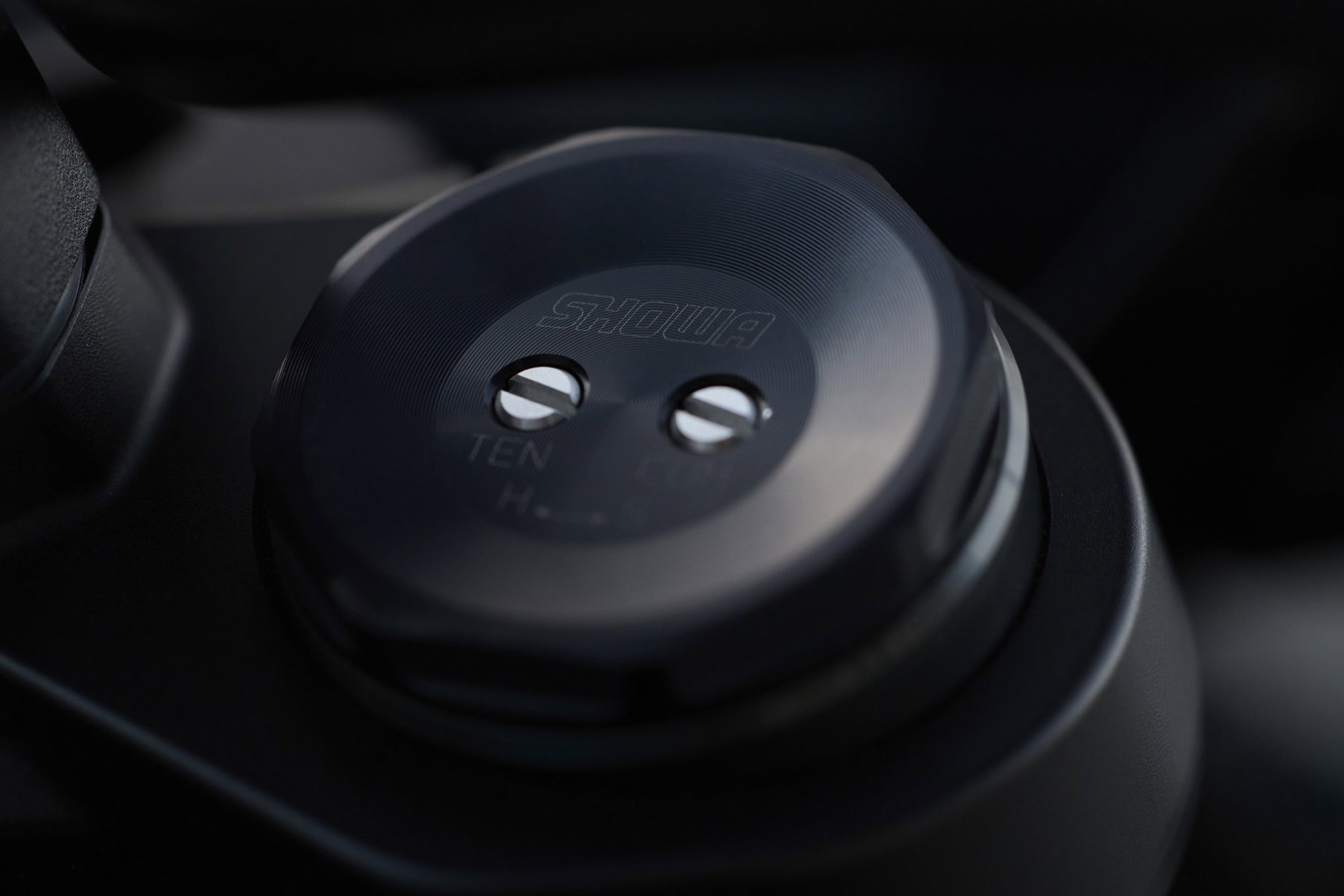
Up front is a fully adjustable Showa Big Piston Fork with 41 mm stanchions and 120 mm of travel. The fork is shorter and therefore stiffer. At the rear, an Öhlins STX46 with a piggyback reservoir and 130 mm of travel handles suspension duties, adjustable for preload, compression and rebound.
Braking is handled by Brembo Stylema four-piston monobloc calipers gripping two floating 310 mm discs. The radial Brembo MCS master cylinder is adjustable for lever span and ratio, allowing the rider to tailor bite point and lever feel. At the rear, a 220 mm disc with a single-piston floating caliper does the work. The 17-inch cast wheels wear Pirelli Supercorsa SP-V3 tyres developed for the World Superbike Championship, in sizes 120/70 ZR 17 and 190/55 ZR 17.
Why does the Street Triple now run a 190 rear tyre?
Because Triumph designed the swingarm from the outset for Supersport racing, where a 190 is used anyway. The predecessor’s swingarm was not built for this, which limited wheelbase adjustment on the race bike. In tests with 180 and 190 mm tyres, the wider tyre suited the new geometry best, and it is also said to offer more grip at full lean.
What is the seat height of the Street Triple 798 RS?
As standard, the seat sits at 836 mm. With accessories, the seat height can be lowered by up to 45 mm to 791 mm.
This is achieved with a different shock linkage, which brings 15 mm, and a lower seat that saves another 30 mm. The new handlebar is 20 mm wider, sits slightly closer to the rider and is rubber-mounted. The longer leverage is meant to make turn-in easier, while the rubber mounts are intended to improve comfort. Across the bar ends, the Street Triple measures 811 mm; it is 2,036 mm long and 1,105 mm high without mirrors. It does not have a heated seat.
What rider aids does the Street Triple 798 RS have?
Triumph has greatly expanded the electronics package. The main new features are launch control, adjustable wheelie control and traction control that also manages rear-wheel drifting.
The basis is a six-axis IMU, a sensor that measures the bike’s lean angle, acceleration and rotational movements. Built on this are cornering ABS, cornering-optimised traction control and Traction Control Plus with rear-wheel slip control, plus engine braking control. All systems can be adjusted on the move via the display.
Seven riding modes are available: Eco, Rain, Road, Sport and Track are preset, while Rider A and Rider B are freely configurable. In Eco mode, the throttle responds more gently and a shift indicator recommends upshifts or downshifts depending on revs and load. The selected settings are retained after the ignition is switched off.
For launch control, the rider selects the mode in the display, opens the throttle fully and releases the clutch. The electronics regulate revs and power so that the bike accelerates as hard as possible while keeping the front wheel just above the tarmac. Speed Triple riders will be familiar with the wheelie control: the rider sets how high the front wheel may rise, and the system holds that attitude, even during upshifts. The Street Triple does not have radar-based assistance systems.
Triumph calls its quickshifter Shift Assist; it works in both directions, with an auto-blipper automatically matching revs on downshifts. Triumph has revised the shift geometry and refined the calibration, and in its own assessment it is the best quickshifter the brand has built so far. The cruise control can be adjusted in small increments via the switches and stays active when the rider changes gear. For the track, there is a lap timer in the display. A tyre pressure monitoring system is available as an option, showing the readings directly in the display.
How do the display and smartphone connectivity work?
The Street Triple 798 RS has a new 7-inch Bosch TFT display with a touchscreen. Apple CarPlay and Android Auto come as standard and run wirelessly.
This brings navigation, music, phone and messaging apps to the display, with the map view filling the entire screen. The touch function only works below 2 km/h. On the move, the joystick on the left switchgear or voice control via Siri and Google Gemini take over. Full functionality requires a compatible Bluetooth headset, and Triumph showed the new Sena 60X for this purpose.
The capacitive display automatically adjusts its sensitivity depending on whether it is operated with or without gloves. A light sensor regulates the brightness, the glass is anti-glare and optically bonded, and the IP6K9K rating stands for dust and water resistance. There are no new menu languages, not even Polish. In the CarPlay and Android Auto views, however, the language set on the phone appears. The cockpit has a USB-C socket with fast charging, and the switches are backlit with two freely assignable buttons.
Design: twin headlights reimagined
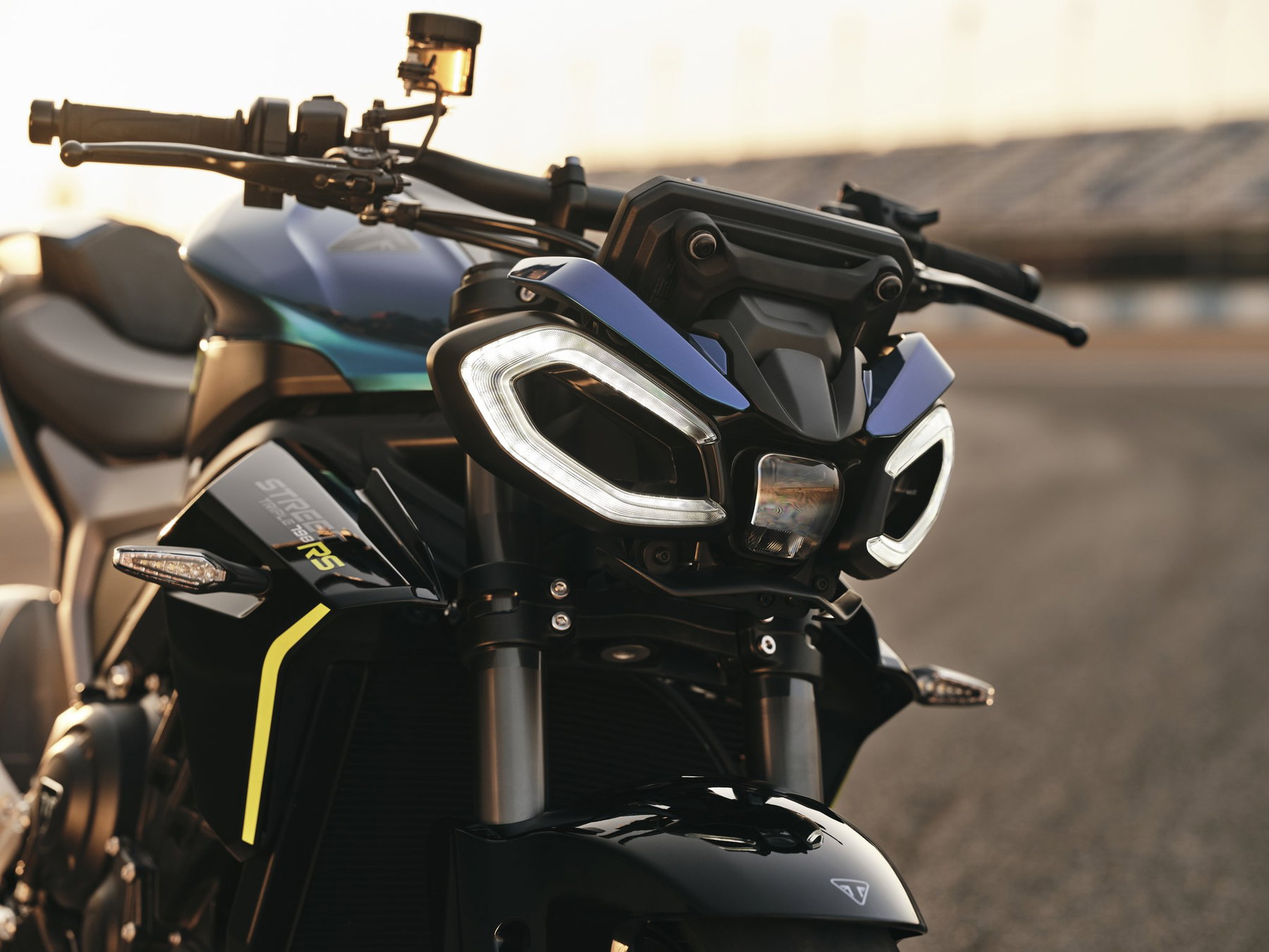
At first glance, the Street Triple is still recognisable as a Street Triple; Triumph deliberately kept the typical twin-light face. What is new is that this signature now comes from two daytime running lights, while an LED projector headlight beneath them illuminates the road. In the USA, the daytime running lights are dimmed to the brightness of a position light due to local regulations.
The headlight features a multi-stage cornering light. At 15 and 30 degrees of lean, additional LED elements in the projector switch on one after the other to illuminate the inside of the bend. The system automatically switches between daytime running light and low beam as lighting conditions change. There is no longer a separate tail light; this job is taken over by the multifunction indicators at the rear. The configurable indicators glow white at rest and switch to orange when signalling. Under emergency braking, the lights automatically warn following traffic.
The new direction is most evident at the rear. The swingarm and subframe deliberately take their cue from Moto2. Cables, hoses and lines around the steering head are routed out of sight. The number plate holder and pillion footpegs can be removed for track use.
What accessories are available for the Street Triple 798 RS?
For the first time, Triumph is offering its own performance accessory line, developed together with the specialist Gilles. In addition, there are carbon parts and an Akrapovič silencer.
Gilles supplies five-way adjustable levers, lever guards with their own geometry for the Street Triple, an oil filler cap and a set of rearsets. The footpegs can each be adjusted in three steps forwards and backwards as well as up and down, which also allows a sportier riding position. Parts that increase engine output are not included. There will be no clip-ons either.
In carbon, there is a rear hugger, a front mudguard, heel guards, a headlight surround and a small windscreen that sits above the headlights in front of the display.
The Akrapovič silencer is made entirely of titanium, with carbon end caps and a laser-engraved logo. It is homologated and works with the standard mapping. This slip-on solution is possible because the new exhaust system has an additional separation point between the catalytic converter and the silencer. All accessories can be found in Triumph’s online configurator.
Where will the new Street Triple race?
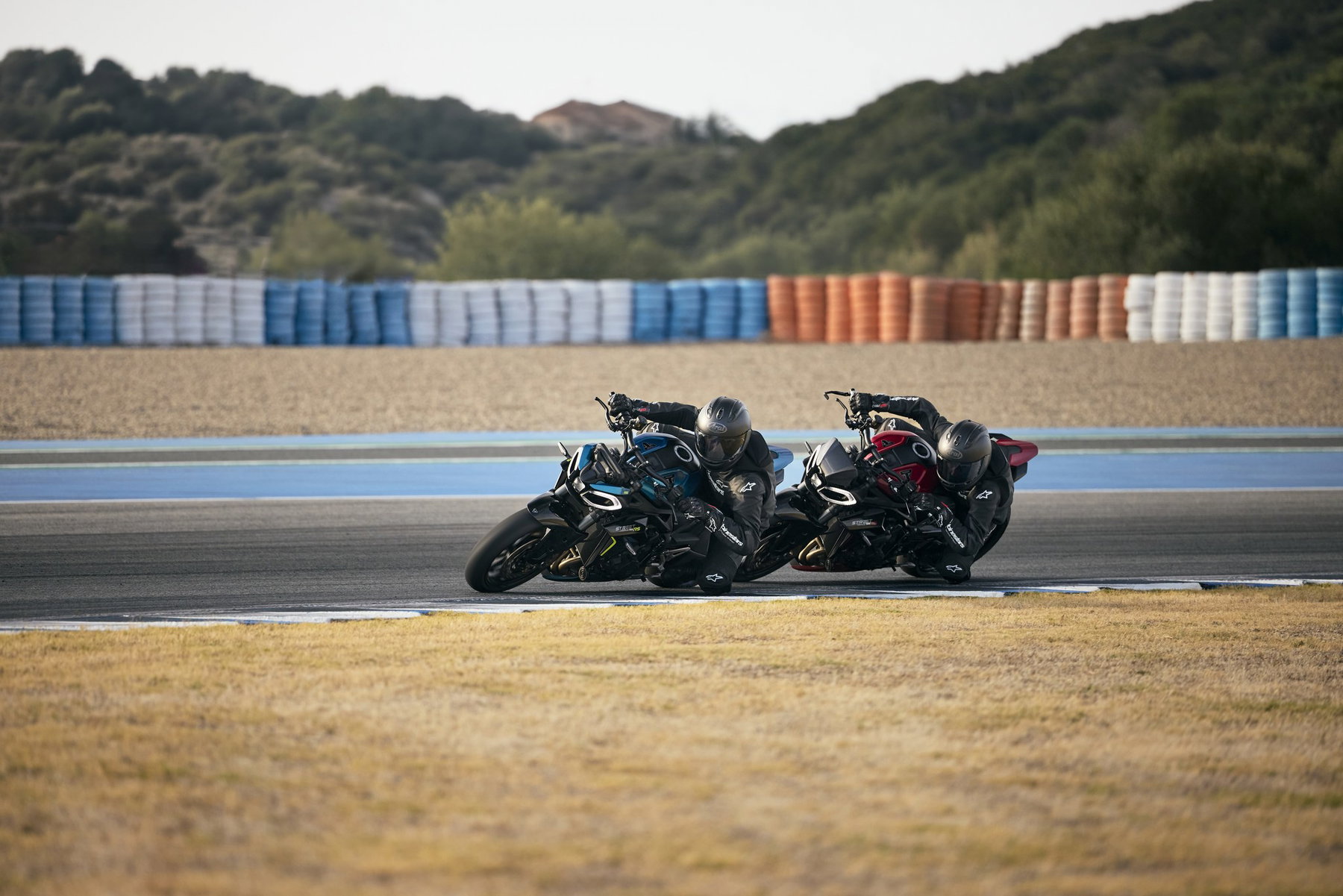
The Street Triple 798 RS will compete in the 2027 World Supersport Championship with the Renegade Triumph Factory Racing team. PTR Triumph Racing and Compos Racing remain on board as factory-supported teams.
In the British Supersport Championship, Macadam Triumph Factory Racing will continue to compete. Oli Bayliss finished third there in 2026, even though he only joined during the season. Triumph is developing its own fairing for racing. It is also set to be available to privateers through the factory team, so the Street Triple can be converted into a race or track day bike. Triumph is not planning a road-going Daytona 798, however; the fully faired Supersport machine remains reserved for the track.
How much does the Triumph Street Triple 798 RS cost?
In Germany, the Street Triple 798 RS costs €13,995 (approx. $15,465) including VAT, plus on-the-road charges. The first bikes are expected at German dealers at the end of January 2027.
In Austria, the price is €15,995 (approx. $17,680) including VAT and NoVA tax. Italy lists €13,995 (approx. $15,465), Spain €14,595 (approx. $16,130). In Switzerland it costs CHF 14,495 (approx. €15,645 / $17,290), in the UK £12,995 (approx. €15,550 / $17,190). It can already be ordered in several countries, but the first bikes will not reach dealers there until February 2027.
The colour options are the premium colours Interstellar Blue and Carnival Red, plus Sapphire Black as the standard colour. Triumph quotes fuel consumption at 5.2 litres per 100 km, corresponding to CO₂ emissions of 118 g/km under Euro 5+. With the 15-litre tank, that gives a theoretical range of just under 290 km.
Frequently Asked Questions
-
How much does the Triumph Street Triple 798 RS cost in Germany?
The price is €13,995 including VAT, plus on-the-road charges. In Austria it is €15,995. Deliveries in Germany are set to begin at the end of January 2027.
-
How much horsepower does the Triumph Street Triple 798 RS have?
The 798 cc triple produces 135 hp (99.3 kW) at 11,500 rpm. Maximum torque is 86 Nm at 9,250 rpm, and the rev limiter kicks in at 12,650 rpm.
-
Is there an A2 version of the Street Triple 798 RS?
No. Triumph does not offer a 35 kW version and refers A2 riders to the Trident and the Tiger Sport. There is also no longer an R or S version of the Street Triple.
-
How many parts does the Street Triple share with the Moto2 engine?
According to Triumph, more than 90 percent of the engine is identical. Among other things, the race engine has different camshafts, titanium intake valves, a more closely spaced gearbox and no starter motor.
-
How heavy is the Street Triple 798 RS?
With a full tank it weighs 183 kg, 5 kg less than its predecessor. The aluminium tank holds 15 litres.
➜ Find all technical specifications for this model in our motorcycle database: Triumph Street Triple 798 RS 2027.