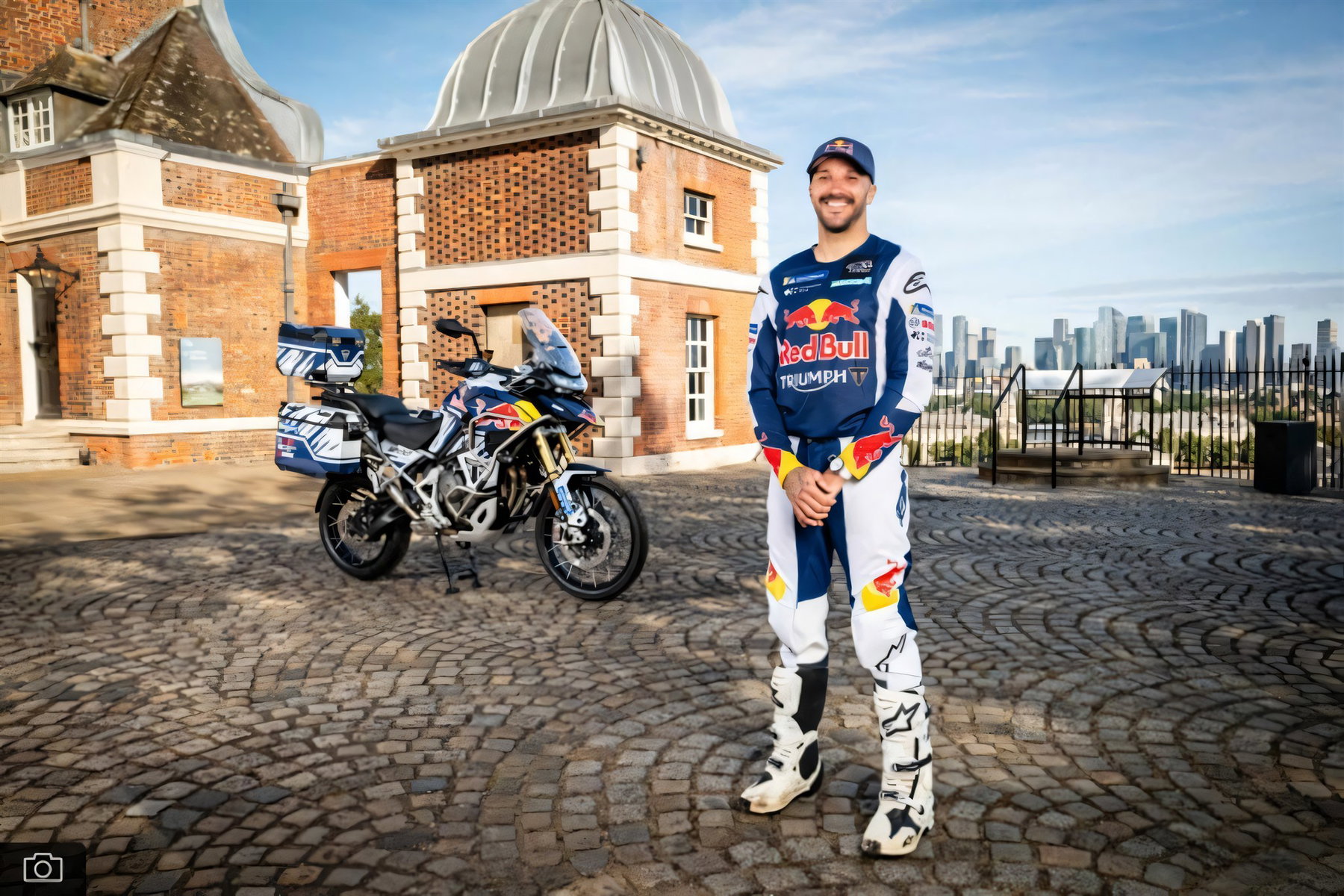
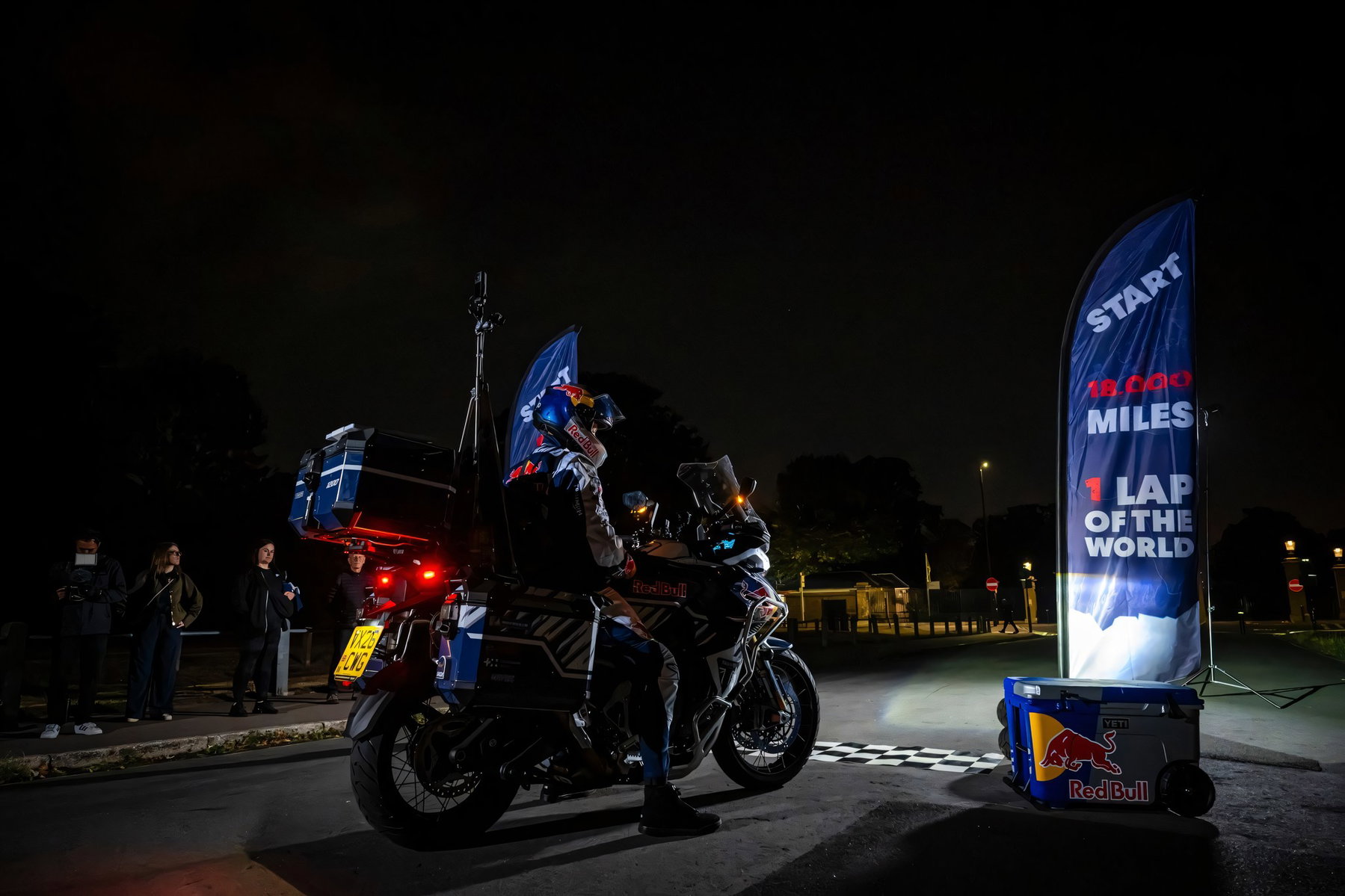
- Start on 5 September 2026 in Greenwich, with 19 days, 8 hours and 25 minutes to beat
- At least 18,000 miles (28,970 kilometres) on the bike, five continents, six riding legs
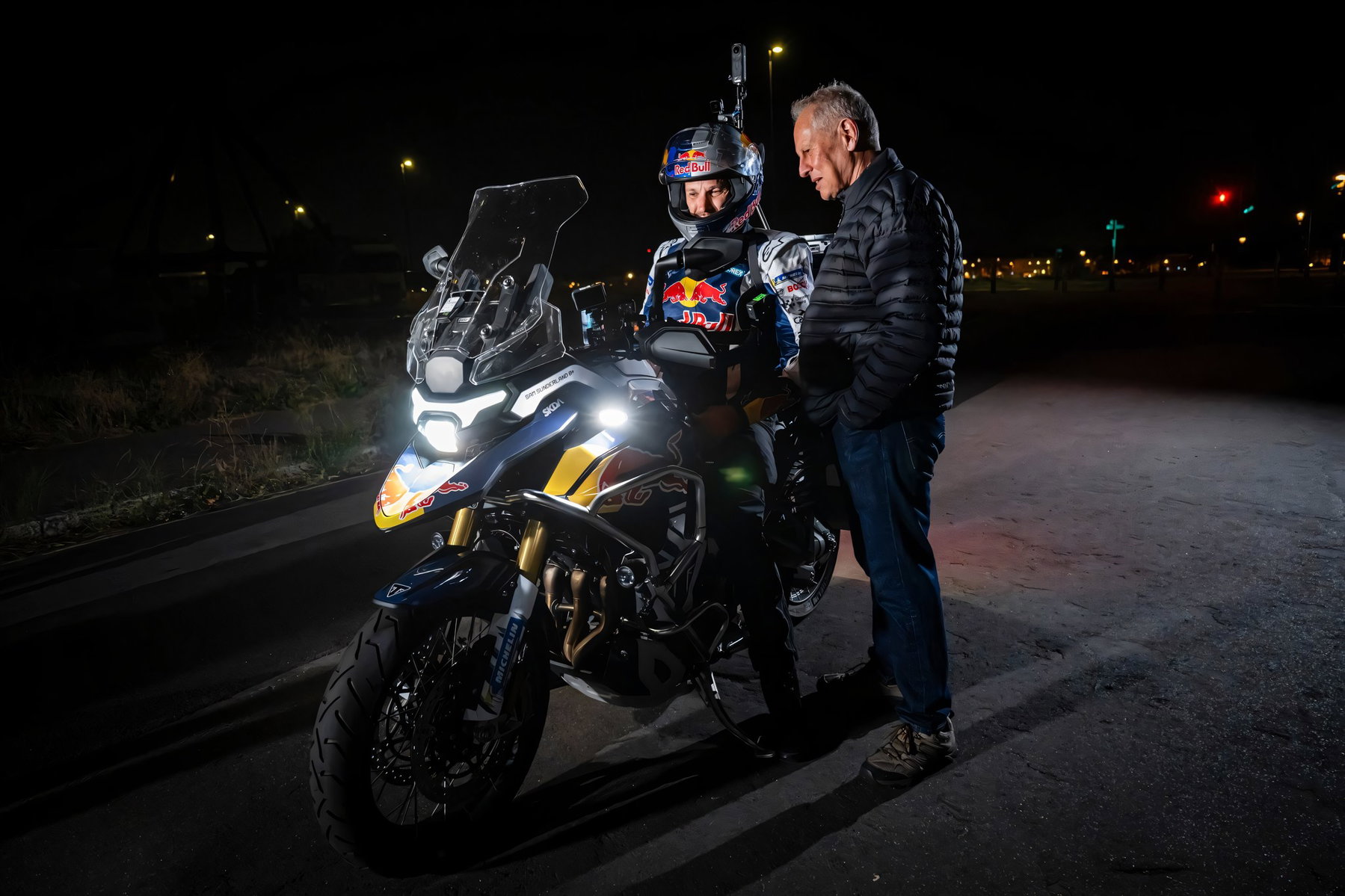
- The start photos show a facelifted Tiger 1200 that Triumph has not announced
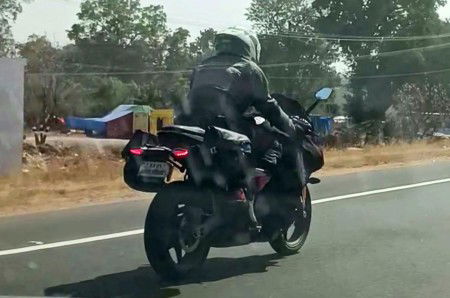
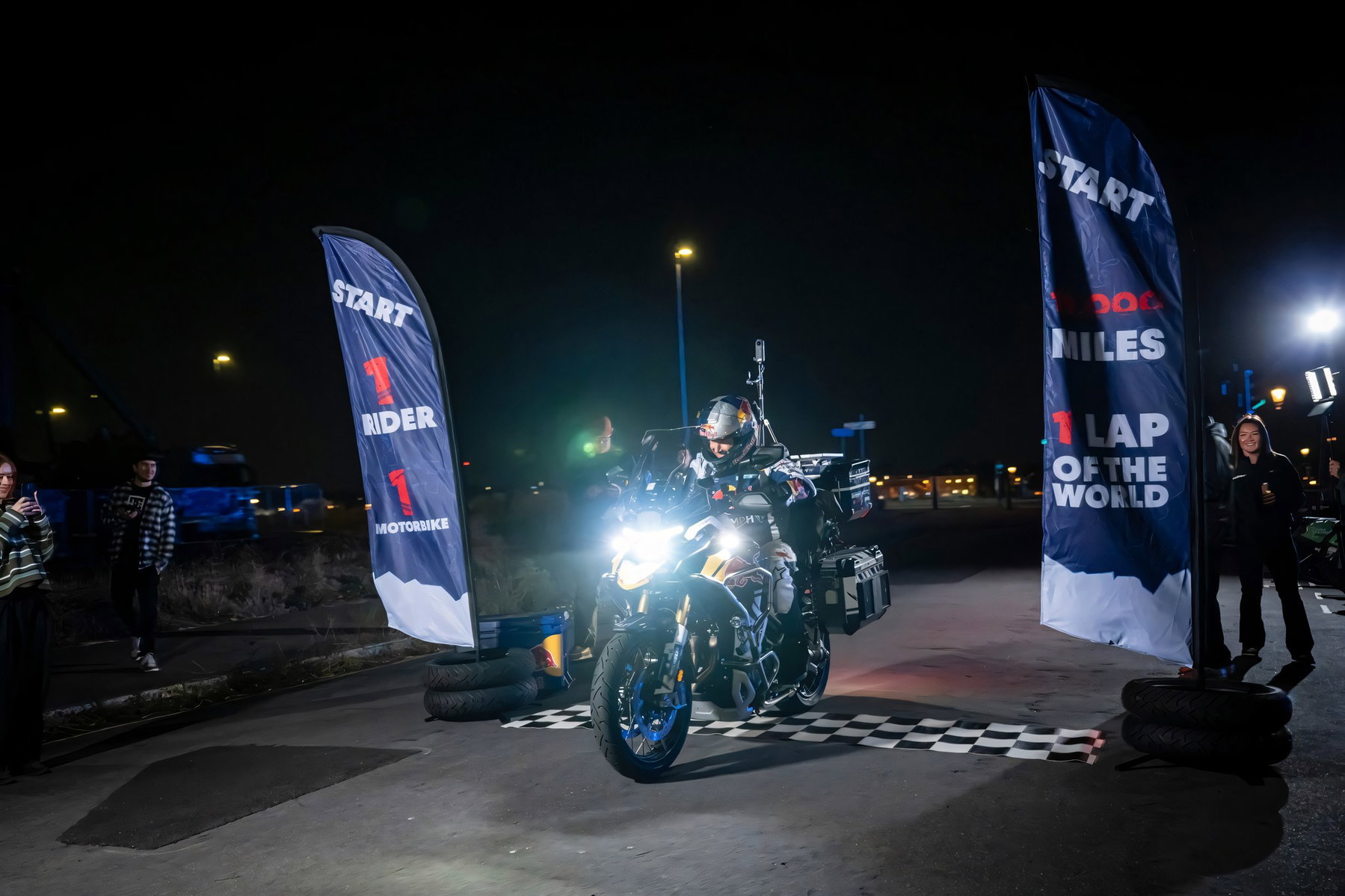
Triumph had promoted the record attempt with press images showing Sam Sunderland on a familiar Tiger 1200 Rally Explorer. On the day of the start, the two-time Dakar winner then published photos and videos on his own social media profiles. They show a noticeably different motorcycle. The machine wears the same Red Bull livery but differs clearly from the production model in several details. What was meant to be a pure record run has therefore also become a model preview.
What changes does the new Triumph Tiger 1200 show for 2027?
The most striking features are the new LED headlights and a sensor above the front end. Added to that are a redrawn beak and a changed shape for the tall screen.
The sensor above the headlights points to a front radar. With it, Triumph complements the rear radar already fitted, which monitors the blind spot. A front radar is the technical basis for adaptive cruise control and for warning systems that alert the rider to approaching or braking vehicles. The tail lights also look different from those on the current model. The photos from the start match spy shots of the next Tiger generation that had already been circulating. Asked about it by media representatives, a Triumph spokesperson would not comment and said only: „No comment.“
What stays the same on engine and chassis?
No changes to the engine or chassis can be seen in the images. This is therefore likely to be a facelift with expanded electronics rather than a complete new development.
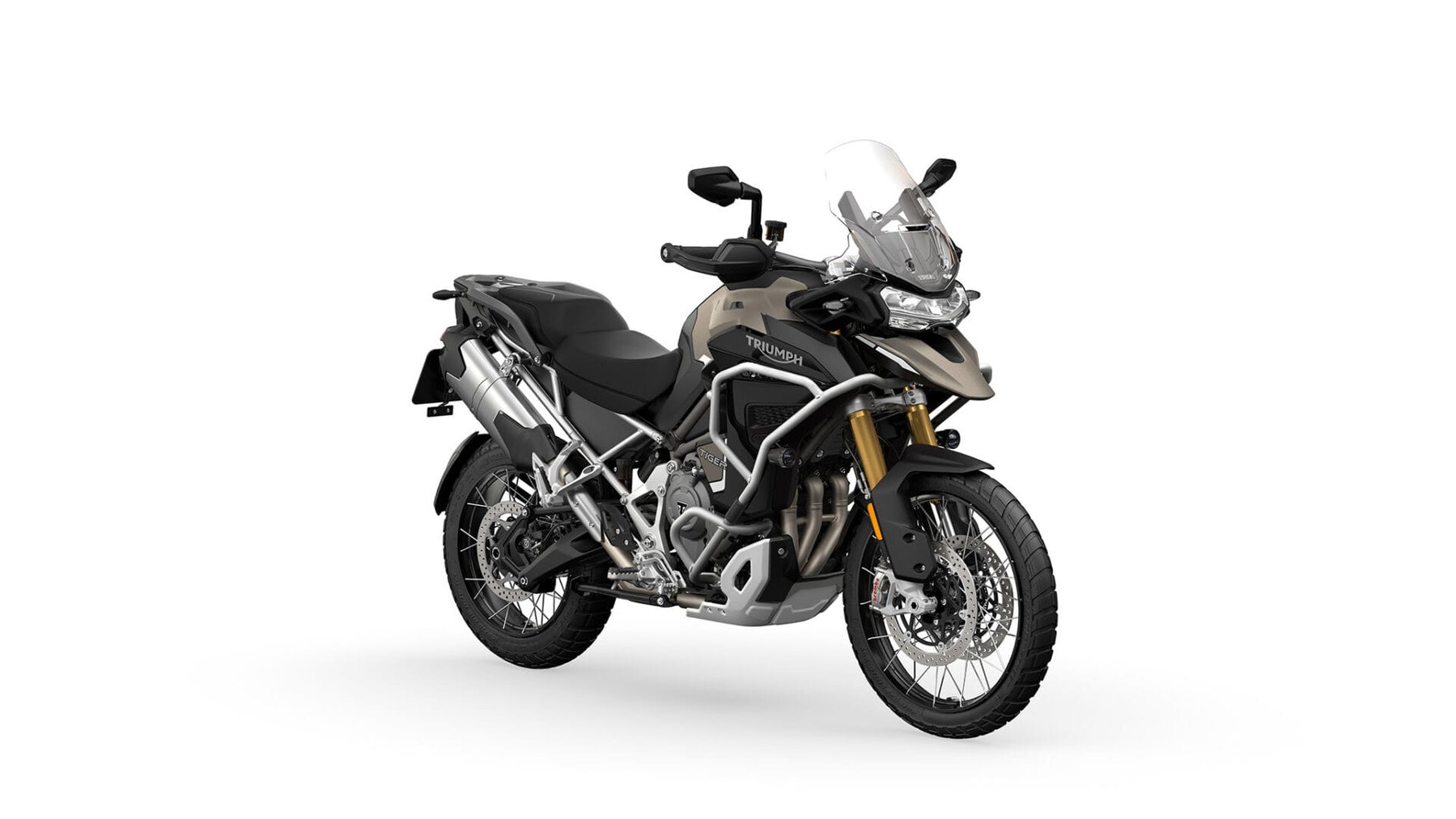
To date, the Tiger 1200 Rally Explorer runs an inline three-cylinder engine of 1,160 cubic centimetres. It produces 150 hp (110 kW) and delivers 130 Nm (96 lb-ft). Ready to ride with a full 30-litre tank, the Rally Explorer weighs 262 kilograms (577 lbs). The only open question concerns the size of the tubeless cross-spoked wheels. So far the Rally Explorer runs 21 inches at the front and 18 inches at the rear, which positions it clearly towards off-road use. In the start photos, the front wheel looks more like a 19-incher. That would be a shift towards adventure touring and would suit the purpose of the record run. Triumph is likely to show the 2027 model year officially at EICMA in November 2026 at the latest.
Which route is Sam Sunderland riding?
The route consists of six riding legs, with the motorcycle transported by air freight in between. It starts and ends in London.
The first section runs from London to Istanbul. Next comes Southeast Asia with the stretch from Bangkok to Kuala Lumpur. In Australia, the route crosses the continent from Perth to Sydney. In New Zealand, Sunderland rides from Christchurch to Auckland. The longest leg awaits in North America, between Vancouver and Montreal. Finally there is the ride from Casablanca back to London. Along the way he passes the Bonneville Salt Flats, among other places, and crosses the Australian outback. At least 18,000 miles must be covered on the bike, that is 28,970 kilometres. Including the transfers, the complete circumnavigation covers 24,900 miles according to the organiser.
What are the rules for the record?
The record follows a fixed set of rules that applies without exceptions. Rider and motorcycle must cover the entire riding distance together.
The direction of travel must not be reversed during the whole journey, so it goes continuously east or continuously west. Start and finish must be at the same place. Two antipodal points are mandatory, meaning two locations exactly opposite each other on the globe. Changing motorcycles is not permitted, and Sunderland must remain the only rider. The clock runs only while riding. It is paused during the transfers between continents. The entire ride is documented and verified afterwards.
Why does the record no longer count with Guinness?
Guinness World Records no longer lists this category for safety reasons. The record nevertheless still exists, but only according to the classic set of rules and without official ratification.
Sunderland is sticking to exactly that traditional rulebook. For recognition within the scene, seamless documentation is therefore decisive. That also explains why every kilometre and every break is recorded.
Who has held the record since 2002?
The benchmark of 19 days, 8 hours and 25 minutes belongs to Kevin and Julia Sanders. The British couple set it in 2002 on a BMW R 1150 GS.
Back then, the pair covered 19,461 miles, around 31,300 kilometres across five continents. The time has stood for more than two decades since. Kevin Sanders supports the current attempt and has explained his experience and the applicable requirements to Sunderland. He talks about records being there to be broken, and about Sunderland facing entirely new challenges. On the day of the start in Greenwich, the two met once more in person.
What the attempt demands of the rider
To beat the time, Sunderland has to manage almost 1,000 miles a day, around 1,600 kilometres. That is roughly the length of Great Britain, and on every single day.
For comparison: at the Dakar Rally, daily stages usually run between 500 and 900 kilometres. According to Triumph, Sunderland spends up to 17 hours in the saddle on some days. He himself expects 15 to 16 hours in cold, rain, heat and wind, and puts it simply: “It’s going to be brutal.” On top of the physical load come sleep deprivation, jet lag and constantly changing road conditions. Across the time zones, it all adds up.
Sunderland had already wanted to attempt the record in 2025 but had to postpone his plans after breaking his back. Months of rehabilitation and training followed, along with a start at the Red Bull Romaniacs on a Triumph Tiger 900. According to the team, the attempt demands not only speed but smart planning, discipline and the ability to handle the unexpected.
Little has been changed on the motorcycle itself, according to people close to the project. The Tiger runs largely in production specification, supported by cruise control and the large tank. Michelin Anakee Road tyres are fitted. Any maintenance work needed along the way is to be handled through Triumph’s worldwide dealer and service network. Triumph itself describes the Rally Explorer as the obvious choice for this task. The return to London is planned for the end of September. Until then it remains open whether a record will stand at the end, or whether a model premiere will be what is remembered.
Frequently Asked Questions
-
What changes on the Triumph Tiger 1200 for 2027?
Visible changes are new LED headlights, a redrawn beak, a modified screen and altered tail lights. Added to that is a front sensor that points to a radar system. Engine and chassis appear to remain unchanged.
-
When will the new Triumph Tiger 1200 be officially unveiled?
There is no official date, and Triumph has not commented so far. A presentation at EICMA in November 2026 at the latest is likely.
-
How fast does Sam Sunderland have to circle the globe?
He has to stay under 19 days, 8 hours and 25 minutes of pure riding time. That requires around 1,600 kilometres per day. The clock pauses only during the transfers between continents.
-
Who holds the record for the fastest motorcycle circumnavigation?
Kevin and Julia Sanders have held the benchmark since 2002. They rode a BMW R 1150 GS and covered around 31,300 kilometres. Guinness World Records no longer lists the category.
-
What role does flight time play in the record?
Flight times do not count towards the record time. Only time on the motorcycle is scored. Rider and machine must, however, complete the entire riding distance together.
➜ This article is part of our comprehensive overview: New Motorcycles 2027: All Models, Releases and Highlights at a Glance. Find all key information on this topic in one place.
➜ All technical data for this model is in our motorcycle database: Triumph Tiger 1200 2027.