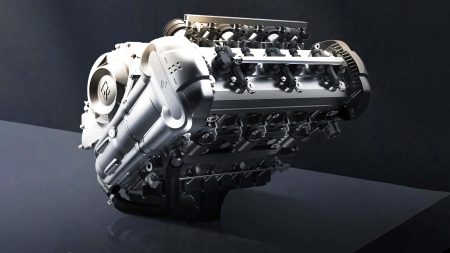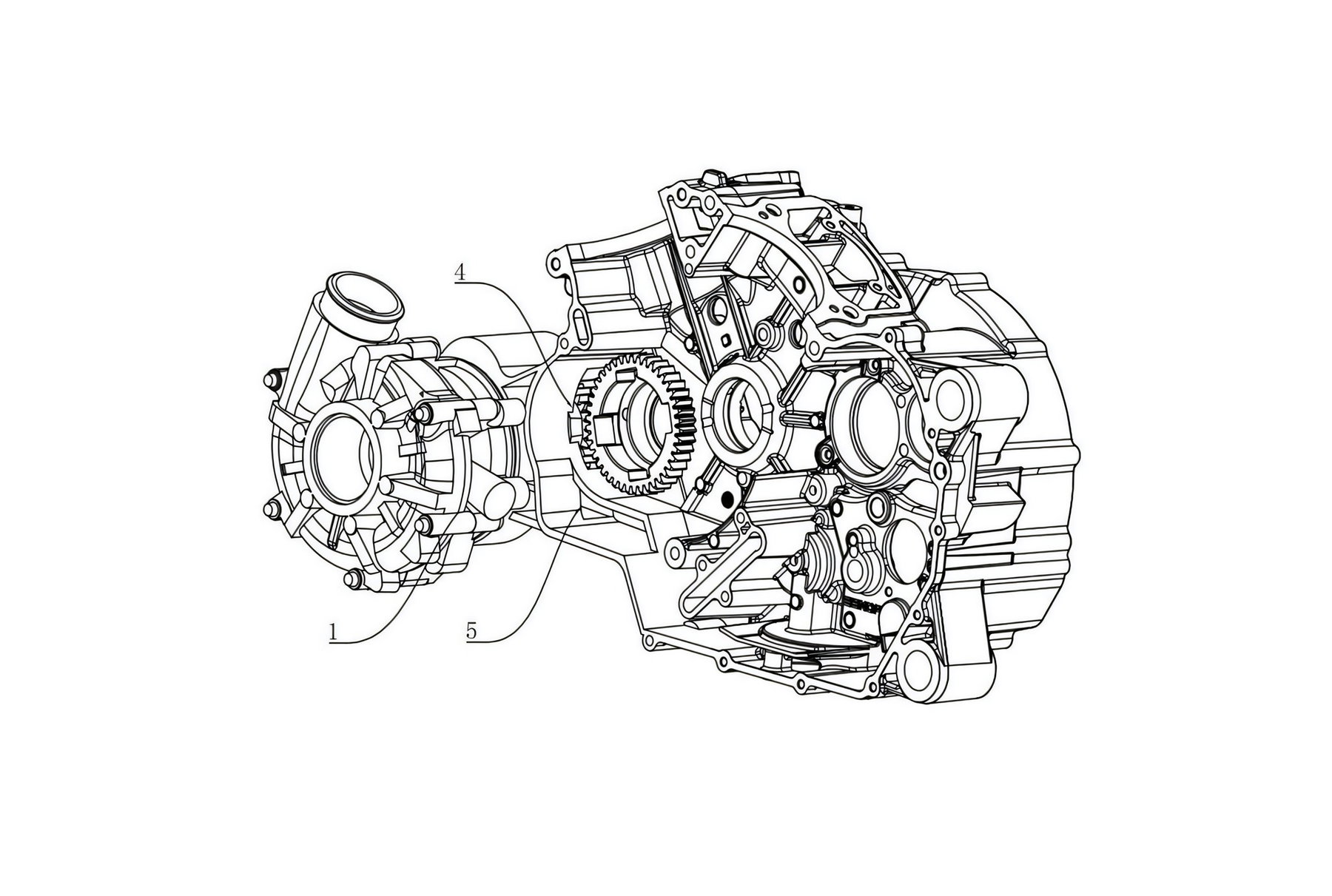
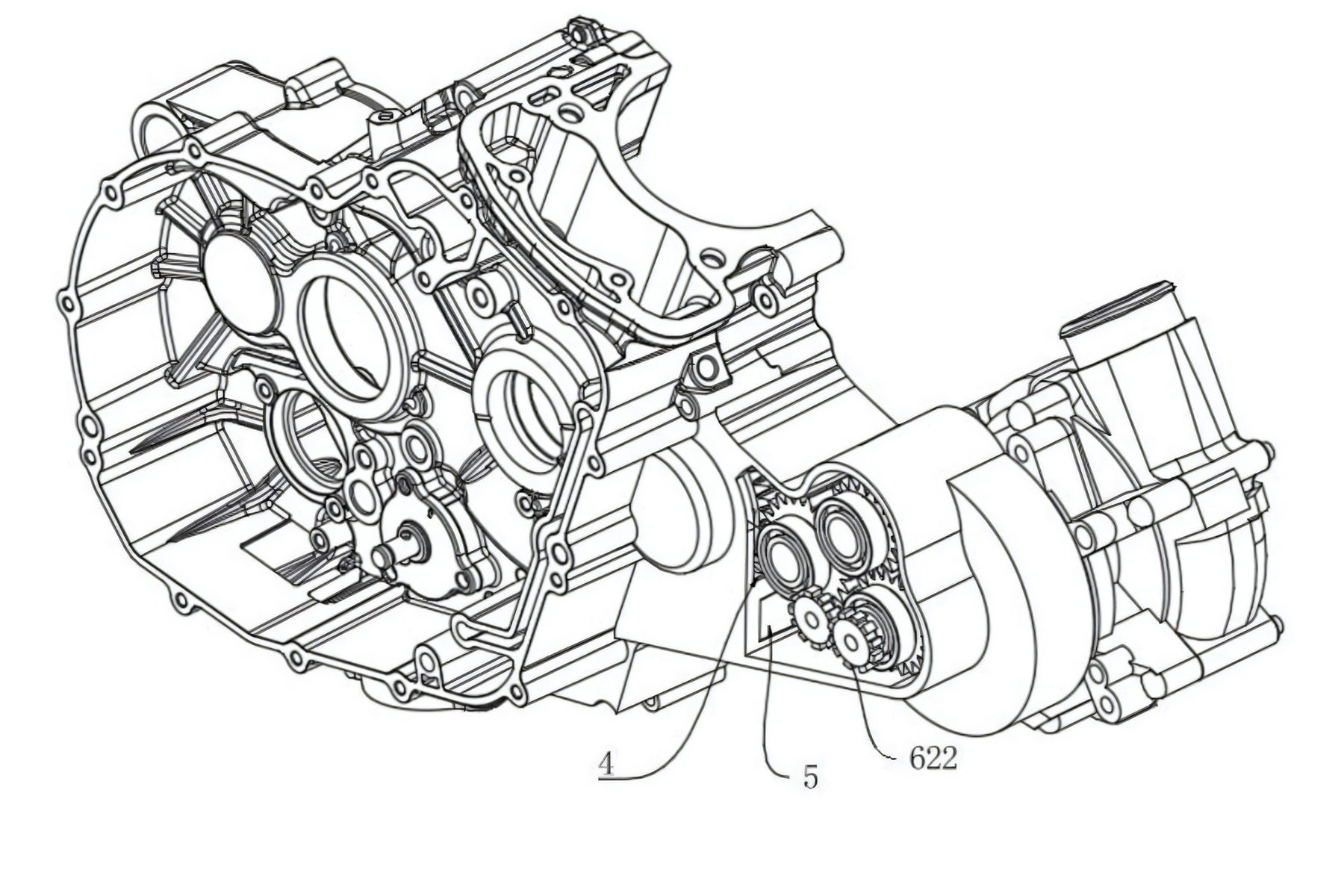
- The centrifugal supercharger sits low in front of the engine and is driven directly by the crankshaft via gears
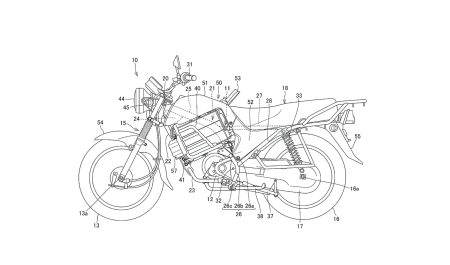
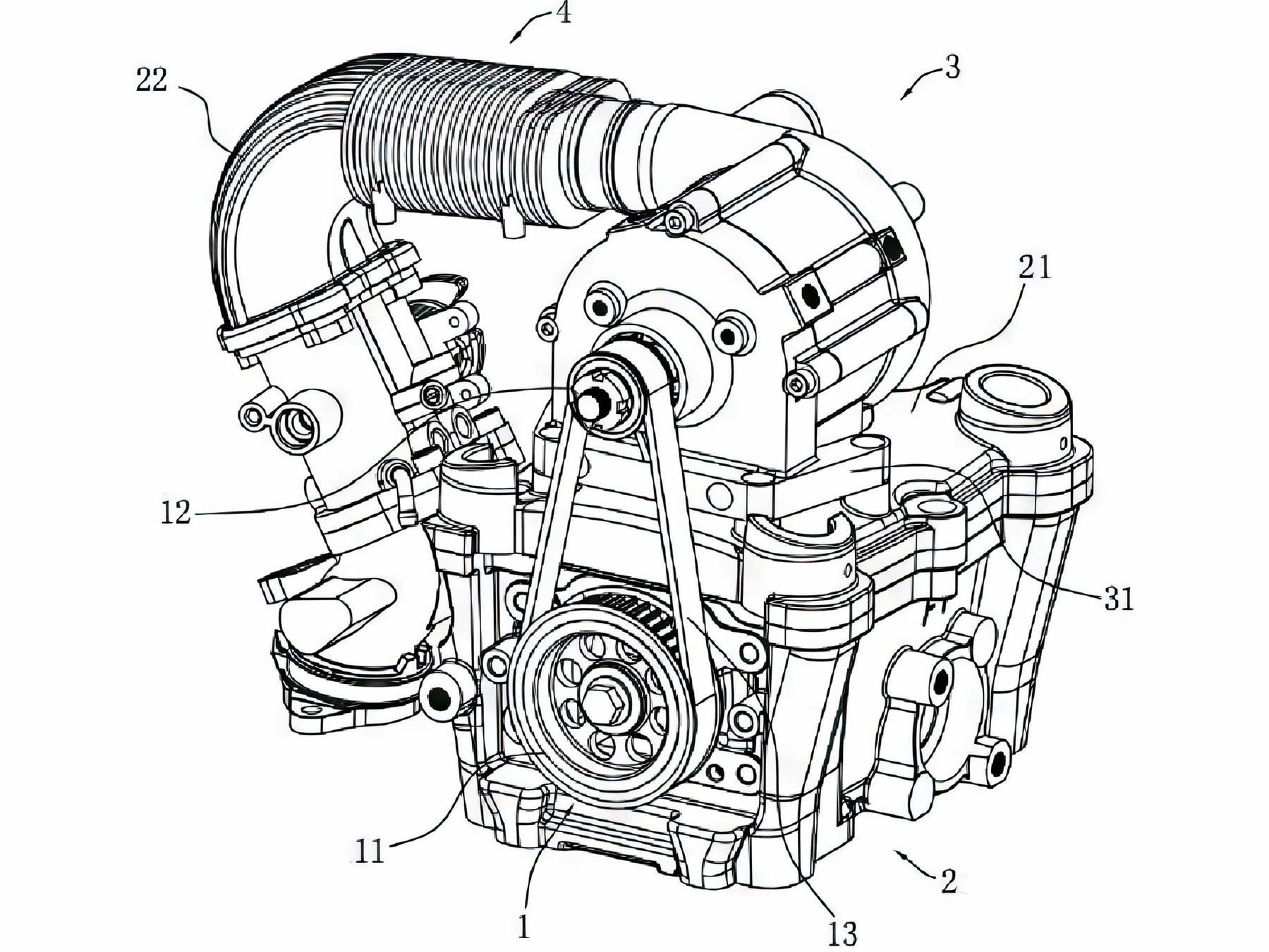
- In the 2023 patent, the blower still sat on one of the cylinder heads and was driven by the camshaft
- The drawing only shows part of the engine, so it remains unclear whether it is a V-twin or a V4
Forced-induction motorcycles have a chequered history. Before the Second World War, BMW raced supercharged machines with great success. In the 1980s, Honda, Kawasaki, Suzuki and Yamaha brought turbo models to the road, but never managed to match the success of their naturally aspirated engines. Now the topic is making a comeback. Modern technology and stricter emissions and fuel consumption rules are pushing manufacturers back towards forced induction. Honda is about to launch the V3R E-Compressor, Yamaha and Suzuki are working on their own boosted engines, and Kawasaki has offered the supercharged H2 range for years. Now a patent shows that Benda is also pushing ahead with its own supercharger project.
What does Benda’s new supercharger patent show?
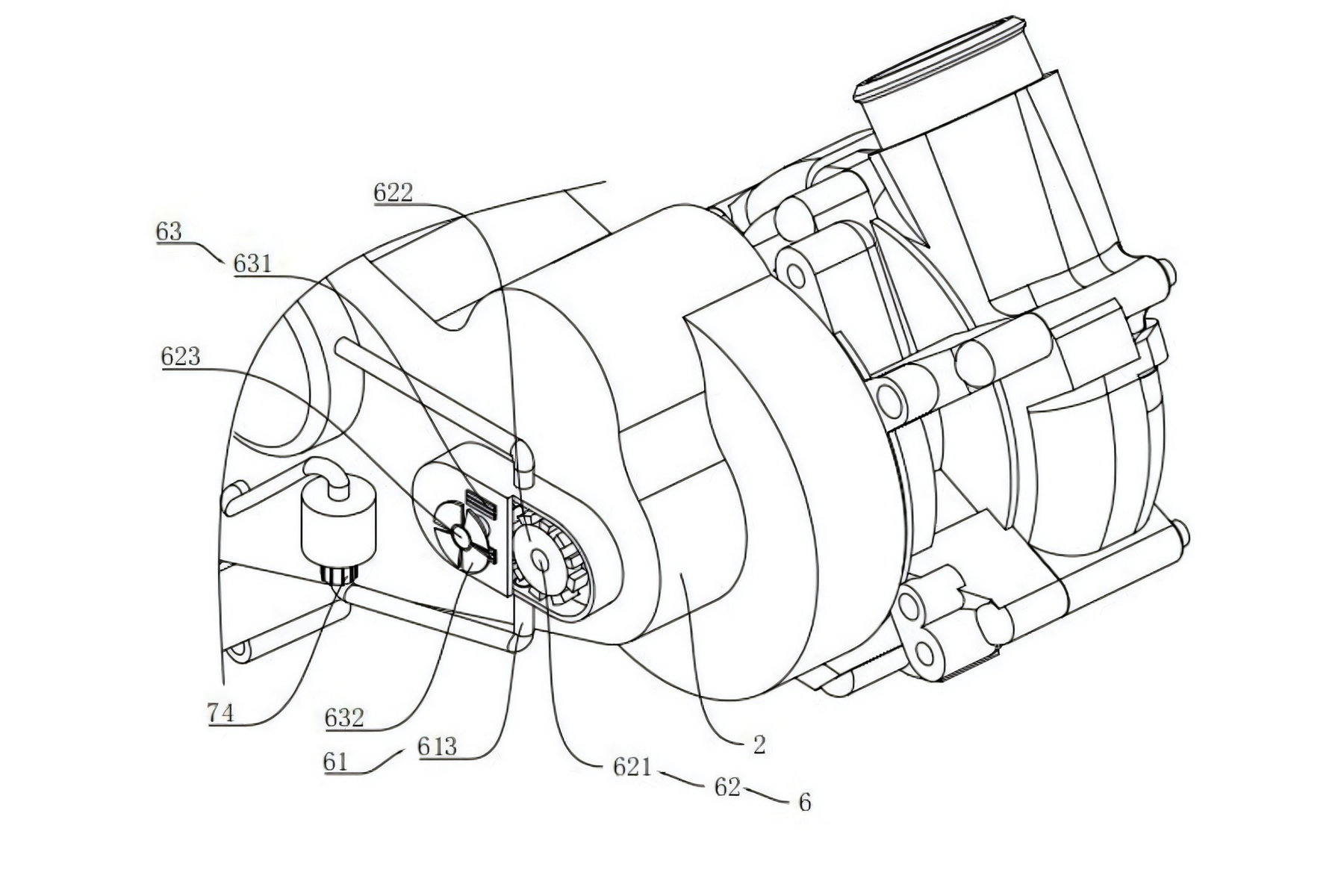
The patent shows a V-engine with an overhead camshaft and a centrifugal supercharger mounted low in front of the engine block. It is driven directly by the crankshaft via gears.
The gears run inside an extension that is cast into the crankcase. This extension also serves as the mounting for the supercharger itself. That makes the blower not a bolt-on part, but an integral element of the engine design.
How many cylinders the engine has remains open. The patent only shows a section of the powertrain. It could therefore be either a V-twin or a V4.
In terms of supercharger type, Benda is following the same path as Kawasaki with the H2, which also uses a centrifugal compressor. The installation position is different, though: on the Kawasaki, the supercharger sits on top above the gearbox, while on the Benda it sits low at the front of the engine.
How does a centrifugal supercharger work on a motorcycle?
A centrifugal supercharger uses a compressor wheel, similar to the compressor side of a turbocharger. The difference: it is driven mechanically by the engine rather than by a turbine in the exhaust flow.
This design works best at high revs. A positive-displacement supercharger, which compresses the air in portions using screws or rotary lobes, delivers more pull at low rpm instead. In both of its patents known so far, Benda has opted for the centrifugal compressor.
What has changed compared to Benda’s 2023 patent?
The biggest difference lies in the drive and the installation position. In 2023, the supercharger still sat on top of one of the two cylinder heads and was driven off the camshaft drive. Now it hangs low at the front, directly connected to the crankshaft.
The older concept was designed to take up as little space as possible. But it had a technical catch: the camshaft turns at only half the speed of the crankshaft. To get the compressor wheel up to the required speed anyway, the drive had to be geared up heavily using pulleys of very different sizes. In an additional section of the patent, the engineers therefore proposed a variable drive. A V-belt was to run on pulleys with adjustable width, similar to the continuously variable transmission of a scooter. This was meant to keep the supercharger spinning as fast as possible across the entire rev range.
The air path was also described in detail in the old patent. The supercharger pushed the intake air through an intercooler and a single throttle body. After that, the intake tract split in a Y shape to feed the two cylinders.
The new patent eliminates the detour via the camshaft. The supercharger now gets its speed directly from the crankshaft.
What happened to the Benda VTR300 Turbo?
To this day, Benda has not brought the VTR300 Turbo to market. Whether it will still arrive is unclear.
First reports about the model surfaced at the end of 2020. In January 2021, Benda revealed the silhouettes of three upcoming motorcycles for Chinese New Year: the VTC-300 cruiser, the LFS-700 flat tracker and the VTR300 Turbo. The other two models went on sale the same year. The VTR300 Turbo, however, never appeared.
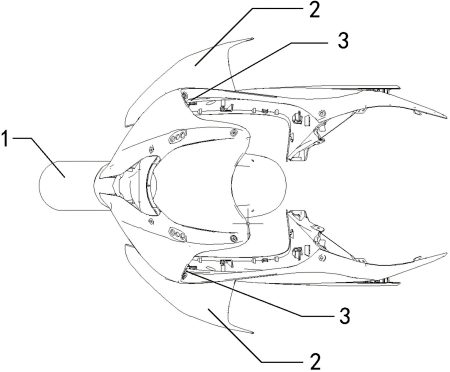
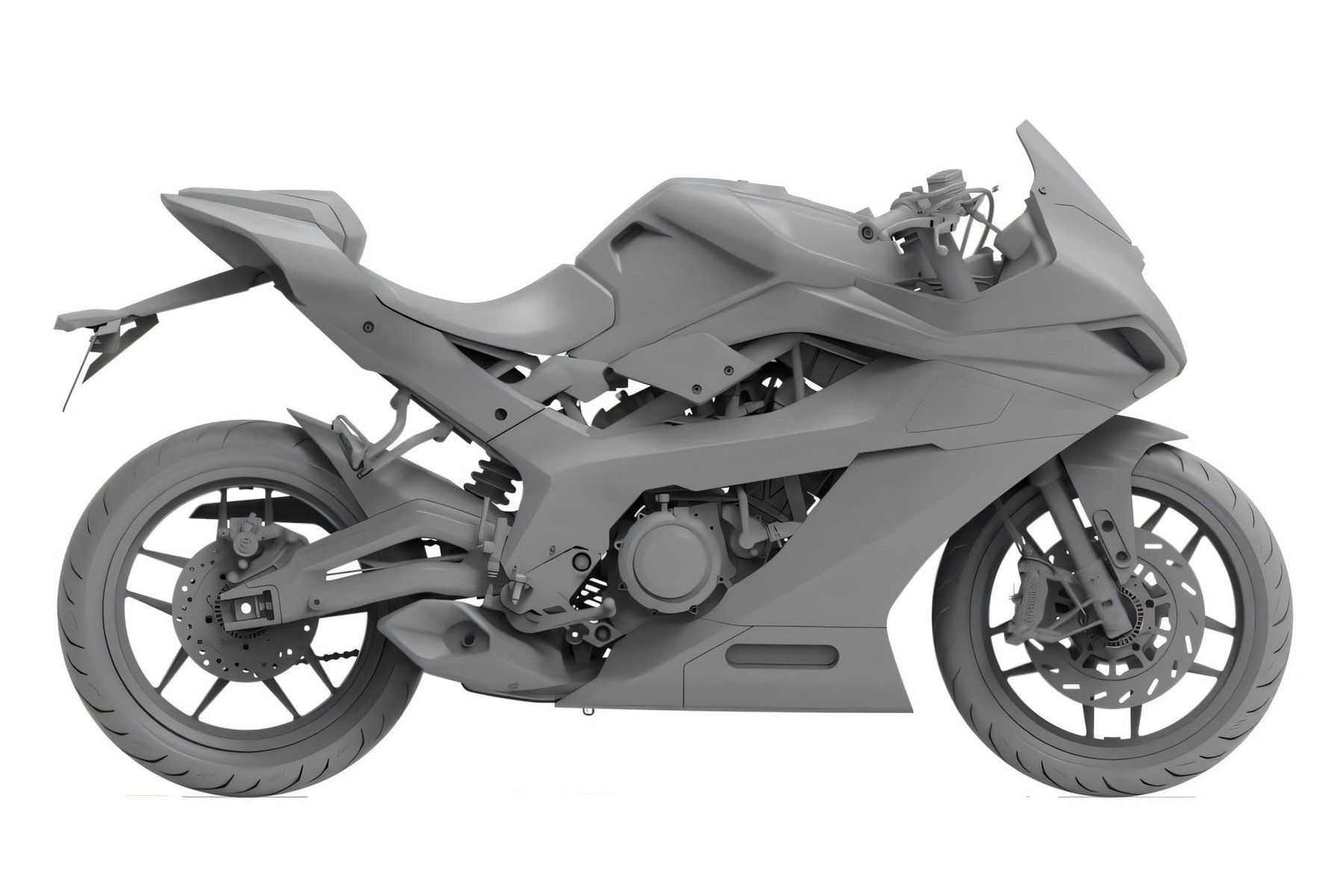
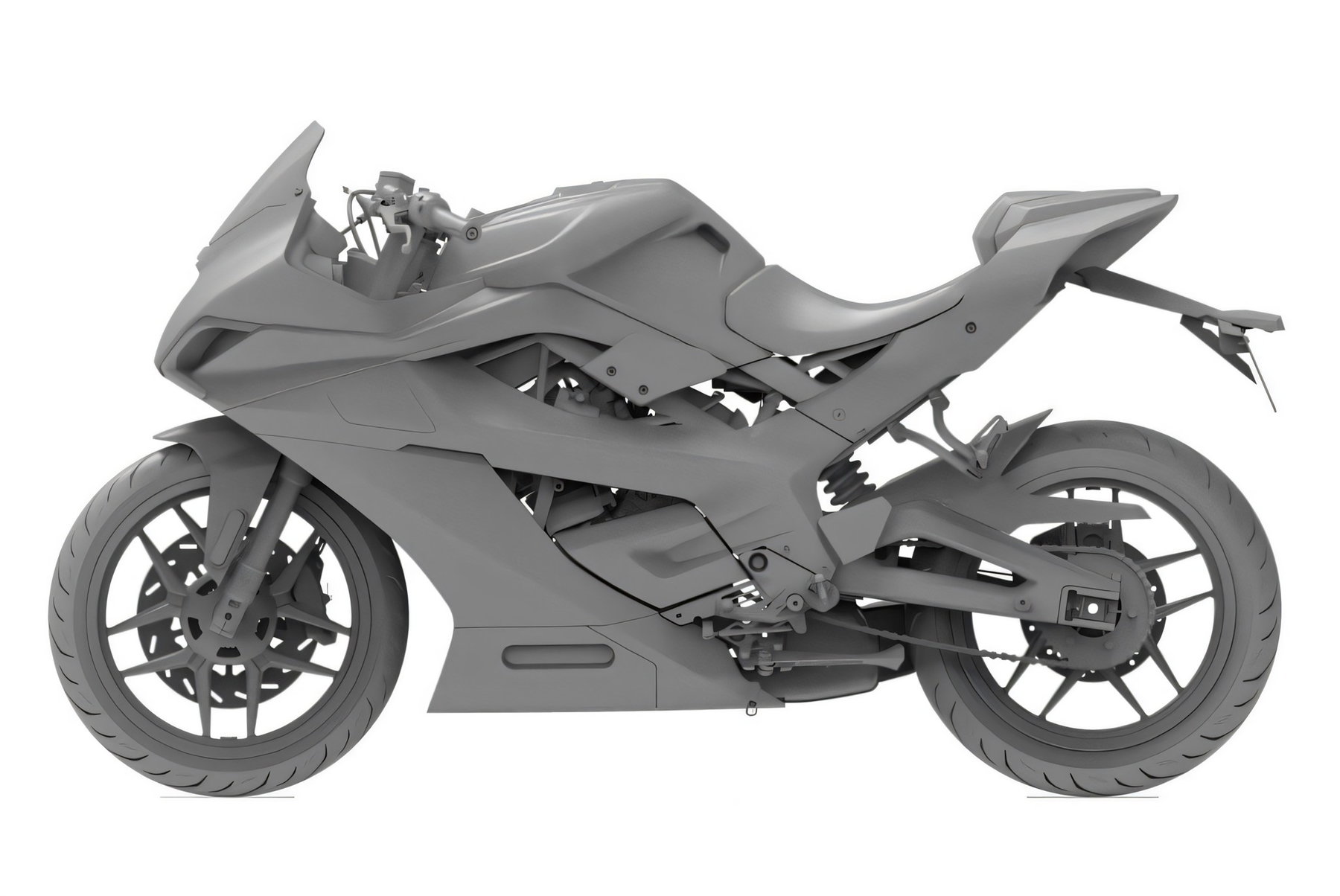
In January 2022, design drawings emerged showing a fully faired sportbike. Among other things, they showed an upside-down fork, a single brake disc front and rear with Brembo calipers, an underslung exhaust and a steel trellis frame. Side fairing panels stretch back to the swingarm like the spars of a perimeter frame. A year later came the patent with the camshaft-mounted supercharger.
The name raised questions from the start. None of the documents showed an exhaust-driven turbocharger. It is quite possible that the word Turbo stems from a translation error and that a supercharger was meant all along. A supercharger is the more obvious solution for this concept anyway.
In early 2023, Benda also admitted to having problems ramping up production. The new models and customer demand posed difficulties for the company at the time. That could explain why the sportbike project was put on hold.
Which engine powers the VTR300?
The basis is believed to be the liquid-cooled 298 cc V-twin that Benda uses in its small cruisers such as the Fox and the VTC-300. The cylinders are set at a 60-degree angle, with a bore of 58 millimetres and a stroke of 56.4 millimetres.
Without forced induction, the four-valve engine produces 30 hp (22 kW) at 8,500 rpm and 23.5 Nm (17.3 lb-ft) at 7,000 rpm. The Euro 5 engine with twin-spark ignition is said to use just 2.7 litres per 100 kilometres. With a supercharger, up to 50 hp (37 kW) is considered possible. A 48 hp (35 kW) version would be conceivable for the European A2 licence.
Why is Benda choosing a supercharger instead of a turbo?
A V-engine is poorly suited to an exhaust-driven turbocharger. On a transversely mounted V-engine, the headers point in two different directions, and the fuel delivery sits between the cylinders.
A turbo would therefore have to be packaged somewhere between the headers and the injection system. There is hardly any room for that with this engine layout. On top of that come fundamental drawbacks on a motorcycle: a turbocharger takes up space, brings high thermal loads and is not a good match for small-displacement, high-revving engines. A mechanically driven supercharger avoids these problems because it does not sit in the hot exhaust tract.
How does the supercharger project fit into Benda’s engine technology?
Benda is one of the Chinese manufacturers that turn new engine concepts into reality the fastest. The brand was the first Chinese company to develop its own four-cylinder engine, the inline-four of the LFC700.
Benda also put the first Chinese-built V4 into series production, ahead of all other manufacturers in the country. As early as September 2021, the company showed two V4 engines with 1,200 and 500 cc. Later came a BMW-inspired inline-six as well as boxer engines with 250 and 700 cc, which are also set to go into production.
With the supercharger patent, Benda joins the group of manufacturers working on the future of the combustion engine through forced induction. While Honda relies on an electrically driven compressor and Kawasaki has been fitting its centrifugal supercharger in series production for years, Benda is choosing a purely mechanical drive via the crankshaft.
When will a supercharged Benda motorcycle arrive?
There is no date for a production model. For now, the patent only shows that Benda is continuing to work on the technology.
Whether the new engine will eventually end up in the VTR300 after all is open. It cannot be ruled out. Experience shows that such a complex project takes a long time to become production-ready. Almost six years have now passed since the first announcement.
Frequently Asked Questions
-
What is the Benda supercharger?
The Benda supercharger is a centrifugal compressor that the Chinese manufacturer is developing for a forced-induction V-engine. According to the new patent, it sits low in front of the engine and is driven by the crankshaft via gears. Whether the engine has two or four cylinders is not yet known.
-
Does the Benda VTR300 have a turbo or a supercharger?
Despite its name, everything points to a supercharger on the VTR300 Turbo. No document known so far shows an exhaust-driven turbocharger. The Turbo suffix may stem from a translation error.
-
How much horsepower does the Benda VTR300 have?
There are no official performance figures. Without forced induction, the underlying 298 cc V-twin produces 30 hp (22 kW) at 8,500 rpm; with a supercharger, up to 50 hp (37 kW) is considered possible. A 48 hp version would be conceivable for the A2 licence.
-
When will the Benda VTR300 go on sale?
No market launch has been announced. Benda had already promised the model for 2021 but never presented it. However, the new supercharger patent shows that the company is still working on forced induction.