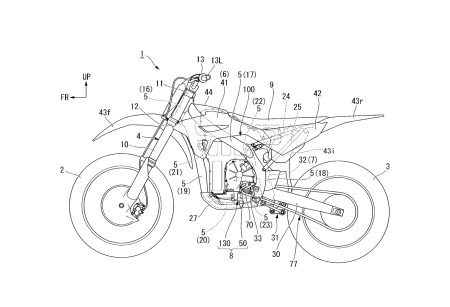
- Patents show a tubular steel frame with removable mounts for either an engine or a battery pack
- The petrol version is set to use the engine from the C125, Monkey or Grom, the electric version a motor in the swingarm
- The original CT50 Motra was launched in 1982 with 4.5 hp (3.3 kW) and six gears
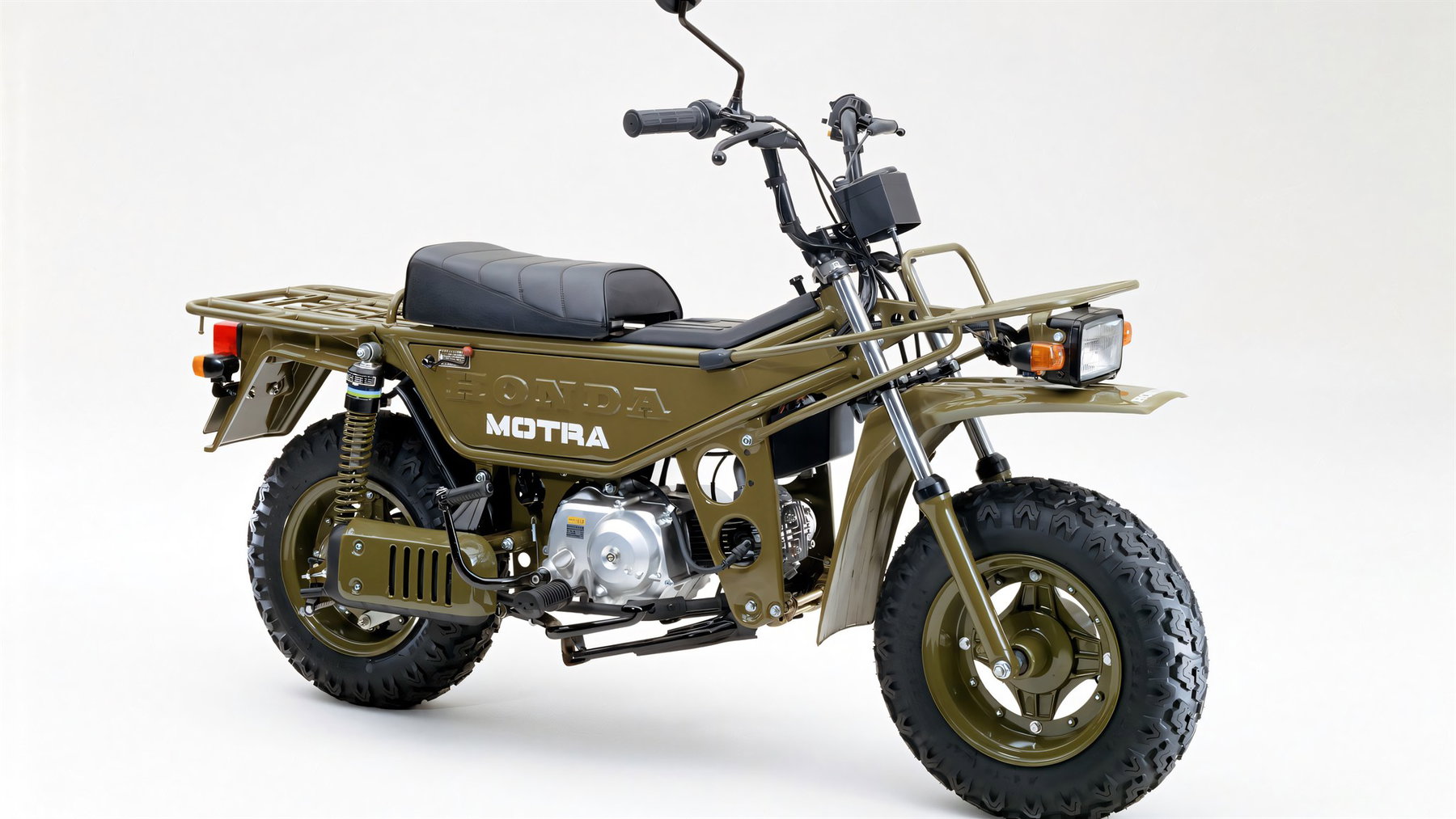
Over the years, Honda has built some unusual motorcycles. Among them are the NR750 with its oval pistons, the DN-01 with its hydraulic transmission and the folding Motocompo. The CT50 Motra from 1982 belongs in this line-up too. The small bike looked like something between a military vehicle and a piece of construction equipment and was designed to carry heavy loads off-road. Back then, the Motra sold poorly. Even so, it is sought after today, and Honda may now bring it back in modern form.
What do Honda’s patents show about the new Motra?
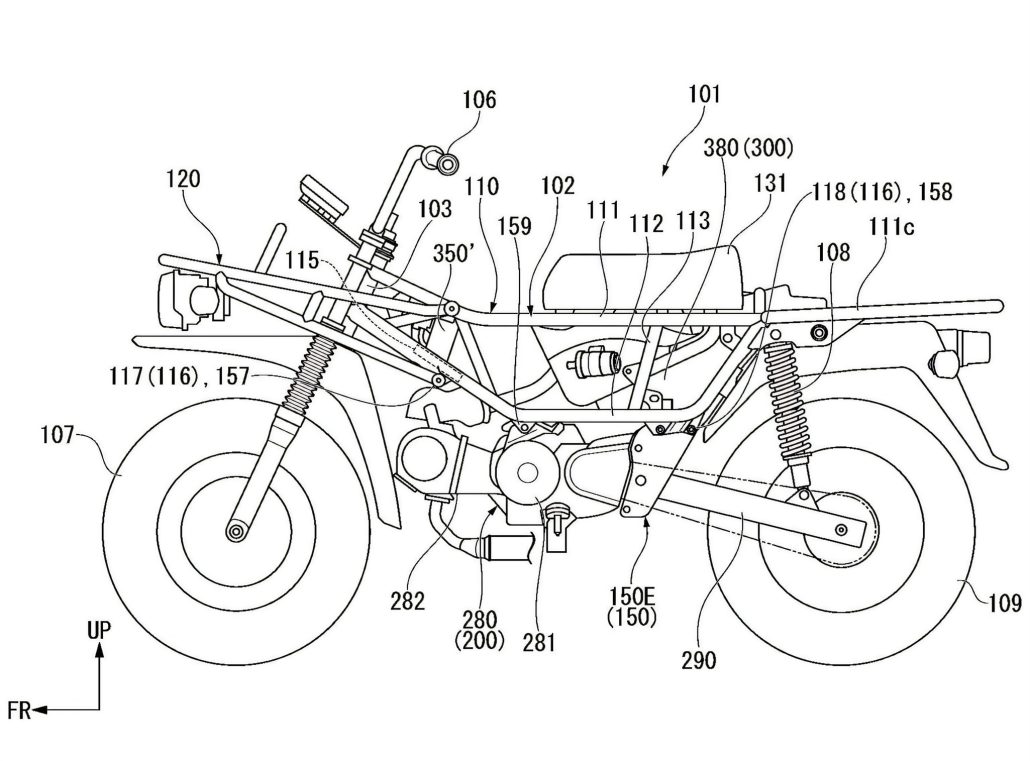
The patents show a new Motra with a simple tubular steel frame that can be built with either a petrol engine or an electric drive. Honda’s development department is said to be working on this successor.
The core of the idea is a shared frame for both drive types. Using removable mounts, either an engine with gearbox or a battery pack is bolted into the same space. Visually, the new Motra stays as plain and rugged as the original. Whether and when it will become a production model is not clear from the patents.
Which engines could the new Honda Motra get?
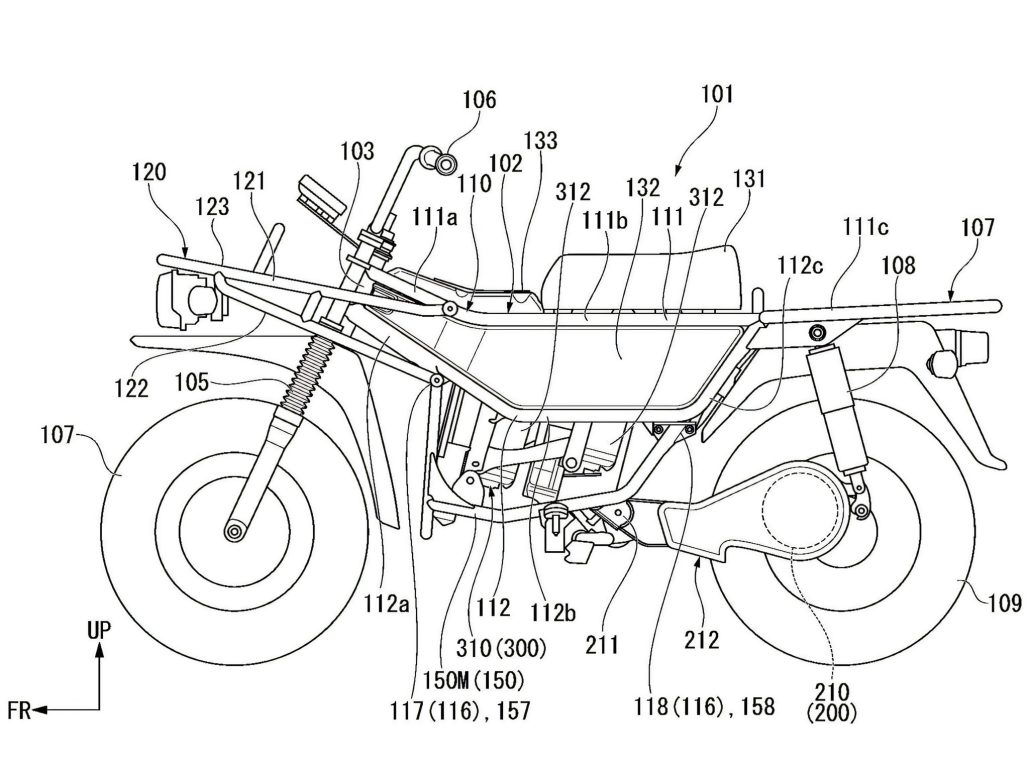
For the petrol version, the single-cylinder engine and gearbox from the C125, the Monkey or the Grom are planned. The electric version gets a battery pack and an electric motor in the swingarm instead.
Petrol engine from the C125, Monkey and Grom
The single-cylinder engine in these three models is a direct descendant of the engine fitted to the first Motra. Both trace their roots back to the Super Cub. Technically, this closes a circle spanning more than 40 years.
Electric drive with a motor in the swingarm
In the electric version, the regular swingarm is dropped. In its place is a swingarm with an integrated motor which, judging by the drawings, closely resembles the solution used in the CUV e: electric scooter. Since this scooter is roughly on par with the C125 Super Cub in terms of performance and price, the two Motra versions are unlikely to differ much in these respects either. Honda has not yet released any specific figures on power, range or battery.
Why is Honda opting for a shared platform for petrol and electric?
A shared platform makes it possible to build either a combustion or an electric model depending on demand, without developing two completely separate vehicles. In doing so, Honda is following a path many car manufacturers are already taking.
In the car industry, many companies initially went all-in on pure electric vehicles and developed models from the ground up around the motor and battery. Combustion engines, however, are hanging on longer than expected. As a result, more and more vehicles are now offered with both drive types. The Motra patents apply this principle to a small motorcycle.
What remains of the old Motra’s design?
The boxy styling, the fat balloon tyres like those on a quad and the racks front and rear are set to stay. This applies to both drive versions.
The new Motra would therefore keep its character as a little workhorse. Luggage can be strapped to the racks, and the toy-like look clearly sets it apart from typical small motorcycles.
What was the 1982 Honda CT50 Motra?
The CT50 Motra was a 50cc leisure motorcycle that Honda built for outings, camping and off-road work. It went on sale in Japan on 10 June 1982, one day after it was unveiled.
The name is said to combine the words motorcycle and truck, “torakku” in Japanese. According to Honda, carrying capacity was the focus during development. The Motra had large tubular steel racks front and rear. The front rack was fixed to the frame rather than the handlebars so that the bike would steer steadily even when loaded. In Japan, however, 50cc motorcycles were limited to a maximum payload of 30 kg (66 lbs).
With the Motra, Honda’s range of 50cc leisure motorcycles grew to seven models in ten variants. The price was 165,000 yen, roughly €930 / $1,040 at today’s exchange rate. In terms of today’s purchasing power, that equals around €2,235 / $2,500. It was offered in two colours: a military-style green called Popo Green and Maize Yellow, which is more reminiscent of construction machinery.
Technology: 49cc and six gears
The Motra was powered by an air-cooled four-stroke 49cc single-cylinder engine from the Super Cub family. According to Honda, it produced 4.5 hp (3.3 kW) at 7,500 rpm and 4.5 Nm (3.3 lb-ft) at 5,500 rpm. It was started by kickstarter, and a centrifugal clutch spared the rider from using a clutch lever.
The special feature was the gearbox. In addition to the three regular gears, there was a sub-transmission with a high and a low range, similar to an off-road vehicle. Switching was done with a lever. In the low range, all three gears were reduced by a factor of 1.459. According to Honda, this allowed the Motra to climb gradients of around 23 degrees, which is roughly 42 percent.
Further data according to Honda:
- Dry weight: 76 kg (168 lbs)
- Seat height: 720 mm
- Fuel tank capacity: 4.5 litres
- Fuel consumption: 1 litre per 100 km at a constant 30 km/h
- Tyres: 5.40-10 with knobbly tread front and rear
- Brakes: drum brakes front and rear
The rear shock absorbers could be adjusted to the weight of the load. An indicator showed the selected setting at a glance. The centre stand was positioned far forward and had a lock. It could only be operated when a lever on the left end of the handlebar was pulled. This kept the loaded bike securely parked even on a slope.
Why was the Motra a flop back then?
The Motra fell well short of Honda’s sales target. The plan was 45,000 units per year, but reportedly only around a tenth of that was sold.
After 1982 and 1983, the Motra disappeared from the line-up. Honda never published an official production figure. Honda later revisited the idea of a motorcycle with an open, exposed frame: in 2001 with the Zoomer, sold in the USA as the Ruckus, and in 2004 with the PS250, which appeared in North America as the Big Ruckus. None of these models adopted the sub-transmission.
How much does an original Honda Motra cost today?
Used examples of the Motra fetch high prices for a small utility vehicle. In 2020, bikes that had made it to Europe were offered from around £3,000 (approx. €3,550 / $3,980). In the USA, asking prices were closer to £6,000 (approx. €7,110 / $7,960).
The Motra was intended for the Japanese market. Since then, however, individual examples have been imported into the USA, Canada, Europe, New Zealand and Australia. Precisely because so few were sold at the time, it is now considered a cult classic.
When will the new Honda Motra come to market?
There is no date for the new Motra. Honda has not officially announced the model so far; it exists only in patent drawings.
Patents are no promise of a production model. They do show, however, that Honda has thought the concept through seriously. Whether the Motra will be among the new motorcycles of the coming model years and in which markets it would be offered remains open. Honda has not yet announced prices either.
Frequently Asked Questions
-
Is the Honda Motra coming back?
Honda has filed patents for a new Motra. However, there is no official announcement or launch date yet. The drawings show a version with a petrol engine and one with an electric drive.
-
Which engine will the new Honda Motra get?
The petrol version is set to use the single-cylinder engine from the C125, Monkey or Grom. The electric version gets a battery pack and a motor in the swingarm that resembles the drive of the CUV e: scooter.
-
How much horsepower did the original Honda Motra have?
According to Honda, the 1982 CT50 Motra produced 4.5 hp (3.3 kW) at 7,500 rpm. The 49cc single-cylinder came from the Super Cub family and was combined with a six-speed gearbox in two ranges.
-
How much did the Honda Motra cost in 1982?
In Japan, the Motra cost 165,000 yen. At today’s exchange rate, that is roughly €930 / $1,040.
-
Why is the Honda Motra called that?
The name is said to combine motorcycle and truck. That fits the concept, as Honda built the Motra as a small workhorse with large luggage racks.