- With the AMT, the GT EVO shifts either fully automatically or via foot lever and handlebar button – it has no clutch lever.
- Both versions produce 190 hp (140 kW), weigh 213 kg (470 lbs) according to KTM and come with radar cruise control as standard.
- For 2027, the 1390 Super Duke R and R EVO get the 8.8-inch touchscreen and Brembo HyPure brake calipers.
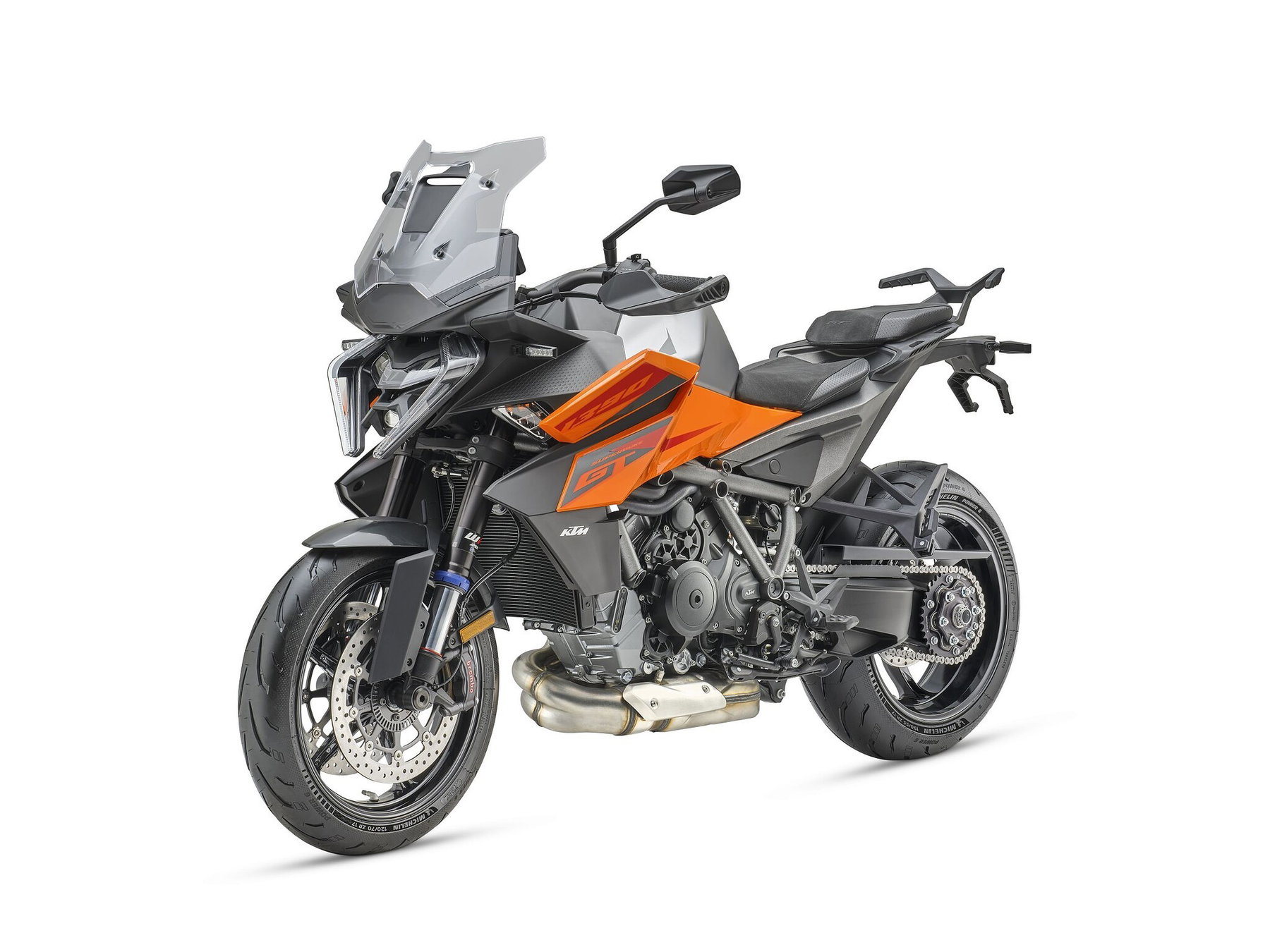
The KTM 1390 Super Duke GT was originally supposed to reach dealers in January 2025. KTM unveiled the sport tourer at EICMA in November 2024, then the company’s restructuring got in the way and the GT disappeared into a holding pattern for almost two years. Now it is back in Milan, and the dealer launch is planned for early 2027. Little has changed in the basic concept: the engine and chassis still come from the 1390 Super Duke R EVO, joined by semi-active suspension, radar-assisted adaptive cruise control and a large touchscreen cockpit. What is new is the GT EVO, which did not exist at the first presentation. It is one of the KTM new models for the 2027 model year that the manufacturer is showing at EICMA 2026.
What is new on the KTM 1390 Super Duke GT since 2024?
The biggest change is the GT EVO with the AMT automated manual transmission. On top of that come revised gearing, new Michelin tyres, self-bleeding hydraulics for brake and clutch, and a reworked fork.
Many of the key figures are already known from the presentation two years ago. The engine, the chassis from the R EVO, the 8.8-inch display and the radar cruise control were all announced back in 2024. For the production version, however, KTM has changed a whole series of details.
On the standard GT’s manual gearbox, fifth and sixth gear are now geared shorter. KTM stresses that these are no longer overdrive gears, i.e. no longer extra-tall gears that merely lower revs on the motorway. The clutch is still hydraulic with an anti-hopping function, but its Brembo master cylinder now bleeds itself. The same principle applies to the front brake master cylinder. According to KTM, it therefore never needs to be bled.
From the factory, the GT rolls on dual-compound Michelin Power 6 tyres. The tyres, sized 120/70 at the front and 190/55 at the rear, sit on 3.5- and 6-inch-wide rims and are a combined 1.2 kg lighter than the previous fitment. Also new is the Supermoto+ ABS mode. It allows the rear wheel to lock, with the electronics limiting the drift to up to 8 degrees.
How does the AMT on the Super Duke GT EVO work?
The AMT is a conventional six-speed gearbox in which a centrifugal clutch handles pulling away and an electromechanical actuator handles the shifting. The rider can leave everything to the electronics or shift manually – a clutch lever is not needed in either case.
KTM already uses the system in the 1390 Super Adventure S EVO. The actuator turns the shift drum, the component in the gearbox that selects the gears. The clutch engages automatically depending on engine speed and also has an anti-hopping function. A gear change is said to take just 50 milliseconds.
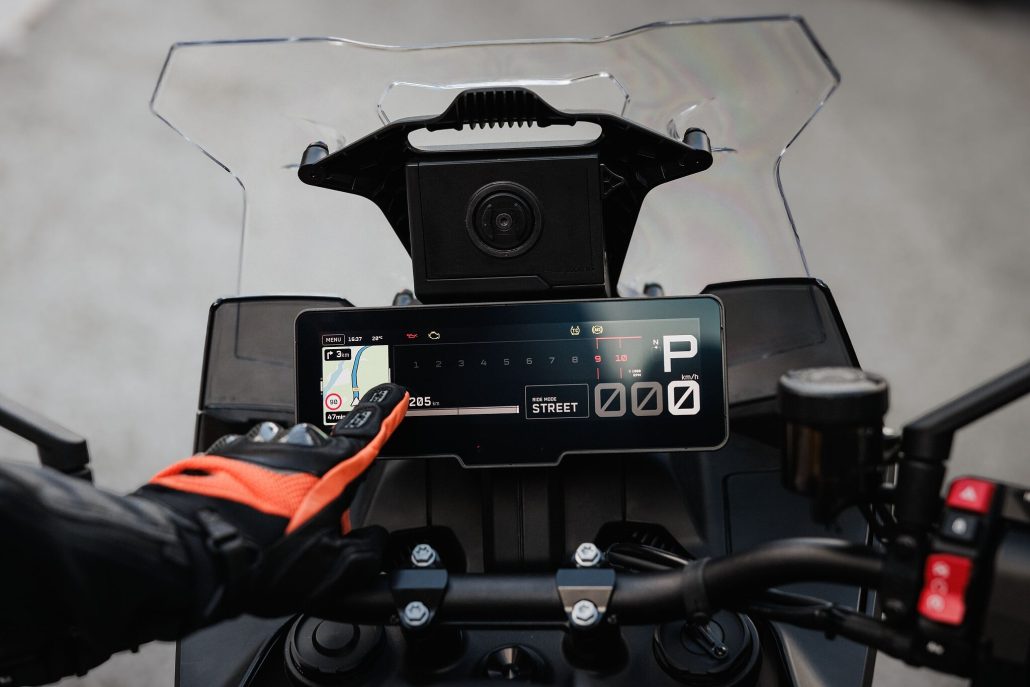
In mode A, the GT EVO shifts all six gears by itself. In mode M, the rider decides when to shift, either using the foot lever as usual or buttons on the handlebar. The engine cannot stall. The shift sequence is P, N and then one to six. In position P the gearbox is locked, so the motorcycle cannot roll away. Park and neutral can only be selected via the handlebar switches, and the cockpit shows a dedicated park indicator.
The AMT is mainly meant to help where a bike this big would otherwise demand a lot from the clutch hand, such as hill starts, manoeuvring at walking pace, and accelerating and braking. The AMT brings no weight penalty: KTM quotes the same 213 kg (470 lbs) for the GT and GT EVO. Fuel consumption, however, is slightly higher.
How much power does the KTM 1390 Super Duke GT have?
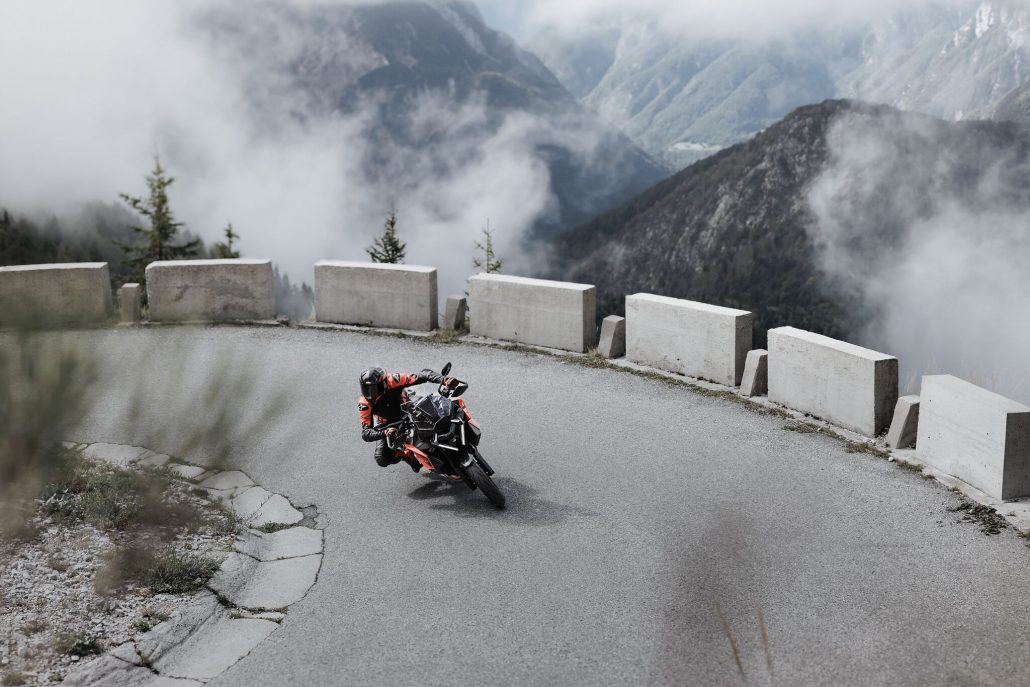
The KTM 1390 Super Duke GT produces 190 hp (140 kW) at 10,000 rpm and 145 Nm (107 lb-ft) of torque at 8,000 rpm. That applies to both versions.
The LC8 twin displaces 1,350 cc, has a 110 mm bore and a compression ratio of 13.2:1. It uses Camshift technology, which allows the valve lift to be varied. Compared with the previous 175 hp 1290 Super Duke GT, there are also 60 mm throttle bodies, a radiator that is 40 mm wider, a redesigned airbox with a central ram-air intake and injectors rotated by 90 degrees.
The service interval has grown longer. Valve clearance only needs checking every 60,000 kilometres, compared with 30,000 kilometres on the 1290 GT. KTM quotes fuel consumption of around 6.2 litres per 100 kilometres for the manual version and around 6.6 litres for the GT EVO.
The tank has become smaller. It is slimmer than on the predecessor and holds 19.5 litres, including a 3-litre reserve. The 1290 GT still had 23 litres. On paper, a full tank is therefore good for around 315 kilometres with the manual gearbox and just under 300 kilometres with the AMT.
Chassis and brakes of the 2027 Super Duke GT
The chromoly steel trellis frame uses the engine as a stressed member. According to KTM, it is three times as torsionally stiff as on the 1290 GT, and the centre of gravity is lower. The wheelbase is 1,491 mm and ground clearance is 149 mm. The aluminium single-sided swingarm, the forged triple clamps with 32 mm offset and the wheels remain unchanged.
The suspension comes from WP and is part of the third generation of the semi-active Apex chassis. Semi-active means that the electronics continuously adjust the damping while riding. The 48 mm fork offers 125 mm of travel, the linkage-mounted shock 140 mm. All of the fork’s sensors now sit in the right leg, making it 750 g lighter than before. The shock has electronic preload with Soft, Standard and High settings plus a valve tuned specifically for the GT. The damping modes Auto, Comfort, Street and Sport come as standard. Track, Pro and an anti-dive function that reduces fork dive under braking cost extra. A WP steering damper is always included.
At the front, two Brembo Stylema four-piston calipers bite 320 mm discs, while a two-piston caliper works on a 240 mm disc at the rear. The new brake lever lets the ratio be adjusted in three steps of 19, 20 and 21 mm, changing how directly the brake responds. Alongside Supermoto+, the cornering ABS, Supermoto and Sport ABS modes are standard.
Which electronics come as standard on the Super Duke GT?
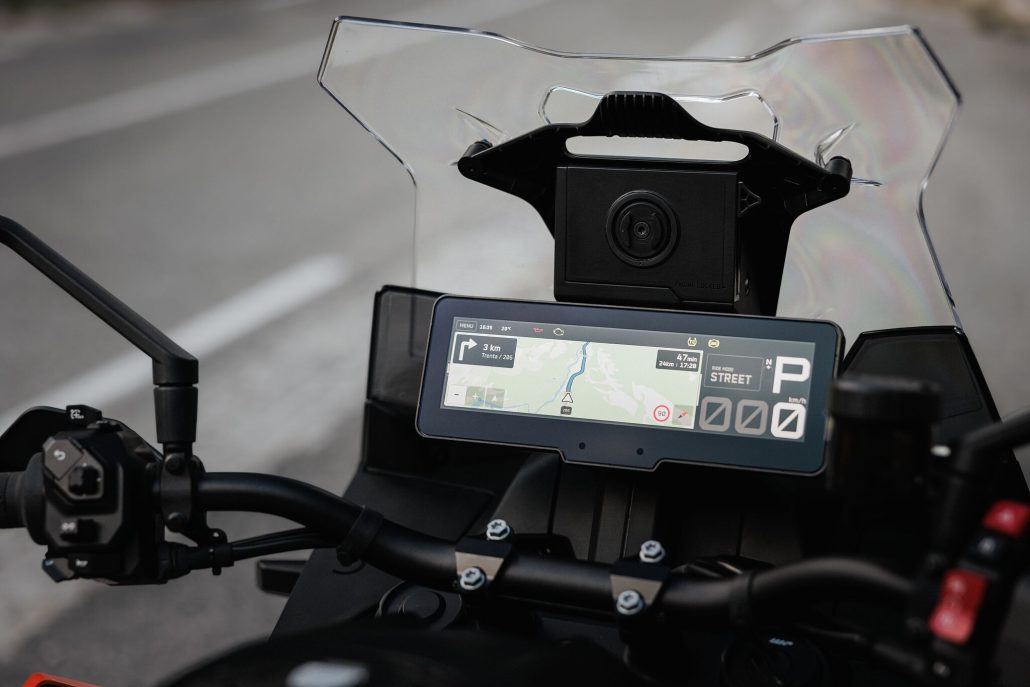
Both versions come as standard with radar-assisted adaptive cruise control, the 8.8-inch touchscreen with offline navigation and four riding modes. Many other assistance systems are only available at extra cost.
The new display replaces the 7-inch cockpit of the 1290 GT. Navigation maps can be downloaded by city, region or country, so route guidance does not need a data connection via the smartphone. Five languages are available. A USB-C socket and an integrated SP Connect smartphone mount are also standard.
From the factory, there are the Rain, Street and Sport riding modes plus one custom mode. In Rain mode, output drops to around 130 hp (95 kW). A Track mode and two further custom modes are optional. Cornering traction control, engine brake control, five-stage wheelie control, the Quickshifter+ and the MSR motor slip regulation also cost extra. Unlike before, you no longer necessarily have to buy a complete Tech or Track pack – KTM also offers the functions individually.
Also new is the tyre pressure monitoring system. It can store a separate target pressure for the track and recognises a second set of wheels.
Riding position, lighting and touring comfort
Visually, the GT has become flatter and more compact than the 1290 GT. KTM has redesigned the tank spoilers. The brake lights have moved into the indicators, which makes the tail slimmer.
The new LED headlight switches the low beam automatically, the high beam uses a projector, and the daytime running light reacts to ambient light. There is also a three-stage cornering light.
Seat height is 834 mm. KTM has reworked the seat for longer stints. The 796 mm wide handlebar can be rotated, moving it 22 mm forwards or backwards. The windscreen is adjustable as standard and has a high position for touring.
What changes on the 2027 KTM 1390 Super Duke R and R EVO?
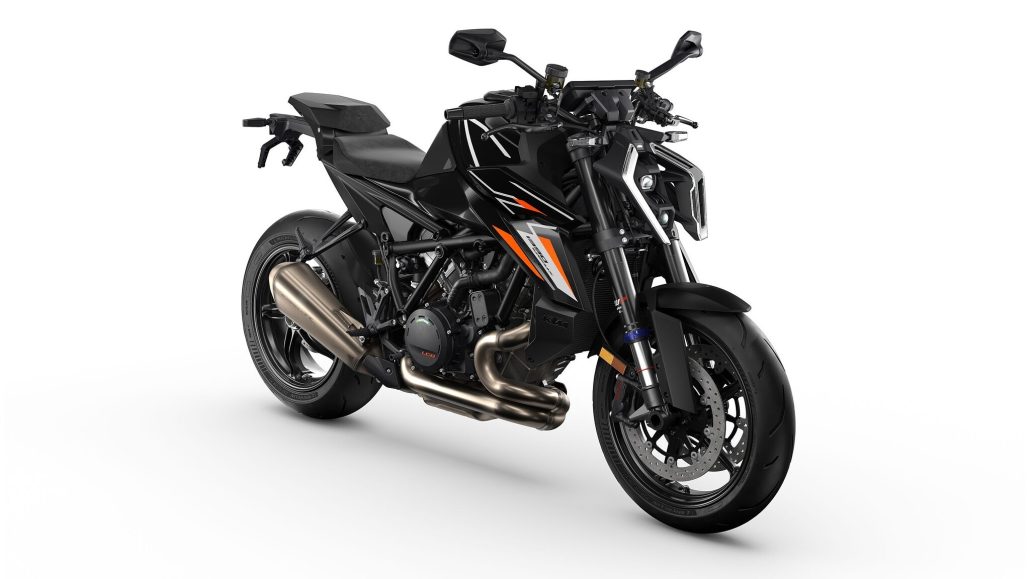
For 2027, the 1390 Super Duke R and R EVO get the 8.8-inch touchscreen and the Brembo HyPure brake calipers from the limited-edition 1390 Super Duke RR. They also gain new handlebar switches, revised riding modes and two new colour options.
The new display replaces the previous 5-inch TFT. Its cover glass is bonded directly to the screen, which is said to make it easier to read and more resistant to scratches and reflections. KTM has simplified the menus, and the cockpit can be operated by touch or via the new handlebar switches. For the first time, the Super Duke R thus has navigation that works without a phone. It offers route planning, turn-by-turn guidance, a map view and an option for twisty roads. For the riding modes, KTM promises more personalisation options but gives no details.
At the front, HyPure calipers replace the previous Stylema calipers. Brembo first used them on the 2025 Ducati Panigale V4 S; at KTM they arrived in April 2026 on the 1390 Super Duke RR, limited to 350 units. KTM has released no new engine figures for the R models.
In terms of colours, there is an orange and a black version. On the black version, the trellis frame is also completely black. This means the Super Duke R is dropping its signature orange frame for the first time.
The R keeps its manually adjustable WP Apex suspension, the R EVO the semi-active system. Unlike on the GT EVO, however, the EVO in the R’s name does not stand for an AMT. It is still ridden with a clutch lever and a conventional manual gearbox.
When is the KTM 1390 Super Duke GT coming and what does it cost?
The KTM 1390 Super Duke GT is due at dealers in early 2027. KTM has not yet announced prices for Germany or any other market.
Exactly when the GT EVO will be available has not been confirmed either. There are also no prices or delivery dates yet for the updated Super Duke R and R EVO. Besides the Super Dukes, KTM is also updating the 790 Adventure, the 390 Adventure R and X and the 390 and 125 cc singles for 2027, though mainly with new colours and minor equipment details.
Frequently Asked Questions
-
What is the difference between the KTM 1390 Super Duke GT and the GT EVO?
The GT EVO has the AMT automated manual transmission and does not need a clutch lever. It shifts either fully automatically or on the rider’s command via foot lever or handlebar button. Engine, chassis, equipment and the 213 kg weight are the same for both versions.
-
How much horsepower does the KTM 1390 Super Duke GT EVO have?
The KTM 1390 Super Duke GT EVO produces 190 hp (140 kW) at 10,000 rpm and 145 Nm at 8,000 rpm. The figures also apply to the GT with manual gearbox. In Rain mode, output is around 130 hp.
-
How big is the tank of the KTM 1390 Super Duke GT?
The tank holds 19.5 litres, including a 3-litre reserve. That is 3.5 litres less than on the predecessor, the 1290 Super Duke GT.
-
Does the KTM 1390 Super Duke GT have radar cruise control?
Yes, adaptive cruise control with front radar is standard on both the GT and the GT EVO. It adjusts the speed to vehicles ahead.
-
Does the 2027 KTM 1390 Super Duke R EVO also get the AMT?
No, the 1390 Super Duke R EVO sticks with a conventional manual gearbox and clutch lever. On this model, EVO stands for the semi-active WP suspension. Among the Super Duke models, the AMT is only available on the GT EVO.