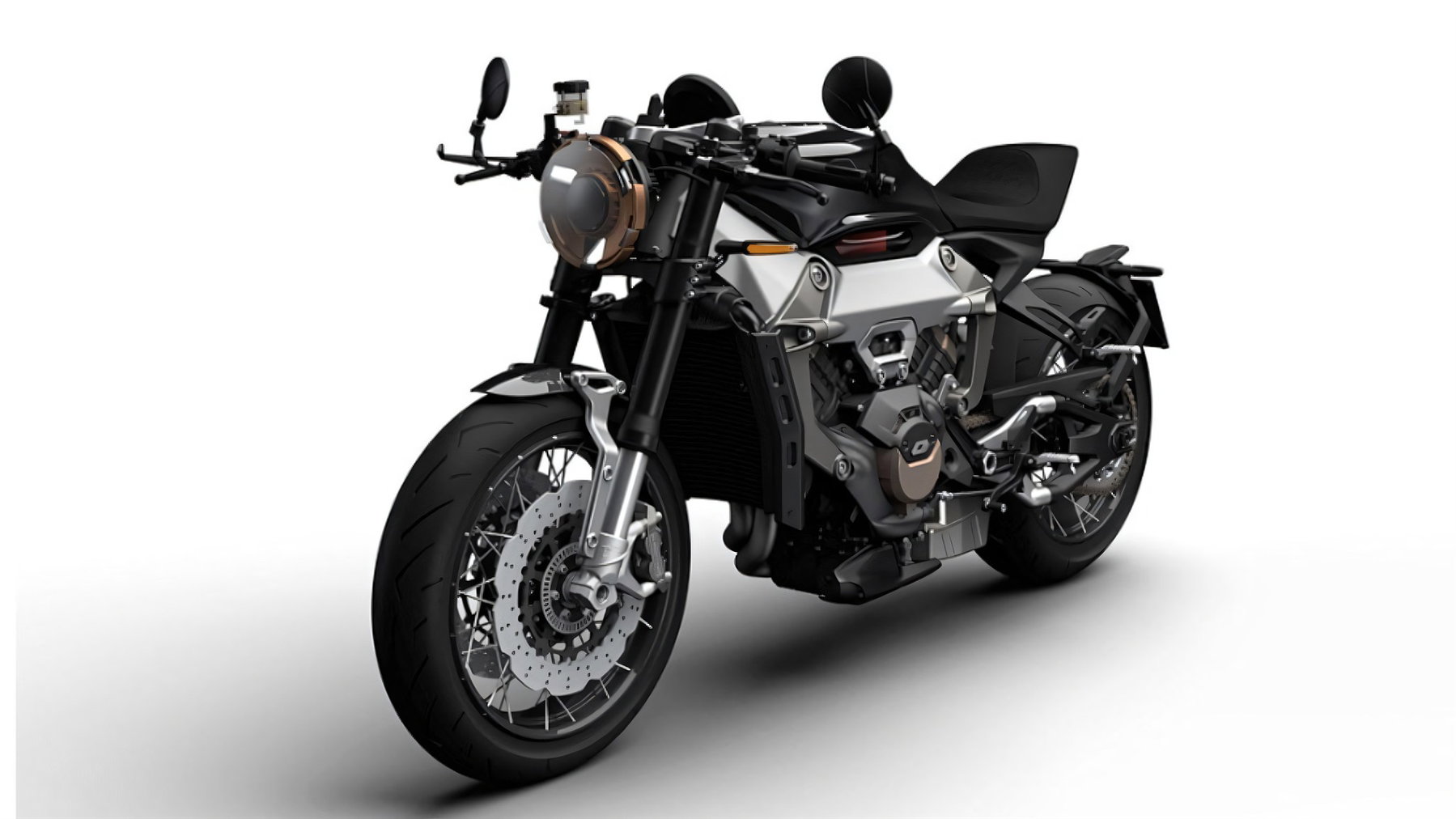
- 561 cc V4 with 70 PS at 10,500 rpm and 53 Nm
- Marzocchi upside-down fork, twin 320 mm discs with radial Brembo calipers
- 210 kg and a 15-litre tank, price not yet known
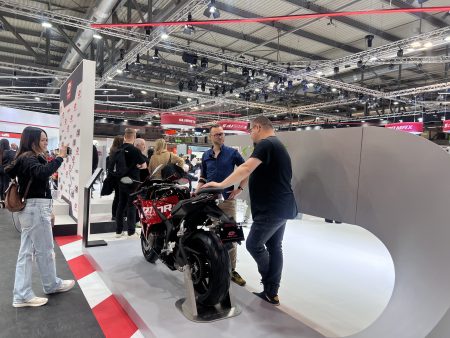
With the SRV 600 VH, QJMotor is expanding its line-up built around the small V4 engine. Until now, this engine has mainly been found in the SRV 600 V, a low-slung cruiser with 16-inch wheels and belt drive. The new variant keeps the basic shape but borrows elements from the café racer world and gets a significantly higher-quality chassis. That makes it one of the EICMA 2026 motorcycle debuts that could reach the market as 2027 models.
What is the difference between the SRV 600 VH and the SRV 600 V?
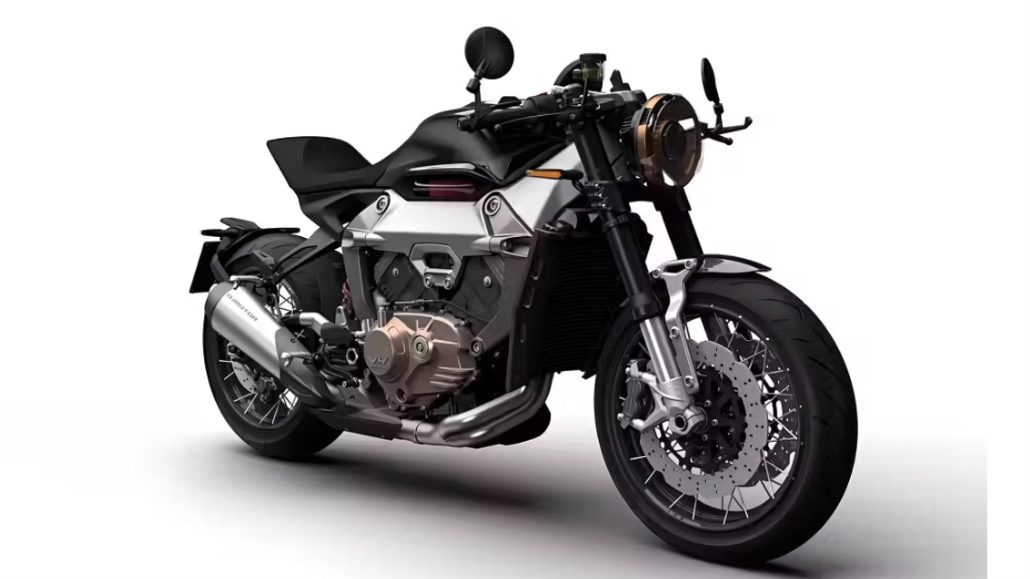
The biggest difference lies in the chassis and brakes. Up front, the SRV 600 VH has a Marzocchi upside-down fork and two 320 mm brake discs gripped by radially mounted Brembo calipers.
On an upside-down fork, the thick tubes sit at the top in the triple clamp and the thin ones at the bottom by the axle. This makes the front end stiffer. Radially mounted calipers are bolted on in the direction of travel and flex less under braking. The SRV 600 V, by contrast, makes do with a conventional telescopic fork and only lists a twin disc at the front, without naming the brake manufacturer. At the rear, it uses a 260 mm disc.
There are also differences in weight and tank size. QJMotor quotes 210 kg (463 lbs) for the VH without saying whether that figure applies with a full tank. According to the manufacturer, the SRV 600 V weighs 212 kg (467 lbs) dry and 228 kg (503 lbs) ready to ride. The VH’s tank holds 15 litres, slightly less than the 16.5 litres of the SRV 600 V.
It remains unclear whether the VH adopts the SRV 600 V’s belt drive. There is also no information yet on wheels, tyre sizes, seat height or electronics.
How much horsepower does the QJMotor SRV 600 VH have?
The QJMotor SRV 600 VH produces 70 PS (around 51 kW) at 10,500 rpm. Peak torque is 53 Nm (39 lb-ft).
The engine is a 561 cc V4, meaning a four-cylinder whose cylinders are arranged in two banks in a V shape. Bore and stroke are 61 and 48 mm, typical dimensions for a free-revving engine. In the SRV 600 V, the same engine produces 68 PS (50 kW), also at 10,500 rpm, and 54 Nm at 8,000 rpm. In the VH, peak power therefore rises slightly, while torque drops marginally.
A four-cylinder is rare among cruisers in this displacement class, as most rivals rely on twins. Further technology includes fuel injection and a multi-plate wet clutch with an anti-hopping function. It prevents the rear wheel from hopping during rapid downshifts.
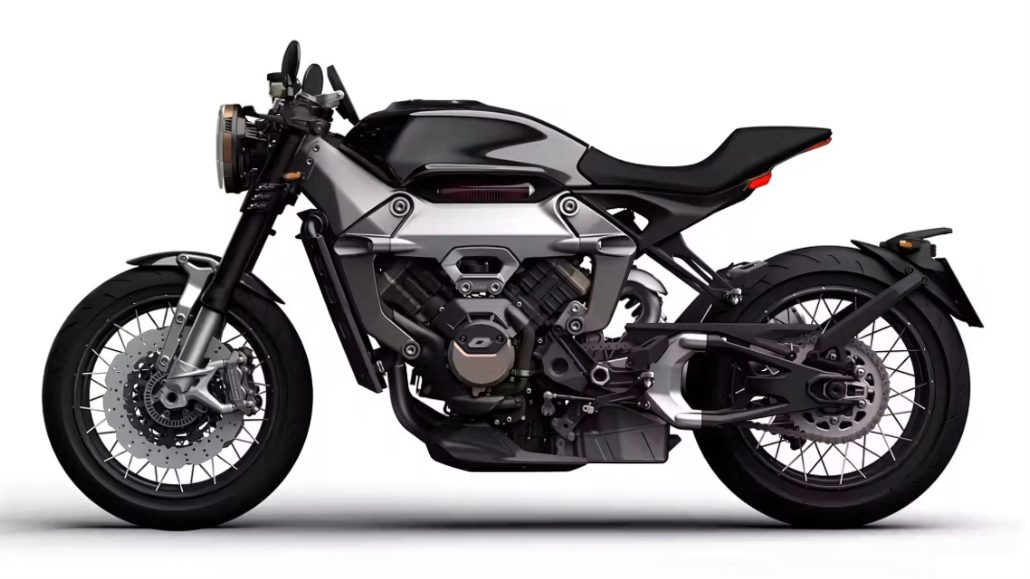
What does the SRV 600 VH look like?
The SRV 600 VH combines the lines of a cruiser with typical café racer details. These include a round headlight and low clip-on handlebars that shift the riding position forward.
At the rear, the number plate holder is mounted low, leaving the tail clean. The swingarm has side cut-outs that give it a retro look, although it is not a single-sided swingarm. The exhaust runs low along the bike. The pillion seat is strikingly narrow and is clearly not intended for longer two-up trips.
Is the SRV 600 VH related to the Equus prototype?
QJMotor has not said whether the SRV 600 VH is related to the Equus prototype. Both use the same V4, but they differ significantly in technical terms.
QJMotor already showed the Equus, officially written EQVVS, as a café racer at EICMA 2025. The name comes from Latin and means horse. It was designed by C-Creative, a design studio in San Marino founded by Giovanni Castiglioni together with Adrian Morton and Paolo Bianchi. On the Equus, the engine is a partially stressed member integrated into an aluminium frame structure. It also features an aluminium swingarm, an upside-down fork and spoked wheels for tubeless tyres.
On the SRV 600 VH, by contrast, the V4 sits in a tubular frame. What the two share is the low-mounted number plate holder and the café racer look. New patents for the Equus surfaced in 2026, including one for an exhaust with catalytic converters and lambda sensors. They suggest that QJMotor is working on a production version. When and where it will arrive is not known.
When will the SRV 600 VH arrive and how much will it cost?
QJMotor did not announce a price or a launch date at the show. Colours and possible further versions are not yet known either.
The SRV 600 V serves as a reference point. In Italy, it costs 7,190 euros (around 8,100 US dollars) including VAT, but excluding registration and delivery. Thanks to its higher-quality chassis and Brembo brakes, the VH is likely to be priced above that, although there is no official figure yet.