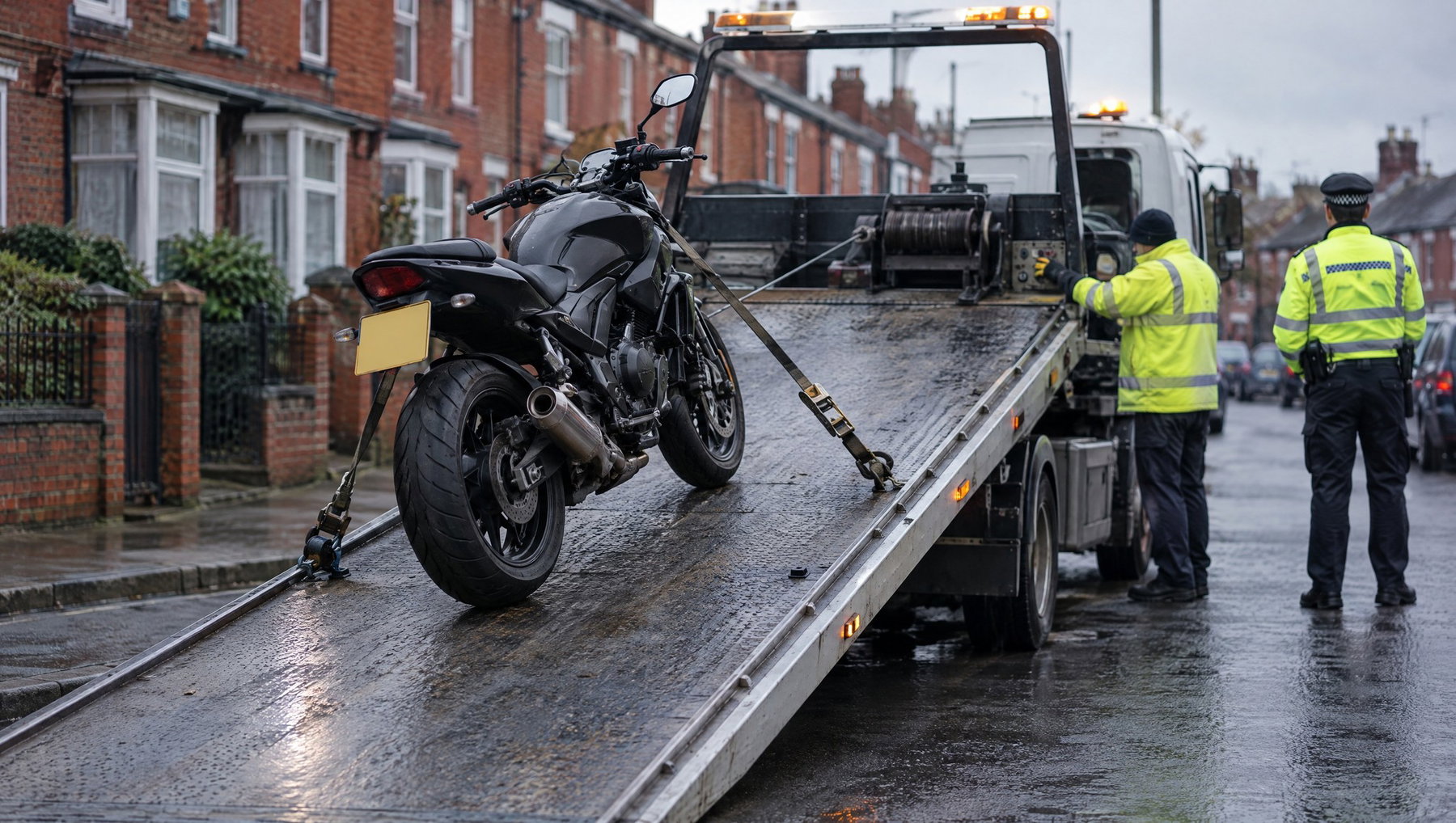
- Since 29 June 2026, police no longer have to issue a warning before a Section 59 seizure.
- Since 22 July 2026, a seized vehicle can be disposed of after 7 days instead of 14.
- According to the BMF, a loud exhaust or an undersized number plate alone is not enough for a seizure.
Until now, England and Wales had a kind of second chance. Anyone who drew negative attention on a motorcycle would usually get a warning first. Only after a further incident were the police allowed to take the bike away. That step no longer exists. The change has caused uncertainty among motorcyclists, as many are unsure exactly how far the new powers go. The British Motorcyclists Federation (BMF), an interest group for British riders, has therefore published its own explanation. In it, the federation also voices concern that some police officers could misinterpret the amended law in individual cases.
What has changed with Section 59 in England and Wales?
Since 29 June 2026, police no longer have to issue a warning before seizing a vehicle under Section 59. A motorcycle can now be seized at the very first incident.
Section 59 is part of the Police Reform Act 2002. It gives the police powers against vehicles used in a way that disturbs or alarms other people. The rule has therefore existed for more than 20 years. What is new is the removal of the warning. This change is set out in Section 8 of the Crime and Policing Act 2026. The government introduced the legislation to Parliament as a bill in February 2025.
Under the old version, the police first had to inform the person responsible that the vehicle would be seized if the behaviour was repeated. There were only two exceptions. Either a warning was not practicable in the situation, or the person had already received a warning in the previous twelve months.
The new rule is part of a broader crackdown on anti-social vehicle use. The government explicitly cites the misuse of off-road bikes, illegal racing with motorcycles and cars, noisy and dangerous motorcycle use, and aggressive driving. British police forces have long relied on increased patrols at hotspots, on marking sprays that allow riders and bikes to be identified later, and on drones to follow riders.
When can police seize a motorcycle under Section 59?
The police may only seize a motorcycle if certain legal conditions are met. Scrapping the warning only changes how quickly officers can act, not when.
First, a uniformed police officer must have reasonable grounds for believing that a vehicle is being or has been used in a particular way. There are two possibilities:
- The vehicle is being driven carelessly or inconsiderately. This is covered by Section 3 of the Road Traffic Act 1988.
- The vehicle is being driven off-road without permission, i.e. on land where motor vehicles are not allowed. This is covered by Section 34 of the Road Traffic Act 1988.
In addition, this behaviour must cause, or be likely to cause, alarm, distress or annoyance to other people. Section 59 only applies when both come together. Besides police officers, Police Community Support Officers may also use these powers. They are civilian support officers who mainly patrol residential areas.
If the conditions are met, the police may stop a moving vehicle, seize it and have it removed. They may also enter premises where they believe the vehicle to be and, if necessary, use reasonable force.
A conviction is not required for the seizure. The reasonable belief of the officer on the spot is enough. That is exactly why the removal of the warning matters: there is no longer any further step between a single incident and the loss of the motorcycle.
What kind of riding can lead to a seizure?
According to the BMF, this mainly covers aggressive or intimidating riding, burnouts, wheelspins, stunts in public spaces and illegal street racing. Repeated revving of the engine in residential areas can also play a role when combined with inconsiderate riding. Riding on land where motorcycles are not allowed is another factor. Wheelies and stoppies can also fall under the rule if they genuinely alarm people nearby.
A seizure does not rule out further action. The police can also investigate careless or dangerous driving, riding without a licence or insurance, or registration offences. Fines, prosecutions and seizures under other laws are also possible.
It is not only conventional motorcycles that are affected. The BMF explicitly mentions illegally modified, high-powered e-bikes, which have become a problem in many communities. The rule generally applies to all motor vehicles, including quads, e-scooters and cars.
Is a loud exhaust enough for a seizure?
No, a loud exhaust alone is not grounds for a seizure under Section 59. The BMF explicitly points this out because there is a lot of confusion on this issue.
Exhaust systems are covered by their own rules, namely the Road Vehicles (Construction and Use) Regulations 1986 in conjunction with the Road Traffic Act 1988. Under these, exhausts and silencers must be in good working order and must not be altered in a way that causes excessive noise. Anyone who breaks these rules faces separate action. This could be an on-the-spot fine, which in practice is reportedly £50 (around USD 67 / EUR 59), or failing the MOT, Britain’s roadworthiness test.
Noise is still not entirely irrelevant for Section 59. It can be part of the overall picture an officer assesses. For example, someone riding inconsiderately through a residential area late at night while repeatedly revving the engine may fall within the scope of Section 59. By contrast, someone riding legally with a slightly louder but approved exhaust is not affected.
Separately, the UK is trialling noise cameras. These are cameras with microphones that detect excessively loud vehicles. The Department for Transport is said to have funded such trials in places including Hampshire and the London borough of Kensington and Chelsea, with fines of around £400 (around USD 533 / EUR 475) under discussion. However, there is not yet a nationwide legal basis for automatic fines based on these measurements. The noise cameras have nothing to do with Section 59, although the two issues are often confused.
What about number plates, stolen motorcycles and green lanes?
An undersized or non-compliant number plate does not automatically lead to a seizure under Section 59 either. It is a separate offence with its own consequences.
In the UK, number plates must comply with the Road Vehicles (Display of Registration Marks) Regulations 2001. These cover, among other things, the size and spacing of the characters, the layout and visibility. An illegal show plate or an undersized plate can lead to an MOT failure and a fine of up to £1,000 (around USD 1,333 / EUR 1,188).
Stolen motorcycles are a special case. If a stolen bike is ridden by someone else in a way that triggers Section 59, it can still be seized. In this case, the owner should make it clear to the police straight away that the motorcycle was stolen, for example by providing the crime reference number from the theft report. This shows that they were not responsible for the way it was ridden.
For riders who enjoy green lanes, the BMF offers reassurance. Green lanes are unsurfaced routes that legally count as roads. Anyone riding them therefore needs a licence and insurance, and the motorcycle must be road-legal. Legal trail riding remains permitted. The only important thing is that motorcycles are actually allowed to use the route and that no restriction applies. In the UK, such a restriction is called a Traffic Regulation Order (TRO). Anyone riding off-road illegally is in breach of Section 34 and can therefore fall under Section 59 if people are also alarmed or disturbed.
How do you get a seized motorcycle back?
To get a seized motorcycle back, the owner has to act quickly and provide several documents. Since 22 July 2026, a vehicle can be disposed of after just seven days.
After a seizure, a recovery company appointed by the police usually removes the vehicle and stores it. The registered keeper receives a notice explaining why the motorcycle was seized and how to get it back. For its release, the police may require the following:
- proof that the vehicle belongs to the applicant
- valid identification
- a valid driving licence
- proof that the vehicle is insured and road-legal
- payment of the recovery and storage fees
Anyone who does not act in time risks losing the motorcycle. Vehicles that are not collected may be disposed of once the deadline has passed, which means sold or destroyed.
What does the 7-day deadline change?
The legal basis is the Removal, Storage and Disposal of Motor Vehicles Timeframes (Amendment) Regulations 2026. For vehicles seized under Section 59, these regulations replace the previous 14-day period with 7 days. Where seven working days used to apply, seven ordinary calendar days now apply. Weekends therefore count.
The government has harmonised three deadlines. Seven days apply from service of the seizure notice, the owner has seven days to state their intention to collect, and a further seven days to actually collect the vehicle. Only then may it be disposed of. The government intends to decide separately on possible changes to the fees.
The new deadline only applies to vehicles seized from 22 July 2026 onwards. According to the government, the aim is to take vehicles used for anti-social behaviour off the road more quickly and to prevent repeat offences. According to the BMF, the shorter deadlines should also reduce expensive storage costs.
How the BMF views the new rules
The BMF says it supports a proportionate approach to genuinely anti-social and illegal motorcycle use. Such behaviour harms communities and the reputation of the vast majority of responsible riders. The motorcycling community should not defend unacceptable behaviour simply because a motorcycle is involved.
At the same time, the federation warns that the misconduct of a relatively small group must not lead to all motorcyclists being tarred with the same brush. The BMF rejects blanket restrictions or an excessively heavy-handed police approach towards legal riders. The federation therefore plans to use its police contacts to clarify how officers apply the amended law when dealing with motorcyclists.
The federation’s recommendations are simple: ride legally and considerately, avoid unnecessary revving and aggressive riding in residential areas, keep exhausts and number plates in a legal condition, and check whether a route is open before riding on unsurfaced tracks. The BMF sums up its message like this:
“Ride responsibly, keep your bike legal and remember that, if Section 59 applies, there may no longer be a second chance!”
The rules apply only to England and Wales. Different legislation applies in Scotland and Northern Ireland. However, Section 59 applies to motorcyclists from other countries riding in England or Wales just as it does to locals.
Frequently Asked Questions
-
What is Section 59?
Section 59 is part of the UK Police Reform Act 2002. It allows police in England and Wales to seize vehicles that are driven carelessly, inconsiderately or illegally off-road in a way that disturbs or alarms other people. Since 29 June 2026, no prior warning is required.
-
Can police in England seize a motorcycle without a warning?
Yes, since 29 June 2026 police in England and Wales can seize a motorcycle without a prior warning. The condition is that a uniformed officer has reasonable grounds to believe the motorcycle is being ridden carelessly, inconsiderately or illegally off-road and that this alarms or disturbs people. A conviction is not required.
-
Can a loud exhaust lead to a seizure under Section 59?
A loud exhaust alone is not enough for a seizure under Section 59. Exhaust systems are covered by separate rules, and breaches can result in a fine or an MOT failure, for example. However, noise can be part of the overall picture, for instance if someone rides inconsiderately through a residential area late at night while revving the engine.
-
How long do you have to collect a seized motorcycle?
For vehicles seized from 22 July 2026, deadlines of seven calendar days each apply instead of the previous 14 days. Once they have passed, the police can have the motorcycle sold or destroyed. To get it back, you need proof of ownership, a driving licence, proof of insurance and payment of the recovery and storage fees, among other things.
-
Does Section 59 also apply in Scotland and Northern Ireland?
No, Section 59 only applies in England and Wales. Scotland and Northern Ireland have their own legislation.