- Compressive yield strength exceeding two gigapascals, roughly twice as strong as steel
- Made from titanium, hafnium, tantalum, niobium, and zirconium
- So far only in the lab, series production and costs still uncertain
Lighter, stronger, more durable: these are the three properties that engineers want from any material used in motorcycle construction. In practice, combining all three in a single material has been nearly impossible without making trade-offs elsewhere. A team of engineers at Monash University in Australia has now presented an alloy that aims to break this very conflict. The work was published in the journal Science and was carried out in collaboration with Chongqing University and Ohio State University.
What makes the new superalloy special?
According to the researchers, the alloy is roughly twice as strong as steel and about three times as strong as conventional aluminum. At the same time, it remains ductile, meaning it can deform to a certain degree without breaking in a brittle manner. This combination has long been considered nearly unachievable in ultra-high-strength materials, because increasing strength usually comes at the cost of increasing brittleness.
In testing, the material achieved a compressive yield strength of more than two gigapascals. This value describes how much pressure a material can withstand before it permanently deforms. Technically, it is a so-called Refractory High-Entropy Alloy, or RHEA for short, a high-melting-point multi-component alloy valued for its strength and resistance under extreme conditions. According to the researchers, it is also the first time that a large, continuous piece of this material has been produced, rather than just a thin coating or a microscopic sample.
How is the new atomic structure created?
The actual breakthrough lies not in the mix of metals, but in the manufacturing process. Instead of fully melting the raw materials at very high temperatures, the team used a slower and gentler heating process at a lower temperature. This gave the atoms time to arrange themselves spontaneously, rather than being locked into a more random arrangement during rapid solidification.
The process was tested on an alloy made from titanium, hafnium, tantalum, niobium, and zirconium. This produced a tightly bonded internal nanostructure consisting of three different components, whose nanocrystals are arranged in different periodic patterns. The researchers describe the result as atomic architecture: a continuously connected structure that is largely free of the microscopic defects that typically limit the strength of conventional alloys.
Professor Jian-Feng Nie from the Department of Materials Science and Engineering at Monash University, who serves as the corresponding author of the study, puts the significance into perspective. He explains that alloy development has focused primarily on composition and processing for over a century, but this work shows that the arrangement of atoms during manufacturing can be equally important. He describes the key point as follows: “The real significance is not just this particular alloy, but the demonstration that atoms can self-organise into defect-free structures in a bulk metallic material, meaning a large, continuous piece of metal, not a thin coating, film or microscopic sample.”
Associate Professor Yu Zhang from Chongqing University, who completed his doctorate at Monash University, describes the targeted control of atomic arrangement during processing as the key to the material’s high strength and stability.
Which motorcycle components could benefit?
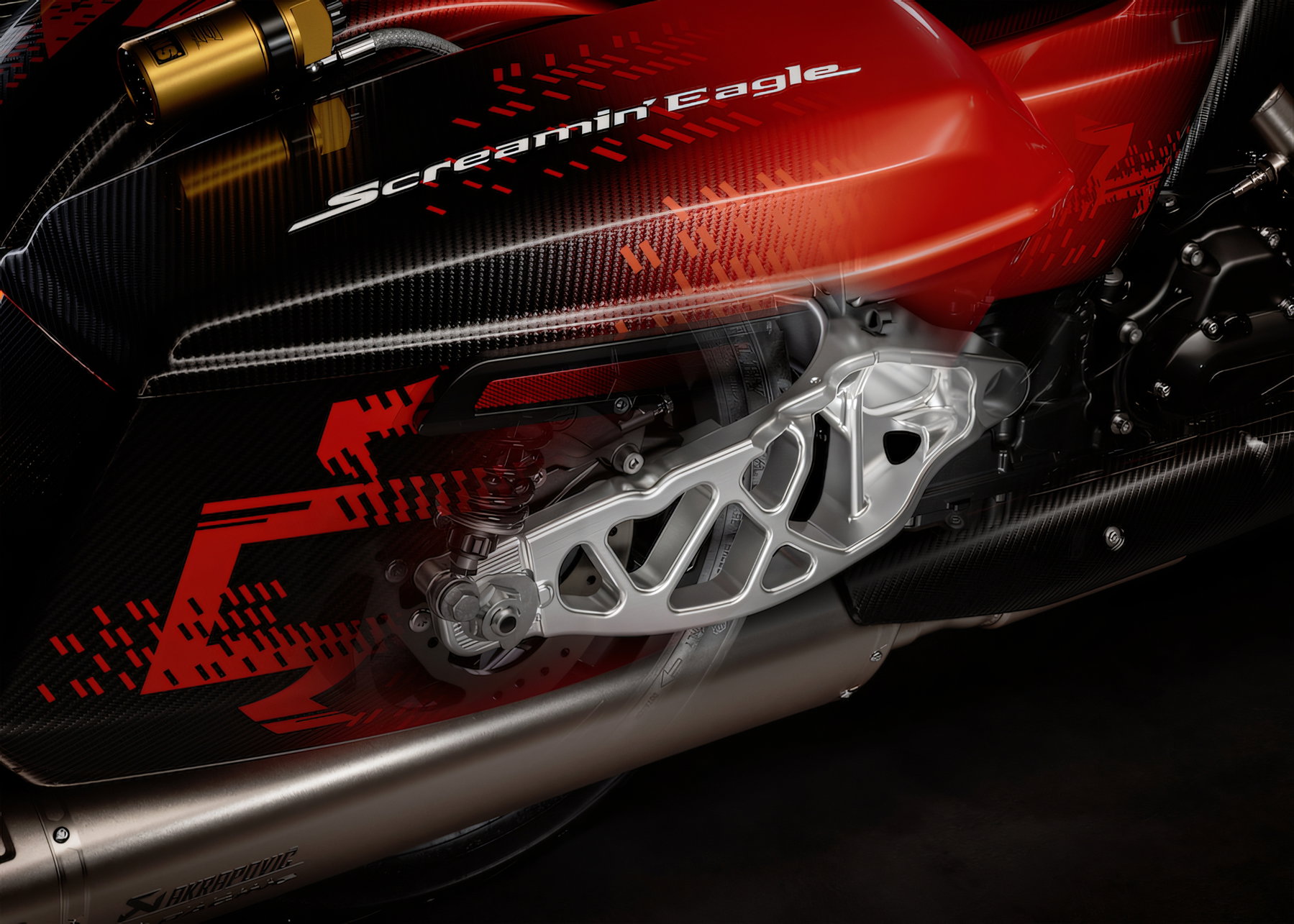
A lighter yet stronger metal could allow manufacturers to build motorcycles that weigh less without sacrificing stiffness or durability. Potential applications include swingarms, subframes, wheels, and even engine components. Reduced weight in these areas affects handling, acceleration, and fuel consumption, as moving and unsprung masses would be reduced.
The development should be placed in the broader context of lightweight construction, which has been a central theme in new motorcycle models for years. Aluminum frames replaced heavier steel constructions in the past, and a new high-performance material could mark a similar step forward.
What does the alloy mean for electric motorcycles?
For electric motorcycles, every kilogram saved is particularly valuable. Less weight on the frame and ancillary parts means either more range with the same battery or room for a larger battery at the same overall weight. Especially for electric models, whose weight is largely determined by the battery, a lighter yet stiffer material could make a noticeable difference.
When will the superalloy appear in production motorcycles?
No specific date has been set, as the work is still confined to the laboratory. A breakthrough under lab conditions does not automatically mean that series-production parts will follow. Motorcycle manufacturers need materials that can be produced in large quantities, that are easy to machine, and above all that can be offered at a reasonable price. It is precisely this last point where promising discoveries often fail.
Should the process prove scalable to industrial levels without excessive costs, it could, according to assessments in the original report, become one of the most significant advances in motorcycle construction since the widespread adoption of aluminum frames. The researchers themselves are currently studying the interactions at the atomic level that lead to the formation of these structures, in order to better understand how the materials develop during processing.
Significance beyond motorcycle construction
The potential benefits of the process extend far beyond motorcycles. Aerospace, automotive, defense, and energy industries are also searching for lighter and more resilient materials. Professor Nie points out that in the future it may be possible to deliberately design internal structures that deliver better properties with fewer alloying elements. This could enable more efficient, more sustainable, and more cost-effective manufacturing. The Dean of the Faculty of Engineering, Professor Yiannis Ventikos, speaks of a once-in-a-generation discovery whose impact could be felt for decades.
Frequently Asked Questions
-
How strong is the new superalloy?
The superalloy achieves a compressive yield strength of more than two gigapascals. According to the researchers, it is roughly twice as strong as steel, about three times as strong as conventional aluminum, and approximately twice as strong as the same alloy produced using conventional methods.
-
What metals is the alloy made from?
The alloy is made from titanium, hafnium, tantalum, niobium, and zirconium. In the new process, these elements form a tightly bonded nanostructure consisting of three different components.
-
Who developed the superalloy?
The superalloy was developed by engineers at Monash University in Australia. The work was carried out in collaboration with Chongqing University and Ohio State University and was published in the journal Science.
-
When will the alloy be used in motorcycles?
No date has been set, as the research is still limited to the laboratory. Whether and when series production will be possible depends primarily on whether the material can be manufactured in large quantities and at an economically viable price.
-
What makes the manufacturing process special?
Instead of fully melting the metals at very high temperatures, the researchers used a slower heating process at a lower temperature. This allows the atoms to self-organize into an ordered, defect-free structure that the researchers call atomic architecture.