- New Explorer variant of the KLX300 with 27.2 hp, 142 kg and switchable front-wheel ABS
- US price 6,499 US dollars (approx. 5,820 euros), dealer arrival in early January 2027
- In Japan, three KLX300 versions arrive from fall 2027, but the XPL is not among them
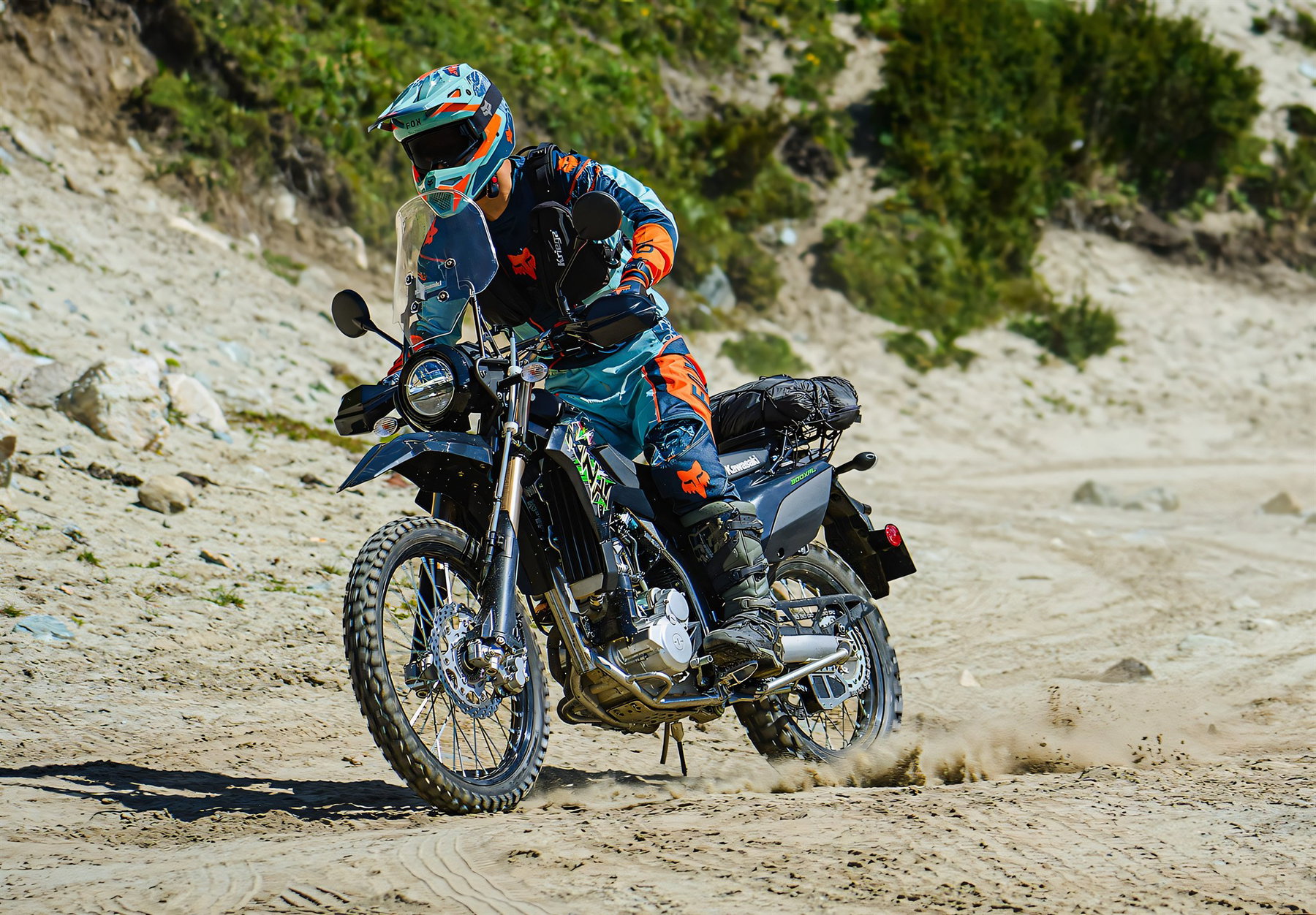
Lightweight enduros with touring equipment are in demand, and Kawasaki is now filling this niche with a model of its own. The KLX300 XPL ABS is based on the familiar KLX300. The abbreviation XPL stands for Explorer. With it, Kawasaki makes clear what the bike is meant for: it should handle long stretches on the road and then keep going on gravel and forest tracks. The XPL was unveiled together with the 2027 model year for North America. There, the KLX300 is now available in four street-legal versions, plus the pure competition bike KLX300R. For the entire range, model year 2027 brings several technical changes that go beyond the new equipment variant.
What sets the KLX300 XPL apart from the regular KLX300?
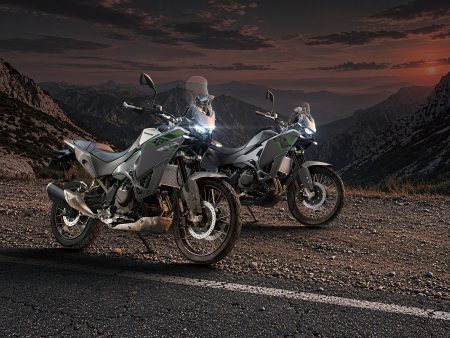
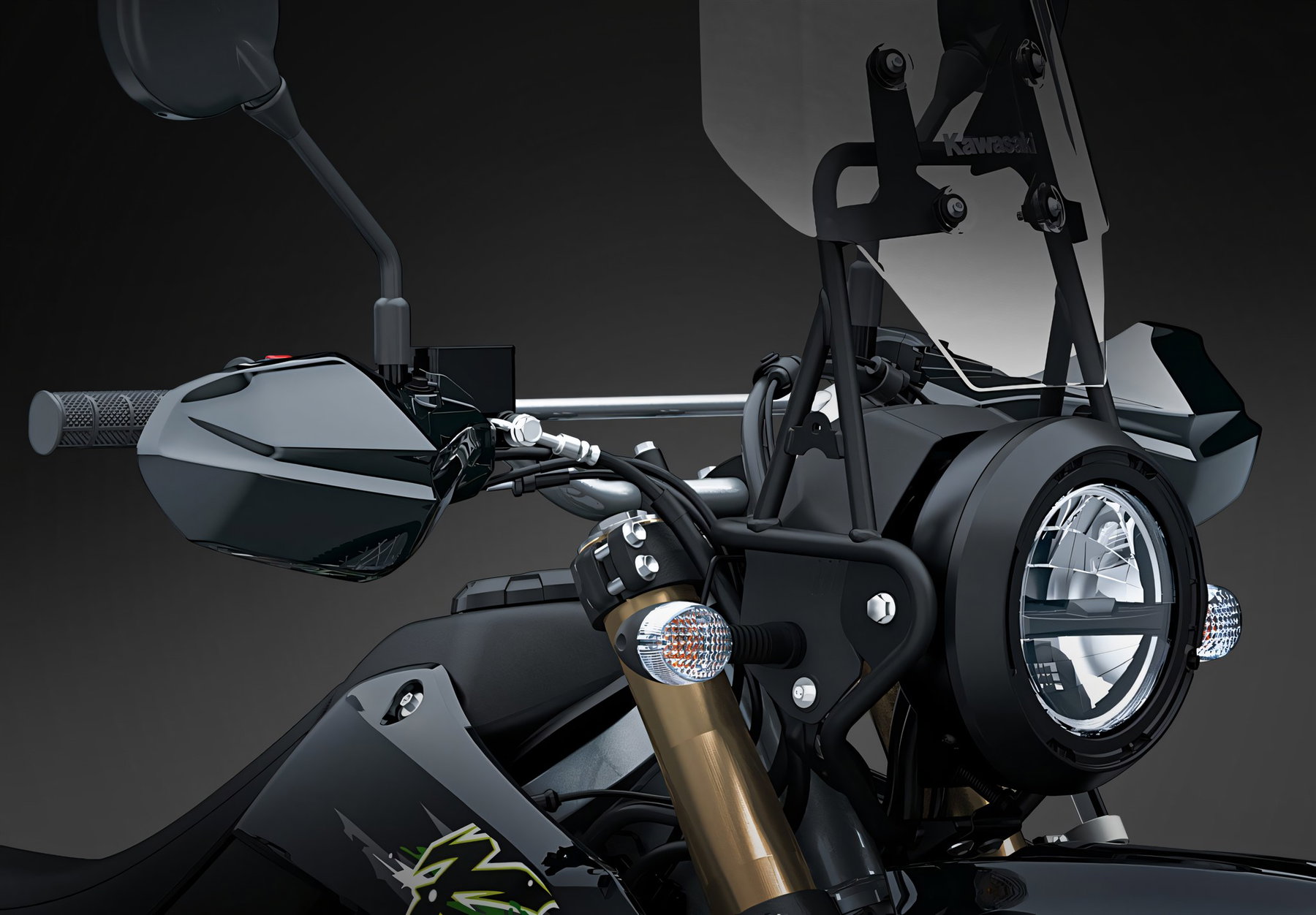
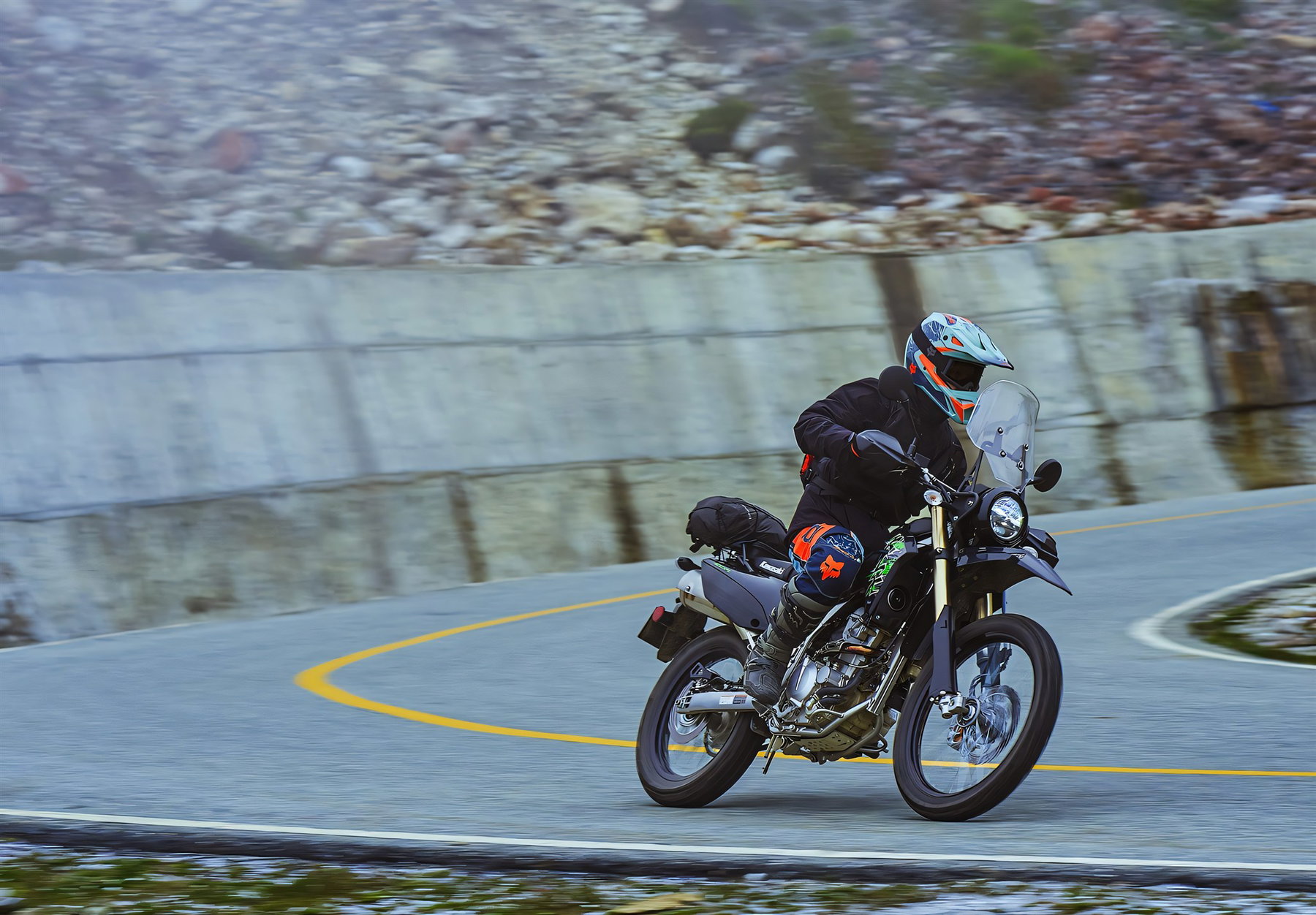
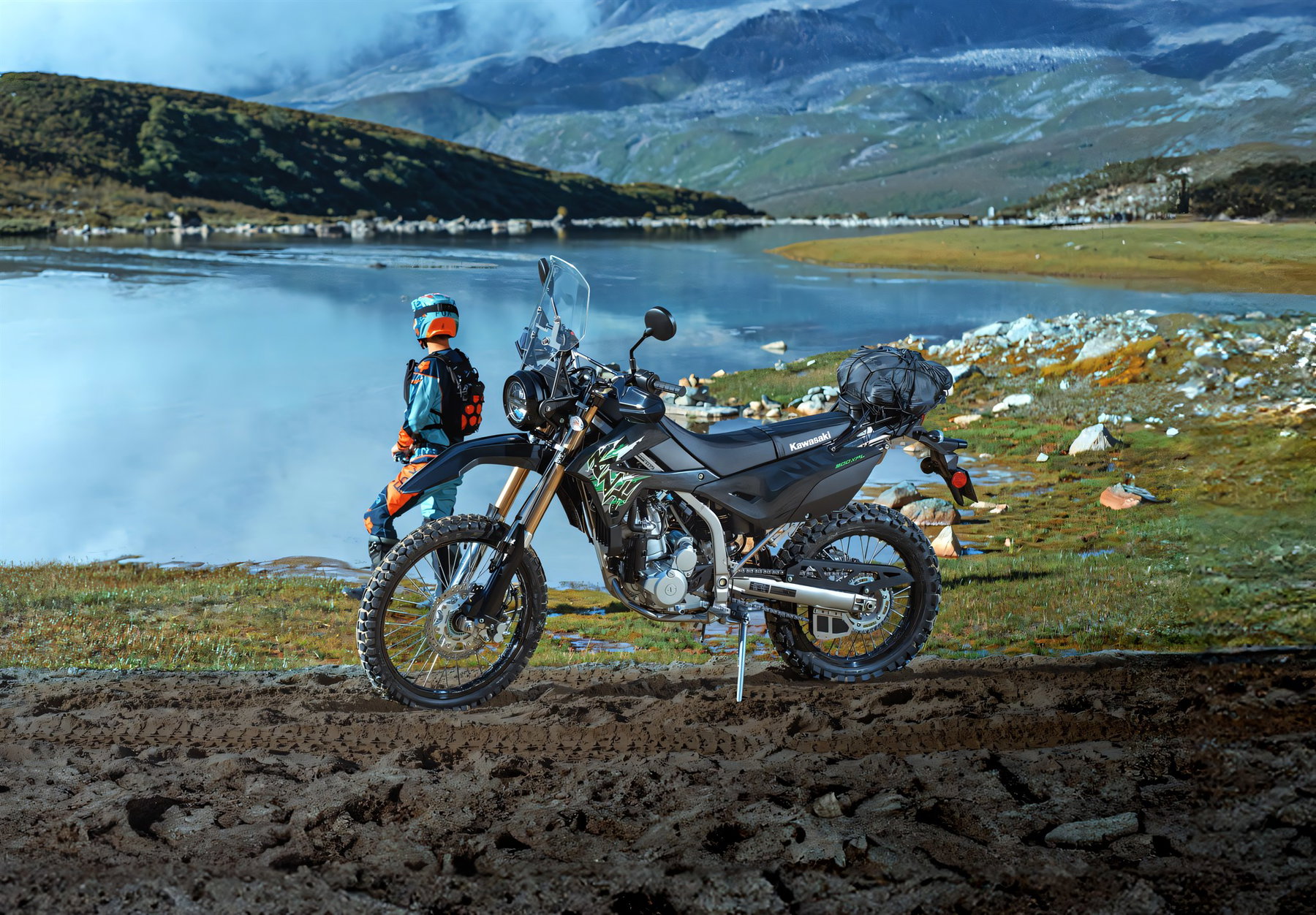
The XPL gets equipment for longer tours that the base KLX300 lacks: a tall, clear windscreen, hand guards, a round LED headlight and a luggage rack. It carries over the engine, frame and chassis unchanged.
The front end stands out most. Instead of the slim light integrated into the fairing on the standard version, there is a round LED headlight with a diameter of 5.1 inches. Low and high beam have separate chambers. A wide, ribbed ring frames the lamp, and the position lights make the entire lens glow. This makes the headlight look like a classic bulb lamp. Kawasaki has designed the beam pattern to be wide so that it lights up both the road and its edges.
The windscreen is meant to take wind pressure off the chest and chin, reducing fatigue on fast stretches. The hand guards protect the levers off-road and also keep wind off on the road. At the rear, the XPL has a luggage rack with integrated tie-down hooks, on which gear for a weekend can be strapped down.
Visually, Kawasaki relies on black. The XPL is only available in Ebony, with blacked-out components and brushstroke-pattern graphics. They are a nod to the KX motocrossers of the 1980s and 1990s. The extra equipment adds 4 kg (9 lbs): the XPL weighs 142 kg (313 lbs) ready to ride, while Kawasaki quotes 134 kg (295.5 lbs) dry. At around 7.6 liters, the tank remains as small as on the base model. So the Explorer equipment does not bring more range. It does, however, make longer days in the saddle more comfortable.
What is Kawasaki changing on the entire KLX300 range for 2027?
All KLX300 models receive a revised engine with slightly more power, front-wheel ABS and a new digital dashboard with smartphone connectivity for 2027. The XPL also has these updates on board.
How much horsepower does the Kawasaki KLX300 XPL have?
Kawasaki now quotes 27.2 hp (20.0 kW) at 8,000 rpm for the 292 cc single. Torque is 24.9 Nm (18.4 lb-ft) at 6,800 rpm. For the 2026 model year, Kawasaki still quoted 25.3 hp (18.6 kW) and 24.0 Nm (17.7 lb-ft) at 7,000 rpm. Kawasaki attributes the increase mainly to a change in the crank drive: the big end of the connecting rod now uses a plain bearing instead of the previous needle bearing. This is meant to reduce friction and improve durability.
The rest of the technology is familiar. The liquid-cooled engine has double overhead camshafts and four valves. The cam profiles come from the KLX300R competition bike. The mixture is supplied via fuel injection with a 34 mm Keihin throttle body. Bore and stroke measure 78.0 and 61.2 mm, and the compression ratio is 10.9:1. A six-speed gearbox and chain drive transfer the power to the rear wheel. A fan directs warm air away from the rider at low speeds, and the engine is started at the push of a button.
How does the new ABS work?
The ABS only works on the front wheel. On the XPL, it can be switched off for off-road use via a switch on the left end of the handlebar. The rear wheel remains unregulated so that it can be deliberately locked on loose surfaces. After a restart, the ABS is automatically active again. To make room for the ABS unit, Kawasaki has moved it to the right side, where the right radiator used to sit. Instead of two radiators, there is now only one larger one on the left side. The brake and clutch levers are correspondingly shorter.
What can the new dashboard do?
The new LCD display has a hexagonal shape. It is about a third of the size of the old instrument and around 180 g lighter. Among other things, it shows speed, rpm as a bar graph, time, two trip meters, fuel consumption, battery voltage and maintenance reminders. Via Bluetooth, it pairs with the Rideology The App Motorcycle app. This allows rides to be recorded, maintenance to be logged and riding data to be shared with others. Incoming calls and messages appear on the display.
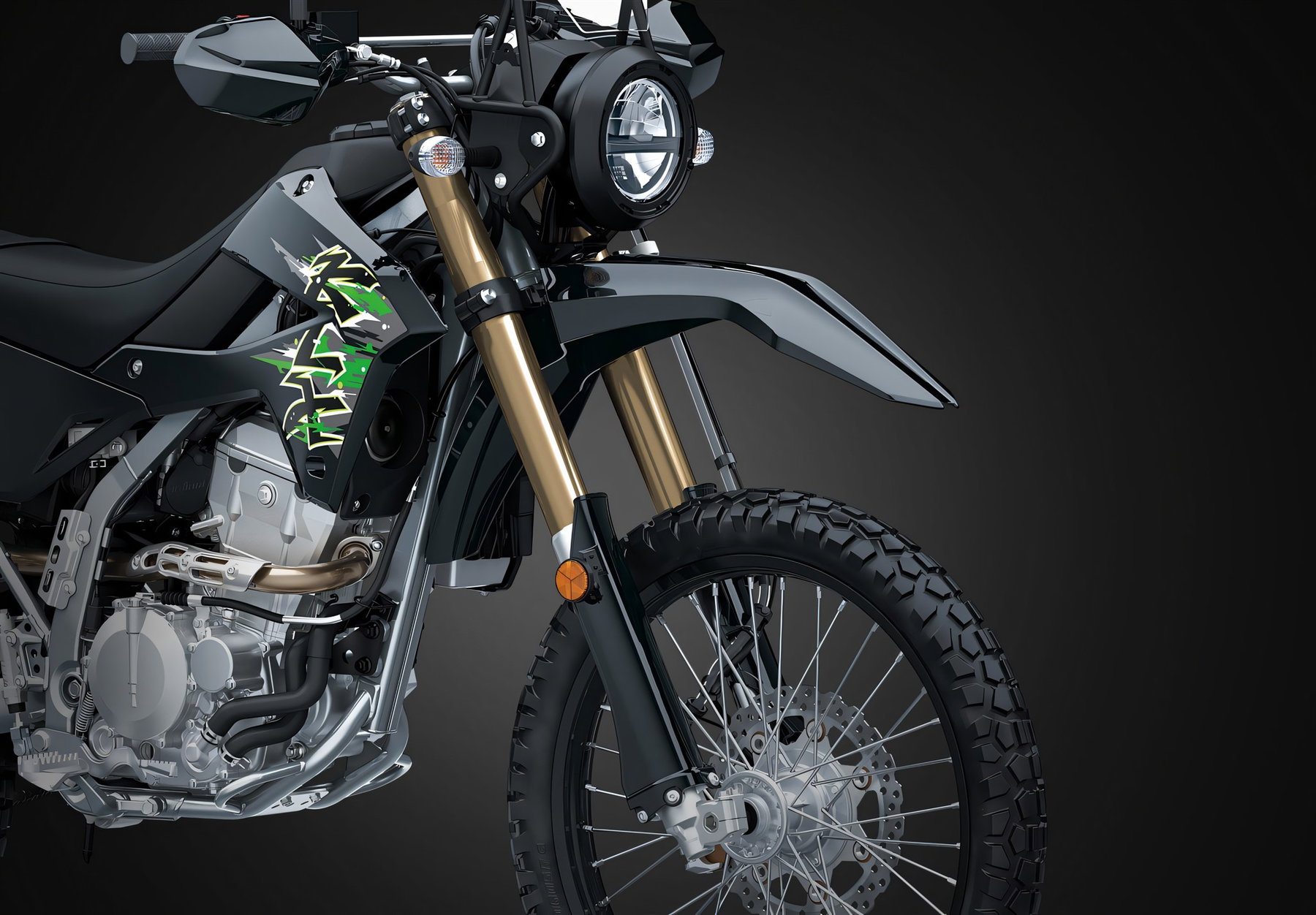
Chassis and dimensions of the KLX300 XPL
The chassis remains unchanged. The KLX300 XPL uses the range’s steel perimeter frame and an aluminum swingarm. At the front, a 43 mm upside-down fork with adjustable compression damping and 254 mm of travel does the work. At the rear, a Uni-Trak shock with a piggyback reservoir provides the suspension. It is adjustable for preload, rebound and compression, with 231 mm of travel.
The spoked wheels measure 21 inches at the front and 18 inches at the rear, fitted with Dunlop tires in 3.00-21 and 4.60-18. At the front, a 250 mm wave disc with a twin-piston caliper provides braking, at the rear a 240 mm disc with a single-piston caliper. The rake is 26.7 degrees and the trail 107 mm.
At 894 mm, the seat height is typically high for an enduro, and ground clearance is 279 mm. The XPL is 2,179 mm long, 914 mm wide, 1,514 mm tall with the windscreen, and has a wheelbase of 1,440 mm. For longer distances, Kawasaki has provided an upright riding position and a thickly padded seat.
How does the XPL compare with the Honda CRF300L Rally and KTM 390 Adventure R?
The obvious rival is the Honda CRF300L Rally, which also focuses on a light, simple enduro with touring equipment. The KTM 390 Adventure R, with almost 40 hp and more electronics, plays in a more powerful league.
The Kawasaki shares the basic idea with the Honda: low weight, simple operation, low maintenance. In terms of power and suspension travel, the two are close. The main difference is the look. The Honda comes in the style of a Dakar rally bike, while the Kawasaki relies on a round headlight and retro graphics. Both come with touring equipment from the factory, so there is no need to reach for the accessories catalog. The KTM 390 Adventure R offers more power and more electronic aids. The Kawasaki counters with less weight and a simpler concept.
In Kawasaki’s own range, the XPL fills a gap below the larger touring models that Kawasaki is also expanding for 2027, such as the new KLE 650. The KLX300 XPL is thus one of the new arrivals for the 2027 model year that broaden the entry-level and touring segment.
How much does the Kawasaki KLX300 XPL cost and is it coming to Europe?
In the USA, the KLX300 XPL ABS costs 6,499 US dollars (approx. 5,820 euros) and will be at dealers from early January 2027. A market launch in Germany has not yet been announced.
The US price excludes taxes, destination and dealer fees. The conversion at the current exchange rate is therefore only a guide. Kawasaki Motors Europe has not commented on Euro 5+ homologation or a market launch in Europe. The KLX300 family has so far been available mainly in North America and in markets outside the EU. The XPL is also left out in Japan for the time being: Kawasaki Motors Japan plans to offer the KLX300, the KLX300SM and the KLX300 DF from fall 2027, but the Explorer variant is not on the list.
In addition to the XPL, the US range includes three other versions. The base KLX300 ABS costs 5,999 US dollars (approx. 5,375 euros) in Lime Green or Bright White and 6,199 US dollars (approx. 5,550 euros) in Cypher Camo Beige. Also new is the KLX300 DF ABS for 6,299 US dollars (approx. 5,640 euros). It features blacked-out engine, frame and swingarm parts, hand guards and a luggage rack and is painted in Medium Cloudy Gray. The KLX300SM ABS supermoto with 17-inch wheels, shorter suspension travel and a larger front brake costs 6,399 US dollars (approx. 5,730 euros) and arrives as early as December 2026. On this model, the ABS cannot be switched off.
Frequently Asked Questions
-
How much horsepower does the Kawasaki KLX300 XPL have?
The Kawasaki KLX300 XPL produces 27.2 hp (20.0 kW) at 8,000 rpm. Maximum torque is 24.9 Nm at 6,800 rpm. Compared with the 2026 model year, the 292 cc single thus gains slightly.
-
How much does the Kawasaki KLX300 XPL cost?
In the USA, the KLX300 XPL ABS costs 6,499 US dollars, or approx. 5,820 euros. That is 500 US dollars more than the base KLX300. Taxes and dealer fees come on top.
-
When is the KLX300 XPL coming to Germany?
There is no date for Germany. Kawasaki Motors Europe has so far announced neither homologation nor a market launch. In Japan, too, the XPL is not planned, unlike three other KLX300 versions.
-
How heavy is the KLX300 XPL?
The KLX300 XPL weighs 142 kg ready to ride and 134 kg dry. Thanks to the windscreen, hand guards and luggage rack, it is around 4 kg heavier than the regular KLX300.
➜ Find all technical specifications for this model in our motorcycle database: Kawasaki KLX300 XPL 2027.
➜ This article is part of our comprehensive overview: New Motorcycles 2027: All Models, Releases and Highlights at a Glance. Find all key information on this topic in one place.